
Wildfire Mitigation vs Monitoring: A Builder's Guide
Smart wildfire alerts can't replace home hardening. A builder's guide to wildfire mitigation, Zone Zero, layered detection, and insurer-grade defense.
Authors:


TLDR
Ring's Fire Watch and Watch Duty give residents earlier awareness of nearby wildfires, but awareness is not protection.
Forbes' coverage of the rollout doubles as a quiet endorsement of a builder-led mitigation hierarchy: Zone Zero first, hardened assemblies next, validated detection third, active suppression last.
Aaron Liu (Builtech Construction) makes the operational case: real-world detection needs visual plus thermal validation to keep false positives from drowning out signal.
Insurance carriers like State Farm aren't discounting Fire Watch yet — and they won't until long-term claims data justifies it.
For builders and high-risk homeowners, the post–Fire Watch playbook is to treat smart alerts as a thin top layer on a much heavier mitigation stack.
A smart doorbell joined the wildfire conversation. Here's what builders should hear.
Ring's Fire Watch service is a useful feature. Marketed as a partnership with Watch Duty, the Amazon-owned doorbell brand now pushes nearby wildfire alerts into the Ring and Neighbors apps, lets Ring Protect subscribers share AI-flagged smoke and flame snapshots, and has been activated during more than 100 fires since its early-March 2026 rollout [1]. Forbes covered it sympathetically as a tool that may help residents and responders gain earlier visual awareness during active fires [2].
Read the same article through a builder's eyes and a different story emerges. Almost every expert Forbes consulted — Ivan O'Neill of Madronus Wildfire Defense, Steve Hawks of the Insurance Institute for Business & Home Safety, and Builtech Construction CEO Aaron Liu — pivoted from the smart-tech headline back to the same boring, durable answer: mitigation. Hardened assemblies. Zone Zero. Multi-layer validation. Long-term claims data. None of those are doorbells.
This guide takes the Fire Watch story seriously and treats it as a moment to recalibrate how high-fire-risk construction projects should be scoped, priced, and explained to clients. The thesis is simple: monitoring is the floor, not the ceiling. The structures that survive the next conflagration are the ones that were built to survive it, not the ones that received the earliest push notification.
Mitigation beats monitoring — and the experts in the room agreed
Steve Hawks, IBHS Senior Director of Wildfire, told Forbes plainly: services such as Fire Watch may improve situational awareness, but the most effective protection comes from reducing a property's exposure to embers, flames, and radiant heat [2]. Hawks emphasized that monitoring systems cannot replace proactive mitigation.
That single sentence is doing a lot of work. It is the difference between a homeowner who watches their house burn from a hotel parking lot, smartphone in hand, and a homeowner who returns to a standing structure because the embers that landed on the property had nothing to ignite.
A practical builder's hierarchy
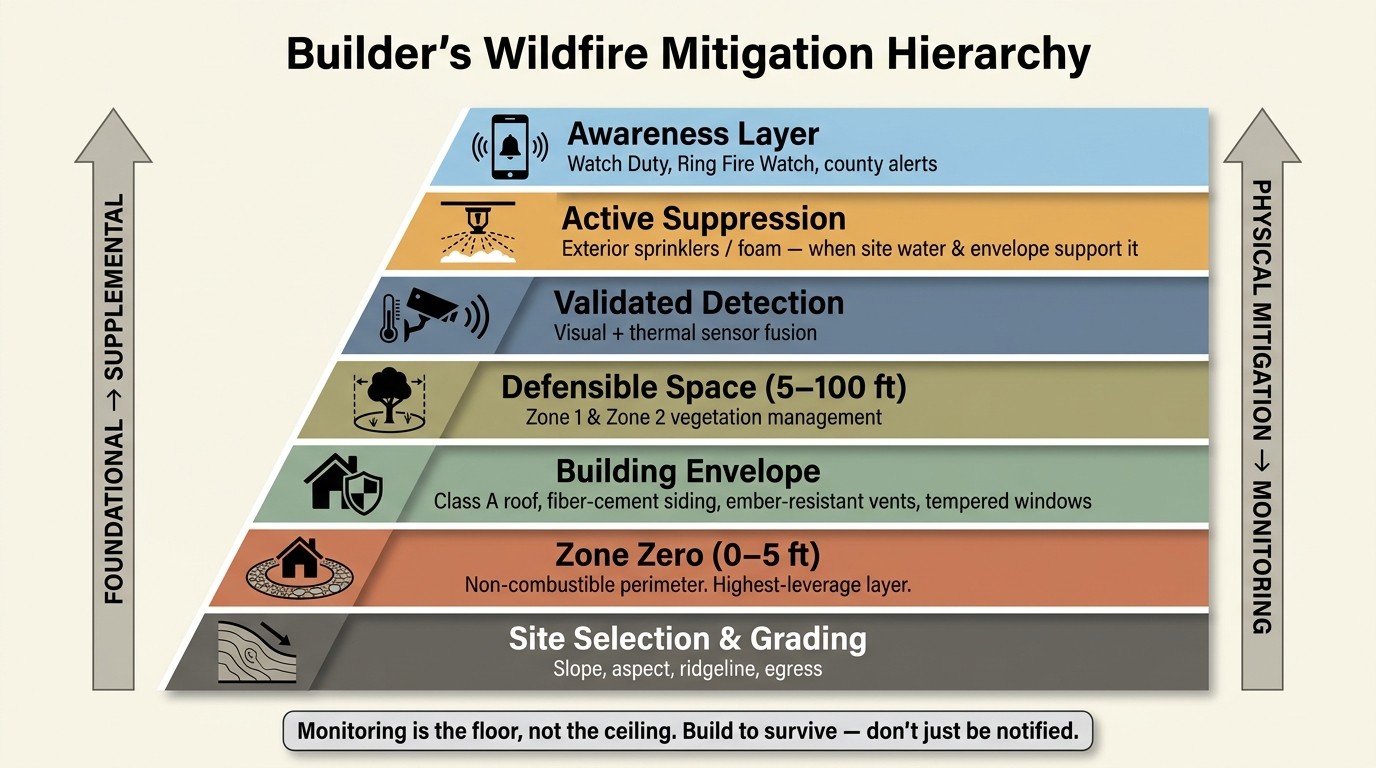
For builders, the practical translation is a hierarchy:
Site selection and grading — slope, aspect, ridgeline exposure, evacuation egress.
Zone Zero (0–5 ft) hardening — non-combustible perimeter, gravel/pavers, no mulch, no woody plants, no fences attaching combustible material to the wall.
Building envelope — Class A roofs, fiber-cement or stucco siding, ember-resistant vents (compliant with ASTM E2886 and California Building Code Chapter 7A), tempered double-pane windows, sealed eaves, and decking detailed to resist ember intrusion.
Defensible space (Zone 1: 5–30 ft, Zone 2: 30–100 ft) — managed vegetation, fuel breaks, separation of fuel beds.
Validated detection — visual and thermal sensors with alerting to occupants and responders.
Active suppression — exterior sprinklers, foam systems, dedicated water supply, where economics and site water support it.
Awareness layer — Watch Duty, Ring Fire Watch, ALERTCalifornia, and similar consumer apps.
Note where Fire Watch lives in that stack: at the top, as a thin awareness layer over six much heavier layers of physical work. Selling it to a client as the first line of defense is mis-engineering the project.
Zone Zero is the floor, not a feature
Ivan O'Neill described the 0–5 ft non-combustible zone as the most important single action a homeowner can take [2]. He is not alone. CAL FIRE, IBHS, NFPA, the FEMA Builder's Guide to Construction in Wildfire Zones, and the recent IBHS Wildfire Prepared Home Standard update all converge on Zone Zero as the highest-leverage control [3][4].
What Zone Zero looks like on a real build
Materials: gravel, decomposed granite, pavers, or concrete directly against the foundation.
Vegetation: none against walls. Potted plants only if low, well-watered, and clearly separated from siding, vents, and windows.
Fences and gates: any combustible fence (wood) terminates at least 5 ft from the house with a metal section, or transitions entirely to non-combustible fencing.
Decks and stairs: ember-resistant decking with closed-bottom assemblies, or a sub-deck non-combustible apron.
Storage: no firewood, no propane tanks, no patio cushions, no door mats, no garbage cans staged within 5 ft.
California's evolving Zone Zero rulemaking — including a stricter one-foot "Safety Zone" being debated for new construction — is heading in only one direction: tighter [5]. Builders who detail Zone Zero correctly today will have less rework when local AHJs adopt the new language. Builders who skip it because the client wanted a hedge against the foundation will rebuild it later, often after a near-miss.
Zone Zero is also the cheapest layer in the stack
This is the part clients miss. Compared to a $80,000 active sprinkler system or a re-roof, a properly detailed Zone Zero is mostly thoughtful design and disciplined material selection. A handful of yards of gravel and a clean transition detail buy more measurable wildfire performance than almost any single technology purchase.
The case for layered detection: visual plus thermal
Aaron Liu, Builtech Construction CEO and a Certified Wildfire Mitigation Specialist, told Forbes that camera-based systems can support detection — but multiple layers of validation are needed to improve accuracy and reduce false positives. Combining visual imaging with thermal sensing, he said, provides a more practical method for real-world wildfire detection [2].
That is not a throwaway line. It is the operational reality that anyone who has run a single-modality fire camera in a real environment learns the hard way:
Visible-spectrum cameras are great at confirming smoke plumes and flame, but they are saturated by sunlit surfaces, false-color from low sun angles, and distorted by haze and dust.
Thermal sensors can flag heat signatures fast, but they false-positive on solar panels, asphalt, sunlit boulders, industrial equipment, and roofing membranes that absorb and re-radiate heat through the day.
Either alone generates enough false positives to either fatigue the user into ignoring real alerts, or train the model to filter so aggressively that real fires are missed.
Validated, layered detection — visual confirming thermal, or thermal confirming visual, ideally cross-checked against satellite hotspot data and a public network like ALERTCalifornia — is the difference between a system you actually act on and a system that lives in your spam folder. It is also, increasingly, what insurers and AHJs will require before crediting detection in underwriting models.
Where Ring Fire Watch fits
Fire Watch is a visual-only AI layer applied to existing doorbell-grade cameras, validated against Watch Duty's authoritative wildfire reporting and shared at the user's discretion [1][6]. It is genuinely useful as a community awareness layer — particularly for evacuation timing and visualization for responders — but it is not a thermally validated property protection system. Builders who explain that distinction up front will save themselves a difficult conversation after the next bad fire season.
When does active suppression earn its place?
Forbes flagged Frontline Wildfire Defense as a representative active-suppression option, with pricing starting at approximately $80,000 for properties of a quarter acre or smaller [2]. That number is real, and the product is real — Frontline reports that the majority of its protected homes survived the 2025 Los Angeles fires [7].
The question is not whether active suppression works. The question is whether it earns its place in the budget on a given project.
A defensible decision framework
Site water supply — is there enough sustained flow and storage to feed the system for hours, including during loss of municipal water?
Slope and exposure — is the home in an ember-cast funnel where passive measures alone leave material residual risk?
Construction class — has the envelope been hardened, or is active suppression being asked to compensate for cheap siding and unprotected vents?
Insurance posture — is the carrier likely to recognize the system, today or in the foreseeable future?
Maintenance reality — will the homeowner test, inspect, and refill foam annually for the life of the property?
If the first four answers are strong, active suppression is a defensible top-of-stack investment. If the envelope is unhardened or Zone Zero is not in place, $80,000 spent on sprinklers is $80,000 papering over the wrong layer.
Insurance, claims data, and the long game
Forbes also noted that State Farm does not currently offer a discount for the Ring Fire Watch service, and that insurance specialists expect any future discount to depend on long-term claims data showing the technology actually reduces wildfire damage [2]. Carriers also tend to favor professionally monitored systems over self-monitored devices.
That posture is consistent with how property insurance has historically priced new mitigation tech: not on marketing claims, not on press releases, but on multi-year loss-ratio evidence. Ting electrical fire sensors took years to translate into a State Farm distribution program. Burglar and fire alarms only became premium-relevant when they were UL-listed central-station services with auditable response.
For builders, the practical implication is that mitigation choices that already line up with carrier-recognized standards — IBHS Wildfire Prepared Home, ASTM E2886 vents, Class A roofs, Chapter 7A assemblies — carry insurance value today. Smart-app awareness layers may carry insurance value eventually. Both can coexist, but only one belongs in the load-bearing column of the project budget.
Watch Duty, ALERTCalifornia, and the public data layer
Watch Duty pulls from radio scanners, public wildfire camera networks, satellite data, and official announcements, and it has integrated ALERTCalifornia and ALERTWest cameras directly into its public map [8]. Ring Fire Watch sits on top of that public data layer, adding private opt-in doorbell snapshots into the same feed.
The takeaway for high-fire-risk construction projects is that the public awareness layer is already very good — and free. Recommending that clients install Watch Duty, configure local ALERTCalifornia camera bookmarks for their canyon, and enable county-level emergency alerts is a five-minute conversation that costs nothing and does not require a Ring purchase. Treat the Ring layer as additive for clients who already have outdoor cameras and a Ring Protect subscription, not as a replacement for the public sources.
A builder's post–Fire Watch checklist
For projects in the Wildland-Urban Interface, the Forbes article is a useful prompt to re-baseline scope.
[ ] Zone Zero (0–5 ft): non-combustible, no mulch, no plantings against walls, ember-safe fence transitions, no flammable storage.
[ ] Roof and vents: Class A roof assembly, ember-resistant vents (ASTM E2886 / CA Chapter 7A), debris-cleaned gutters with metal gutter guards.
[ ] Walls and openings: fiber-cement, stucco, or other non-combustible siding; tempered dual-pane windows; sealed eaves; metal mesh screens.
[ ] Decks and attachments: ember-resistant decking, closed sub-deck, no combustible storage below.
[ ] Defensible space (5–100 ft): managed vegetation, fuel breaks, separation of trees and shrub clusters.
[ ] Detection: visual plus thermal where budget supports; minimum baseline is enrollment in Watch Duty and county alerts.
[ ] Active suppression: evaluated against site water, slope, envelope condition, and insurance posture.
[ ] Insurance alignment: target IBHS Wildfire Prepared Home or carrier-equivalent designation; document for underwriters.
[ ] Owner manual: written wildfire response plan, evacuation routes, water shutoffs, and tested annual drill.
A project that ticks those boxes does not need Fire Watch to be safe. It will, however, use Fire Watch well — as one more sensor on a property that was already built to survive the bad day.
FAQs
Is Ring Fire Watch enough to protect a home from wildfire?
No. Ring Fire Watch is a visual-only awareness layer that pushes Watch Duty alerts and AI-flagged camera snapshots into the Ring and Neighbors apps. It improves how early residents see a fire approach, but every expert quoted in Forbes' coverage emphasized that real protection comes from physical mitigation — Zone Zero, hardened envelopes, and validated detection — not from a smart doorbell layered on top of an unhardened structure.
How big should a Zone Zero perimeter be around a house?
Zone Zero is the 0–5 ft non-combustible band immediately around the home, including any attached decks. NFPA Certified Wildfire Mitigation Specialist Ivan O'Neill described establishing this zone as the single most important action a homeowner can take. California's emerging rulemaking is also debating a stricter one-foot Safety Zone for new construction, signaling the regulatory direction is tighter, not looser.
What materials should go inside a Zone Zero perimeter?
Use only non-combustible materials directly against the foundation: gravel, decomposed granite, pavers, or concrete. Eliminate mulch, woody plants, firewood, propane tanks, patio cushions, door mats, and trash cans staged within 5 ft. Combustible wood fences must terminate at least 5 ft from the wall with a metal section. Potted plants are acceptable only if low, well-watered, and clearly separated from siding and vents.
Why is multi-layer detection preferred over single-camera systems for wildfire?
Single-modality systems false-positive too often. Visible-spectrum cameras get confused by sunlit surfaces, haze, and low-angle light. Thermal sensors flag heat from solar panels, asphalt, and roofing membranes that re-radiate during the day. Builtech Construction CEO Aaron Liu, a Certified Wildfire Mitigation Specialist, told Forbes that combining visual imaging with thermal sensing provides a more practical method for real-world wildfire detection because each modality validates the other.
When does an active suppression system like Frontline make financial sense?
Active suppression earns its place when site water supply is sufficient, slope and exposure put the home in an ember-cast funnel, the building envelope is already hardened, and the homeowner will maintain the system long-term. Forbes reported pricing starts around $80,000 for properties of a quarter acre or smaller. Without a hardened envelope and Zone Zero in place, that spend papers over the wrong layer of the stack.
Does State Farm or other carriers give an insurance discount for Ring Fire Watch?
Forbes reported State Farm does not currently offer a discount for the Ring Fire Watch service. Insurance specialists expect any future discount to depend on multi-year claims data showing the technology actually reduces wildfire damage, and carriers tend to favor professionally monitored systems over self-monitored devices. Mitigation aligned with carrier-recognized standards — IBHS Wildfire Prepared Home, Class A roofs, Chapter 7A assemblies — carries insurance value today.
How is Watch Duty different from Ring Fire Watch?
Watch Duty is a 501(c)(3) nonprofit that aggregates wildfire data from radio scanners, public cameras like ALERTCalifornia and ALERTWest, satellites, and official feeds into a free real-time public map. Ring Fire Watch is a private feature that sits on top of that public layer, adding opt-in doorbell snapshots and AI-flagged smoke detection inside the Ring and Neighbors apps for Ring Protect subscribers.
What ember-resistant building materials should a builder specify in the WUI?
A wildland-urban interface build should specify a Class A roof assembly, fiber-cement or stucco siding, ember-resistant vents compliant with ASTM E2886 and California Building Code Chapter 7A, tempered dual-pane windows, sealed eaves, ember-resistant decking with closed sub-deck assemblies, and metal mesh screens on openings. Gutters should be debris-cleaned with metal gutter guards. These specifications align with carrier-recognized standards like IBHS Wildfire Prepared Home.
Should builders still recommend Watch Duty if a client already has Ring Fire Watch?
Yes. Watch Duty is the authoritative public data layer that Ring Fire Watch itself relies on. Recommending Watch Duty plus county-level emergency alerts and local ALERTCalifornia camera bookmarks is a five-minute, no-cost conversation that gives clients faster, broader awareness than any single consumer doorbell. Treat Ring Fire Watch as additive for clients already in the Ring ecosystem, not as a replacement for the public sources.
What is the highest-leverage, lowest-cost wildfire upgrade for an existing home?
A properly detailed Zone Zero. Compared with an $80,000 active sprinkler system or a full re-roof, a few yards of gravel against the foundation, removal of mulch and combustible storage within 5 ft, and a clean wood-to-metal fence transition cost very little and deliver measurable wildfire performance. CAL FIRE, IBHS, NFPA, and FEMA all converge on Zone Zero as the highest-leverage control.
Related resources
IBHS Wildfire Prepared Home Standard — the most rigorous third-party home hardening standard currently in market.
CAL FIRE Defensible Space (Zone 0, 1, 2) — authoritative California guidance on the 0–100 ft buffer.
Watch Duty — the nonprofit wildfire awareness app behind Ring Fire Watch's data layer.
References
Ring Fire Watch rollout draws wildfire protection scrutiny — Fire & Safety Journal Americas, April 17, 2026. https://fireandsafetyjournalamericas.com/fire-watch-forbes-ring
Jamie Gold — Can A New Smart Doorbell Service Save Your Home And Life? Forbes, April 14, 2026. https://www.forbes.com/sites/jamiegold/2026/04/14/can-a-new-smart-doorbell-service-save-your-home-and-life/
IBHS releases updated Wildfire Prepared Home Standard — Insurance Institute for Business & Home Safety. https://ibhs.org/ibhs-news-releases/ibhs-releases-updated-wildfire-prepared-home-standard/
Defensible Space — CAL FIRE. https://www.fire.ca.gov/dspace
What to know about California's new 'Zone Zero' fire-safety proposal — Los Angeles Times, April 18, 2026. https://www.latimes.com/environment/story/2026-04-18/what-to-know-about-californias-new-zone-zero-fire-safety-proposal
Ring and Watch Duty Launch New 'Fire Watch' Feature — Fire Apparatus Magazine. https://www.fireapparatusmagazine.com/industry-news/ring-and-watch-duty-launch-new-fire-watch-feature/
Frontline Defense System 2: The Best Inventions of 2025 — TIME. https://time.com/collections/best-inventions-2025/7318351/frontline-defense-system-2/
ALERTWest & ALERTCalifornia wildfire camera integration — Watch Duty. https://www.watchduty.org/blog/alertwest-alertcalifornia-wildfire-camera-integration