California's First ICF Type I Home: A New Wildfire Standard
California’s first ICF Type I residential build by Builtech sets a new wildfire‑resilience benchmark, using insulated concrete form walls to achieve the highest fire‑resistance classification (Type I) typically reserved for hospitals and high‑rises. The project highlights that fire‑resistant new construction costs 10‑40 % more than standard wood‑frame homes, while hardening existing homes ranges from $10 K to $100 K+, and that ember ignition accounts for up to 90 % of wildfire home losses. Emphasizing a layered, system‑based approach—noncombustible structure, Class A roofing, ember‑resistant vents, multi‑pane windows, defensible space, and Zone Zero—shows how strategic upgrades improve safety, insurance eligibility, and overall resilience in California’s high‑risk WUI zones.
Authors:


TLDR
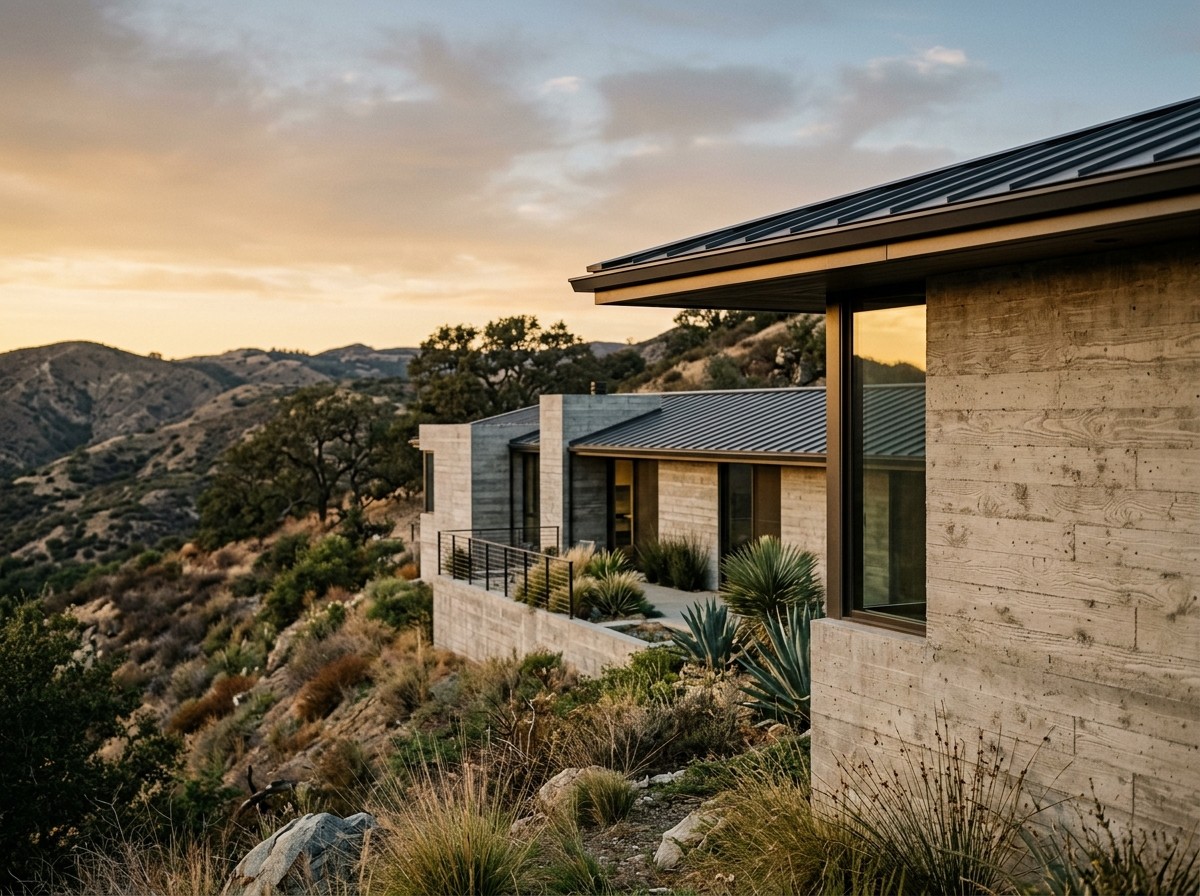
Builtech is building the first known ICF-based residential project in California designed to meet Type I, the highest fire-resistance classification in the IBC and CBC.[1]
Code compliance is a floor, not a guarantee — California's building codes were shaped by seismic risk first, and the wildfire layer is still catching up.
~80% of homes lost in wildfires are ignited by embers, not direct flame contact, which means the most expensive failures usually start small and far from the fire front.
Fire-resistant new builds run 10%–40% more than wood-frame; existing-home hardening lands between $10,000 and $100,000+ — usually less than people assume, and increasingly the difference between insurable and uninsurable.
True resilience treats the home as a system of stacked layers, not a code checklist.
Why Like-for-Like Rebuilds Are Quietly Failing LA
Since the January 2025 wildfires, rebuilding has been the dominant conversation in Los Angeles — even among households that didn't lose a home. The default path has been like-for-like: rebuild what was there, on the same footprint, to the same specs, through an expedited permitting lane.
In practice, that path is narrowing. Aaron Liu, founder of Builtech Construction and a certified wildfire mitigation specialist, frames the slowdown this way: it is not a single construction problem; it is a stack — permitting, cost, infrastructure, and changing expectations.[1] Most homeowners do not actually want to recreate the home that just burned. They want to expand, upgrade, or rebuild more resilient. The moment a project moves beyond like-for-like, it generally falls outside the expedited process and timelines stretch.
Layer in two more constraints. Insurance payouts often understate the real cost of rebuilding in today's market — especially when materials are upgraded — and that gap delays decisions before a single permit is filed. Utility upgrades like undergrounding power lines add long-term resilience but also coordination, excavation, and redesign time. The combined effect is a city that is rebuilding slower and more carefully — and increasingly skeptical that putting back the same house is the right move.
What "Type I" Actually Means in California's Building Code
The International Building Code defines five construction types, from Type V (combustible, light-frame, the typical wood-frame home) up to Type I (noncombustible, highest fire-resistance ratings on structural elements). California's Building Code adopts this same hierarchy. Type I is what you find in hospitals, high-rises, and critical infrastructure — buildings where structural collapse during a fire is treated as unacceptable.
Applying Type I to a single-family residence is rare. The structural system has to be noncombustible. Wall and floor assemblies have to deliver the longest required fire-resistance ratings. Detailing — penetrations, openings, transitions — has to hold the rating in real-world conditions, not just in a lab.
That is the bar Builtech is targeting with the first known ICF-based residential project in California designed to meet Type I.[1] It is not a marketing label. It is the same classification used to design buildings that have to keep standing while people inside are still being evacuated.
How ICF Gets a Residential Wall to Type I
Insulated Concrete Form (ICF) construction stacks rigid-foam blocks like a permanent formwork system, then fills the cavity with reinforced concrete. The result is a continuous, monolithic wall with concrete in the middle and insulation on both sides. Structurally, it behaves like cast-in-place concrete; thermally, it behaves like a high-R-value envelope; from a fire perspective, the structural element itself is noncombustible.
That matters in three ways for wildfire performance:
No combustible structural fuel. A wood-frame wall contributes fuel to the fire. An ICF wall does not.
High mass, slow heat transfer. Concrete absorbs and dissipates radiant heat instead of conducting it through to the interior the way thin-skinned assemblies do.
Tight, continuous envelope. Embers exploit gaps. ICF eliminates the cavity-style framing where small openings, sheathing edges, and concealed spaces typically fail first.
Liu makes the broader point clearly: for new construction, the most effective approach is to limit combustible materials — wood framing, wood-based sheathing, and similar. ICF is one of several routes to a noncombustible primary structure (steel framing and 3D-printed concrete are others), but it is the route Builtech is pushing to a Type I residential outcome.
Code Compliance Is Not Wildfire Resilience
A dangerous assumption homeowners make: "My builder pulled a permit, so my house is safe." Liu's pushback is direct. Building code compliance sets a minimum standard. It does not guarantee wildfire resilience.
Historically, California's codes prioritized seismic performance — for good reason. That priority shaped how walls, connections, and load paths were designed for decades. Wildfire exposure and prolonged drought have always lived in the codebook, but with far less depth, and that imbalance still shows up in real homes that meet code yet remain vulnerable to ember intrusion, radiant heat, and direct flame contact.
The codes have started to evolve. Class A fire-rated roofing, tempered glass at exterior windows, and ember-resistant vents are now standard requirements in California's higher-risk fire severity zones. These are real improvements. They are also, by themselves, not a finished resilience strategy. A home can pass every one of those requirements and still hand the fire a path in.
The Ember Problem: 80% of Losses Start Before the Flames Arrive
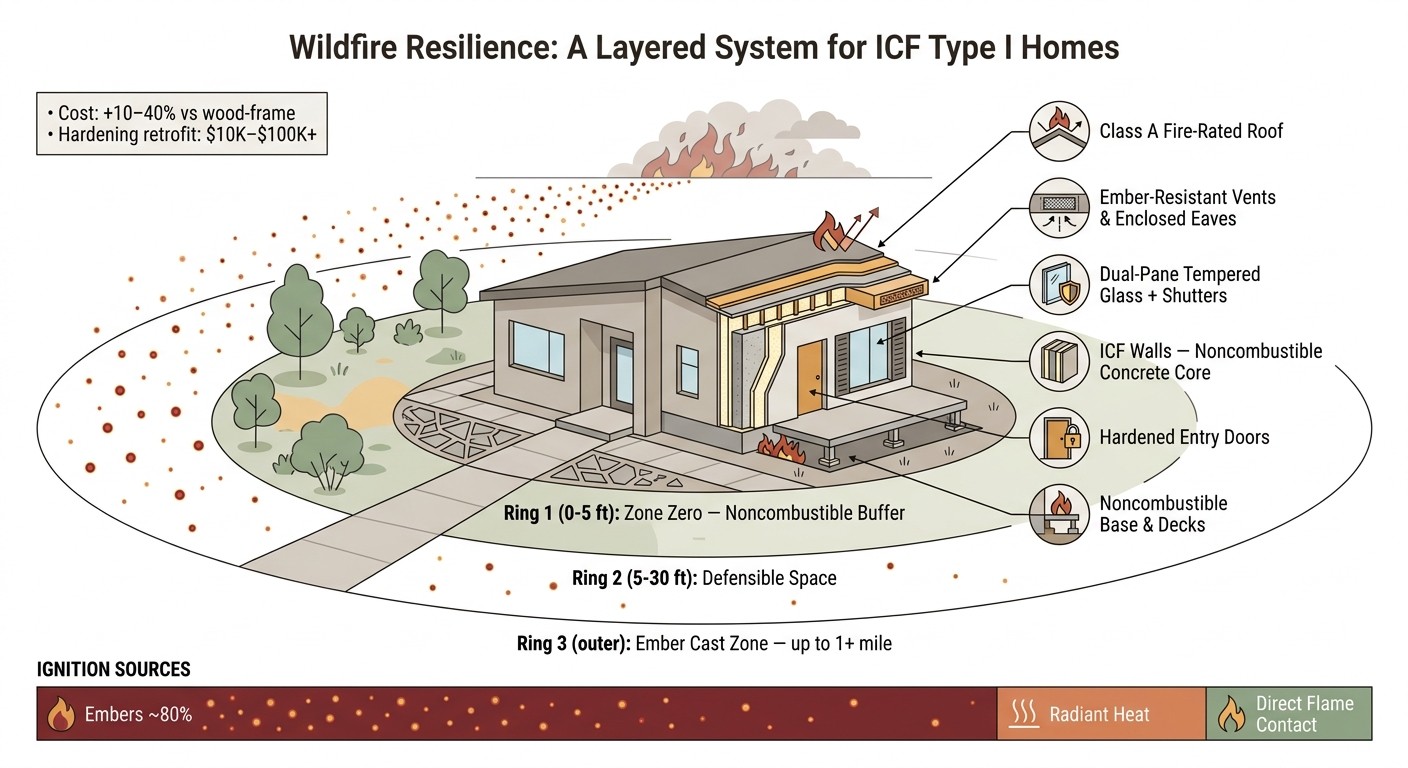
There are three primary ways a wood-frame home is ignited during a wildfire: embers, radiant heat, and direct flame contact. Embers are by far the most significant. Nearly 80% of homes lost in wildfires are believed to be ignited by embers — and independent research from IBHS and the U.S. Forest Service puts the number as high as ~90%.
Embers do not behave like flames. Under strong wind, they travel hundreds or thousands of feet ahead of the fire — sometimes miles. They land on doormats, deck boards, gutter debris, vent screens, patio cushions, and the corner where a fence meets the wall. They smolder. They wait. By the time visible flames arrive, the ignition has already happened, often hours earlier.
This is why the 0–5 foot "Zone Zero" around the structure has become so central to California's wildfire codes, and why ember-resistant vents and enclosed eaves matter more than they look on paper. The fight is not against a wall of flame at the property line. It is against thousands of small ignition events at every reachable surface of the home.
Why Tempered Glass Still Fails — And What Sits Above the Code Line
Of the new code-mandated upgrades, tempered glass at exterior windows is one of the most cited. It is roughly four times more resistant to thermal breakage than annealed glass and remains the right minimum for any home in a fire severity zone.
It is also not invincible. Liu's example: tempered glass can still fail under impact during high winds — a tree limb, debris, a lifted patio object — and once the glass is gone, embers and radiant heat have an open door. That is a code-compliant assembly losing to a real-world scenario that the code was not optimized for.
The upgrade path is clear and not exotic: dual-pane assemblies with tempered glass, multi-pane windows or shutters, ember-resistant metal screens, noncombustible framing material, and a clean 0–5 foot zone outside the window where ember-borne objects can't accumulate. These are not luxury features; they are the difference between meeting code and treating the window as a vulnerable point that has been strengthened.
The Real Cost of Going Noncombustible
The sticker-shock fear is loud and usually wrong. Liu's read of the market: fire-resistant homes are typically more expensive than wood-frame builds, but less expensive than most homeowners assume.
For new construction, fire-resistant homes typically cost about 10%–40% more than standard wood-frame, depending on the system used. ICF, steel framing, and 3D-printed concrete sit at different price points but all deliver strong fire performance.
For existing homes, hardening upgrades typically range from $10,000 to $100,000 or more, depending on home size and scope.
Independent IBHS / Headwaters Economics modeling found that building to California's CWUIC Part 7 adds about $13,000 over traditional construction for a 1,750 SF single-level home — flame- and ember-resistant vents, open-eave detailing, metal gutters, fire-rated wallboard at exterior walls, dual-pane single-tempered windows, and a 0–5 ft noncombustible zone included.
The spread is wide because the work is layered. The honest framing is not "how much extra to make my house fireproof" but "how much risk am I removing per dollar, and at what step does the curve flatten."
Insurance Math: Why Resilient Homes Get Coverage When Others Can't
The case for spending more upfront has shifted in the last 24 months. In many of California's fire-prone areas, insurance is becoming harder to obtain or keep at all. Carriers are non-renewing policies, narrowing coverage, and pricing risk that they used to absorb.
Liu's field observation: owners of fire-resilient homes are securing coverage more easily and at lower-than-average premiums. That is not a marketing claim; it is the natural consequence of underwriting math. A home that is materially less likely to ignite produces materially fewer claim dollars.
Most insurance discounts fall into two categories:
Defensible space — clearing vegetation and debris near the home (especially within five feet), spacing trees, removing combustible materials around the structure.
Home hardening — Class A roofing, enclosed eaves, ember-resistant vents, multi-pane windows or shutters, and noncombustible materials at the base of exterior walls.
The under-discussed factor is documentation. Discounts and, increasingly, coverage itself depend on records of the upgrades and, where possible, third-party inspections or certifications that verify the work. Build the file as you build the house.
Hardening an Existing Home: Where the $10K–$100K Actually Moves the Needle
Not every homeowner is in a position to rebuild from scratch. For existing homes, the smartest hardening dollar tends to follow a predictable order:
Roof and roof attachments. Class A roofing, clean gutters or gutter guards, sealed roof-to-wall transitions, and metal flashing where wood frames meet skylights or vents.
Vents and eaves. Ember-resistant vents listed by the California State Fire Marshal or tested to ASTM E2886. Enclosed eaves and noncombustible soffits.
Windows and openings. Dual-pane tempered glass, multi-pane assemblies, shutters, and ember-resistant metal screens.
Exterior walls and base. Noncombustible materials at the lower portion of exterior walls; replacement of wood-based sheathing where feasible.
Zone Zero. Hardscape, rock mulch, ceramic planters, wrought-iron furniture, and zero combustibles within 0–5 feet of the structure.
Decks, fences, and outbuildings. These are the most common bridge between vegetation and the house — the place embers turn into structural fire.
The sequencing matters. A perfect Zone Zero with an unsealed attic vent is still a losing trade. A Class A roof with a wooden lattice fence joining the house is still a losing trade. The order above approximates how risk drops per dollar spent.
A System, Not a Checklist: How to Stack the Layers
The single most useful framing in Liu's interview is also the simplest: treat the home as a system, not a checklist. Identify every vulnerable point and strengthen it. Assume that some layers will fail in the real event and design so that no single point of failure brings the whole structure down.
For new construction, that often means starting with a noncombustible primary structure (ICF, steel, or printed concrete), then layering Class A roofing, ember-resistant vents and eaves, multi-pane tempered or shuttered glazing, hardened entry doors, a real Zone Zero, and a defensible-space ring beyond it. For existing homes, it means working through the hardening order above with the same systems mindset, accepting that perfection is impossible but redundancy is not.
The Builtech project pushing for Type I is not interesting because of the marketing line. It is interesting because it forces every layer of the system to actually carry the rating — structural, envelope, openings, transitions, and site. That is what it takes to stop rebuilding the same vulnerable house twice.
The blunt summary is Liu's: the best way to fight a fire is to prevent it. Treat wildfire protection as a stacked system, leave no single point of failure exposed, and the math — on safety, on insurance, on the next disaster — starts to work in the homeowner's favor.
FAQs
How much does it cost to build a fire-resistant home in California?
New fire-resistant builds typically run 10%–40% more than standard wood-frame construction, depending on whether the system is ICF, steel, or 3D-printed concrete. Independent IBHS / Headwaters Economics modeling found that meeting California's CWUIC Part 7 adds about $13,000 over traditional construction on a 1,750 SF single-level home. Final pricing varies widely with site, size, and how many hardening layers are stacked on top.
What is Zone Zero and is it required around new California homes?
Zone Zero is the 0–5 foot ember-resistant buffer immediately surrounding a structure, kept clear of wood mulch, wood fences, planters, patio cushions, and other combustibles. In California's highest fire severity zones, a noncombustible Zone Zero is required on new builds. It exists because most wildfire home losses start with embers landing within a few feet of the wall, not from a wall of flame at the property line.
How far can wildfire embers travel before igniting a home?
Wind-driven embers routinely travel hundreds to thousands of feet ahead of a wildfire front, and in extreme conditions can drift miles before landing. They smolder in gutter debris, vent screens, doormats, deck cracks, and Zone Zero clutter, often igniting a structure hours before visible flames arrive. That is why ember-resistant detailing matters more than perimeter defense, and why nearly 80% of homes lost are ember-ignited.
Is ICF construction safe enough for Southern California seismic zones?
ICF walls behave structurally like cast-in-place reinforced concrete, which has a long, well-understood track record in California seismic design when properly engineered. Reinforcement schedules, foundation connections, and diaphragm tie-ins must be designed by a licensed structural engineer to local seismic requirements. ICF does not exempt a project from Title 24 or seismic provisions — it is a wall system that still has to meet them.
Why do code-compliant homes still burn down in California wildfires?
California's building codes set a minimum standard, not a wildfire guarantee. They were historically shaped around seismic performance, with wildfire provisions added later. Compliance can still be defeated by ember intrusion at vents, debris in gutters, combustible Zone Zero materials, or a single wood deck or fence touching the wall. Real resilience requires a layered system design, not just permit-level boxes checked.
Does a fire-resistant home actually lower insurance costs in California?
In many California fire-prone areas, fire-resistant homes are securing coverage more easily and at lower-than-average premiums, while comparable wood-frame homes face non-renewals and narrowed policies. Discounts and eligibility typically tie to documented defensible space and home hardening — Class A roofing, ember-resistant vents, multi-pane windows, and noncombustible exterior materials. Records and third-party verification of the upgrades matter as much as the upgrades themselves.
What is the cheapest way to harden an existing wood-frame house?
The highest-ROI dollars usually go to roof and roof attachments first — Class A roofing, sealed roof-to-wall transitions, and clean gutters or gutter guards — followed by ember-resistant vents and enclosed eaves, then a noncombustible Zone Zero. These steps reduce ignition risk before more invasive work on windows, walls, and decks. Existing-home hardening typically lands between $10,000 and $100,000+ depending on home size and scope.
Should I do a like-for-like rebuild after the LA wildfires or upgrade?
Like-for-like keeps the expedited permitting lane but recreates the same vulnerabilities that allowed the original loss. Most homeowners do not actually want the old home back — they want to expand or upgrade. Going beyond like-for-like generally falls outside expedited review and stretches timelines, but in WUI zones the upgrade is increasingly the difference between a future insurable property and a stranded asset.
What roofing is required for new homes in California wildfire zones?
California requires Class A fire-rated roofing — the highest fire-resistance class under ASTM E108 / UL 790 — across its higher-risk fire severity zones. Class A covers concrete and clay tile, metal, and qualifying asphalt assemblies. The roof system must also address attachments, flashings, eaves, and gutters, because embers exploit the edges and openings rather than the field of the roof itself, where most ignitions begin.
When are ember-resistant vents required in California?
Ember-resistant vents are required on new construction and major rebuilds in California's higher-risk fire severity zones under Chapter 7A of the California Building Code. Compliant vents are listed by the California State Fire Marshal or tested to ASTM E2886 to block flame and ember intrusion. Standard mesh screens alone do not meet the requirement, and retrofitting non-compliant vents is one of the highest-ROI hardening upgrades for existing homes.
Related resources
CAL FIRE — Home Hardening: Authoritative California-specific reference for roofing, vents, windows, and exterior wall details. https://www.fire.ca.gov/home-hardening
IBHS / Headwaters Economics — Construction Costs for Wildfire-Resistant Homes (Fall 2025): Independent cost modeling for CWUIC Part 7 and WFPH Plus builds. https://ibhs.org/wp-content/uploads/Construction_Costs_Wildfire_Resistant_Homes_HE-IBHS_Final_2025.pdf
California Building Code 2022, Chapter 7A — Materials and Construction Methods for Exterior Wildfire Exposure: The actual code language behind ember-resistant vents, roofing, and exterior walls. https://up.codes/viewer/california/ca-building-code-2022/chapter/7A/sfm-materials-and-construction-methods-for-exterior-wildfire-exposure
References
Koslow, J. Rethinking Fire Safety: An expert's perspective as LA continues to rebuild. LA Downtown News, Apr 6, 2026. https://www.ladowntownnews.com/news/rethinking-fire-safety-an-expert-s-perspective-as-la-continues-to-rebuild/article_84a38cd7-e3ce-4f00-9d61-43993f2019e5.html
CAL FIRE. Home Hardening. https://www.fire.ca.gov/home-hardening
CAL FIRE Ready for Wildfire. Fire Safety Laws. https://www.readyforwildfire.org/fire-safety-laws/
Frontline. Wildfire Embers: How Homes Catch on Fire. https://www.frontlinewildfire.com/wildfire-news-and-resources/wildfire-embers-how-homes-catch-on-fire/
IBHS / Headwaters Economics. Construction Costs for Wildfire-Resistant Homes, Fall 2025. https://ibhs.org/wp-content/uploads/Construction_Costs_Wildfire_Resistant_Homes_HE-IBHS_Final_2025.pdf
California Building Code 2022, Chapter 7A — Materials and Construction Methods for Exterior Wildfire Exposure. https://up.codes/viewer/california/ca-building-code-2022/chapter/7A/sfm-materials-and-construction-methods-for-exterior-wildfire-exposure