Eave Vents and Windows: 3D-Printed ADU Fire Weak Points
A source-grounded breakdown of why eave vents and windows are the weakest links in a fire-resistant 3D-printed ADU, what California Chapter 7A actually requires at those openings, and how the Builtech + RIC Walnut ADU hardens them inside a concrete-and-steel envelope.
Authors:


TLDR
A 3D-printed concrete wall is non-combustible, but a home is only as fire-resistant as its smallest opening.
In the Walnut, California 3D-printed ADU, Builtech Construction Group and RIC Technology explicitly call out eave vents and windows as the weak points they will strengthen.[1]
Embers, not flame fronts, ignite most homes in wildfires; eaves and windows are where embers find fuel and where glass fails.
California Building Code Chapter 7A and CAL FIRE home-hardening guidance already define what "strengthened" should mean at those openings.[2][3]
For owners and general contractors building printed ADUs in WUI zones, the cost of getting vents and windows wrong is much higher than the cost of upgrading them.
Concrete walls alone do not make a printed ADU fireproof
A concrete envelope is the headline feature of the Walnut, California accessory dwelling unit being built by Builtech Construction Group and RIC Technology, but it is not the whole fire story. Interesting Engineering's coverage of the project lays out the team's logic in plain language: of the three legs of the fire triangle, the only one a builder controls is fuel, and that is what the design eliminates.[1] Concrete used in 3D printing is fire-resistant and non-combustible. The roof swaps wood for light steel and Sure-Board. And then comes the line that most readers skim past: "areas such as eave vents and windows that are vulnerable to fires will also be strengthened."
That one sentence is the entire opening-protection problem of wildfire-resistant construction. A wall can be poured from molten basalt and still lose the house if a single soffit vent admits an ember into the attic. A printed ADU lives or dies at its openings. Glass, mesh, frames, gaskets, and the seam where the roof meets the wall are where embers find oxygen and fuel, and where heat finds the one combustible thing in the assembly.
This post is about that one sentence. What does "strengthening" eave vents and windows actually mean on a 3D-printed concrete envelope, who decides whether it is enough, and where does the printed wall change the conversation versus a stick-framed house?
The eave vent problem in printed-wall ADUs
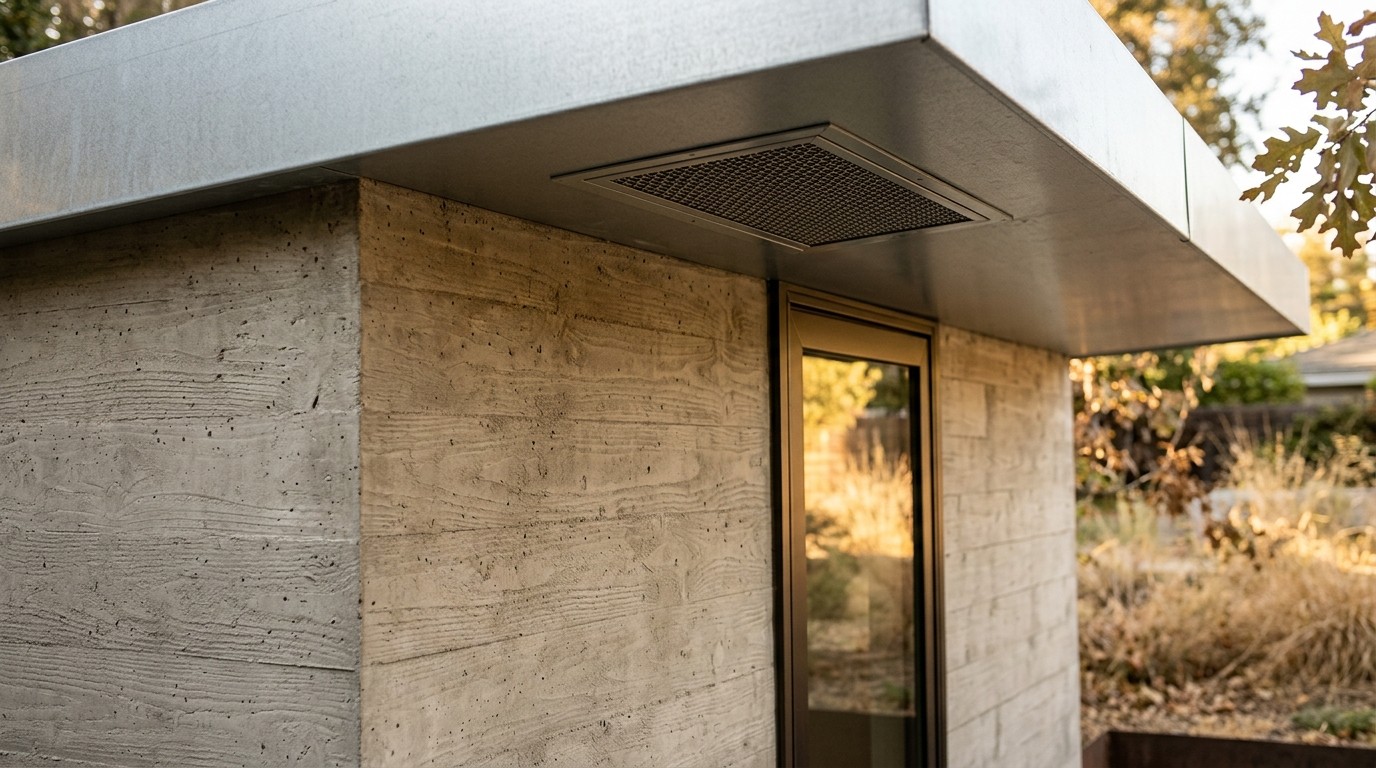
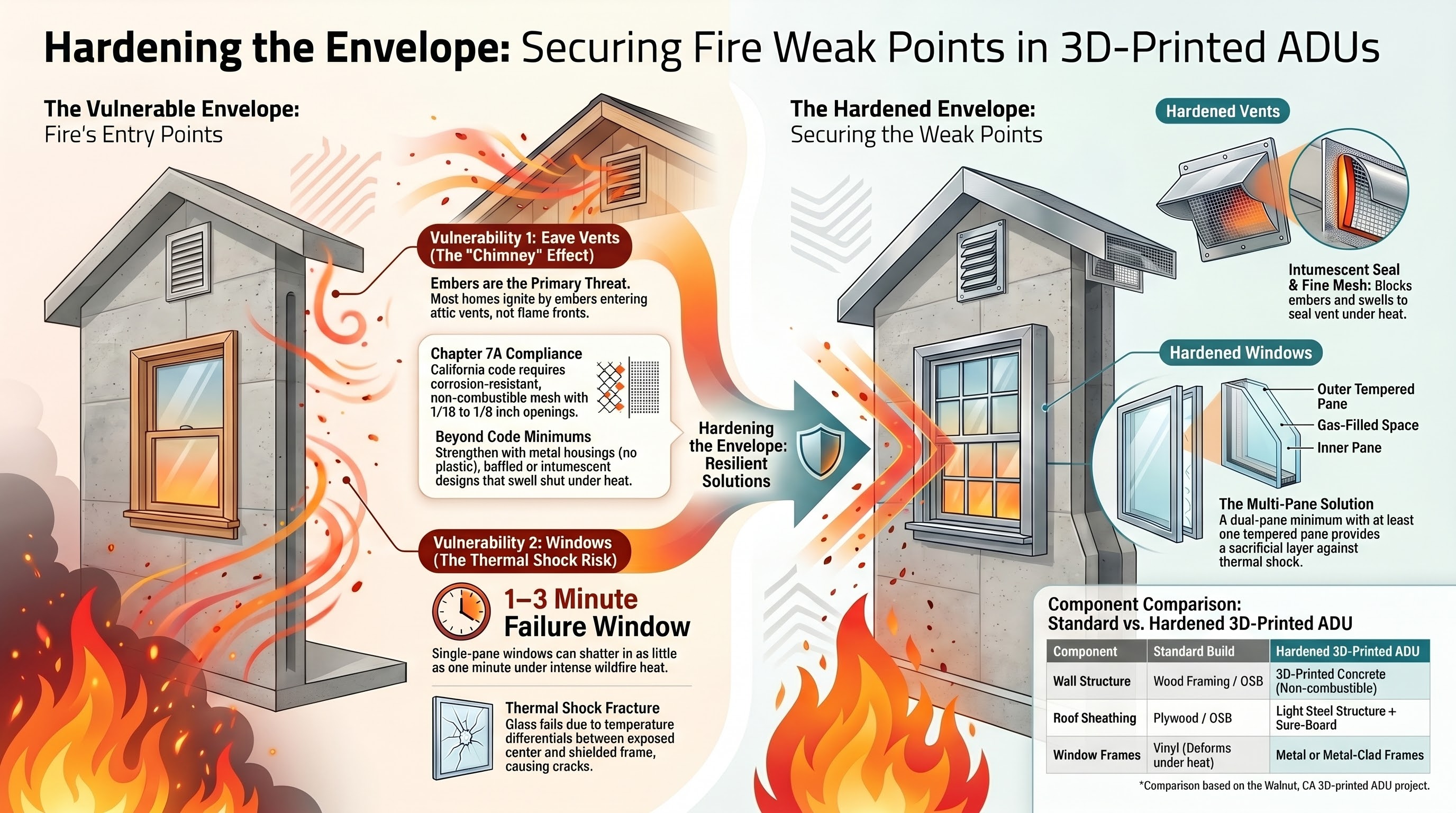
Eave vents — the screened openings tucked under the roof overhang — exist to ventilate the attic and roof cavity. In a wildfire, that same airflow path becomes a chimney for embers. CAL FIRE's home hardening guidance calls vents out specifically: attic and crawlspace vents are access points where embers and flames can enter and ignite combustible materials inside the home.[2] Standard vents are also frequently built from flammable plastic, which fails fast under direct ember contact.
On a 3D-printed ADU, the concrete wall pushes the fire conversation up to the eave. Once you have removed wood framing from the wall, the next combustible target in the building section is whatever lives under and behind the eave: roof underlayment, insulation, blocking, or wood backing in the soffit. An ember does not need much. A 1.5-millimeter gap in a metal vent screen is enough for the smaller embers; a torn screen or warped vent face is enough for the larger ones.
The printed wall also creates a real detailing problem at the eave. The concrete is poured (or extruded) in layers that may not align cleanly with a standard truss heel or fascia detail. The interface between the top of the printed wall and the steel roof structure is exactly where eave vents typically sit. If that interface is treated like a conventional stick-framed eave, the entire fire-hardening logic of the printed wall is wasted at the very point where embers concentrate.
The Walnut project's commitment to strengthen eave vents is, in effect, a commitment to redesign that interface — to make sure the seam between the printed concrete and the steel roof is itself an ember-resistant assembly rather than a continuation of legacy practice.
The window problem in printed-wall ADUs
Windows are the other obvious opening, and they fail in wildfires for a reason that has nothing to do with the wall around them. Fire Safe Marin's technical guidance is blunt: single-pane windows are highly vulnerable to breaking under wildfire heat; depending on glass type, a pane can break after only 1–3 minutes of exposure to intense heat or flame.[5] Once the glass fails, the interior of the home is exposed to embers, radiant heat, and direct flame, and the fire has effectively entered the structure.
The physics is a thermal-shock story. Glass exposed to a wildfire front experiences a large temperature differential between the part of the pane that is exposed and the part that is shielded by the frame. Cracks initiate at the edge and propagate inward, which is why larger panes are more failure-prone than smaller ones.
A printed concrete wall does not change that physics. It does, however, change the failure consequences. In a stick-framed home, once a window fails the fire can chew into combustible framing immediately behind the opening. In a printed ADU, the wall material is non-combustible, but the contents of the room are not. Curtains, furniture, flooring, and roof structure above the window are still vulnerable, and the interior pressure dynamics of a partially-vented hot fire can rapidly escalate damage even without wall ignition.
The Walnut project's window strengthening, taken together with the printed concrete wall, is what closes the loop. Hardened glazing keeps the fire out long enough for the front to pass; the non-combustible wall ensures that even if embers do land on the exterior near the window, they have nothing to ignite.
What "strengthening" eave vents actually means in California
In California, eave-vent strengthening is not aesthetic — it is code. Chapter 7A of the California Building Code requires that vents in WUI-designated areas be able to resist the intrusion of embers and flames, and that they be protected by corrosion-resistant, non-combustible wire mesh screen with openings between 1/16 and 1/8 inch.[3] That is the minimum legal posture for a vent on a new build in a fire-prone zone.
In practice, "strengthened" on a project like the Walnut ADU should mean at least four things stacked together:
Non-combustible vent housings. Plastic vent assemblies, which CAL FIRE specifically flags as highly vulnerable, are replaced with corrosion-resistant metal.[2]
Ember-resistant mesh sizing. The opening size is held at the lower end of the Chapter 7A range, with detail attention to mesh attachment so embers cannot bend the screen away from the housing.
Baffled or intumescent designs. Where the budget allows, baffled vent designs that interrupt direct line-of-sight to attic insulation, or intumescent vents that swell shut under heat, provide a second line of defense after the screen.
Sealed soffit transitions. The seam where the soffit meets the printed concrete wall is sealed with fire-rated joint detailing so embers cannot bypass the vent entirely by entering through a gap.
None of this is exotic. It is now standard wildfire-hardened-construction practice on conventional builds. The reason it matters more on a printed ADU is that the rest of the envelope has set such a high bar; a non-compliant vent is the single weakest link in an otherwise non-combustible structure.
What "strengthening" windows actually means in California
Window strengthening in WUI zones is also a code conversation, but with more design latitude. Multi-pane (dual- or triple-glazed) windows offer markedly better wildfire performance than single-pane, in large part because the inner pane is shielded from the initial thermal shock by the outer pane.[5] At least one tempered pane in each unit raises the survival window further by tolerating greater thermal stress before fracturing.
A serious wildfire-resistant window package for a 3D-printed ADU looks something like this:
Dual-pane minimum, with the exterior pane tempered. Some assemblies specify both panes tempered, especially on west- and south-facing elevations or windows large enough that edge effects become a problem.
Non-combustible frames. Metal-clad or all-metal frames replace vinyl, which deforms quickly under sustained heat.
Ember-resistant detailing at the sill and trim. Caulks, weatherstripping, and any wood trim near the opening are replaced or upgraded so embers landing on the sill have nothing to ignite.
Smaller, well-placed openings on the worst-exposed elevations. Where the architecture allows, the largest panes face the least-exposed direction; smaller panes are inherently more failure-resistant than larger ones.
Optional exterior shutters or screens. Metal shutters or fine-mesh screens add a sacrificial layer that the homeowner can deploy in an evacuation.
The printed concrete wall makes the metal frames easier to detail well: the opening is a clean, durable, dimensionally stable mass that gives the installer something to anchor into directly, without the thermal-bridging and shrinkage problems of wood framing.
Where steel-and-Sure-Board roof meets printed concrete wall
The eave is also where two of the project's headline systems collide. Above is the light steel and Sure-Board roof that the team is using in place of conventional wood framing.[1] Below is the printed concrete wall. The vent sits in between. Get this transition right and the home is essentially a single continuous non-combustible envelope. Get it wrong and the eave becomes the home's first ignition point.
The practical move is to treat the eave as an assembly, not as a list of products. That means:
A non-combustible fascia material continuous with the steel roof framing, not a wood ladder applied as an afterthought.
A soffit panel made from fiber-cement, Sure-Board, or metal — not OSB or T&G wood — even where it will be covered by paint.
A fire-rated joint at the wall-to-soffit interface, sized to the actual movement that occurs between a printed concrete wall and a steel roof in real thermal cycles.
A vent product whose published assembly test results match the assembly that is actually being built, not just the product in isolation.
This is the kind of detail that does not show up in a press release but determines whether the home survives a real fire night.
Why printed concrete walls change the opening-protection conversation
In a conventional stick-framed wildfire-hardened home, opening protection is one chapter in a longer fight that includes wall sheathing, cladding, framing, and interior fire blocking. In a printed concrete ADU, that fight is mostly over before it starts. The wall is concrete. The exterior is concrete. The structural frame is concrete. There is no stud cavity for an ember to enter, no OSB to ignite, no housewrap to char.
That changes two things.
First, it concentrates the remaining risk at the openings. The eaves and windows are no longer the weakest link in a long chain; they are functionally the only link. Resources that would normally be spread across many wall-system upgrades can be redirected into best-in-class vents, glazing, and detailing.
Second, it raises the standard for what "good enough" looks like at those openings. When a homeowner pays the premium for a printed concrete fire-resistant envelope, the marginal cost of upgrading from a code-minimum vent to a baffled or intumescent vent, or from a dual-pane to a tempered dual-pane window, is small compared to the cost of having engineered the envelope in the first place. The opening upgrades are also the part most likely to be revisited by insurers when underwriting a hardened ADU; insurers reward measurable, code-aligned upgrades, not abstract claims.
The Builtech + RIC Walnut blueprint
The Walnut ADU is a single project, but it is also a reference build. Interesting Engineering's coverage frames it as a milestone in the housing industry and a model for future fire-resistant homes in wildfire-prone areas.[1] Build in Digital and 3DPrint.com describe the same build with the same emphasis on compact robotic printing enabling on-site construction in confined backyards.[6][7]
What does the blueprint actually look like from an opening-protection perspective?
Walls: 3D-printed concrete; non-combustible by default.
Roof: Light steel structure with Sure-Board sheathing in place of dimensional lumber and wood sheathing; eliminates the largest combustible mass in a conventional roof.
Eaves: Strengthened — read as non-combustible soffit, ember-resistant metal vents per Chapter 7A, sealed transitions to the printed wall.
Windows: Strengthened — read as multi-pane tempered glazing, metal frames, hardened sill and trim.
The lesson is that the headline is concrete, but the engineering is detail. The Walnut ADU works because the team treated the openings with the same seriousness as the walls.
Field guidance for owners and general contractors
For a homeowner considering a 3D-printed ADU in a wildfire-prone area, the practical takeaway is to read every line item in the wildfire-hardening scope, not just the wall spec. Ask what specific vent product is being installed and whether it is listed for the assembly in which it sits. Ask whether the glazing is dual-pane with at least one tempered light. Ask what the soffit material is and how the wall-to-soffit transition is sealed.
For a general contractor pricing a printed ADU, the practical takeaway is to underwrite the openings as a discrete scope. The print subcontractor will deliver the wall. The roofer will deliver the steel and Sure-Board assembly. Neither is naturally accountable for the eave detail unless the GC owns it. That ownership is what separates a code-compliant build from a genuinely fire-resistant one.
A 3D-printed concrete envelope is a real wildfire-resilience advance. It is not magic. The fire enters where the envelope has a hole. Strengthen the holes.
FAQs
Why do eave vents matter so much on a 3D-printed concrete ADU?
The concrete wall removes most of the combustible material from the envelope, which concentrates the remaining fire risk at the openings. Eave vents are the most exposed openings on most homes and are designed to admit airflow — which during a wildfire means embers. A single non-compliant vent can ignite the attic of an otherwise non-combustible structure, so the vent assembly is the deciding factor in many printed ADU survival scenarios.
Are 3D-printed concrete walls truly fire-resistant?
Concrete is non-combustible, and 3D-printed concrete walls used in projects like the Walnut, California ADU are explicitly described as fire-resistant.[1] That said, fire-resistance of the wall is not the same as fire-resistance of the home. The roof, eaves, vents, windows, and any combustible interior contents all influence whether the structure survives, which is why projects pair concrete walls with steel-and-Sure-Board roofs and hardened openings.
What is California Chapter 7A and why does it apply to 3D-printed ADUs?
Chapter 7A of the California Building Code governs materials and construction methods for exterior wildfire exposure in designated WUI zones. It sets requirements for roofing, vents, eaves, exterior walls, windows, and decking. A 3D-printed concrete ADU in a fire-prone area is subject to the same Chapter 7A requirements as any other build, which means its vents and windows must meet the same ember- and flame-resistance standards.[3]
What are ember-resistant vents and how do they work?
Ember-resistant vents block windblown embers from entering attic or crawlspace cavities while maintaining airflow. They typically combine corrosion-resistant non-combustible mesh sized between 1/16 and 1/8 inch with baffles or, in some designs, intumescent material that closes the opening under heat.[4] On a printed ADU, they are installed at every soffit, gable, ridge, and foundation vent location to maintain a continuous non-combustible perimeter.
Why are single-pane windows so vulnerable in a wildfire?
Single-pane windows are vulnerable because exposure to wildfire heat creates a steep temperature differential between glass exposed at the center and glass shielded by the frame. That differential cracks the pane, often within 1–3 minutes of intense heat exposure, allowing flames and embers into the home.[5] Dual-pane assemblies with at least one tempered light hold longer, which is why they are standard on hardened ADU builds.
How is the eave designed on a steel-and-Sure-Board roof above a printed concrete wall?
The eave is a transition assembly between the steel roof framing and the printed concrete wall. Best practice is to use non-combustible fascia, a non-combustible soffit panel such as fiber-cement or Sure-Board, ember-resistant metal vents listed for the assembly, and fire-rated sealants at the wall-to-soffit joint. The goal is a continuous non-combustible perimeter so embers cannot bypass any single product.
Do hardened windows and vents help with insurance on a 3D-printed ADU?
Generally, yes. Insurers underwriting wildfire-zone properties reward measurable, code-aligned hardening upgrades, including Class A roof assemblies, ember-resistant vents, and non-combustible siding. Hardened windows and vents on a printed ADU usually qualify under standard wildfire-hardening criteria, though owners should request a formal hardening assessment from their broker after construction to capture every applicable discount.
Can existing ADUs be retrofitted with the same vent and window upgrades?
Yes. Most ember-resistant vents and hardened window assemblies are designed for both new construction and retrofit. CAL FIRE's home-hardening program specifically targets retrofits in WUI zones, and many municipalities offer incentive programs.[2] Retrofitting an existing ADU is not as comprehensive as building one with printed concrete walls, but the vent and window upgrades alone can meaningfully reduce ignition risk.
Why is a compact robotic 3D printer specifically relevant to fire-resistant ADUs?
Most wildfire-resilient construction happens in dense residential neighborhoods or on infill lots adjacent to wildland, where gantry-based printers cannot physically fit. RIC Technology's compact modular robotic printer enables on-site concrete printing in confined backyards, which is the setting where fire-resistant ADUs are most needed.[7] Without that form factor, the fire-resistant printed ADU is a lab demonstration rather than a deployable model.
What is the practical first step for a homeowner considering a printed ADU in a fire zone?
Start with a hardening-first scope. Talk to a general contractor who has built in WUI conditions, ask specifically which vent and glazing products they will use, and confirm those products are listed for the assemblies in which they sit. Then have the printed-wall conversation. A printed concrete envelope is a powerful advantage, but only if the openings receive the same engineering attention as the walls.
Related resources
CAL FIRE — Home Hardening overview: the authoritative California guide to vent, window, roof, and eave upgrades in WUI zones.
Fire Safe Marin — Fire-Resistant Windows: clear, illustrated breakdown of how windows fail in wildfires and which assemblies hold up.
3DPrint.com — Fire-Resistant 3D Printed Accessory Dwelling Unit Unveiled by RIC: supplementary technical and quotation context for the Walnut, California project.
References
[1] Interesting Engineering — Robotic 3D printer to build fire-resistant home in California: https://interestingengineering.com/innovation/compact-3d-fire-resistant-house
[2] CAL FIRE — Home Hardening: https://www.fire.ca.gov/home-hardening
[3] California Building Code Chapter 7A — Materials and Construction Methods for Exterior Wildfire Exposure: https://up.codes/viewer/california/ca-building-code-2016/chapter/7A/sfm-materials-and-construction-methods-for-exterior-wildfire-exposure
[4] Fire Safe Marin — Fire-Resistant Vents: https://firesafemarin.org/harden-your-home/fire-resistant-vents/
[5] Fire Safe Marin — Fire-Resistant Windows: https://firesafemarin.org/harden-your-home/fire-resistant-windows/
[6] 3DPrint.com — Fire-resistant 3D Printed Accessory Dwelling Unit Unveiled by RIC: https://3dprint.com/307742/fire-resistant-3d-printed-accessory-dwelling-unit-unveiled-by-ric/
[7] Build in Digital — Robot system to print wildfire-resistant California home: https://buildindigital.com/robot-system-to-print-wildfire-resistant-california-home/