Fire-Resistant 3D-Printed ADU: A Fire Triangle Blueprint
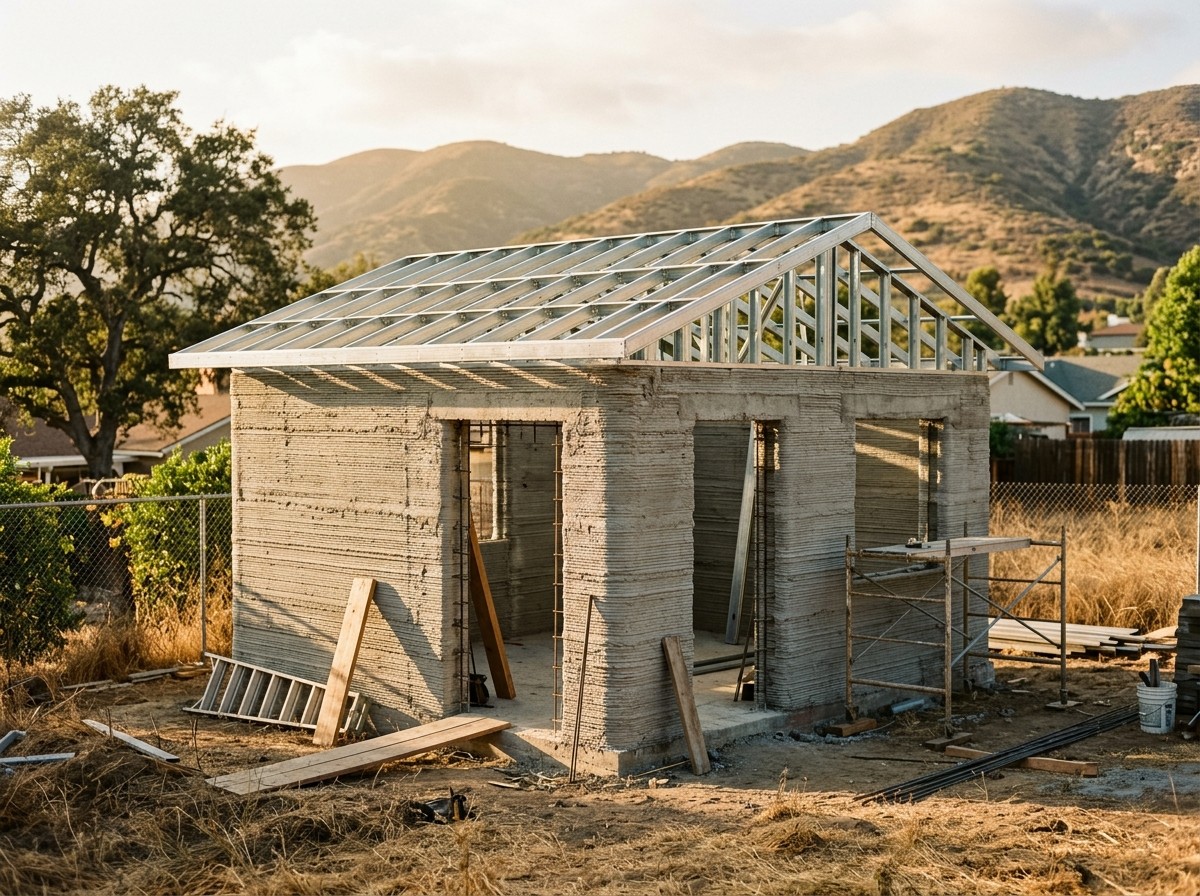
Builtech Construction Group has developed the first onsite 3D-printed, fire-resistant accessory dwelling unit (ADU) in the U.S., designed around the fire triangle principle by eliminating combustible materials. The Walnut ADU features 3D-printed concrete walls, a non-combustible steel roof, and hardened openings to prevent ember entry, making it suitable for California's wildfire-prone areas. The project demonstrates that fire-resistant, code-compliant homes can be built efficiently using advanced 3D printing technology, addressing both wildfire risk and housing needs.
Authors:


TLDR
The Walnut ADU built by Builtech Construction Group is the first onsite 3D-printed, fire-resistant ADU in the United States, built with the City of Walnut and the LA County Fire Department.
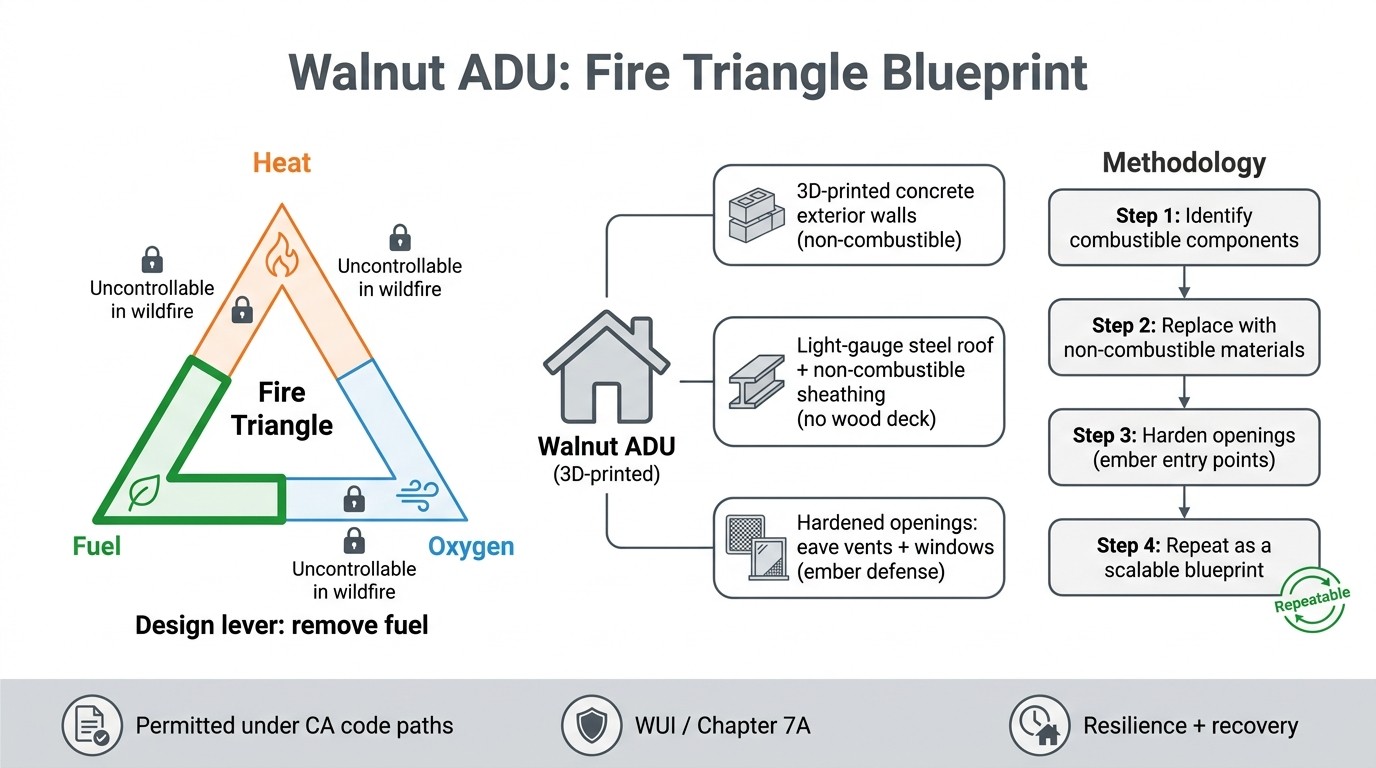
Builtech engineered the home around a single principle from combustion science: the fire triangle. With heat and oxygen uncontrollable in a wildfire, the only lever left is fuel — so the design eliminates fuel from the structure itself.
The exterior walls are 3D-printed concrete; the roof uses light steel and sure-boards instead of wood; the main structure forgoes wood and nails entirely.
The most underrated detail is the hardening of eave vents and windows — the same micro-failure points where USDA Forest Service and IBHS data show home destruction usually starts.
For homeowners and builders in California's wildland-urban interface, the lesson is methodological, not material: design the building as a fuel system, then remove the fuel.
Why the Fire Triangle Belongs on the Blueprint
Most wildfire-resistant building advice reads like a checklist. Use Class A roofing. Add ember screens. Choose dual-pane windows. The advice is correct, but the framing is wrong. It treats wildfire resilience as a sequence of product upgrades rather than as an engineering problem with a known model.
That model is the fire triangle. Fire requires three things to ignite and sustain: heat, oxygen, and fuel. Remove any one and combustion stops. In an active wildfire, two of those three sides are essentially uncontrollable at the building scale. Heat from a passing front can exceed 1,500°F. Oxygen is everywhere. The only side a designer can influence is fuel.
Aaron Liu, CEO of Builtech Construction Group and an NFPA-certified wildfire mitigation specialist (CWMS), made that explicit when describing the Walnut ADU project: "During wildfires, 'heat' and 'oxygen,' two of the three components of the fire triangle, are beyond control. Therefore, our focus is on eliminating 'fuel' — the unique architectural design and building materials in this case." [1]
That sentence is the actual blueprint for the Walnut project. Everything else — the 3D-printed concrete, the light-steel roof, the absence of nails — is a downstream consequence.
The Walnut Project, in One Paragraph
The Walnut ADU is a 1,200 sq ft, two-bedroom, 2.5-bathroom accessory dwelling unit built in the backyard of two Walnut residents, Philips and Constance, in partnership with the City of Walnut and the LA County Fire Department. [1] Builtech Construction Group is the general contractor; RIC Technology supplies a compact modular robotic arm that 3D prints the concrete exterior walls; K4K Construction Design is the print subcontractor; the print phase is expected to take roughly 20 days. [1] After receiving construction permits in February despite California's strict building code, the project broke ground and started installing plumbing and sewage before the print began. [1]
What makes it newsworthy is not that it is 3D printed. Plenty of homes are 3D printed now. What makes it newsworthy is that it is the United States' first onsite-built concrete ADU explicitly engineered for fire resistance, in a backyard, in California's wildland-urban interface.
Treating the House as a Fuel System
If you accept Liu's framing, the next question is mechanical: what counts as fuel in a typical home?
The honest answer is most of it. Wood-frame walls. Wood roof sheathing. Wood eaves and soffits. Cedar shake or asphalt shingles. Wood decks. Plastic vent screens. Vinyl windows. Wood fascia. Even paint and sealants contribute. A conventional Southern California single-family home is, structurally, a slow-release fuel package wrapped in stucco.
Builtech's design treats every component as a binary: combustible or not. Combustible elements are removed from the main structure or replaced. The result is a home where the only credible ignition pathway is through openings, and openings are explicitly hardened.
That is the actual innovation in Walnut. Not the printer.
Why 3D-Printed Concrete Is a Fuel Decision Before It Is a Print Decision
Concrete does not burn. That is its entire value in a wildfire context. Independent analysis from Columbia University's School of Professional Studies argues that concrete's non-combustibility is the single biggest reason concrete homes consistently outperform timber-framed homes in wildfire exposures. [2] Recent fire-resistant 3D-printed homes built in Buena Vista, Colorado by VeroTouch and COBOD use A1-classified concrete — the highest non-combustible rating, meaning the material does not contribute to combustion at any stage. [3]
So the choice to 3D print the Walnut ADU is not, primarily, a speed or cost decision. It is a fuel decision. Once you commit to non-combustible exterior walls, the question becomes how to build them efficiently in a tight backyard. Conventional concrete masonry units (CMU) require skilled masons, formwork, and significant on-site logistics. A compact robotic 3D printer is, in this context, the lowest-friction way to land non-combustible walls in someone's yard.
RIC Technology's robotic arm matters here for a specific reason. Ziyou Xu, RIC Technology's founder and CEO, explained that "Our compact modular robotic 3D printer overcomes conventional gantry systems' limitations, enabling 3D construction on site, in confined space such as people's backyards." [1] Gantry-style construction printers typically require setup space several times larger than the printed footprint, which is a non-starter for backyard ADUs. A robotic arm is one of the few delivery mechanisms that can land non-combustible walls on a constrained residential lot.
The Roof Is Where Most Wildfire Homes Die
Engineers who study wildfire home loss agree on one uncomfortable fact: roofs ignite first. The roof is large, horizontal, and exposed to ember rain from miles away. A 2024 Headwaters Economics analysis identified roughly one million U.S. homes with combustible wood-shake or wood-shingle roofs in medium-to-very-high wildfire risk areas, with retrofit costs of at least $6 billion. [4]
This is why the Walnut project's roof spec is more revealing than its walls. Builtech's roof uses light steel and sure-boards instead of wood. [1] In other words, the same fuel-elimination logic applied to the walls is applied to the most ignition-vulnerable surface on the building. There is no wood roof deck waiting to catch an ember.
This is also where many "fire-resistant 3D-printed home" stories quietly fall short. Concrete walls are easy to advertise. A non-combustible roof system requires more discipline. Walnut got both.
Eave Vents and Window Edges as the Real Failure Points
The detail that separates a wildfire-marketed home from a wildfire-engineered home lives in the millimeters around openings.
Post-fire forensics from the Insurance Institute for Business & Home Safety (IBHS) and CAL FIRE consistently show that embers infiltrating eaves and vents are among the leading causes of structure loss during wildfires. [5] Embers are small enough to pass through standard vent screens, lodge in attic insulation, and ignite from inside. Window glass, meanwhile, fails because of thermal stress: when one part of the glass is shielded by the frame and another part is hit by radiant heat, differential expansion cracks the glass and lets flame inside. [6]
Builtech's design specifically reinforces eave vents and windows. [1] That is more important than it sounds. A concrete-walled, steel-roofed home with a standard eave vent and a single-pane window is still an ember entry. A concrete-walled, steel-roofed home with hardened vents and tempered, dual-pane windows is a closed system.
The Walnut ADU is being built to behave as a closed system.
Why a CWMS-Led Project Reads Differently
Most contractors building "fire-resistant" homes are not formally certified in wildfire mitigation. The NFPA Certified Wildfire Mitigation Specialist (CWMS) credential, built around NFPA 1140, requires demonstrated knowledge of wildfire behavior, hazard assessment, the home ignition zone, and mitigation planning. [7] Many California fire agencies are now requiring or strongly preferring CWMS certification for wildfire-related roles.
Aaron Liu holds the CWMS credential. [1] That single fact reframes the Walnut project. It is not a marketing-led 3D-printing demo with a fire angle. It is a CWMS-led wildfire mitigation project that happens to use 3D printing as one of its tools.
The distinction matters for buyers. A CWMS-led project will, on average, get the un-glamorous details right: vent mesh, ember-resistant soffits, defensible space, fuel transitions at the foundation, attic ventilation strategy. Those are the details that determine survival.
What the Permit Says About the Future
California has the strictest building codes in the United States, particularly through Title 24 and Chapter 7A for wildland-urban interface construction. [8] The Walnut ADU received construction permits in February despite that bar. [1] California has also issued a formal residential 3D printing code path — Appendix AW of the 2022 California Residential Code — that gives 3D-printed buildings a recognized framework for review. [9]
The implication is that 3D-printed, fire-resistant homes are no longer a code workaround. They are a code-recognized building method. That is the policy unlock that has been missing for the past five years. With permits and code paths in place, the constraint is no longer regulatory; it is operational.
Recovery Math: Why Fire-Resistant ADUs Pay Back
The economic case for fire-resistant construction is now well-documented. Headwaters Economics estimates that rebuilding to California's Chapter 7A wildfire-resistant standards adds less than 10% to construction costs — roughly $30,000 on a 2,000 sq ft home — while sharply reducing the risk of total loss. [10]
Avoided rebuild cost is the obvious benefit. The less-discussed benefit is timeline. Surviving a wildfire, even with damage, dramatically compresses recovery. Demolition, debris removal, permitting, and reconstruction routinely take 18 to 36 months in California. A standing, hardened, code-compliant ADU on the property gives a family somewhere to live during that period — and increasingly, somewhere to live permanently if the main home is unrecoverable.
For Walnut homeowners Philips and Constance, the ADU is both a hedge and an upgrade. It is the structure most likely to survive the next fire, and it is also a 1,200 sq ft, two-bedroom unit that exists in their backyard.
What This Project Does Not Do
A serious analysis has to be honest about scope.
The Walnut ADU does not eliminate wildfire risk. No single building can. Without defensible space, fuel-cleared landscaping, and community-scale mitigation, even a non-combustible building can be flanked by ignition events. Fire science consistently shows that home survival is a system problem: structure, vegetation, neighbors, weather. [5]
The project also does not promise lower insurance premiums tomorrow. California's insurance reform is still mid-flight; current discounts for hardened components — fire-resistant windows, for example — are real but modest, often in the single digits as a percentage of premium. [12] The bigger insurance shift will come from cumulative non-combustible builds and evolving wildfire catastrophe models, not from any one ADU.
What the project does do is show that fully non-combustible, code-compliant, 3D-printed residential construction is buildable today, in a California backyard, under existing permits. That is the proof point that has been missing.
A Methodology, Not a Product
The way to read the Walnut ADU is as a methodology Builtech can repeat. Identify the fuel. Remove it from the main structure. Replace combustible roof systems with non-combustible alternatives. Harden every opening. Lead the project with a CWMS-credentialed contractor who knows where homes actually fail. Use the most efficient available delivery mechanism — currently, a compact robotic 3D printer — to build non-combustible exterior walls in tight residential lots.
Repeat in another backyard. Repeat in another wildfire-prone city. Each repetition is more useful than the last because the methodology, not the technology, is what compounds.
The wildfire-prone communities of California do not need one fire-resistant home. They need a thousand of them, built quickly, by people who understand the fire triangle better than they understand the printer.
FAQs
What makes the Walnut ADU different from other 3D-printed homes?
Most 3D-printed homes are marketed for speed or design freedom. The Walnut ADU is engineered explicitly around the fire triangle: it eliminates combustible fuel from the main structure, including the roof, and hardens openings. It is also the United States' first onsite-built, fire-resistant 3D-printed accessory dwelling unit, permitted under California's strict wildland-urban interface building codes.
Why does the fire triangle matter for residential construction?
The fire triangle says combustion needs heat, oxygen, and fuel. In a wildfire, designers cannot remove heat or oxygen, so the only controllable variable is fuel. A residential design that systematically removes combustible materials from the structure — concrete walls, steel roof, no wood or nails — is engineering against the only side of the triangle that humans can actually control.
Is concrete really fire-resistant in a wildfire?
Yes. Concrete does not burn and does not contribute to combustion. The 3D-printed walls used in modern fire-resistant homes typically reach the highest non-combustibility ratings (A1 in European classifications) and 2-hour or greater fire ratings under North American testing. Concrete walls do not eliminate ember-driven ignition through openings, but they remove the most vulnerable structural surface.
What is a CWMS and why does it matter for the Walnut project?
CWMS is the NFPA's Certified Wildfire Mitigation Specialist credential. It assesses knowledge of wildfire behavior, hazard mitigation, planning, and the home ignition zone. Builtech CEO Aaron Liu holds the CWMS credential, which is why the Walnut design treats vents, eaves, and windows as carefully as it treats walls — those are the ignition points CWMS training emphasizes.
How long does it take to 3D print an ADU like the Walnut project?
The print phase for the Walnut ADU's exterior walls is expected to take about 20 days. Total project time is longer once you include foundations, plumbing, sewage, electrical, the steel roof, finishes, and inspections. The print is one phase of a multi-month project, not the whole build.
Can a 3D-printed concrete home survive wildfire embers?
Concrete walls can withstand direct flame and ember exposure that would ignite a wood-framed home. But survival also depends on the roof system, vent mesh, window glazing, and defensible space. The Walnut project pairs concrete walls with a light-steel and sure-board roof and hardened openings precisely because walls alone are not enough.
Why does Builtech use a robotic arm instead of a gantry 3D printer?
Gantry construction printers typically need a frame larger than the structure being built, which makes them impractical for backyards or constrained lots. RIC Technology's robotic arm is a multi-axis system that can print in confined spaces. For ADU work — which is, by definition, a backyard problem — the robotic arm is one of the few viable delivery mechanisms.
Did California's strict building codes block this project?
No. The project secured construction permits in February. California's residential code now includes Appendix AW for 3D-printed building construction, giving 3D-printed buildings a code-recognized review framework. The regulatory path is open; the harder constraints today are operational and economic.
How much does a fire-resistant 3D-printed ADU cost compared to a traditional ADU?
Costs vary widely, but California ADUs typically run $150 to $400 per square foot for traditional construction. Fire-resistant 3D-printed builds are in a similar range today, with the premium for non-combustible specifications generally adding less than 10% to total cost when designed from the start, per Headwaters Economics. The economics improve as repeat builds drive down setup overhead.
Can fire-resistant ADUs lower home insurance premiums in California?
Some California insurers — including State Farm and Mercury — have begun offering discounts for hardened components, and Mercury offers up to 50% off the fire portion of premium for fully noncombustible homes. Discounts are still modest in most regions, but the direction is clear. As insurers transition to forward-looking wildfire catastrophe models, fully non-combustible ADUs are positioned to qualify for the strongest pricing improvements.
Related resources
USDA Forest Service & IBHS — Wildfire Risk to Communities — Authoritative national data on home wildfire risk and ember-driven ignition.
IBHS — Wildland Fire Embers and Flames: Home Mitigations That Matter — System-based home hardening guidance grounded in burn-test research.
3D Printing Industry — California's First Fire-Resistant 3D-Printed ADU — The original reporting on the Walnut project.
References
Concrete vs. Timber: Rethinking Our Homes in the Face of Wildfires — Columbia University SPS
Fire-Resistant 3D Printed Homes Debut in Colorado — 3D Printing Industry
Wood roofs are a $6 billion wildfire problem — Headwaters Economics
Wildland Fire Embers and Flames: Home Mitigations That Matter — IBHS
Appendix AW — 3D Printed Building Construction, 2022 California Residential Code
Building wildfire-resistant homes after disasters will save billions — Headwaters Economics
Building Resilient 3D-printed Homes: Testing for Fire, Hurricanes and High Wind — ICON
California insurers begin giving discounts for fire-proofed homes — E&E News by POLITICO