Fire-Resistant 3D-Printed ADU: California's Owner-Led Pilot
California's first onsite fire-resistant 3D-printed ADU in Walnut was commissioned by private homeowners, not a state pilot. The build matters less as a tech demo than as evidence that owner-initiated commissions are emerging as the fastest path to WUI wildfire resilience.
Authors:


TLDR
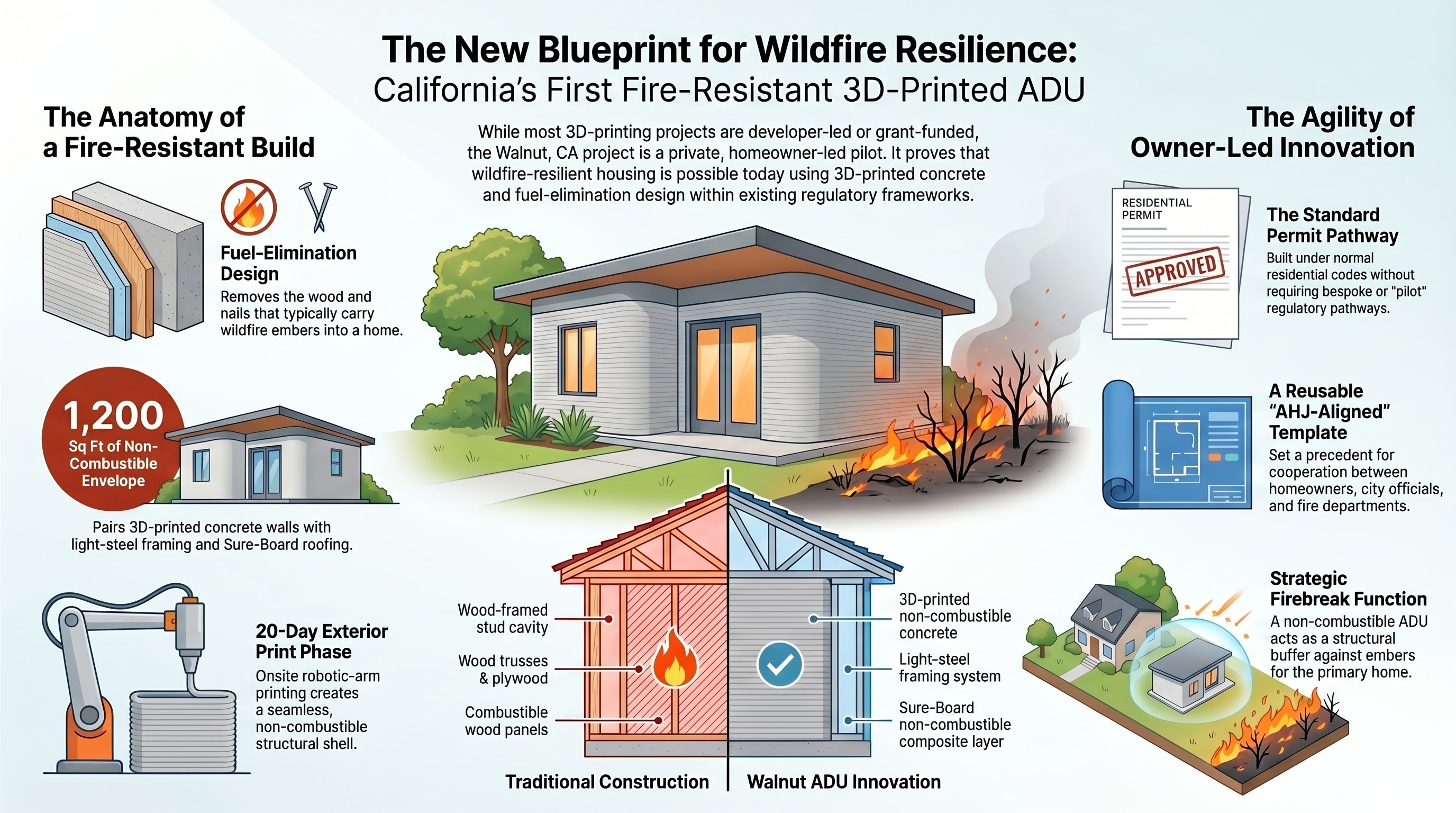
California's first onsite, fire-resistant 3D-printed concrete Accessory Dwelling Unit was built in Walnut, Los Angeles County, on a private lot owned by two homeowners who chose to pilot the method themselves.[1]
The 1,200 sq ft ADU pairs 3D-printed non-combustible concrete walls with a light-steel and Sure-Board roof, removing the wood and nails that typically carry wildfire into a home.[1]
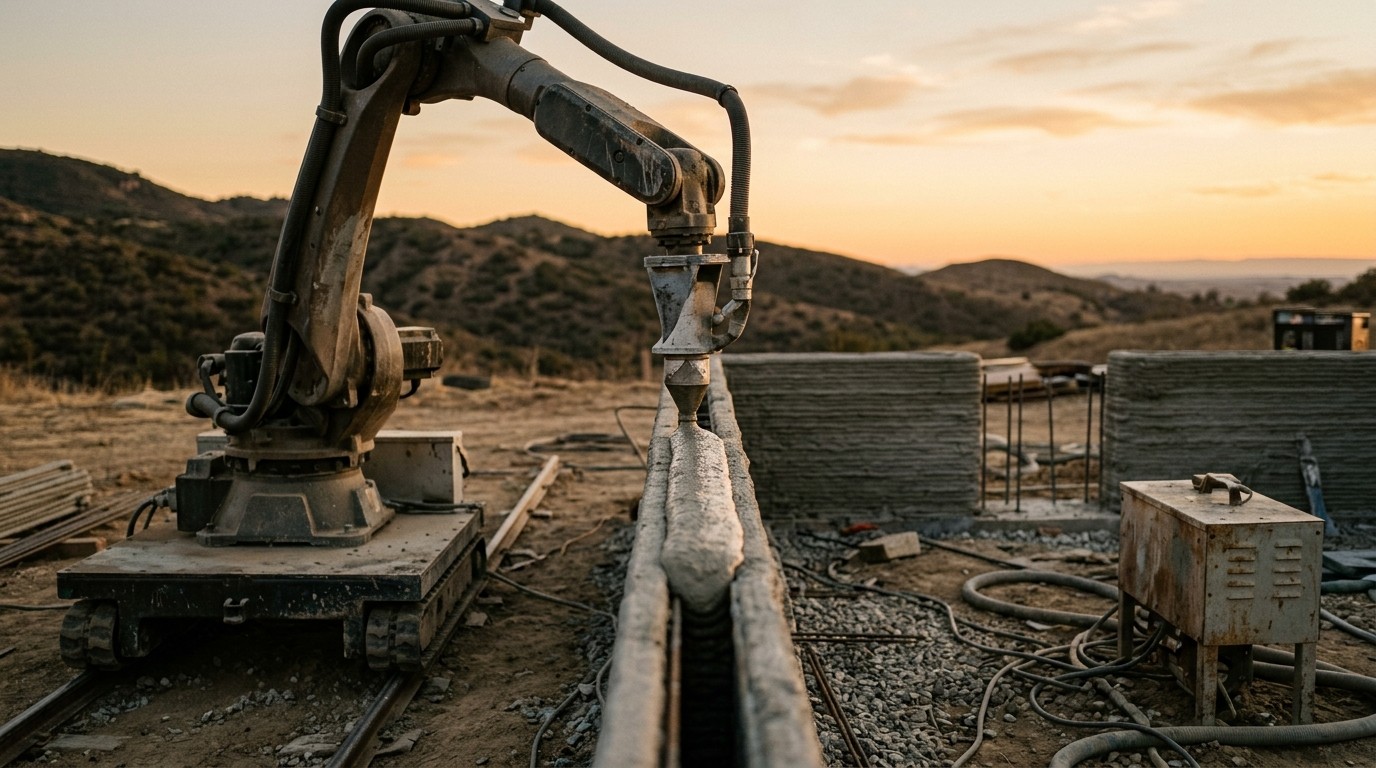
Builtech Construction Group led the project as general contractor, with RIC Technology supplying the robotic-arm printer and K4K Construction Design subcontracted for the print itself.[1]
The permit was issued in coordination with the City of Walnut and the Los Angeles County Fire Department, setting a reusable template for AHJ-aligned wildfire-resilient builds.[2]
The Walnut project is best read not as a tech demo but as evidence that homeowner-commissioned ADUs are emerging as California's most agile path to WUI wildfire resilience.
A Wildfire Pilot That Started in a Walnut Backyard
Most coverage of the Walnut ADU treats it as a story about a robotic arm. The more important story is who pulled the trigger. Two homeowners — identified in the project announcement only as Philips and Constance — partnered with Builtech Construction Group to commission a fire-resistant, 3D-printed Accessory Dwelling Unit on their own property in Walnut, Los Angeles County, motivated by direct exposure to California wildfire risk.[1]
That detail matters because almost every other high-profile 3D-printed home story in California has been organized around developers, state grants, or post-wildfire reconstruction nonprofits. The Walnut ADU was none of those. It was a private residential commission that happened to also become the state's first onsite-printed fire-resistant ADU. The permit was issued under the standard residential code in coordination with the City of Walnut and the Los Angeles County Fire Department, which means no bespoke regulatory pathway was required — just structured AHJ engagement on a single-family lot.[2]
That is the underrated insight of the project. California has thousands of homeowners in the wildland-urban interface who are exhausted by insurance non-renewal letters and emotionally drained by every red-flag warning. They are not waiting for policy. They are looking for a builder who can deliver a defensible structure on their lot, on a normal residential permit, on a timeline they can plan around. The Walnut ADU shows that pathway exists and is repeatable.
What Fire-Resistant Actually Means in the Walnut ADU
The Walnut ADU's wildfire performance is not a single feature; it is a stack of decisions that together remove fuel from the building envelope. The exterior walls were 3D-printed using non-combustible concrete, eliminating the wood-framed stud cavity that normally hides combustible insulation and sheathing.[1]
The roof is where the design philosophy becomes obvious. Instead of conventional wood trusses and plywood sheathing, the Walnut ADU uses a light-steel framing system clad with Sure-Board, a composite panel of light-gauge steel and noncombustible sheathing.[1] The intent is explicit in the project narrative: by excluding wood and nails from the main structure, the team minimized the most common pathways for embers to enter the home.[1]
That philosophy — fuel elimination — is the through-line. It is more disciplined than the typical home-hardening retrofit, which adds protective layers to a fundamentally combustible house. A retrofit ember-resistant vent is a useful upgrade on a wood-framed home, but it lives inside a building that still has stud bays, fascia boards, and rafter tails capable of supporting ignition. The Walnut ADU instead asks a stricter question at the design stage: which combustible components can be removed entirely, not just shielded? The answer turns out to be most of them.
Non-combustible does not mean fireproof, and the project does not claim otherwise. What it means is that the structure itself does not contribute fuel to a wildfire and is far less likely to sustain ember-driven ignition in a wind-driven event. Performance still depends on the rest of the envelope — vents, windows, eaves, and the defensible space around the building — being treated with the same fuel-elimination discipline encouraged in CAL FIRE home-hardening guidance.[6]
How Owner-Initiated Projects Beat Top-Down Policy to Market
California's WUI code framework, anchored in Chapter 7A of the Building Code, is mature and well-documented. Yet most of the homes burning in California today were built decades before that framework existed and remain primarily wood-framed. Wholesale code modernization moves at the pace of regulatory cycles. Individual homeowner decisions move at the pace of a building permit.
That asymmetry is the reason owner-commissioned projects like the Walnut ADU are strategically important. When a homeowner commits their own capital to a non-combustible build, they do not need a statewide consensus to act. They need a contractor who can integrate the technology stack — robotic printer, structural steel, noncombustible sheathing, hardened openings — into a buildable, permitted package. The City of Walnut and the Los Angeles County Fire Department's role here was not to mandate the approach but to validate it within the existing residential code.[2]
The Walnut precedent also implicitly resolves the chicken-and-egg problem that has slowed fire-resistant 3D printing nationally. AHJs are reluctant to approve novel assemblies without precedent; novel assemblies cannot generate precedent without an AHJ willing to approve them. A homeowner-funded ADU is uniquely well-suited to break that loop. It is small enough to be reviewable in a normal residential queue, structurally simple enough to document, and consequential enough to its owner to justify the extra coordination.
The broader implication for California's wildfire posture: there is no reason to wait for the next building code cycle. The Walnut pathway already exists. Each subsequent owner-led project narrows the documentation gap for the project after it.
The Public-Private Coordination That Made the Permit Possible
A single contractor cannot will a new wall assembly into existence. The Walnut ADU advanced because three layers of expertise were aligned and visible to the AHJ. Builtech Construction Group held overall general-contractor responsibility from design through finish. RIC Technology, the California-based robotics company whose CEO Ziyou Xu pushed for broader fire-resistant applications, provided the robotic arm printer. K4K Construction Design was subcontracted specifically for the 3D printing scope.[1]
That structure is worth borrowing. On a printed ADU, the print itself is a specialty scope that deserves its own subcontractor — much the way structural steel or curtain wall is treated on a commercial project — rather than being absorbed into the framer's contract. The site/foundation work, the print, and the noncombustible roof assembly each have distinct quality-control hand-offs. Treating them as separate scopes makes the permit submittal cleaner because each subcontractor signs off on a defined deliverable that the AHJ can witness.
Building-department coordination here was meaningful but not exotic. Independent inspection services from RKA Consulting Group are reported to be supporting the Walnut project, providing the kind of third-party inspection record that fire and building officials look for when an assembly is unfamiliar.[4] Engaging an inspection group with concrete and structural depth early in design — before submitting for permit — is a low-friction way to translate a new method into a vocabulary the AHJ already trusts.
The fire department's role is similarly pragmatic. LA County Fire's involvement signaled that the Walnut ADU satisfied wildfire-exposure concerns in a way the department could endorse for its jurisdiction. That endorsement is a transferable asset; future projects in the same WUI footprint can cite Walnut as precedent in their own pre-application meetings.
Why ADUs Are the Right Unit of Wildfire Innovation
There is a strong structural argument for centering wildfire-resilience innovation on ADUs rather than primary residences. ADUs are small, owner-financed, and built one at a time. They sit on existing lots with existing utility connections, which keeps site costs predictable. They are governed by California's accelerated ADU permitting framework, which builders and AHJs both understand. And they almost always live in a backyard immediately adjacent to a primary residence, which means a non-combustible ADU also functions as a structural buffer against ember-driven ignition reaching the main home.
That last point is widely under-stated. Treating a non-combustible ADU as a passive structural firebreak — a built object that simply cannot carry fire — changes how owners can think about lot layout in WUI zones. The Walnut design's reliance on non-combustible concrete walls and steel-and-Sure-Board roofing is consistent with this firebreak framing.[1]
The scale argument is compelling. CoreLogic estimated in 2024 that more than 2.6 million California homes face moderate to high wildfire risk.[5] Even a small fraction of those properties adopting a non-combustible ADU on their lot would meaningfully alter California's housing stock without waiting for tear-down rebuilds of primary residences. It is the most actionable hardware lever available in the WUI today.
ADUs also fit the funding profile of the homeowner most motivated to act. The Walnut project's homeowners did not need a state grant or a developer's balance sheet; they needed a permitted plan, a credible GC, and a defined timeline. Each owner-led ADU expands the reference base of completed projects, which lowers the perceived risk for the next homeowner to commission one.
What the Next Owner-Led Build Should Negotiate Up Front
The Walnut precedent is most useful to the next homeowner if it is translated into a short, defensible set of negotiation points. Five matter most.
First, define the non-combustible scope clearly. The print is highly visible, but the unglamorous decisions about roof assembly, eaves, vents, windows, and door openings carry equivalent weight in WUI performance. A contract that specifies the printed wall assembly and is silent on the rest leaves the most consequential decisions for the field.
Second, write the print scope as a named subcontract. Treat the 3D-printing subcontractor as a structural specialist with a defined deliverable: clean foundation handoff, witnessed wall geometry, documented embeds and openings. Builtech's separation of K4K's print scope from the broader GC scope is the model.[1]
Third, pre-engage the AHJ. The Walnut ADU advanced because the City of Walnut and LA County Fire were brought in early enough to validate the assembly within the standard residential code rather than carve out a special pathway.[2] The same is reproducible elsewhere by scheduling pre-application meetings before final design.
Fourth, lock the inspection plan. Independent inspection on a novel assembly is the AHJ's confidence anchor. Have it scoped, named, and budgeted before submitting for permit.[4]
Fifth, document for the next project. Each owner-commissioned ADU is more valuable to California's wildfire posture if its drawings, inspection record, and AHJ correspondence are preserved as a reference set. That is how owner-led innovation compounds.
The Owner-Led Pathway From Here
The Walnut ADU does not solve California's wildfire problem. No single building does. What it does is collapse the imagined distance between two ideas: that fire-resistant 3D-printed homes are a future technology, and that a private homeowner can commission one today on a normal residential permit.
The trajectory is reasonably easy to project. As more owner-led non-combustible ADUs are completed, each subsequent project benefits from a thicker base of AHJ familiarity, a more defined contractor specialty, and a more confident insurance posture. The bottleneck is no longer technology or code; it is sequencing the right team and the right pre-application engagement.
For homeowners in California's WUI footprint, the practical question is not whether non-combustible 3D-printed construction is real. The Walnut ADU has answered that. The practical question is which contractor will lead the next one on their lot, and how soon. Builtech's role in Walnut is the template for the answer.
FAQs
What makes the Walnut ADU California's first fire-resistant 3D-printed home?
It is the first onsite, 3D-printed concrete Accessory Dwelling Unit in California whose envelope is explicitly engineered to resist wildfire, combining non-combustible printed concrete walls with a light-steel and Sure-Board roof in lieu of wood framing and nails, permitted in coordination with the City of Walnut and the Los Angeles County Fire Department.[1]
How big is the Walnut 3D-printed fire-resistant ADU?
The Accessory Dwelling Unit is 1,200 square feet, a substantial residential unit by California ADU standards and large enough to demonstrate the full envelope system rather than a token wall sample. Its size also keeps the project firmly within the standard residential permit pathway used by most owner-led ADU builds in the state.[1]
Who actually built California's first fire-resistant 3D-printed ADU?
Builtech Construction Group, led by CEO Aaron Liu, served as general contractor with overall responsibility from design through finish. RIC Technology, headed by founder and CEO Ziyou Xu, supplied the robotic-arm 3D printer. K4K Construction Design was subcontracted specifically for the 3D-printing scope, which was treated as a discrete specialty trade rather than absorbed into the GC's framing scope.[1]
Why did the homeowners choose a 3D-printed concrete ADU instead of a traditional build?
The homeowners, identified as Philips and Constance, were motivated by direct exposure to California wildfire risk and wanted to demonstrate that a non-combustible 3D-printed home could function as a real wildfire-resilience tool on a private residential lot. They commissioned the project themselves rather than waiting for a state-led pilot, which is itself the defining feature of the Walnut precedent.[1]
Is the Walnut 3D-printed home actually fireproof?
No residential structure is genuinely fireproof, and the project does not market itself that way. The Walnut ADU is fire-resistant: its envelope removes most of the combustible material that normally carries wildfire into a home, but performance still depends on hardened openings, ember-resistant detailing, and defensible space around the building, consistent with CAL FIRE home-hardening guidance.[6]
How long does it take to 3D-print a fire-resistant concrete ADU?
For the Walnut ADU, the onsite concrete-printing phase was projected to take approximately 20 days for the exterior walls. That figure covers the print scope only; site, foundation, roof, finishes, and inspection sequencing run on a broader residential schedule and are coordinated by the general contractor.[2]
What role did the Los Angeles County Fire Department play in approving the project?
The Los Angeles County Fire Department coordinated with the City of Walnut on the project's permit, validating that the wildfire-exposure characteristics of the assembly were acceptable within the existing California residential code. The fire department was not asked to write a new standard; it was asked to confirm that this build met current expectations, which is the reproducible part of the model.[2]
Should I consider a 3D-printed ADU on my California property in a wildfire-prone area?
For homeowners in WUI zones who already plan to build an ADU, a non-combustible 3D-printed concrete envelope is one of the most defensible options available today, especially when paired with a hardened roof, ember-resistant vents, and treated defensible space. The decision should be made with a contractor experienced in coordinating the print, structural steel, and AHJ approval, not as a do-it-yourself exercise.[6]
How does an owner-commissioned 3D-printed ADU differ from a government-funded pilot project?
A government-funded pilot typically carves out a bespoke approval pathway, runs on a grant timeline, and is one-of-one. An owner-commissioned ADU like the Walnut project runs through the standard residential permit process on a privately owned lot, which means the precedent it sets is directly transferable to other homeowners rather than being treated as a special exception.[2]
When could non-combustible 3D-printed ADUs become common across California's WUI?
The pace will be driven less by technology than by accumulated AHJ familiarity and contractor capacity. Each completed owner-led ADU lowers the perceived risk for the next homeowner, expands the reference base of approved assemblies, and trains another set of inspectors. Adoption will compound project by project, beginning in the WUI counties where wildfire pressure is most acute.[7]
Related resources
Fire Resistant 3D Printed Home in LA — YouTube walkthrough: On-camera tour of a fire-resistant 3D-printed home in Los Angeles County, useful for visualizing the printed wall and noncombustible roof together.
California's First Innovative Fire-Resistant 3D Printed ADU Unveiled in Walnut — 3D Printing Industry: Independent coverage of the same project with additional detail on the print schedule and AHJ coordination.
CAL FIRE Home Hardening: The state-level reference for which envelope decisions matter most in WUI zones, useful for translating the Walnut design into a homeowner checklist.
References
[1] California Gets First Fire Resistant 3D Printed Concrete Home — 3DPrinting.com
[2] California's First Innovative Fire-Resistant 3D Printed ADU Unveiled in Walnut — 3D Printing Industry
[3] 3D printed fire-resistant home being built in Los Angeles County — KTLA
[4] First 3D-printed Accessory Dwelling Unit — RKA Consulting Group
[5] Wildfire Insurance in California: What Homeowners Should Know — Bankrate (citing CoreLogic 2024)
[6] Home Hardening — CAL FIRE
[7] Defensible Space — Ready for Wildfire (CAL FIRE)
[8] Fire-resistant 3D Printed Accessory Dwelling Unit Unveiled by RIC — 3DPrint.com