Fire-Resistant 3D-Printed Homes: A CWMS-Led Blueprint
Builtech Construction Group's NFPA-CWMS-led design, executed with RIC Technology's robotic concrete 3D printer, produced America's first fire-resistant 3D-printed ADU in Walnut, California. The blog argues that pairing a CWMS design lens with construction 3D printing is the most defensible path to wildfire-grade homes that California families can actually afford to build.
Authors:


TLDR
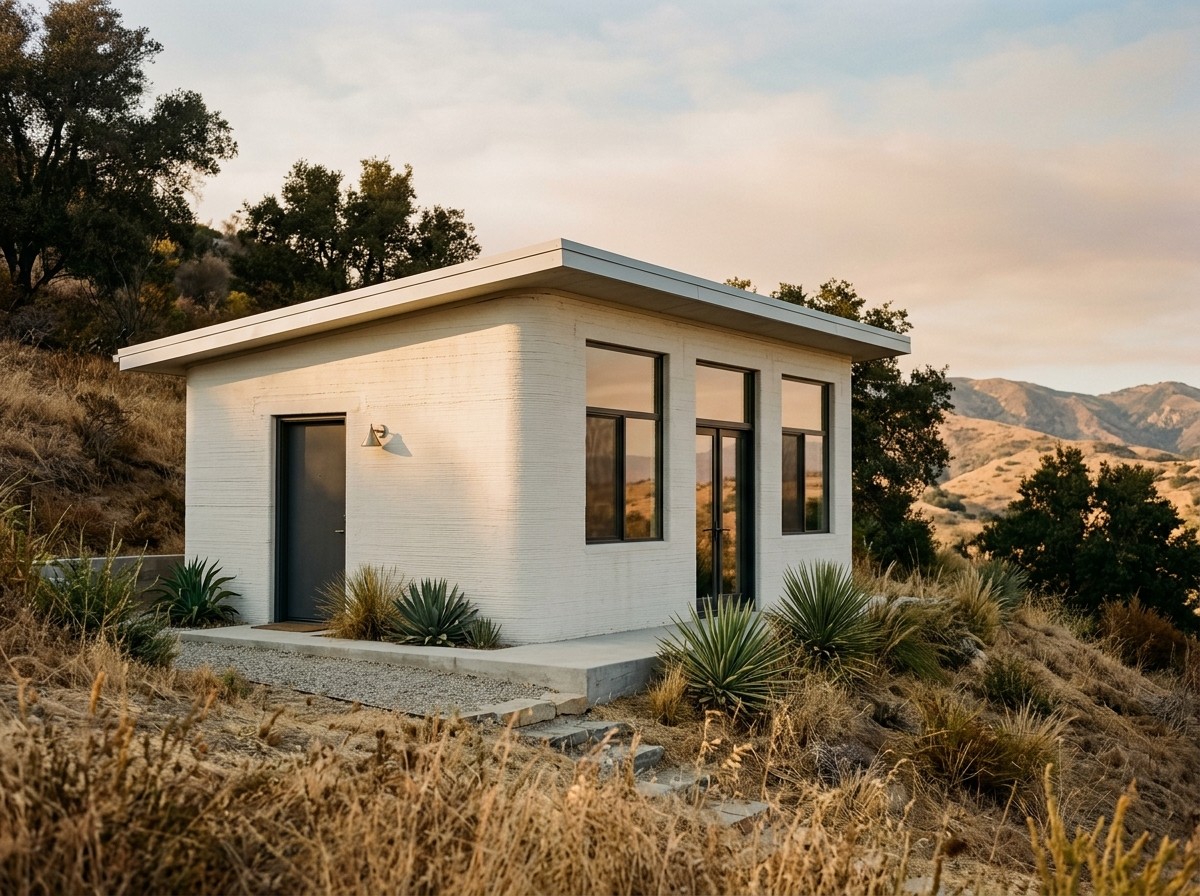
Builtech Construction Group's NFPA-certified Wildfire Mitigation Specialist (CWMS) lens, paired with RIC Technology's robotic concrete printer, produced America's first fire-resistant 3D-printed ADU — a 1,200 sq ft, 2-bed/2.5-bath unit in Walnut, California.[1]
The Walnut design eliminates the structure's combustible fuel load: steel-reinforced concrete walls, a steel roof, no wood, no nails.[1]
Construction 3D printing brings formerly military-grade steel-reinforced concrete into a residential cost envelope, with the Walnut walls printed in 20 days.[1]
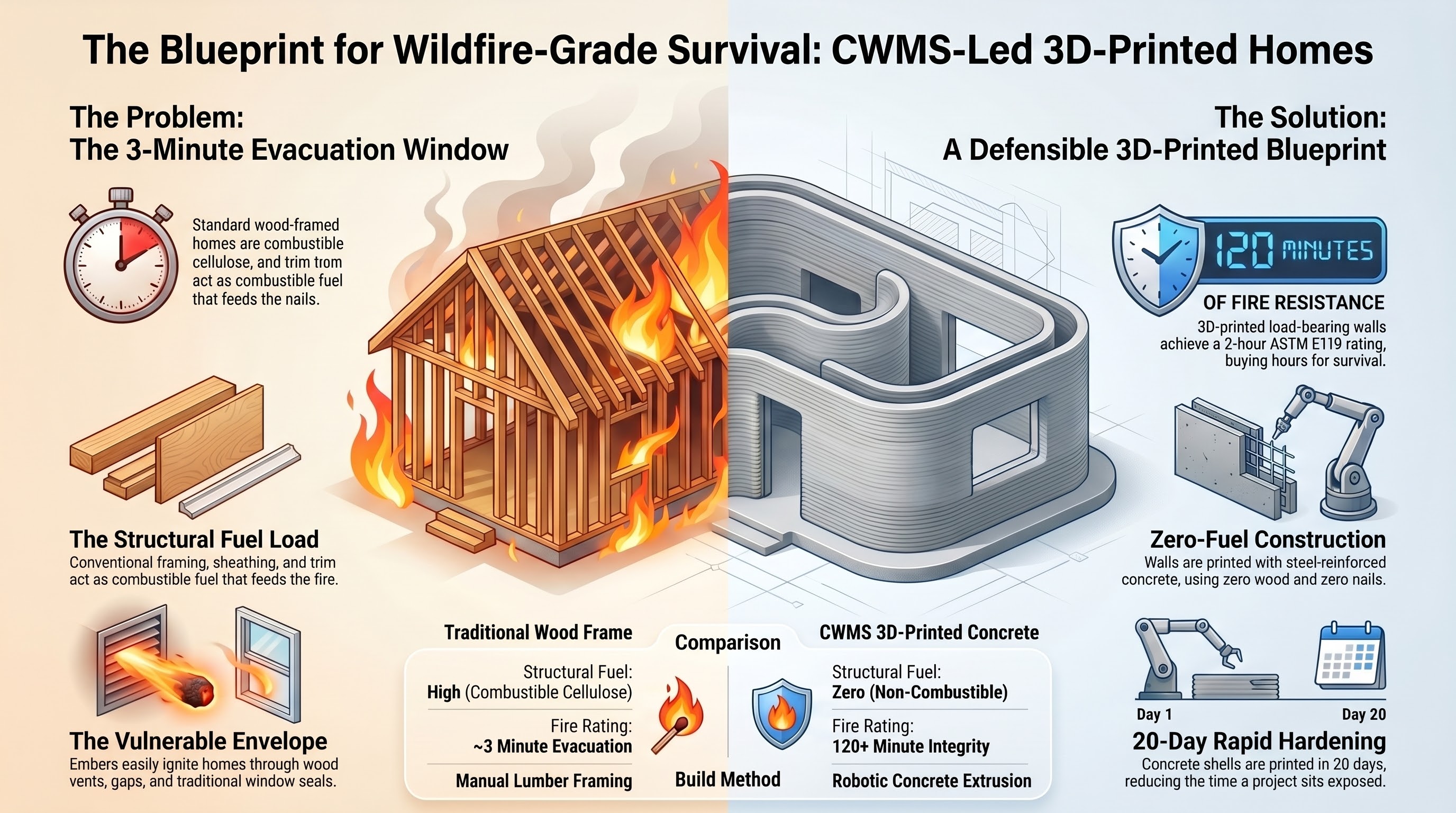
ICON's printed load-bearing walls already meet a 2-hour ASTM E119 fire rating versus the 3 minutes UL says families typically have to evacuate a standard home — a measurable, testable life-safety delta.[1][3][4]
A CWMS-led 3D-printed ADU is not a gimmick; it is a defensible, code-aligned answer to California's wildland-urban interface (WUI) reality and the only path that scales with the projected 62.4% CAGR of the 3D-printed houses market.[1]
Why a CWMS-Led Blueprint Matters in Wildfire Country
After the January 2025 fires scorched more than 37,000 acres, killed 28 people, and destroyed over 10,000 homes and businesses across Southern California, the construction conversation cannot stay where it has been.[1] The standard wood-framed Southern California home is, in physics terms, a stack of cellulose with a roof on top. It will eventually meet the wrong ember on the wrong day.
A Certified Wildfire Mitigation Specialist (CWMS) is trained to treat that physics problem as a design problem. NFPA's CWMS credential covers hazard assessment, planning, structure ignition potential, and communication in the wildland-urban interface — the body of practice that decides whether a structure in fire country survives or feeds the next ember storm.[2]
What is unusual about the Walnut ADU project is not that a builder used 3D printing. It is that the general contractor — Builtech Construction Group, led by Aaron Liu, an NFPA-CWMS — designed the building from the ember inward, then chose 3D printing because it was the only way to deliver the resulting wall section at residential cost.[1] That sequencing matters. Most fire-resilient marketing in residential construction starts with the technology and bolts on a fire story. A CWMS lens inverts that — start with the home ignition zone, the local fire department's exposure model, and the failure modes of standard assemblies, and then pick the construction method that lets you actually meet the spec without inflating the budget.
What "No Fuel on the Main Structure" Actually Means
When Aaron Liu describes the Walnut ADU's structure as having "no fuel," he is not being poetic. He is describing the building's structural fuel load.[1]
In a conventional Southern California build, the framing, sheathing, blocking, sub-fascia, and exterior trim are all combustible. Even with a fire-rated roof and Class A siding, the bones of the house remain wood, and wood remains the fuel. Once embers find a way in — through an unscreened vent, a deck-to-wall junction, or a window seal — the framing becomes the fire's main course.
The Walnut ADU removes that menu entirely. Steel-reinforced concrete walls are printed on site, with a light-steel roof, and zero wood or nails in the main structure.[1] That is not a marginal hardening; it is a categorical change in the home's relationship to wildfire. An ember can land on the wall, on the roof, on the eave detailing, and find nothing it can ignite at the structural layer.
This is the difference a CWMS lens forces. The question stops being "What rating does this assembly carry?" and starts being "What ignition pathway are we removing entirely?" Removing pathways is more durable than rating-stacking, because ratings are time-limited and pathways are not.
How 3D Printing Brought Steel-Reinforced Concrete Out of the Bunker
Steel-reinforced concrete is not new. What is new is that a homeowner can afford it.
Before on-site construction 3D printing, steel-reinforced concrete walls of this thickness and detail level were primarily used for military bunkers and other defensive structures, because the cost and accessibility were prohibitive for residential work.[1] Robotic concrete printers like RIC Technology's compress that delta. Walls are extruded layer by layer using non-combustible, high-pressure 3D printing material from Quikrete, the formwork is eliminated, and labor is concentrated on placement, finishing, and embeds rather than on framing crews.[1]
This matters for a CWMS strategy because a pathway-removal approach only scales if you can actually build it at residential margins. A custom wildfire-grade build that is twice the cost of a conventional ADU does not get adopted in California's housing-starved WUI; it stays a one-off. A 3D-printed wildfire-grade build that lands inside the same project budget changes the adoption math. The Walnut ADU's reinforced eave vents, reinforced windows, and thicker walls were achieved with no significant increase in cost.[1]
That is the bunker-to-home democratization. The wall section a CWMS would specify in an ideal world is now buildable with a single robotic arm and a delivery of pre-batched mix.
ASTM E119 in Plain English: The 2-Hour Wall and the 3-Minute House
ASTM E119 is the standard the construction industry uses to put a number on a wall's fire performance. A specimen is exposed to a controlled, time-graded fire curve, then hosed down to simulate firefighting water hitting a structurally-stressed assembly. If a load-bearing wall maintains structural integrity and limits heat transmission for the rated period, it earns that rating in hours.[1][5]
ICON's printed load-bearing 2-bead wall has achieved a 2-hour fire rating, with development underway to surpass a 3-hour rating.[1][4] Compare that to the residential reference point Underwriters Laboratories has been broadcasting for years: in standard homes, occupants have approximately three minutes to evacuate once a fire takes hold.[3]
The gap between two hours and three minutes is not a marketing line. It is the difference between a structure that buys families and first responders enough time to live, and a structure that does not. From a CWMS perspective, this is the most important number in the entire conversation, because every other design decision — defensible space, fuel modification, ember screening — buys minutes. A wall that buys hours changes the survival curve.
It also changes how you should think about insurance and inspection. A 2- to 3-hour rated load-bearing wall is in the same fire-resistance neighborhood as commercial-grade CMU assemblies, and that is not a comparison residential builders have historically been able to make.
Defensive Design at the Eave, the Window, and the Roof
Wildfires almost never enter a home through the middle of a wall. They enter through the openings. USDA Forest Service and NFPA guidance both make the same point: embers and small flames ignite homes through vents, gaps, and combustible details long before any wall fails.[7]
The Walnut ADU treats this as a first-class design problem rather than an afterthought. Eave vents and windows — the textbook ember-intrusion paths — are reinforced as part of the design, and the printed envelope is paired with a steel roof that removes one of the largest combustible surfaces a home presents to a wildfire.[1]
This is what a CWMS would call a layered approach. The thick printed concrete walls handle radiant heat and direct flame contact. The steel roof handles ember showers and flying brand exposure. The reinforced eaves and windows close the openings that decide most home losses. None of these is sufficient on its own; the architecture wins because it stacks.
The CWMS lens also forces honesty about what 3D printing does not solve by itself. The walls and roof are not the home — the openings are. Without ember-resistant vents, properly sealed window assemblies, and non-combustible decking and detailing, even a printed concrete house can burn through its weakest gasket. The Walnut team's choice to harden those details is what turns a printed shell into a wildfire-grade home.
The 20-Day Build: From Foundation to Fire-Hardened Walls
On-site construction 3D printing collapsed the wall-erection schedule for the Walnut ADU into roughly 20 days from start to finish.[1] That is not a marketing throwaway; it is a structural advantage for wildfire-zone projects.
In fire country, every additional week a project sits framed and exposed is a week of fuel sitting on a lot. Conventional framing introduces a long window where the building is, by definition, combustible — a mass of dimensional lumber with no envelope yet. A 20-day printed envelope shrinks that window dramatically and produces a non-combustible shell early in the schedule, which makes the rest of the trades safer to coordinate on a WUI lot.
It also changes the economics of inspection. The City of Walnut and the Los Angeles County Fire Department co-developed the project, with municipal building and safety teams providing inspection of an ADU type that had not previously existed in California.[1] That partnership is the template every WUI municipality will eventually need: a CWMS-led design, a printer that produces a repeatable wall section, and a fire department engaged from drawings forward rather than at final.
Where 3D-Printed ADUs Fit Into the WUI Code Stack
California's Chapter 7A of the building code defines what a WUI-zone home has to do at the roof, vents, eaves, exterior walls, decking, and windows. FEMA's P-737 Builder's Guide to Construction in Wildfire Zones layers on planning and topography guidance.[6] Most current 3D-printing coverage talks past these documents. A CWMS-led blueprint cannot.
A printed concrete wall with a tested fire-resistance rating, a steel roof, ember-resistant venting, and reinforced openings can satisfy Chapter 7A's exterior-envelope intent without exotic material substitutions. The acceptance pathway is not yet uniform — ICC-ES AC509 sets out the criteria for evaluating 3D automated construction, including optional ASTM E119 testing for fire-resistance-rated wall assemblies.[5] Builders who want their printed walls to count as fire-resistance-rated assemblies need to test against E119 or UL 263 with the specific mix design they plan to print.
This is the unsexy part of the pitch and the part that wins in front of plan checkers. A CWMS-credentialed builder who arrives at the counter with E119-tested wall data, an ember-resistant vent specification, and an LA County Fire Department co-design history is going to have a different conversation than one selling a tech demo.
What This Means for the Next Decade of California Construction
Skyquest's market data put the global 3D-printed houses market at $36.9M in 2023, projecting growth to $2,899.35M by 2032 at a 62.4% CAGR.[1] That is not a hockey-stick chart; that is structural demand meeting structural capacity. California has lost a significant chunk of its housing stock to fire in the past five years, ADU laws have loosened, and the WUI keeps growing.
The interesting research is also moving in the right direction. University of Virginia engineers have designed a 3D-printable concrete that emits 31% less carbon, and University of New Mexico researchers have developed bendable concrete formulations for more durable construction printing.[1] The mix designs the next decade of CWMS-led homes will use are not the mix designs available today. Lower carbon, higher ductility, and tighter fire-resistance ratings are converging on the same wall section.
The takeaway for builders, owners, and policymakers is narrow and concrete. Construction 3D printing alone is not a wildfire strategy. A CWMS-led design that uses construction 3D printing as the build method is. The Walnut ADU is a first datapoint, not a finished case. The builders who follow that template — credential first, design second, technology third — will be the ones still building in California's WUI in 2032.
FAQs
What is a Certified Wildfire Mitigation Specialist (CWMS) and why does it matter for construction?
A CWMS is an NFPA credential covering hazard assessment, planning, structure ignition potential, and communication in the wildland-urban interface.[2] For construction, it matters because a CWMS-trained builder designs the home around ember and radiant-heat failure modes first and selects materials and methods second, instead of bolting wildfire features onto a conventional design.
How is a fire-resistant 3D-printed ADU different from a conventional concrete home?
The printed ADU uses on-site robotic extrusion of non-combustible concrete to produce steel-reinforced load-bearing walls without traditional formwork, with no wood or nails in the main structure and reinforced detailing at vents and windows.[1] That delivers a structural fire-resistance level historically associated with bunkers at residential cost and schedule.
Are 3D-printed homes actually fire-resistant or is it marketing?
Independent ASTM E119 testing of printed load-bearing walls has produced 2-hour fire-resistance ratings for at least one tested system, with development underway for 3-hour rated walls.[1][4] Fire resistance for 3D-printed walls is a measurable, third-party-tested property, not a marketing claim, when the specific mix design and wall section are documented under ICC-ES AC509.[5]
How long does it take to 3D print a fire-resistant ADU?
The Walnut ADU's exterior walls were printed in approximately 20 days from start to finish, after foundation and rough plumbing work.[1] Total project time is longer because finishing, mechanical, electrical, and plumbing trades still proceed conventionally, but the envelope itself is closed in days rather than weeks.
What does a 2-hour ASTM E119 fire rating mean for a homeowner?
It means the tested load-bearing wall maintained structural integrity and limited heat transmission for two hours under a standard fire exposure followed by a hose-stream test.[1][4] For a homeowner, it means the wall buys hours of survivable evacuation and defensible-space firefighting time, compared to the roughly three-minute window UL associates with standard homes.[3]
Why are eave vents and windows the most important parts of a wildfire-resistant home?
Embers and minor flames most often initiate home destruction through openings rather than through intact walls or roofs, and unscreened vents, gable openings, and unsealed windows are the dominant ignition paths.[7] The Walnut ADU reinforces these vulnerable areas as part of the printed design rather than treating them as accessories.[1]
Is a 3D-printed home more expensive than a traditional ADU?
The Walnut ADU achieved its higher fire-resistance level — including reinforced eave vents, reinforced windows, and thicker walls — with no significant increase over conventional cost on the project.[1] Cost outcomes vary by region, mix design, and contractor, but residential construction 3D printing is no longer priced like exotic disaster-resilient construction.
How do California's WUI building codes treat 3D-printed walls?
California's Chapter 7A WUI requirements describe performance and material expectations at the envelope, but they do not assume any specific construction method.[6] Printed walls are evaluated under ICC-ES AC509, which includes optional ASTM E119 or UL 263 testing for fire-resistance-rated assemblies.[5] When a printed wall is tested and documented to those standards, plan checkers can treat it like any other rated assembly.
Should homeowners in fire-prone areas consider a 3D-printed ADU?
In the wildland-urban interface, a 3D-printed ADU designed under a CWMS-led framework is one of the most defensible options available today, particularly for owners who want a hardened secondary unit, a backup residence, or a refuge structure on the same lot as a conventional home. It is most effective when paired with hardened openings, defensible space, and ongoing fuel management.
What is the future of 3D-printed homes for wildfire resilience?
Market forecasts put the 3D-printed houses market on a 62.4% CAGR trajectory through 2032, and ongoing research is producing lower-carbon and higher-ductility printable concretes.[1] Combined with growing CWMS adoption and tighter WUI code enforcement, the next decade should see printed wildfire-grade homes move from one-off demonstrations to a standard option for fire-zone construction.
Related resources
Building Resilient 3D-printed Homes: Testing for Fire, Hurricanes and High Wind — ICON — ICON's writeup of its ASTM E119, ASTM E330, and TAS impact testing for printed walls.
FEMA P-737 Builder's Guide to Construction in Wildfire Zones — The reference manual for site selection and envelope detailing in WUI zones.
Preparing Homes for Wildfire — NFPA — Plain-language guidance on the Home Ignition Zone and structure-hardening priorities.
References
[1] Are 3D Printed Homes Really a Solution in the Face of Wildfires? — 3Dnatives.
[2] Certified Wildfire Mitigation Specialist (CWMS) — NFPA.
[3] You Only Have 3 Minutes to Escape a Home Fire — UL Research Institutes.
[4] Building Resilient 3D-printed Homes: Testing for Fire, Hurricanes and High Wind — ICON.
[5] AC509 Acceptance Criteria for 3D Automated Construction — ICC-ES.
[6] FEMA P-737 Builder's Guide to Construction in Wildfire Zones — FEMA.
[7] Preparing Homes for Wildfire — NFPA.
[8] Builtech Construction Group.
[9] RIC Technology.