Fire-Resistant ADU: The Backyard Firebreak Strategy
California's first 3D printed fire-resistant ADU, constructed in Walnut, features non-combustible concrete walls and a light-steel roof, eliminating wood and nails. This design acts as a structural firebreak, preventing ember-driven fires from spreading between homes. The project showcases how such ADUs can enhance wildfire resilience in neighborhoods, with a 20-day construction timeline facilitating rapid rebuilding after wildfires. Key challenges include gaining recognition from insurance and building codes for these zero-fuel structures to promote wider adoption.
Authors:


TLDR
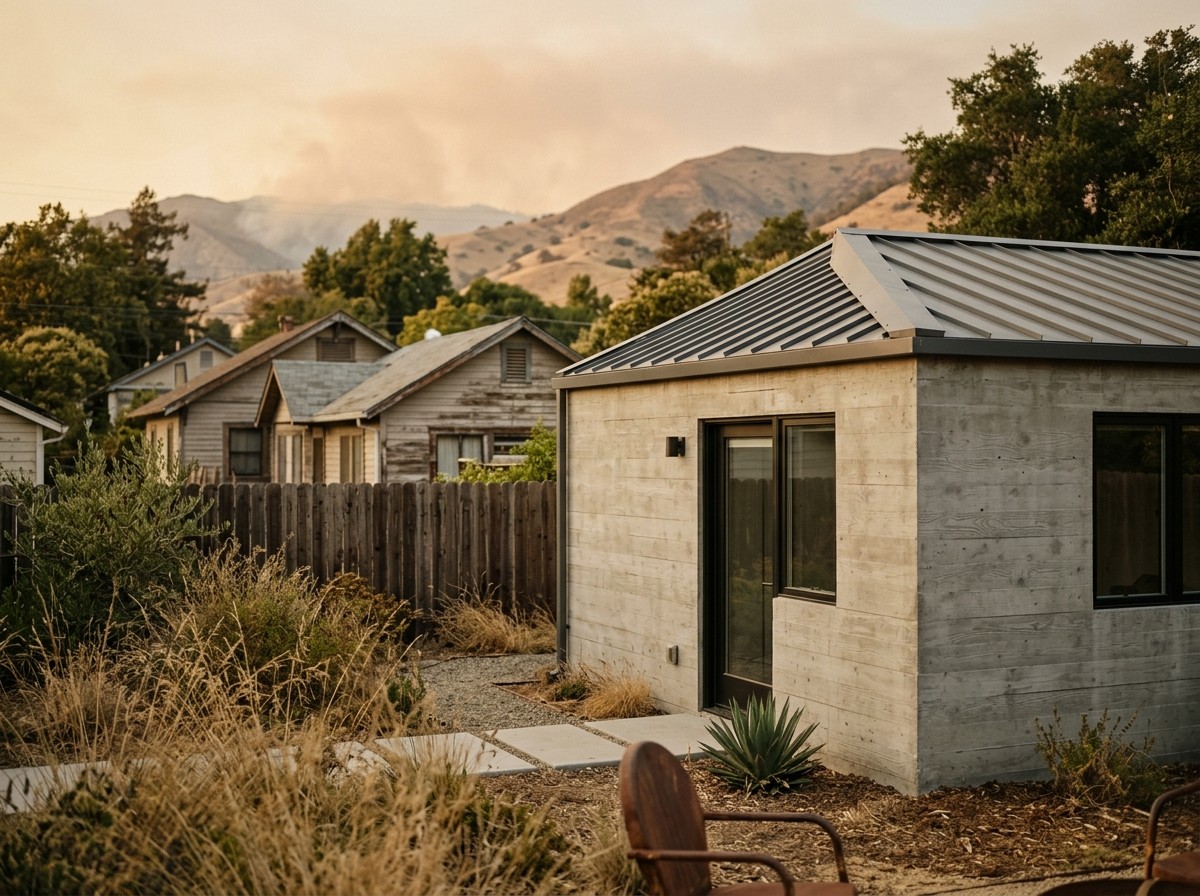
California's first 3D printed fire-resistant ADU, built in Walnut by Builtech Construction Group with RIC Technology, uses concrete walls and a light-steel roof — and zero wood or nails on the main structure.[1][2]
The design isn't just a safer guesthouse. A non-combustible ADU is a structural firebreak that interrupts ember-driven structure-to-structure spread inside dense neighborhoods.
Builtech's framing — eliminate fuel, the only side of the fire triangle a builder can control — is the right mental model for every WUI build, not just headline projects.[3]
20-day robotic wall construction is fast enough to make hardened ADUs a realistic post-wildfire rebuilding tool, not a one-off pilot.[4]
The next unlock is insurance and code: underwriters and AHJs need to recognize zero-fuel main structures as a distinct, lower-risk class.
Why a Single ADU Can Stop a Block From Burning
The Walnut project is being covered as a 3D printing milestone. That framing undersells it. The more important story is what happens at the property line.
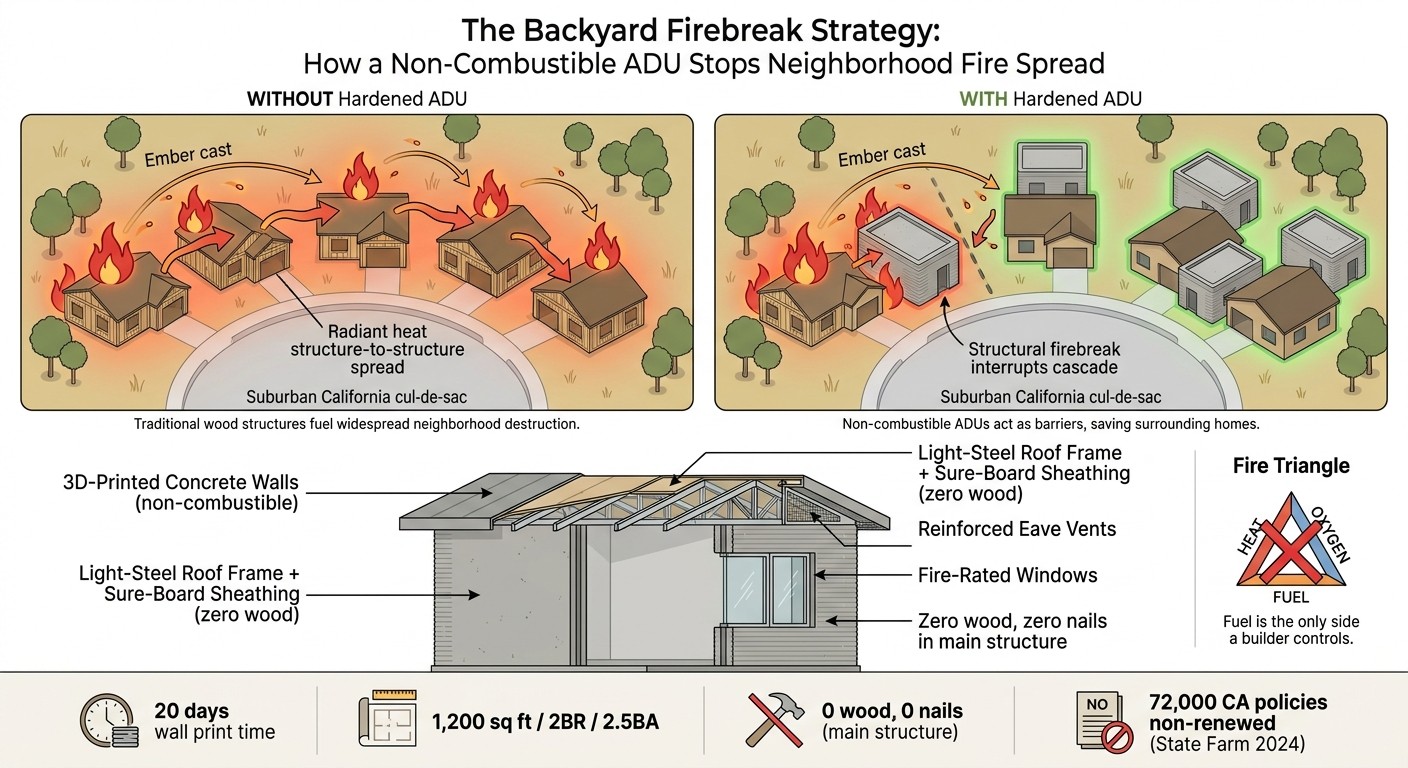
In most California wildfire losses, the first house ignites from an ember cast — burning particles thrown a mile or more from the fire front. Once one structure is alight, radiant heat and direct flame contact from that burning home are what take down the next house, and the next. Vegetation rarely propagates a fire through a developed neighborhood; buildings do. That is why entire blocks burn while individual trees survive.
A non-combustible ADU sitting in a backyard changes that math. It does not catch from embers. It does not radiate flame back into the primary house or the neighbor's siding. It does not collapse and shower a fence line in burning debris. In the worst case, the ADU is the only thing standing on the lot — but more often, it is a hardened mass that interrupts the chain of structure-to-structure ignition long enough for engines to arrive.
That is the definition of a structural firebreak. It is the same logic engineers use when they place a concrete utility building between two flammable warehouses on an industrial campus. Builtech and RIC Technology have just demonstrated the residential version of it.[1]
The Fire Triangle: Why Fuel Is the Only Variable Builders Control
Aaron Liu, Builtech's CEO and an NFPA-certified Wildfire Mitigation Specialist, frames the project around the fire triangle: heat, oxygen, fuel. During a wildfire, two of those three are out of any builder's hands.[5]
Heat is whatever the fire front and ember cast deliver. Oxygen is ambient. Fuel — the stuff a building is made of — is the only side of the triangle a designer or contractor can actually engineer. Strip fuel from the main structure and you have not made the home "more resistant." You have changed the category of the building. There is nothing on the envelope to ignite.
That is a much sharper standard than the typical "fire-hardened" home. Most hardened homes still rely on fire-rated wood assemblies, ignition-resistant siding over wood sheathing, or Class A roofs over wood trusses. They buy time during ember exposure, which is real and valuable.[7] But they remain combustible at the system level. A zero-fuel main structure is a different conversation: there is no fuel at the system level to ignite, only finishes and contents.
For builders, this reframes the question. The right WUI question is no longer "how do we slow ignition?" It is "what fuel can we eliminate from the main structure entirely, and what is the minimum cost to do so?" The Walnut ADU is one answer. There will be others. But the question is the design lens.
Inside California's First 3D Printed Fire-Resistant ADU
The Walnut project is a 1,200 sq ft, two-bedroom, two-and-a-half-bathroom accessory dwelling unit in eastern Los Angeles County, built in collaboration with the City of Walnut and the LA County Fire Department. Builtech Construction Group is the general contractor; K4K Construction Design is the 3D printing subcontractor; and RIC Technology supplied the robotic concrete printer.[3]
Foundation, plumbing, and sewage went in first, in early February 2024. Once that base was complete, RIC's robotic arm was deployed on site to print the exterior concrete walls. The wall printing process is expected to take roughly 20 days from start to finish.[4]
What makes the project distinctive is not the printer. Several California projects now use 3D concrete printing for ADUs and small homes. What makes it distinctive is the complete fuel elimination from the main structure: concrete walls, light-steel roof, sure-boards in lieu of wood roof sheathing, reinforced eave vents and windows, and — by Liu's own description — "not a single piece of wood or nail" on the main structure.[1][8]
That is the design choice that makes the ADU function as a firebreak. A 3D printed concrete shell with a wood truss roof would still burn from above. The Walnut design closes that loophole.
Concrete Walls and Light-Steel Roofs: Engineering a Zero-Fuel Envelope
A hardened envelope is a system, not a product. Each component has to clear the same bar.
Walls. 3D printed concrete walls are non-combustible by material category. They give the ADU thermal mass, which buffers interior temperatures during fire exposure, and they are inherently watertight, termite resistant, and recyclable.[2] At the wall level, there is no fuel to ignite.
Roof. This is where most "fire-resistant" homes still concede ground. Most 3D printed homes ship with wood structural roofs, which means a flying ember that lands in roofing debris or a vent gap can still find combustible material above the ceiling line. Builtech's choice of light-steel framing with sure-board sheathing closes that gap — the assembly is non-combustible top to bottom.[3]
Eave vents and windows. These are the historical losers in WUI fires. Embers enter through unscreened eave vents and ignite attic insulation; radiant heat through single-pane glass ignites curtains. Builtech specifically calls out reinforcement of these areas, in line with Chapter 7A guidance for WUI construction.
The key engineering principle: every penetration of the envelope is a fuel pathway. Closing penetrations is more important than choosing a slightly better cladding. A zero-fuel main structure with a single unscreened vent is still an ignition site.
Robotic Construction in 20 Days: Speed That Matters for Wildfire Recovery
The 20-day wall printing window is being marketed as a productivity story. In wildfire recovery it is also a resilience story.
After a major California wildfire event, the bottleneck on rebuilding is rarely cash. It is permitted skilled labor: framers, roofers, drywall crews. Demand spikes overnight in the burn footprint and stays elevated for years. Homeowners wait. Insurance proceeds expire. Communities atrophy.
A workflow that compresses wall framing into a 20-day robotic process changes that bottleneck. The robot does not need to be unionized, certified, or coaxed back from another job site. The same crew that ran the Walnut ADU can run the next one as soon as the foundation is poured. Multiply by ten or fifty pilot ADUs in a burn footprint and you have meaningful capacity.
This matters for ADUs specifically because California ADU policy already encourages dense, by-right backyard construction. The Walnut project shows the technology stack is ready to take advantage of that policy in a wildfire-resilient way, not just a code-compliant way.
From Backyard Project to Neighborhood Firebreak
The firebreak framing only works if hardened ADUs proliferate. One ADU on one lot is a personal solution. A hardened ADU on every fourth lot starts to behave like distributed infrastructure.
Imagine a typical California cul-de-sac in a Fire Hazard Severity Zone. Today, the homes are wood-framed, vintage 1980s or older, with shake-style composition roofs and combustible fences in between. An ember cast lands. The first ignition cascades through the row.
Now imagine the same cul-de-sac with five hardened ADUs scattered across the backyards. Each ADU is a non-combustible mass. Each one occupies the strip of property where structure-to-structure radiant heat would otherwise jump. The cascade has to go around those masses to spread, which slows the fire, gives engines a chance to anchor, and — critically — gives evacuating residents more time.
This is not theoretical. It is the same principle behind concrete tilt-up commercial buildings interrupting fire spread in mixed-use districts. We have just never deployed it at the residential parcel level. The Walnut ADU is the proof of concept.
The public-policy implication is significant. If a city or county can document that hardened ADUs reduce neighborhood-level loss, the math for ADU incentive programs changes. ADUs stop being only a housing-affordability tool and become a wildfire-resilience tool that local jurisdictions can fund with mitigation grants, FAIR Plan offsets, or insurance discount programs.
Insurance, Codes, and the Path to Replication
The insurance crisis is the missing co-author on every California wildfire conversation. State Farm announced non-renewal of approximately 72,000 California policies in 2024. Other major carriers have followed.[1] The insurable surface area of California is shrinking.
A zero-fuel main structure is exactly the kind of building underwriters should want. The peril (fire damage to structure) is materially reduced — not by a probabilistic discount, but by a categorical change in the building. The challenge is that current actuarial models do not have a clean class for this. A 3D printed concrete ADU with a light-steel roof gets priced like "a small detached structure," not "a non-combustible main-structure building."
Three shifts have to happen together to scale this:
Underwriting class. Carriers, the FAIR Plan, and Lara-era California regulators need an explicit non-combustible main-structure category in their rate filings, with a documented discount tied to the construction class.
Code recognition. Chapter 7A and the California Wildland-Urban Interface Code already recognize non-combustible roof assemblies and Class A coverings. They need to recognize whole-structure non-combustibility as a distinct, lower-risk pathway with streamlined permitting.
Builder credentialing. GCs leading these projects should hold the NFPA Certified Wildfire Mitigation Specialist credential or its equivalent, because the design decisions are inseparable from wildfire science.[6] Builtech is on the right side of this; Aaron Liu is CWMS-certified.
None of these shifts are technical problems. They are coordination problems. The Walnut project gives every party a real, permitted, insurable building to point at. That is what coordination problems usually need.
What Homeowners and Builders Should Take From the Walnut ADU
For homeowners in WUI areas considering an ADU, the Walnut project lowers two specific risks: ignition risk on the new structure, and ignition cascade risk to the primary home. That second one is rarely priced into the decision but is the larger value.
For builders, the lessons are concrete:
Treat wood roofs as a category to retire on WUI projects. Light-steel framing with non-combustible sheathing is the new floor.
Reinforce eave vents and windows the way you reinforce shear walls — they are structural to fire performance.
Get CWMS-certified. The credential is professional cover when you tell a homeowner their existing design will not survive a wildfire.
Treat ADU placement as a fire-engineering decision, not just a setback question. Where the ADU sits on the lot determines what it can interrupt.
The Walnut ADU will not solve California's wildfire problem on its own. It does not have to. Its job is to demonstrate that a permitted, insurable, repeatable backyard build can act as a structural firebreak. From here, the work is to get more of them on the ground, fast.
FAQs
What is a fire-resistant ADU and how is it different from a hardened home?
A fire-resistant ADU is an accessory dwelling unit engineered so its main structure cannot ignite under realistic wildfire exposure — typically using non-combustible walls, a non-combustible roof assembly, and reinforced openings. A hardened home, by contrast, usually keeps combustible structural framing and adds ignition-resistant cladding, vents, and Class A roofing. Both reduce risk; only the first eliminates fuel from the main structure itself.
How does a 3D printed concrete ADU resist wildfires better than a wood-framed home?
The 3D printed walls are non-combustible concrete, so they cannot be ignited by ember cast or radiant heat. When that concrete shell is paired with a light-steel roof rather than a wood truss assembly, the entire main structure has nothing flammable for a wildfire to attack. A wood-framed home, even with fire-rated finishes, retains combustible structural members that can ignite once flames reach them.
Can a backyard ADU really act as a neighborhood firebreak in California?
Yes, when it is non-combustible. Most structure-to-structure fire spread in California neighborhoods happens by radiant heat and direct flame contact between adjacent buildings, not by vegetation. A non-combustible ADU placed between a primary residence and the property line interrupts that radiant pathway. It will not stop a major wildfire, but it can break the local cascade long enough for fire crews to anchor and for occupants to evacuate.
How long does it take to build a 3D printed fire-resistant ADU?
For the Walnut project, RIC Technology's robotic arm prints the exterior concrete walls in approximately 20 days after the foundation, plumbing, and sewage are in place. Total project timelines, including foundation, roofing, mechanicals, and finishes, run longer, but the wall-construction phase is dramatically compressed compared to traditional framing schedules.
Is a 3D printed concrete ADU more expensive than a traditional ADU in California?
Upfront costs are roughly comparable to high-quality traditional ADUs in California, which typically run several hundred dollars per square foot when fully finished. The savings are concentrated in framing labor and schedule, with potential long-term offsets through lower insurance premiums, lower energy use thanks to thermal mass, and reduced maintenance from termite and moisture resistance.
Why does the Walnut ADU use a light-steel roof instead of a wood truss roof?
Most 3D printed homes pair concrete walls with conventional wood roof structures, which leaves the most ember-vulnerable part of the building combustible. The Walnut ADU uses light-steel framing with sure-board sheathing so the roof matches the walls — fully non-combustible — and there is no wood pathway above the ceiling for embers to ignite.
What is the fire triangle and why does Builtech focus on fuel?
The fire triangle is the model that ignition requires three components: heat, oxygen, and fuel. During a wildfire, builders cannot influence ambient heat from the fire front or oxygen in the surrounding air. Fuel — what the building is made of — is the only side of the triangle a designer can actually control. Eliminating fuel from the main structure is the most reliable way to prevent ignition.
Will insurance companies cover 3D printed fire-resistant homes in California?
Carriers can write coverage on 3D printed concrete ADUs today, but most have not yet created an explicit underwriting class for fully non-combustible main structures. As more permitted projects like the Walnut ADU come online and California regulators continue to require wildfire mitigation in pricing, fire-resistant builds are increasingly likely to qualify for documented discounts and easier renewals.
What certifications should a contractor have to build wildfire-resistant homes?
Look for the NFPA Certified Wildfire Mitigation Specialist (CWMS) credential, which assesses a professional's knowledge of structure ignition, mitigation strategy, and wildfire science. A CWMS-certified general contractor can speak fluently to assembly-level fire performance, defensible space requirements, and Chapter 7A WUI code, rather than only to general code compliance.
How does a fire-resistant ADU help with California's homeowners insurance crisis?
It addresses the underwriting problem at the source. A non-combustible main structure has materially less expected fire-loss exposure than a combustible one, and recent California laws require insurers to factor wildfire mitigation into pricing. As fire-resistant ADUs become more common and verifiable through permits, they give carriers a defensible reason to keep writing in fire-prone areas they would otherwise non-renew.
Related resources
Disaster Recovery Journal — U.S.'s First Fire Resistant 3D Printed Concrete ADU Starts Construction — Detailed project background on the Walnut ADU, including collaborators and timeline.
NFPA — Certified Wildfire Mitigation Specialist program — The credentialing program behind builders like Aaron Liu, useful for any GC pursuing WUI work.
Ready for Wildfire — Hardening Your Home — California-specific homeowner guidance on roofs, vents, windows, and decks that complements zero-fuel ADU strategies.