ICF Construction in LA: Why Inspectors Crash Site Visits
Builtech Construction is building Los Angeles' first Type I-level ICF home, a 1,150 sq ft ADU designed to withstand up to 3 hours of fire exposure. The project highlights a knowledge gap among city inspectors unfamiliar with ICF technology, which complicates the approval process. Despite ICF's higher upfront costs compared to wood framing, it offers significant fire resistance and energy efficiency advantages. The Eagle Rock project serves as a template for future ICF constructions in wildfire-prone areas, emphasizing the need for institutional familiarity to facilitate broader adoption.
Authors:


TLDR
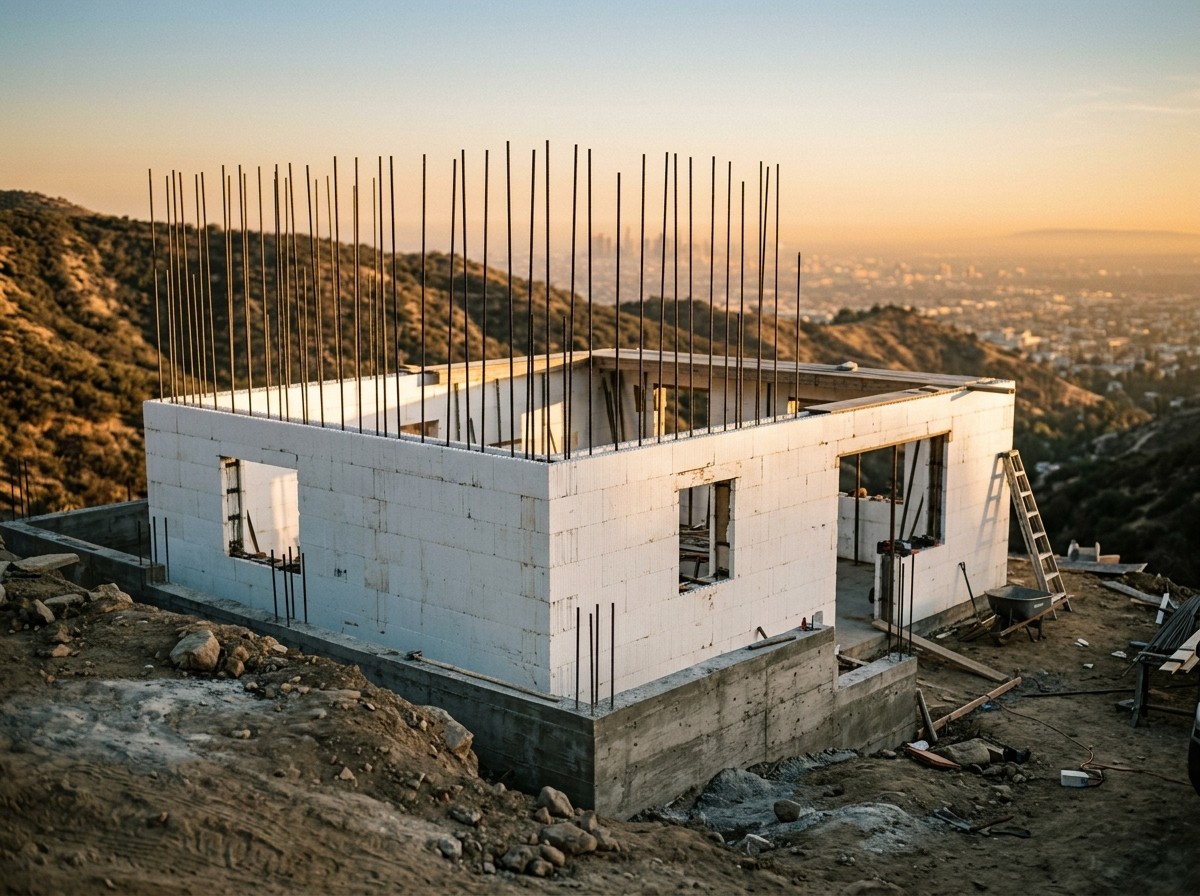
Builtech Construction is building Los Angeles' first known Type I–level ICF home, a 1,150 sq ft ADU in Eagle Rock engineered to resist up to 3 hours of direct fire exposure.[1]
During a routine inspection, three additional city personnel showed up uninvited just to watch — a quiet signal that LA's residential plan-review workforce has not yet caught up to non-combustible construction.[1]
The real bottleneck for scaling Type I residential construction in WUI zones is not cost, code, or material — it's institutional familiarity inside the cities that approve and inspect the work.
Closing that knowledge gap is what determines whether ICF stays a curiosity in Los Angeles or becomes the default for backyards in Eagle Rock, Altadena, and the Palisades.
The Day Three Inspectors Showed Up Uninvited
In the hills of Eagle Rock, what should have been a single-inspector site visit turned into something closer to a field trip. According to Builtech Construction, three additional city personnel joined the designated inspector to observe the construction firsthand on what is, to the company's knowledge, Los Angeles' first ICF (Insulated Concrete Form) home built to Type I–level fire resistance.[1]
That is not a story about ICF technology. It is a story about institutional memory. LA's residential building department has reviewed tens of thousands of wood-framed permits in the last decade. It has reviewed almost no Type I single-family work, because Type I has historically lived in the world of high-rises, hospitals, and parking structures.[2] When a 1,150-square-foot ADU walks in with the same fire-rating ambitions as a 12-story tower, the entire review workflow has to bend.
The inspectors who showed up uninvited were not slowing the project down. They were doing the opposite — they were privately retraining themselves on the city's clock so the next ICF permit on their desk does not stall. That is the most important sentence in this entire build.
Why ICF Feels Unfamiliar to LA's Residential Code Reviewers
ICF has been around for decades. California's own DGS Interpretation of Regulations document on flat-wall ICF construction has existed in some form since well before the Eaton fire.[3] The technology is not exotic. What is exotic, in Los Angeles, is seeing it on a backyard ADU permit instead of a school district project.
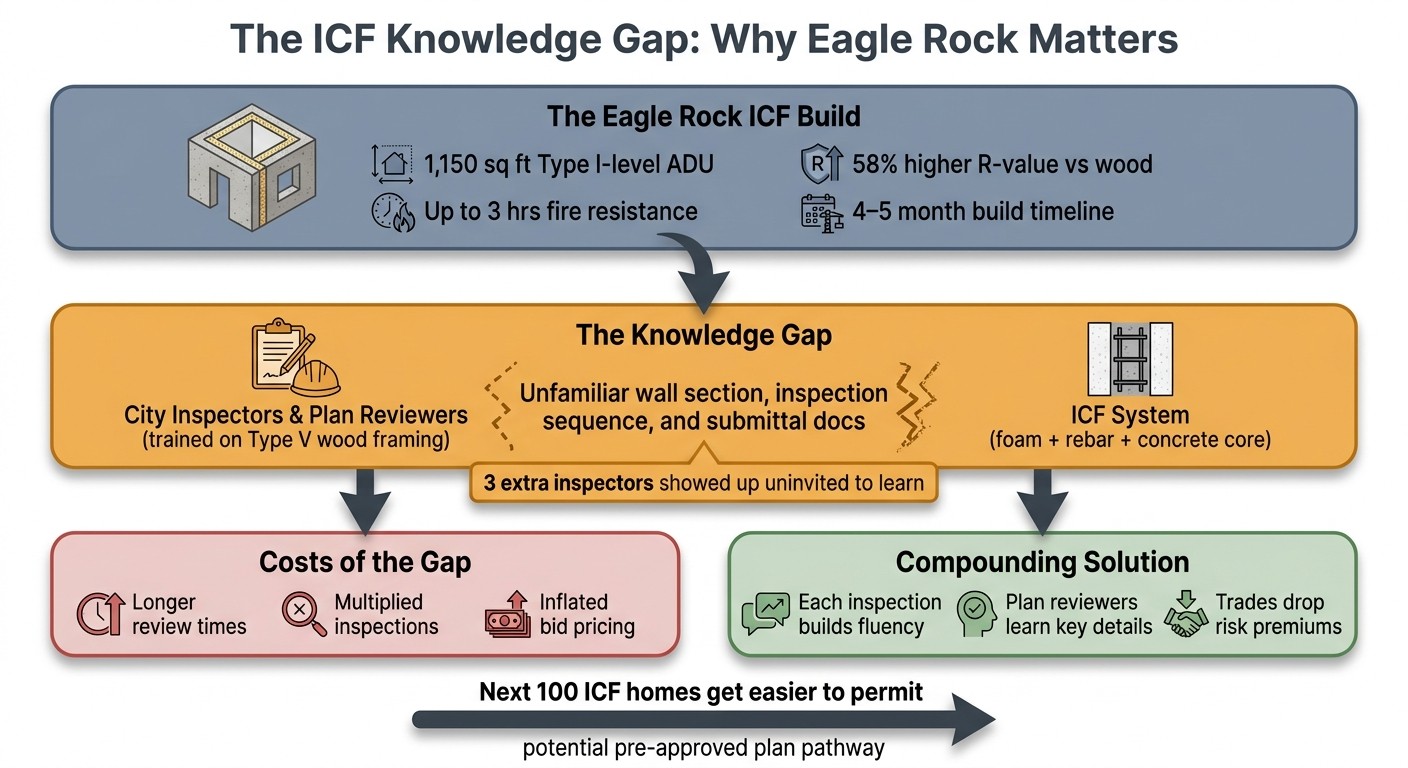
Three things make ICF feel foreign to a residential reviewer trained on Type V wood framing. First, the wall section is unfamiliar — foam, rebar cage, poured concrete, with finishes attached over the foam face. Second, the inspection sequence is different — the critical inspection windows happen before the pour, not after sheathing. Third, the supporting documentation is different — manufacturer ESR reports, ACI 560R references, and structural calc packages tend to dominate the submittal where prescriptive Chapter 6 tables would have done the work.
None of this is a code problem. The code already accommodates it. It is a familiarity problem, and familiarity is built one inspection at a time.
What Type I–Level Fire Resistance Actually Means at the ADU Scale
Under the IBC and CBC, Type I is the highest fire-resistance classification. Type I–A typically requires 3-hour rated exterior bearing walls and structural frames; Type I–B requires 2-hour ratings. These ratings are designed for buildings where evacuation is slow, occupant load is enormous, or both — towers, jails, hospitals.[4]
For a 1,150-square-foot ADU in Eagle Rock, you do not legally need any of that. Chapter R337 of the California Residential Code and Chapter 7A of the CBC set the WUI exterior-element baseline, and a wood-framed ADU with Class A roofing, ignition-resistant siding, and ember-resistant vents is fully code-compliant in a Very High Fire Hazard Severity Zone.[5]
What Builtech is doing is borrowing the performance of Type I — non-combustible structural frame, multi-hour fire resistance — and applying it where the code merely asks for ignition-resistant detailing. The ICF wall section reportedly delivers up to 3 hours of direct fire exposure for the structural frame, on a building that legally needed almost none.[1]
That distinction — performance Type I, not procedural Type I — is exactly the nuance that separates a confident plan reviewer from an overwhelmed one.
The Eagle Rock Build: Small Lot, Sloped Grade, Type I Shell
The project sits on a small, sloped lot in a Wildland-Urban Interface zone. Two things make that geometry meaningful.
The first is that conventional wood-framed ADUs struggle on sloped lots. Stick framing on a sloped grade typically demands cripple walls, stepped foundations, and careful shear-wall detailing — all of which add labor and time. ICF blocks, because they stack like oversized Legos and tolerate stepped courses, are well-suited to terrain where access is limited.[1]
The second is that small lots in Eagle Rock are exactly the geometry that California's ADU statutes were designed to unlock. State law caps detached ADUs at 1,200 square feet and 16-foot heights in setback areas, with reduced parking and review timelines.[6] Builtech's 1,150-square-foot footprint is sized to that envelope deliberately. The Type I performance is not a luxury upcharge layered onto a custom estate — it is sitting on the most common ADU geometry in the state.
That is what makes Eagle Rock a credible template, not a one-off.
Where the 58 Percent R-Value Advantage Comes From
Builtech's release cites up to 58% higher effective R-values for ICF walls compared to traditional wood framing.[1] That number is not magic. It is a combination of three quietly compounding effects.
Thermal mass slows the rate at which heat moves from one face of the wall to the other. The continuous EPS foam on both faces of the concrete core eliminates the thermal-bridging penalty that wood studs impose every 16 inches in a stick-framed wall. And the airtight monolithic core dramatically reduces infiltration losses, which often dominate operating energy in older Los Angeles homes.
For a homeowner, that translates into lower HVAC runtimes year-round. For a CWMS-led design, it also matters during a fire event: a wall that resists conductive heat flow keeps interior surfaces below ignition temperatures longer, even if the exterior face is being radiated by a nearby flame front.
Fire performance and energy performance are usually pitched as separate value propositions. In ICF, they are the same wall section.
Cost Myths Versus the 4-to-5-Month Build Reality
The most persistent myth about ICF is that it is a luxury budget category. The Eagle Rock homeowner reports the opposite — wood-frame quotes he received were comparable, and in some cases higher, than the ICF bid he accepted.[1]
Industry-wide cost data lines up with the homeowner's experience. ICF generally adds about 3-5% to upfront framing costs versus wood,[7] and Headwaters Economics' California analysis pegs total wildfire-resistant construction at 2-13% above baseline depending on how aggressive the package is.[8] Once you net those numbers against insurance availability, energy savings, and avoided rebuild risk, the spread compresses further.
The schedule is the other half of the equation. The Eagle Rock build expects a 4-5 month total timeline against 5-6 months for a comparable wood-framed ADU, with the foundation pour completed in three weeks and the first half of the ICF walls erected in three days.[1] In Los Angeles, where soft-cost carrying costs are punishing, a month of saved schedule is not a marketing line. It is the difference between green-lighting an ADU and shelving it.
Why "ICF Walls" Are Not the Whole Answer
It would be easy to read the Eagle Rock story as "ICF walls solve wildfire risk." That reading is wrong, and the project itself is the cleanest counterargument.
ICF gives you a non-combustible structural shell. It does not, by itself, harden the roof, the windows, the vents, or the five-foot zero-combustible zone immediately around the building. That is why Builtech's design integrates a non-combustible roof assembly, fire-rated triple-glazed windows, and a defensible-space landscape under the guidance of a Certified Wildfire Mitigation Specialist.[1][9]
The Insurance Institute for Business & Home Safety has been clear on this for years: even concrete homes need strong sealing, ember-resistant vent design, and defensible space, because embers — not direct flame contact — are how most homes ignite in a wildfire.[10] Type I walls without the rest of the envelope are a partial solution.
The lesson: do not let homeowners — or inspectors — interpret ICF as a single-product fix. It is a system, and it has to be reviewed as one.
What This Knowledge Gap Costs LA Homeowners
When a building department is unfamiliar with a system, three things tend to happen, and all of them cost the homeowner.
Review times stretch. A reviewer who has never seen an ICF detail asks for additional structural calcs, ESR reports, and clarifications that a more experienced reviewer would have absorbed in one pass. Inspections multiply. As the Eagle Rock experience shows, even a routine inspection can turn into a 4-person event, which is fine for a flagship project but unsustainable at scale. And bid pricing inflates. General contractors and subs price unfamiliar work with risk premiums; that risk premium goes away only when the local trade base has done the work two or three times.
This is the part of the wildfire-resilience story that does not show up in the press release. The technology works. The code accommodates it. The cost is competitive. The thing that bottlenecks adoption is institutional fluency — and that is exactly what Eagle Rock is buying for the city.
How the Next 100 ICF Homes Get Easier to Permit
The Eagle Rock project compounds in a way one-off custom builds usually do not, and that is worth being explicit about.
Every additional ICF inspection in Los Angeles raises the city's institutional baseline. Each inspector who has seen a rebar cage tied inside a foam form does not need to be retrained on the next one. Each plan reviewer who has stamped a Type I–performance ADU once knows where to look for the 12 details that matter on the second one. Each general contractor who has poured a sloped ICF foundation can quote the next one without a 15% risk premium.
LA County's pre-approved plans program for Eaton and Palisades fire rebuilds is already a structural acknowledgment that knowledge compounding matters: the program's central promise is shortened review timeframes and predictable review processes.[11] An ICF detail set that has been reviewed once at the city level is a candidate for the same kind of pre-approval treatment in the next code cycle.
The right reading of Eagle Rock is therefore not "a single ADU is fire-resistant." It is "the next ten ADUs in this neighborhood will be measurably easier to permit."
The Pattern Other California Jurisdictions Should Copy
Los Angeles is not the first California city to host a Type 1A ICF ADU. San Jose got there first, in a project that explicitly framed the build as a precedent for densifying neighborhoods well outside traditional WUI maps.[12] California's 2025 Title 24 Building Standards Code, including the updated WUI Code, took effect for permit applications submitted on or after January 1, 2026, freezing residential code updates until at least 2031 under AB 130.[13]
That means jurisdictions have a ~5-year window to build inspector and reviewer fluency on top of a stable rule set. The cities that quietly invest in cross-training residential reviewers on flat-wall ICF, that update their plan-review checklists to handle non-combustible wall sections natively, and that publish bulletins acknowledging Type I–performance residential work will see ICF adoption curve up far faster than the cities that don't.
Los Angeles, with its Eaton rebuild pipeline, its Palisades rebuild pipeline, and its WUI-zoned hillsides from Eagle Rock to Mandeville Canyon, is the highest-leverage place in the country to run this experiment. Three uninvited inspectors at a single Eagle Rock site visit suggest the city is already running it.
FAQs
Is ICF construction allowed for residential homes in Los Angeles?
Yes. Insulated Concrete Form construction is fully permitted under the California Building Code and California Residential Code, and the California DGS publishes formal interpretations governing flat-wall ICF systems. Homeowners can use ICF for new single-family homes, ADUs, and remodels in Los Angeles, including in Very High Fire Hazard Severity Zones. The constraint is rarely the code — it is finding a contractor and a plan-review pathway with ICF experience inside city limits.
How does an ICF home achieve Type I-level fire resistance?
An ICF wall section pairs a continuous reinforced concrete core with stay-in-place EPS foam on both faces. The concrete core does not combust, and the foam chars rather than sustains flame. With appropriate exterior finishes, vent design, and roof assembly, the structural frame can resist multiple hours of direct fire exposure — performance comparable to Type I commercial construction, even on a single-family ADU.
How much more does an ICF ADU cost than wood framing in LA?
Industry data places ICF framing at roughly 3-5% above wood-framed equivalent costs, with total wildfire-resistant construction adding 2-13% to overall project cost in California. In Los Angeles specifically, real-world bids on small lots have come in comparable to — and in some cases lower than — wood-frame quotes, particularly when sloped grade and tight access penalize stick framing.
What is the difference between Type I and Chapter 7A WUI compliance?
Chapter 7A of the California Building Code governs ignition-resistant detailing of exterior elements — roofs, vents, siding, decks, windows — in WUI zones. Type I is an entire IBC construction-type classification with multi-hour fire ratings on structural elements. A wood-framed ADU can be fully Chapter 7A compliant without being Type I; Type I performance goes substantially further, especially on the structural frame.
Why are city inspectors unfamiliar with ICF construction in California?
ICF has historically been used in California for commercial, institutional, and tilt-up adjacent work, not residential ADUs and single-family homes. Most city residential reviewers and field inspectors are trained on Type V wood-framed construction and Chapter 7A WUI detailing. ICF appearing on a backyard ADU permit is genuinely new in many Los Angeles neighborhoods, which is why a single project can attract multiple inspectors during a routine visit.
Should I rebuild with ICF after the Eaton or Palisades fires?
For homeowners in WUI zones, ICF is one of the strongest options for non-combustible structural performance, particularly when paired with a hardened roof, ember-resistant vents, fire-rated windows, and defensible space. It is not the only option — Chapter 7A-compliant wood framing with strong defensible space remains code-compliant. The right answer depends on lot geometry, budget tolerance, insurance access, and how risk-averse the household is for the next 30 to 50 years.
How long does it take to build an ICF ADU compared to wood framing?
A Type I-level ICF ADU on a small Los Angeles lot can be completed in approximately 4-5 months total, against roughly 5-6 months for a comparable wood-framed ADU. ICF wall erection is fast — half of an ADU's exterior walls can go up in days once the foundation is poured — though the foundation pour itself is unchanged from any other concrete construction.
Can ICF homes lower wildfire insurance premiums in California?
Many California insurers will price an ICF home more favorably than a comparable wood-framed home in a Very High Fire Hazard Severity Zone, and some will write coverage on ICF properties when they decline wood-framed equivalents. Reported premium reductions vary widely, from modest discounts to as much as 40-50%. Coverage availability is often the more material variable than premium percentage.
What does a Certified Wildfire Mitigation Specialist actually do on a project?
A CWMS, certified by the NFPA, applies a structured, ground-up methodology to wildfire risk: hazard assessment, ignition-resistant material selection, detailing of vulnerable envelope elements, defensible-space planning, and homeowner communication. On an ICF project, the CWMS makes sure the non-combustible shell is not undermined by a vulnerable roof, vent, window, deck, or landscape detail.
Is ICF a good choice for sloped or small lots in WUI zones?
Yes. ICF blocks tolerate stepped foundation courses well and require less on-site space and lumber staging than stick framing, which makes ICF particularly well-suited to tight Los Angeles hillside lots. On WUI parcels, the same compactness that helps construction also helps maintain a stronger zero-combustible buffer immediately around the structure.
Related resources
Pasadena Weekly — Rethinking Fire Safety: Aaron Liu on rebuilding LA after the 2025 wildfires — Profile of the founder of Builtech and his case for non-combustible WUI construction.
LAist — Why some homeowners rebuilding from the Palisades Fire are choosing concrete — Reporting on concrete and ICF rebuild trends in post-fire Los Angeles.
California DGS Interpretation of Regulations IR 19-6 — Flat Wall Insulating Concrete Form Construction — California's formal regulatory interpretation of flat-wall ICF systems under the CBC.
References
https://headwaterseconomics.org/natural-hazards/wildfire-resistant-costs-california/
https://alleguard.com/insights/fire-resistant-homes-lessons-from-paradise/
https://www.hansonbridgett.com/publications/251230_8187_construction-laws-2026
https://www.hcd.ca.gov/building-standards/mh/wildland-urban-interfaces
https://www.hcd.ca.gov/sites/default/files/docs/policy-and-research/adu-handbook-update.pdf
https://www.samuelsgroup.net/blog/5-types-of-building-construction
https://www.strongholdengineering.com/the-5-types-of-building-construction-and-their-pros-and-cons/