
Inside Builtech's Wildfire Playbook: Aaron Liu's Four-Tier Approach For 2026
Builtech Construction Group's four-tier wildfire playbook emphasizes the need for layered validation in wildfire detection, combining awareness, dual-mode sensing, automatic response, and Zone Zero hardening. Each tier builds on the previous one, with a focus on integrating technology and structural defenses to enhance safety in high-risk areas. The playbook outlines the importance of pre-plumbing for automatic responses during construction and stresses that Zone Zero is a non-negotiable starting point for any build.
Authors:


TLDR
Builtech Construction Group founder and CEO Aaron Liu, a Certified Wildfire Mitigation Specialist, argued in Forbes that no single wildfire technology is enough on its own — builders have to spec in dependency tiers.[1]
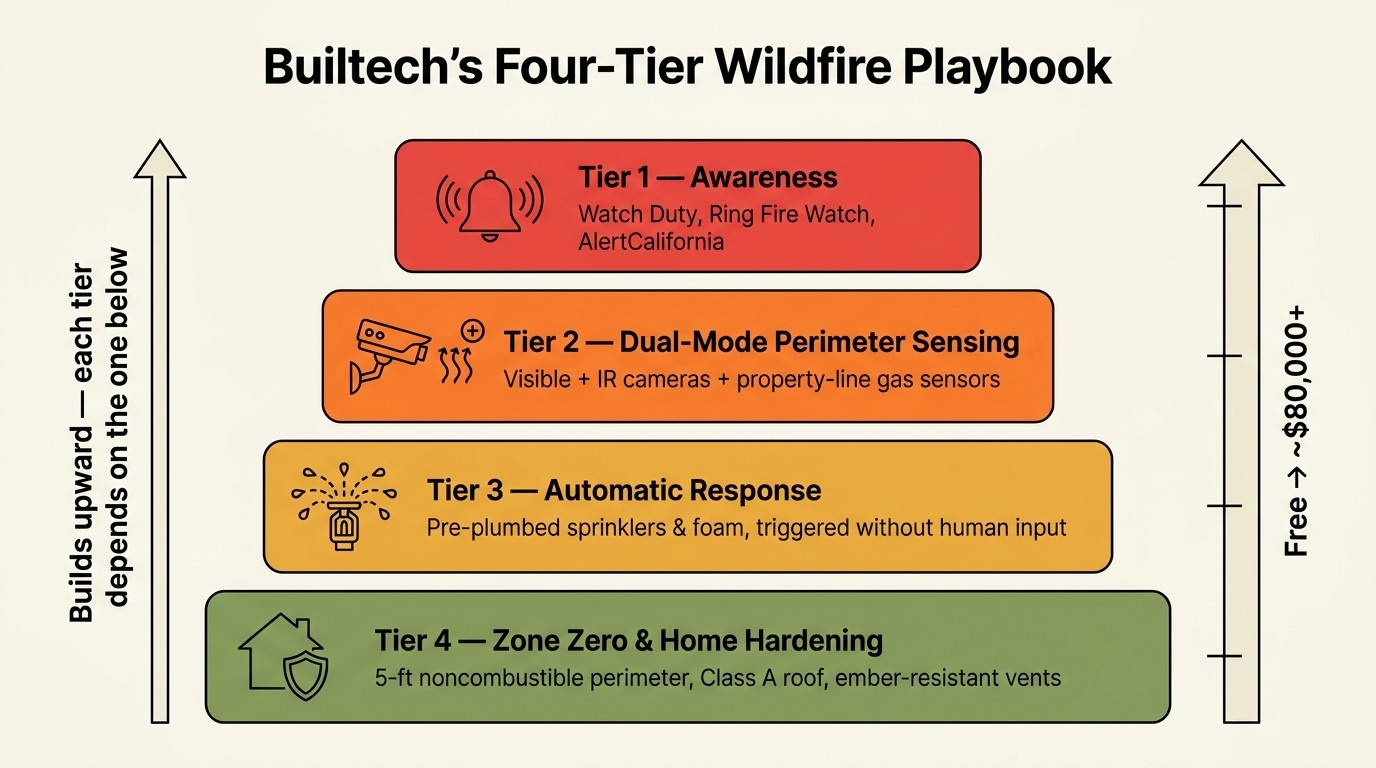
Builtech's four-tier playbook: awareness, dual-mode perimeter sensing, automatic response, and Zone Zero hardening — each tier only pays off when paired with the next.
Ring Fire Watch and Watch Duty raise the floor on neighborhood awareness but do not replace a Builtech-spec'd dual-mode camera and property-line sensor loop.
Builtech pre-plumbs for automatic response at rough-in; retrofitting later costs homeowners multiples of the new-build marginal cost.
Zone Zero is not optional in Builtech's spec book. Every other tier is evaluated against it.
Why Builtech Is Writing This Playbook
Jamie Gold's recent Forbes piece on Ring Fire Watch opens a question that Builtech Construction Group — a California WUI-focused builder led by founder and CEO Aaron Liu, a Certified Wildfire Mitigation Specialist — has been answering on client sites for years: when a neighbor's smart doorbell can beat the fire department to an alert, what does that change about how you spec a home in a high-risk zone?[1]
Liu's answer in Forbes is the thesis of this playbook: cameras alone are not always sufficient for accurate wildfire detection. You need multiple layers of validation.[1] Builtech's field experience pushes that one step further — the layers are not just technology stacks. They are dependency tiers, and the order matters.
This blog formalizes Builtech's internal approach into a public four-tier playbook: what we spec, what we pre-plumb, what we defer, and what we refuse to skip. It is written for homebuyers evaluating a WUI build, and for the insurance brokers and peer builders comparing notes with Builtech on the same streets.
The Builtech Spec Spectrum: From Free Alert Apps To $80,000 Systems
On every Builtech project, we walk the homeowner through this price curve before we ever specify a camera model.
At one end sits Watch Duty — a free nonprofit wildfire monitoring service that aggregates radio scanners, wildfire cameras, satellite data, and official announcements.[4] Above that sits Ring Fire Watch, which piggybacks on Watch Duty and layers AI-driven smoke and flame detection on outdoor Ring cameras. Ring Protect is not required to receive Fire Watch alerts, but it is required to share camera snapshots with neighbors and first responders, and runs $4.99 to $19.99 per month.[1]
At the other end sits Frontline Wildfire Defense, whose automated rooftop sprinkler system starts at roughly $80,000 for a quarter-acre lot, with 96% of the company's LA-area client homes surviving last year's fires.[5]
Between those two ends lives the real work of Builtech's wildfire stack. There is no single correct answer in this range. There is, however, a correct sequence — Builtech will not sell a homeowner a $12,000 thermal camera array before their landscaper has cleared Zone Zero. We build outward from the structure, not inward from the gadget.
Tier 1 — Awareness (What Builtech Hands Off In The Homeowner Manual)
Free and subscription alert services
Tier 1 is mostly software, and it is the cheapest line item on Builtech's wildfire spec. Three services cover almost every WUI homeowner scenario, and Builtech lists all three in the homeowner manual on every WUI build:
Watch Duty. Free, nonprofit, near-universal coverage in California and expanding across the West.[4]
Ring Fire Watch. Free for Ring camera owners within active Fire Watch zones, with AI smoke and flame analysis layered on top. During its March 2026 ramp-up the service was activated for more than 100 fires across the country, and hundreds of Ring camera owners chose to share snapshots with Watch Duty to help first responders.[1]
AlertCalifornia. The publicly funded statewide wildfire camera network, frequently cited inside Watch Duty's own incident reports.
They are free, they cross-verify each other, and they degrade gracefully — when Ring's network is down, Watch Duty's is not.
Why Builtech does not stop at Tier 1
Liu, in Forbes: cameras alone are not always sufficient for accurate wildfire detection. You need multiple layers of validation.[1]
Visual-only systems fail in three predictable ways Builtech has seen in the field:
Smoke blindness. Heavy smoke scatters visible light and can render a standard camera's AI effectively useless precisely when it matters most.
Night and low-light. Without infrared, embers and smoldering fuels can sit undetected for hours.
False positives. Sunset glare, steam, and dust routinely fool visual-only fire models — which erodes homeowner trust in the alert, and eventually the system gets muted.
Tier 1 is necessary. It is not sufficient. That is the hinge on which the rest of Builtech's playbook turns.
Tier 2 — Dual-Mode Perimeter Sensing (Builtech's Default Above Entry Tier)
Pairing visible light with thermal
Liu's recommended architecture — imaging plus thermal sensing, cross-verifying each other — is Builtech's default for any WUI build above the entry tier.[1] In practice, that means Builtech specifies dual-mode (visible + long-wave IR) pan-tilt-zoom cameras at eave height on the fire-exposed elevations of the structure, with both feeds routed to the same controller.
Thermal resolves the three visual-only failure modes Builtech catalogued above: it penetrates smoke, works in total darkness, and keys on heat signatures that glare, steam, and dust do not produce. Pairing the two modes lets the controller require agreement before raising an alarm, which is what actually moves the false-positive rate down to something a homeowner will live with over time.
Property-line sensors
Cameras on the eave answer what is happening. Sensors at the property line answer how close. Liu, in Forbes: Adding sensors along the property line can improve accuracy and reduce false positives, especially in complex wildfire environments.[1]
On new Builtech builds, we carve out a low-voltage sensor loop along the parcel boundary on every vegetation-facing side. Modern gas-sensing wildfire sensors detect the pyrolysis gases — carbon monoxide, hydrogen, and hydrocarbons — that precede visible smoke, and they stay useful in poor visibility. Builtech integrates their output with the camera controller so any one sensor firing elevates the others into a higher-confidence state.
Two low-voltage runs, buried at rough-in, cost a fraction of what the same system costs to retrofit two years later. This is one of the decisions Builtech most often revisits with homeowners considering whether to wait and see.
Tier 3 — Automatic Response (What Builtech Pre-Plumbs At Rough-In)
Tiers 1 and 2 alert a human. Tier 3 acts without one.
This is where Frontline Wildfire Defense's automated rooftop sprinkler system and a handful of newer automated yard and perimeter systems live. The common element is that verified detection — ideally from more than one modality — automatically triggers perimeter sprinklers, foam application, or structural shutoffs. It does not ask the homeowner. It does not wait for the fire department.[5]
Liu again, in Forbes: camera systems should be integrated with other fire protection measures, like outdoor sprinkler systems, so that detection will trigger a response automatically.[1]
On a Builtech project, Tier 3 resolves into two binary decisions:
Pre-plumb at rough-in, even if the homeowner defers installation. Builtech's standing recommendation in high-risk WUI zip codes is yes. The marginal cost at rough-in is small. The retrofit cost is enormous.
Wire response to detection, or leave it manual. Automatic triggering is where survival curves bend. A manual system, even at $80,000, still assumes the homeowner is home, awake, and not evacuating.
Tier 4 — Zone Zero And Home Hardening (Where Builtech Starts)
Builtech starts with Tier 4 on the drawing board. Every tier above is additive on top of a non-negotiable base: a hardened structure and a noncombustible perimeter.
Ivan O'Neill, CEO of Madronus Wildfire Defense, stated the ordering in Forbes: Homeowners should focus first on creating a noncombustible zone (Zone Zero) within the first five feet around their homes. This is the single most important thing to protect homes.[1] Builtech agrees — Zone Zero is the first line item we draw on any WUI site plan.
California's regulators agree as well. Commissioner Lara has endorsed the IBHS Wildfire Prepared Home standard for the rebuilding of Los Angeles and has continued to push Zone Zero regulations as the precondition for broader insurance discounts and non-FAIR-Plan coverage.[3] The California FAIR Plan now offers up to 12 distinct wildfire hardening discounts; Dwelling Fire policyholders who earn all 12 can save up to 16.4% off the wildfire portion of the premium.[6]
On Builtech projects, Zone Zero is the easiest line item to design into a new build and the hardest to retrofit cleanly. We spec it first:
No combustibles within five feet of the structure — no wood mulch, no wood fencing, no woody plants.
Only noncombustible materials for fencing, gates, decking, and hardscape within five feet.
Class A roofing, ember-resistant vents, fire-rated windows, and noncombustible soffits as the structural baseline. This is table stakes for a post-2025 WUI home on any Builtech spec sheet.[7]
A camera array over a combustible perimeter is a very expensive way to watch a house burn down. Builtech declines to sell the camera without the perimeter.
The Builtech 2026 Decision Tree
Collapsing the four tiers into Builtech's decision tree for a WUI new build:
Always (non-negotiable): Zone Zero, Class A roof, ember-resistant vents, fire-rated windows, and a homeowner manual listing Watch Duty, Ring Fire Watch, and AlertCalifornia.
Default: Dual-mode (visible + IR) cameras at eave height on fire-exposed elevations. Low-voltage conduit runs at rough-in for future property-line sensors.
Recommended: A property-line gas and thermal sensor loop integrated with the camera controller. Pre-plumbed rooftop or perimeter sprinkler system.
Premium: Full automatic-response sprinkler and foam system integrated with the detection layer and tied into utility shutoffs.
At handoff, Builtech answers two questions for every tier: what happens when this tier fails? and what is the failover? A homeowner who can articulate both is a homeowner an insurer will increasingly be willing to discount.
Insurance, Community, And Builtech's Legislative Position
Insurance economics are not yet perfectly aligned with Builtech's playbook — but they are bending in its direction.
State Farm, California's largest homeowner insurer, does not currently offer a discount specifically for Ring Fire Watch.[1] Rob Bhatt of LendingTree noted to Forbes that if it proves effective in reducing damage from wildfires, insurance companies may offer a discount for joining. Joshua Morey, president of J. Morey Co., cited the usual carrier objections: lack of long-term actuarial data, Wi-Fi and user-error reliability gaps, verification challenges, and a clear preference for professionally monitored over self-monitored systems.
The carriers that are discounting aggressively are discounting for IBHS-designated homes — up to 37.5% for Wildfire Prepared Home and up to 50% for WPH+, with those ceilings scaled by home spacing.[8] That is not a coincidence. IBHS's standard codifies exactly the kind of structural hardening and Zone Zero work that sits at the base of the Builtech stack.
Liu's closing argument in Forbes doubles as Builtech's legislative position going into the next California session: Wildfire risk is a shared, community-level issue, and technologies like this could have much broader impact if supported or subsidized by local or state governments. Making these systems more accessible would help more homeowners take proactive steps, rather than relying solely on evacuation notices.[1]
For Builtech, that is not just a civic point. It is a demand signal. The home buyers of 2027 will ask for this stack by name, and the carriers will underwrite against it. Builtech has already written it into its spec book.
FAQs
What is Zone Zero in California wildfire defense?
Zone Zero is the five-foot noncombustible perimeter directly around a structure, treated as the highest-priority defensive zone in California's evolving wildfire code. California's Insurance Commissioner has continued pushing Zone Zero regulations as the precondition for broader insurance discounts. On Builtech projects, that means no wood mulch, wood fencing, or woody plants within five feet — only noncombustible materials like gravel, stone, and metal hardscape.
Does Ring Fire Watch require a Ring Protect subscription?
No. Per Forbes' coverage of the Ring Fire Watch rollout, Ring Protect is not required to receive Fire Watch alerts. Ring Protect, which costs between $4.99 and $19.99 per month, is only required to share camera snapshots with neighbors and first responders. Homeowners with eligible Ring outdoor cameras inside an active Fire Watch zone receive AI-driven smoke and flame alerts at no additional cost.
How much does an automated wildfire sprinkler system cost?
Frontline Wildfire Defense's automated rooftop sprinkler system starts at roughly $80,000 for a property of a quarter-acre or smaller, per Forbes and Frontline's own materials. Frontline reports that 96% of its client homes survived last year's Los Angeles fires. On a Builtech project, the marginal cost of pre-plumbing for an automatic response system at rough-in is dramatically lower than retrofitting the same system later.
What insurance discounts can California homeowners get for wildfire hardening?
The California FAIR Plan offers up to 12 wildfire hardening discounts. Dwelling Fire policyholders who earn all 12 can save up to 16.4% off the wildfire portion of their premium. Mercury's IBHS-linked discounts reach up to 37.5% for Wildfire Prepared Home certification and up to 50% for WPH+, with the ceiling scaled by home spacing — dropping to 22.5% and 30% at under 10 feet of separation.
How does dual-mode wildfire detection work?
Dual-mode detection pairs a visible-light camera with a long-wave infrared sensor and requires both feeds to agree before raising an alert. Thermal imaging penetrates smoke, works in total darkness, and keys on heat signatures that glare, steam, and dust do not produce. Cross-verification sharply reduces false positives, which matters because homeowners eventually mute systems they cannot trust over time, eroding the entire detection layer.
Are property-line wildfire sensors worth the cost on a new build?
On new Builtech builds, yes — when planned in at rough-in. Property-line gas sensors detect pyrolysis gases such as carbon monoxide, hydrogen, and hydrocarbons before visible smoke or flame appears, and stay useful in poor visibility. Two low-voltage sensor runs buried during construction cost a fraction of the same retrofit two years later, and any one sensor firing elevates camera alerts to a higher-confidence state.
What's the difference between Watch Duty and Ring Fire Watch?
Watch Duty is a free nonprofit wildfire monitoring service that aggregates radio scanners, fire cameras, satellite data, and official announcements across the Western U.S. Ring Fire Watch piggybacks on Watch Duty's network and adds AI-driven smoke and flame analysis on top of outdoor Ring cameras. The two services cross-verify each other and degrade gracefully — when one network is down, the other usually is not.
Should I retrofit my home for wildfire defense or wait for new construction?
Builtech's standing recommendation in high-risk wildland-urban interface zip codes is to pre-plumb at rough-in whenever a new build is on the table, because retrofit costs run several multiples of the new-build marginal cost. For existing homes, prioritize Zone Zero hardening first — the five-foot noncombustible perimeter — then Class A roofing and ember-resistant vents before investing in any detection or automated response technology.
Why isn't State Farm offering a Ring Fire Watch insurance discount?
State Farm, California's largest homeowner insurer, currently does not offer a Ring Fire Watch–specific discount, per Forbes. Industry voices cited typical carrier objections: lack of long-term actuarial data, Wi-Fi and user-error reliability gaps, verification challenges, and a carrier preference for professionally monitored over self-monitored systems. If Fire Watch demonstrably reduces wildfire losses over time, carriers may revisit and add a discount.
What's the most important step in protecting a home from wildfires?
Zone Zero — the five-foot noncombustible perimeter immediately around the structure — is the single highest-leverage step. Madronus Wildfire Defense CEO Ivan O'Neill stated this directly in Forbes, and Builtech agrees. A camera array, sensor loop, or automated sprinkler system installed over a combustible perimeter is an expensive way to watch a house burn down. Every other tier in Builtech's playbook is evaluated against this baseline.
Related Resources
Watch Duty — the free nonprofit wildfire monitoring app that powers Ring Fire Watch; the single highest-leverage homeowner install Builtech recommends.
IBHS Wildfire Prepared Home — the certification standard behind California's deepest insurance discounts and the structural baseline for every Builtech WUI build.
FEMA Home Builder's Guide to Construction in Wildfire Zones — the baseline technical reference for WUI construction; part of Builtech's internal spec library.
References
Forbes — Can A New Smart Doorbell Service Save Your Home And Life? (Jamie Gold, Apr 14, 2026): link
Ring — Fire Watch launch post: link
California Department of Insurance — Commissioner Lara on Zone Zero: link
Watch Duty: link
Frontline Wildfire Defense: link
FBIA — California FAIR Plan Wildfire Hardening Discounts: link
FEMA — Home Builder's Guide to Construction in Wildfire Zones: link
Insurance for Good — Do California Insurers Reward Wildfire Resilience?: link
Ring Search Party / Fire Watch overview: link
AlertCalifornia: link
Madronus Capture app: link
WIRED — Ring and Watch Duty Team Up to Keep a Closer Eye on Wildfires: link