Steel and Sure-Board Roof: A Class A No-Fuel ADU Spec
A steel and Sure‑Board roof provides a Class A, non‑combustible envelope for 3D‑printed ADUs and other wildfire‑prone homes by using cold‑formed steel framing, fire‑rated composite sheathing, and ember‑resistant detailing, eliminating wood and nails to dramatically reduce ember‑driven ignition risk, improve durability, and qualify for insurance and code hardening incentives.
Authors:


TLDR
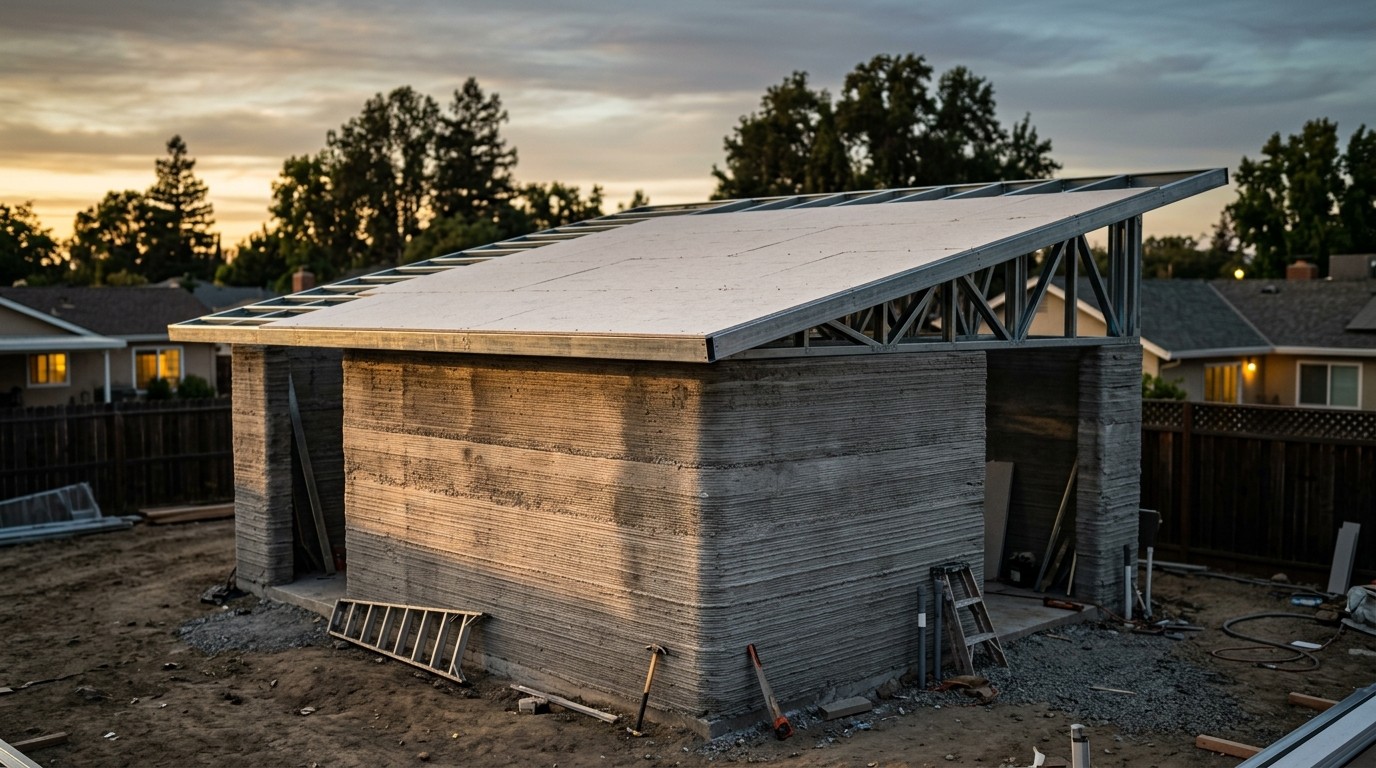
The Walnut, CA 3D-printed ADU eliminates wood from the roof entirely, replacing it with light steel and Sure-Board sheathing — a Class A, no-fuel envelope above the printed concrete walls.[1]
Most wildfire home losses come from embers, not direct flame, so pulling combustible material out of the roof plane is the highest-leverage move a builder can make.[3]
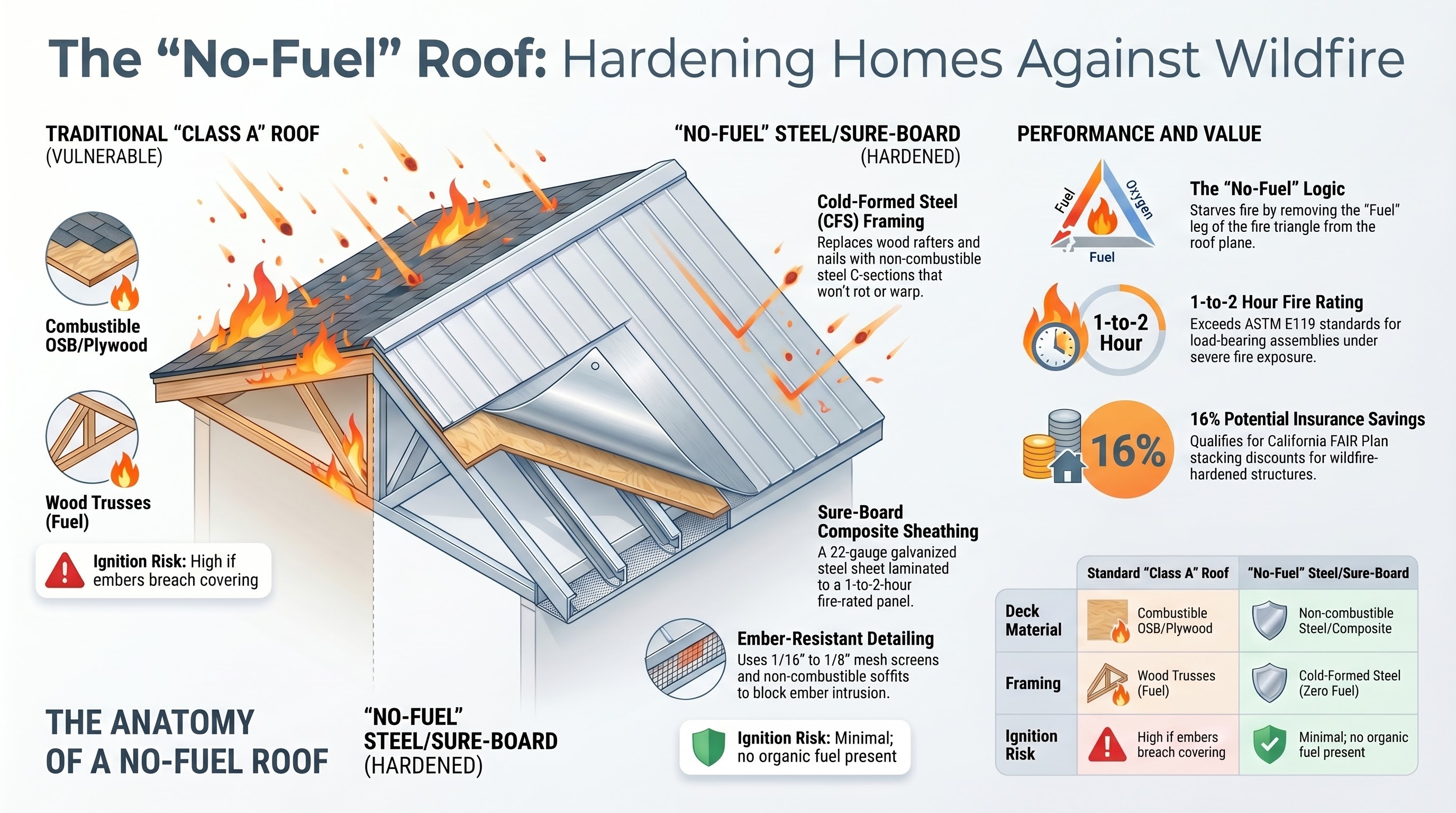
Sure-Board is a 22-gauge galvanized steel sheet laminated to a fire-rated panel; it's tested through ASTM E119 for 1- and 2-hour load-bearing assemblies and pairs naturally with cold-formed steel framing.[4]
Pricing the assembly fairly means accounting for what wood costs in fire country: insurance loadings, missed FAIR Plan stacking discounts, defensible-space exposure, and the rebuild tax on every wood roof in the WUI.
The same steel-and-Sure-Board logic extends well past the Walnut ADU. It's a replicable, code-defensible spec for primary homes, garages, and rebuilds on any California wildfire-prone lot.
Why the Roof Is the Wildfire Failure Point
In California's wildfire conversation, attention drifts to walls, vegetation, and defensible space. The roof gets less airtime, which is backwards. The roof is where ember storms land first, where pine needles accumulate, where eave vents pull radiant heat, and where a single failed shingle can release the rest of the house to fire. CAL FIRE's home-hardening guidance puts the roof at the top of its list precisely because it is the most exposed plane on any structure.[8]
The Walnut, CA project documented by Tomorrow's World Today is unusual because it treats the roof not as a covering decision but as a structural material decision.[1] The team — RIC Technology on the printer, Builtech Construction Group on the wet trades and structure — chose to build the entire roof without a single piece of wood or a single nail. That is a deliberate engineering posture, not a marketing line. Removing wood from the roof is the only way to remove fuel from the most fire-vulnerable surface of a single-family home.
This blog walks through the actual assembly: what cold-formed steel framing does in this context, why Sure-Board is the right partner for it, how the assembly earns its Class A rating, and what builders need to know before they specify it on their own projects.
The Source-of-Truth: Walnut, CA's No-Wood Roof
The Walnut ADU is a 1,200 sqft, two-bedroom, 2.5-bathroom unit printed on-site over roughly 20 days using RIC Technology's compact modular robotic 3D printer.[1] The walls are extruded concrete. The roof is the more interesting decision: light steel and Sure-Board.
In Aaron Liu's own words, the ADU "will be built without a single piece of wood or nail – no 'fuel' on the main structure."[7] That is the design constraint that drove every roof selection that followed. If wood and nails are off the table, the roof needs cold-formed steel framing, a non-combustible sheathing, a non-combustible underlayment, and a Class A finish layer.
This is a structural choice, not just a covering swap. A standard tile-on-OSB roof is technically Class A at the covering level, but the OSB underneath is fuel. Embers that breach a tile gap, or that ride into the soffit cavity through a failed vent, will find the OSB. The Walnut roof refuses to give them anything to find.
Sure-Board: What It Is and Why It Belongs Here
Sure-Board is a composite panel: 22-gauge galvanized sheet steel (per ASTM A 653 CS) laminated to an approved fire-rated panel product such as DensGlass Gold, Durock, Fiberock, MgO Board, or PermaBase.[4] It was originally engineered for shear-wall applications because the steel-on-board lamination delivers very high in-plane shear capacity. That same composition turned out to be a strong fire performer.
For fire applications, Sure-Board exceeds the requirements of ASTM E119 for 1- and 2-hour load-bearing assemblies on both interior and exterior cold-formed steel framing.[4] On a roof above 3D-printed concrete walls, that 1- to 2-hour rating is exactly the kind of margin builders want, because the fire scenario is not "stick frame in a fully developed structure fire"; it's "ember storm + radiant heat + minor flame contact" for a window of minutes to hours.
The product reads like steel sheathing because it is steel sheathing, but the gypsum, fiber-cement, or magnesium-oxide layer underneath gives it dimensional stability, screw-through performance, and a fire core that does not lose strength in the temperature range a wildfire actually delivers at the roof plane. It is also tested at the assembly level — meaning the fire rating belongs to the sandwich, not just the panel — which is the test path local fire authorities want to see.
The Light-Steel Frame Above 3D-Printed Concrete Walls
Cold-formed steel (CFS) is the natural framing partner for 3D-printed concrete walls. Concrete walls already do most of the structural lifting; the roof just needs to span between bearing points, manage diaphragm action, and resist uplift. CFS does all three with no organic material in the load path.
CFS framing on the Walnut ADU connects to the printed concrete walls via embedded plates and post-installed anchors at the wall top. Rafters, ridge, and ceiling joists are CFS C-sections; sheathing is Sure-Board screwed (not nailed) to the steel frame. The assembly delivers the diaphragm and shear continuity that a wildfire-resilient envelope requires, while leaving zero combustible mass at the roof plane.
The benefit goes beyond fire. CFS does not host termites, does not rot, does not hold moisture, and does not warp through California's seasonal humidity swings. In a Walnut backyard, where the ADU sits close to a primary structure and to neighbors, the absence of organic decay paths matters as much as the absence of wood fuel. Maintenance burden drops. So does the long-tail liability that comes with ten or twenty years of small fascia replacements on a wood roof.
Class A Test Path: ASTM E108 / UL 790
Class A is not a marketing badge. It is a defined performance class under ASTM E108 and UL 790, the two parallel standards that govern roof covering fire performance.[5] The tests evaluate how a roof covering responds to severe fire test exposure: spread of flame, intermittent flame, burning brand, rain test, and gust resistance, depending on the variant.
Roof coverings rated Class A include most metal roofs, clay tile, concrete tile, and certain composite shingles installed over compliant decks. The deck matters: a Class A covering installed over an OSB deck still leaves combustible material in the system. The Walnut project's decision to put a non-combustible covering over a non-combustible Sure-Board deck over CFS framing is what makes the entire assembly — not just the covering — function as a Class A system end to end.
For builders specifying the assembly, the practical takeaway is simple: rely on tested assemblies, not on field substitutions. Sure-Board has UL fire-rated assembly listings for floors, roofs, and walls. The roof spec that gets approved by a local fire authority is going to reference those listings, not a generic "metal roof" statement.
The Fuel-Removal Logic at the Roof Plane
The Walnut roof is best understood through the fire triangle: take fuel, heat, or oxygen out and combustion stops. Embers and radiant heat are abundant in a wildfire. Oxygen is everywhere. The only leg the builder controls is fuel.
Pull fuel out of the roof plane and several things change at once. Ember intrusion through soffits no longer finds OSB to ignite. Radiant heat through skylight gaps no longer cooks roof rafters. Spot-flame contact at the eave no longer climbs into a fascia board. The structure does not become fireproof, but its ignition probability drops to a level where defensible space and exterior hardening can meaningfully save the home rather than merely delay its destruction.
This is the design logic embedded in the Walnut ADU's roof spec, and it is more transferable than the printed walls themselves. A homeowner outside California who can't access on-site 3D-concrete printing can still adopt a steel-and-Sure-Board roof on a conventional concrete or CMU wall, or even on a re-roof project over an existing CFS structure.
Edges, Eaves, and Vents: Where Embers Actually Win
Most wildfire ignitions in surviving neighborhoods do not start at the roof field. They start at edges and openings. Eave vents pull air, and embers ride that air. Soffit gaps catch embers behind the fascia. Roof-to-wall flashings collect debris and provide a sheltered ignition pocket. The Walnut roof closes those failure points deliberately.
Eave vents on the Walnut project use ember-resistant screens with openings between 1/16 and 1/8 inch — small enough to refuse embers, large enough to keep ventilation rates code-compliant. Soffits are non-combustible. Roof-to-wall transitions land directly on the printed concrete and are flashed with prefinished steel. Skylights, when used, are tempered double-pane with metal frames. None of those details are unique to a 3D-printed home; they are the standard ember-resistant detailing required by Chapter 7A of the California Building Code in WUI zones, applied without exceptions or value-engineering substitutions.
The point is that a Class A roof system fails at its weakest detail. The Walnut team designed the details to be the strongest part of the roof, not the weakest.
Cost and Schedule Implications for Builders
Steel-and-Sure-Board roofs cost more in materials than a standard truss-and-OSB-and-asphalt-shingle roof. They cost less in labor when the framing crew is already CFS-trained, and they cost dramatically less over the life of the building once insurance, replacement, and rebuild-after-fire are priced in.
On schedule, the assembly does not lengthen the critical path. Rafters set in a day. Sure-Board screws in faster than nailed plywood when the crew is comfortable with the panel format. Fastener pattern and edge spacing follow Sure-Board's published submittals. The longest phase is usually the metal-roof finish itself, which is unrelated to the deck choice.
The honest cost story is this: the assembly carries a few thousand dollars more in hard cost on a 1,200 sqft ADU footprint, and it pays back through California FAIR Plan wildfire-hardening discounts, lower defensible-space loadings during insurance underwriting, and a meaningfully lower probability of catastrophic loss. For an owner rebuilding after a wildfire, the math tilts further: replacement-cost insurance does not refund the displacement, the rent, the schools rerouted, or the second loss exposure of putting wood back on the same lot.
Where the Steel-and-Sure-Board Roof Fits Beyond ADUs
The Walnut ADU is a 1,200 sqft pilot. The roof spec generalizes to much more. Detached garages, casitas, primary residences in WUI zones, hillside cabins, and post-wildfire rebuilds all benefit from a no-wood roof. The Walnut precedent makes it easier for the next builder to specify the assembly, because the LA County permit and inspection have already validated the path.
For owner-builders considering the assembly on a primary residence, the entry point is usually a roof replacement after a re-roof inspection or after a wildfire loss. Replacing a tile-on-OSB roof with a metal-on-Sure-Board roof on existing CFS or wood framing is a viable interim step, and it stacks several California wildfire-hardening incentives on a project that was going to be re-roofed anyway. The work is not exotic. It is, increasingly, the appropriate baseline for any California roof that touches a fire-prone lot.
Verifying the Spec on Your Own Project
If a homeowner or builder wants to put this roof on a project, three steps make it real. First, get a structural engineer to specify the CFS section sizing, anchor pattern at the wall top, and Sure-Board fastening schedule, referencing the published Sure-Board submittals. Second, choose a Class A metal roof finish — standing seam steel is the most common — and confirm the manufacturer's Class A assembly listing matches the deck. Third, walk the local fire authority and building department through the assembly listing and the WUI code references early in design. The Walnut team's experience is that fire authorities are receptive to non-combustible upgrades when the listings are on the table from day one.
The Walnut ADU is not a one-off curiosity. It is a template for what every California roof in fire country should look like by the end of this decade. The materials are available. The listings exist. The permit path has been walked. What remains is the willingness to stop putting wood where wildfires keep finding it.
FAQs
Is a steel and Sure-Board roof considered Class A for wildfire ratings?
Yes, when paired with a Class A roof covering and installed per the manufacturer's listed assembly. Sure-Board itself exceeds ASTM E119 for 1- and 2-hour load-bearing assemblies, and a Class A covering installed over a Sure-Board deck and cold-formed steel framing produces a non-combustible, Class A roof system end to end. Always verify against the specific assembly listing accepted by your local fire authority before submitting plans.
How does Sure-Board differ from regular gypsum sheathing?
Sure-Board is 22-gauge galvanized sheet steel laminated to a fire-rated panel such as DensGlass, Durock, or MgO Board. The steel layer carries shear and hardens the surface; the panel layer adds fire endurance and dimensional stability. Plain gypsum sheathing has no steel and no comparable shear capacity, so it cannot perform the structural-and-fire dual role that Sure-Board performs in a wildfire roof assembly on cold-formed steel framing.
Why are most homes in a wildfire actually destroyed by embers, not flames?
Wind-driven embers travel up to a mile from the active fire front and ignite homes far ahead of any visible flame. Industry estimates put ember-driven losses at roughly 90% of structures destroyed in a wildfire. Embers find vents, eaves, gaps, and combustible roof decks. A non-combustible roof and detailing strategy directly addresses that primary failure mode rather than the much rarer direct flame contact with a structure.
Can a steel and Sure-Board roof span over 3D-printed concrete walls without a wood frame?
Yes. Cold-formed steel framing connects to printed concrete walls via embedded plates or post-installed anchors at the wall top, and Sure-Board screws to the steel rafters. The Walnut, CA ADU is built exactly this way, with no wood and no nails in the main structure. The concrete walls handle vertical and lateral loads; the steel-and-Sure-Board roof manages the diaphragm, uplift, and weather envelope.
What does "no fuel" mean in a wildfire-resistant ADU design?
"No fuel" is shorthand for removing combustible material from the structural envelope. In the Walnut ADU, that means no wood framing, no nailed wood sheathing, no combustible underlayment, and no exposed wood at eaves or fascia. Embers can still land on the roof, but with no fuel to ignite, the structure denies the fire its third leg of the fire triangle and starves the ignition event before it begins.
How long does it take to install a steel and Sure-Board roof on a 3D-printed ADU?
The framing and sheathing phase typically takes a small CFS-experienced crew three to six working days on a 1,200 sqft ADU footprint, plus the metal roof finish on top. The schedule rarely lengthens the critical path versus a standard truss-and-OSB roof, especially because Sure-Board's predictable panel format and steel-screw fastening pattern are faster once the crew is calibrated and the engineer's fastening schedule is on site.
Does removing wood from the roof affect a home's insurance premium in California?
It can. The California FAIR Plan offers stacking wildfire-hardening discounts that often total around 16% off the dwelling fire premium. Class A roofing, ember-resistant vents, and non-combustible siding each contribute. A steel-and-Sure-Board roof clears the Class A criterion cleanly, and the absence of wood makes the rest of the underwriting walkthrough easier. Homeowners should request a hardening assessment from their broker after construction to capture all applicable discounts.
What's the difference between a fire-rated assembly and a Class A roof covering?
A Class A roof covering is rated under ASTM E108 or UL 790 for severe fire test exposure. A fire-rated assembly is the full sandwich — covering, underlayment, deck, framing — tested under ASTM E119 for hourly endurance under load. The Walnut roof aims to satisfy both: a Class A finish and a 1- to 2-hour fire-rated assembly underneath, so the system performs whether the threat is ember showers or sustained heat at the roof plane.
Are there code references for steel and Sure-Board roofs in the California Residential Code?
The California Residential Code references California Building Code Chapter 7A for ignition-resistant construction in WUI Fire Hazard Severity Zones, plus assembly listings for non-combustible roof systems. Sure-Board has UL-listed fire-rated assemblies the local fire authority can accept directly. The straightforward path is to submit the manufacturer's listed assembly and the engineer's structural calculations to the AHJ early in the permit set, before substantive plan review begins.
Should homeowners outside the WUI bother with a no-wood roof?
Often yes. WUI zone maps shift over time, and parts of California outside formal WUI boundaries still see ember-driven loss in major fires. A non-combustible roof reduces ignition probability anywhere ember transport is possible. It also lowers maintenance, eliminates termite and rot risk, and frequently improves resale in any region where wildfire has become a market consideration. The cost premium is small relative to the long-tail benefits.
Related resources
California Builders Embrace Fire-Resistant Construction Amid Rising Risks — Davis Vanguard — context on Builtech and Type IA fire-resistance work in California.
CAL FIRE Home Hardening guidance — official California guidance on roof, vent, eave, and window detailing for wildfire-prone lots.
Sure-Board fire applications page — primary technical reference for ASTM E119 listings and product composition.
References
[1] Tomorrow's World Today, "Fire-Resistant, 3D-Printed Homes Can Reduce Wildfire Damage." https://www.tomorrowsworldtoday.com/innovation/fire-resistant-3d-printed-homes-can-reduce-wildfire-damage
[2] KTLA, "3D printed fire-resistant home being built in Los Angeles County." https://ktla.com/news/california/wildfires/3d-printed-fire-resistant-adu-being-built-in-los-angeles-county/
[3] Frontline Wildfire Defense, "Wildfire Home Hardening." https://www.frontlinewildfire.com/wildfire-home-hardening/
[4] Sure-Board, "Fire — Sure-Board." https://sureboard.com/products/by-climate/fire/
[5] Western States Metal Roofing, "Metal Roof Fire Resistance: Class A Fire Ratings Can Protect Your Home." https://www.westernstatesmetalroofing.com/blog/metal-roofing-fire-resistance
[6] Montecito Fire Department, "Home Hardening." https://www.montecitofire.com/home-hardening
[7] Build in Digital, "Robot system to print wildfire-resistant California home." https://buildindigital.com/robot-system-to-print-wildfire-resistant-california-home/
[8] CAL FIRE, "Home Hardening." https://www.fire.ca.gov/home-hardening
[9] Disaster Recovery Journal, "U.S.'s First Fire Resistant 3D Printed Concrete ADU Starts Construction." https://drj.com/industry_news/u-s-s-first-fire-resistant-3d-printed-concrete-adu-starts-construction/