Structure-to-Structure Spacing: California's Fire Frontline
California's ADU boom has cut structure-to-structure spacing to 4–10 feet, making fire spread the new wildfire frontline. Here's how to build for it.
Authors:


TLDR
California's ADU boom has compressed lot density so far that adjacent structures now sit as close as 4–10 feet apart, putting fire-spread risk inside the urban core, not just on the WUI fringe.[1]
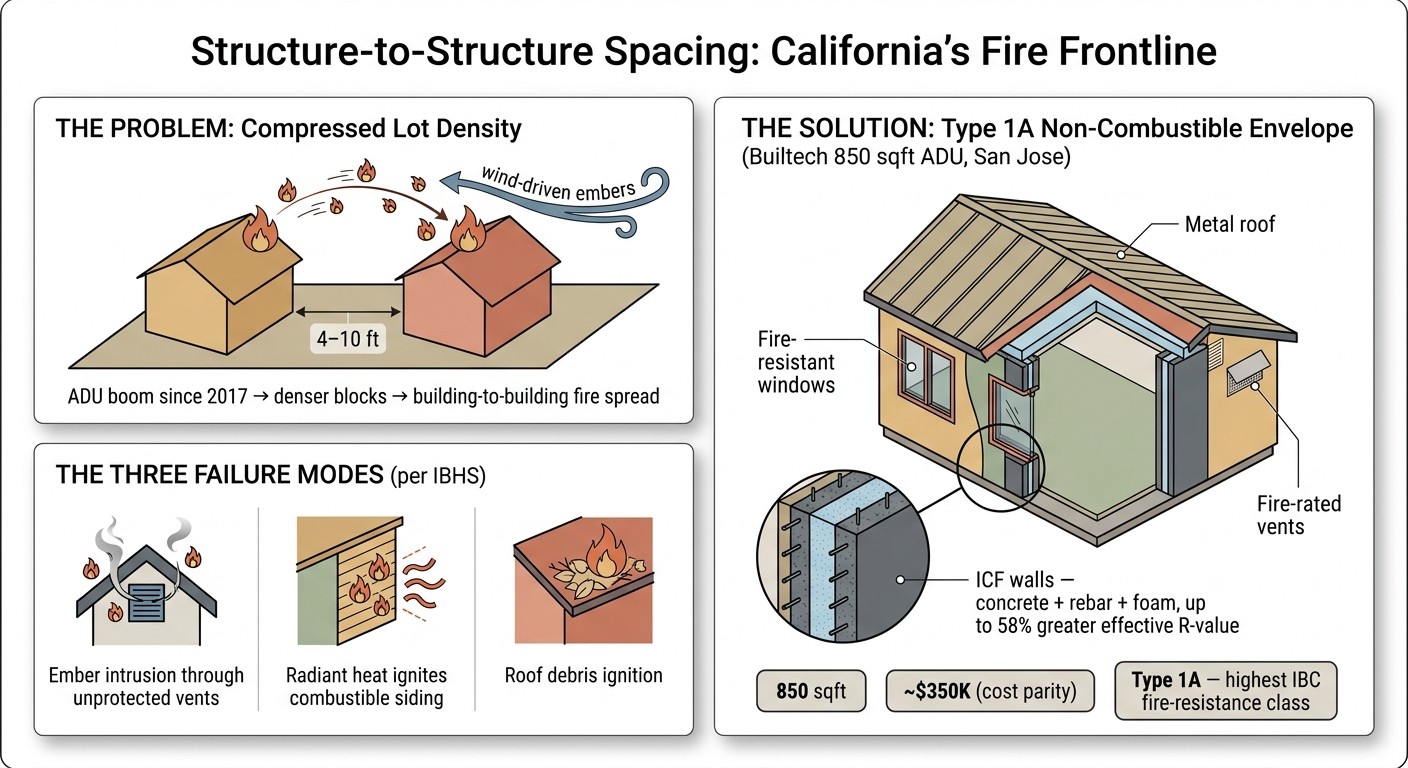
Wildfire research consistently identifies structure-to-structure spacing as a primary driver of fire propagation, with extreme winds and ember showers turning a single ignition into a domino chain.[2]
Builtech Construction Group's new 850-square-foot ADU in San Jose is the first in the city built to Type 1A standards, the highest fire-resistance classification in the IBC and California Building Code.[1]
The project was delivered at roughly $350,000 — comparable to wood-frame construction in the area — using an ICF (Insulated Concrete Form) system paired with fire-resistant windows, a metal roof, and fire-rated vents as one non-combustible envelope.[1]
For homeowners, contractors, and policymakers, the takeaway is that fire-resilient infill housing is now a buildable, cost-comparable, code-aligned option — not a premium add-on.
Why The Wildfire Frontline Moved Into Your Block
For most of the last two decades, California wildfire policy has been organized around a single mental map: the Wildland-Urban Interface, or WUI. The thinking was straightforward — homes that intermingle with brush, forest, or chaparral burn first, so that's where defensible space, ember-resistant vents, and Chapter 7A materials matter most. CAL FIRE's Office of the State Fire Marshal still frames structural fire ignition risk in WUI terms, with three pillars: ignition-resistant construction, defensible space, and identification of high-risk areas.[3]
That model is necessary, but no longer sufficient. The April 2026 Builtech project in San Jose is a useful inflection point because it forces a reframe: fire risk is no longer limited to WUI zones.[1] What changed isn't just the climate. It's the geometry of the block.
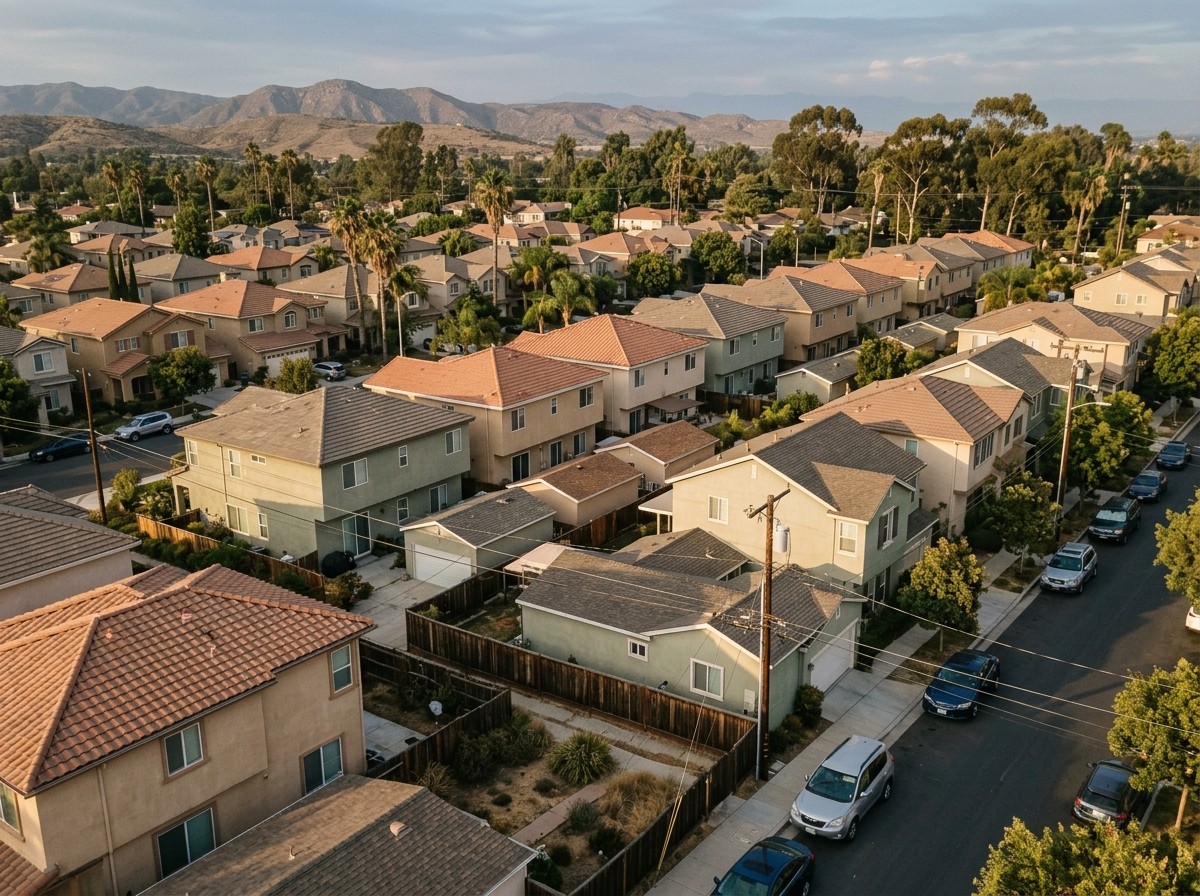
Since 2017, California has dramatically expanded ADU development as a response to the housing shortage. Lots that once held one home and a detached garage now host two, three, sometimes four units, sharing four to ten feet of side-yard separation. Stack that with junior ADUs, SB-9 lot splits, and a steady decade of infill, and the average California suburban parcel has become a much denser combustion environment than it was when the state's Chapter 7A WUI rules were drafted.
That compression is the new frontline.
What Structure-To-Structure Spacing Actually Does To Fire Spread
The phrase "structure-to-structure spacing" sounds antiseptic. The physics it describes is anything but. The Insurance Institute for Business & Home Safety has shown, through controlled burns and instrumented field research, that when extreme winds drive ember showers across a high-density neighborhood, ignition is no longer a single event — it's a chain. Once a few buildings ignite, fire propagates rapidly between structures until conditions diminish.[2]
The California Air Resources Board has been running structure separation burn experiments alongside IBHS and UC Berkeley to put numbers on this behavior, including controlled burns of ADU-scale structures with drone-sampled emissions plumes. Those experiments make a quiet but important point: the relevant unit of analysis is no longer a single home, it's a cluster.[4]
The Los Angeles Times surfaced the same idea after the Palisades and Eaton fires: experts agree that increased density can be safer when paired with current standards and resilient landscaping, but the open scientific question is exactly how close is too close — "It could be 10 feet or 15 feet. No one knows," UC Santa Barbara's Max Moritz told the paper.[5]
What we do know:
Radiant heat from a fully involved adjacent structure can ignite combustible siding at distances comparable to typical California side-yard spacing.
Wind-blown embers travel hundreds of meters and exploit any combustible surface, gap, or unprotected vent on the receiving structure.
Once two adjacent structures are involved, ambient flame and convective heat make defense of the third structure on the line dramatically harder.
So when the Builtech press release calls 4–10 foot spacing a "meaningful shift in how fire safety is being considered," that's the conservative version of the statement.[1]
How California's ADU Boom Compressed Lot Density
The density increase is policy-driven, not accidental. Since 2017, the state has steadily knocked down setbacks, parking requirements, owner-occupancy clauses, and approval timelines for ADUs. The cumulative effect, sustained for almost a decade, is that California's existing single-family lots are absorbing population growth in a way they were never originally permitted for.
Research on land-use patterns and wildfire risk argues this is, on net, a good thing for fire risk overall: infill development concentrates housing inside already-urbanized areas and produces the lowest aggregate wildfire exposure compared to leapfrog or peripheral expansion.[6] Pushing growth inward is better than pushing it deeper into chaparral.
But "better than leapfrog" is not the same as "safe." Within an infill block, density still raises the probability of building-to-building spread, especially when structures are wood-framed, vented through traditional ridge and soffit assemblies, and clad in combustible siding. The aggregate map looks better; the per-block math gets harder.
The second-order effects are subtle but real. Higher density means more ignition sources per square mile — Aaron Liu, founder of Builtech and a Certified Wildfire Mitigation Specialist, points to barbecues as a mundane example: more families hosting them on the same lot, in summer, near other structures.[1] The point isn't that backyard cooking causes wildfires; it's that human ignition density tracks housing density.
The Builtech Case Study: An 850 Sqft Type 1A ADU In San Jose
With that backdrop, the San Jose project becomes more than a press release. It is a working hypothesis about what infill construction should look like under current risk conditions.
The headline numbers from the project:
850 square feet — a typical California detached ADU footprint.
First in San Jose built to Type 1A standards, the highest fire-resistance classification under the IBC and California Building Code.
Approximately $350,000 total cost — comparable to traditional wood-frame construction in the same market.
ICF exterior walls, erected in roughly two weeks once the foundation is complete.
Holistic non-combustible design including fire-resistant windows, a metal roof, and fire-rated vents.[1]
The homeowner, identified only as Eric, framed his decision as long-horizon thinking: "Wildfire risk is here to stay, and I didn't want to wait for it to become real before taking it seriously. If we're building something new, it makes sense to build it stronger from the start and not have to rethink it later."[1]
That sentence is the part that should travel. It captures the actual delta this project represents: not a luxury upgrade, but a quiet reallocation of the same construction budget toward a structure that is designed for the next thirty years of California weather, not the last thirty.
ICF, Decoded: Why The Wall Doesn't Burn
Insulated Concrete Form construction is conceptually simple. Hollow, lightweight foam blocks stack like oversized Legos. Rebar is placed inside the hollow cores. Concrete is poured into the assembly and cures into a continuous reinforced wall. The foam stays in place as both formwork and insulation.[1]
The materials list is the entire fire-safety story:
Concrete — non-combustible.
Rebar — non-combustible.
Expanded polystyrene foam — flame-retardant treated, encased on both faces by concrete and finishes, no exposed combustible cavity.
What that yields, in code terms, is a non-combustible structural wall assembly. What it yields in operational terms is a wall that does not contribute fuel to a fire and does not radiate ignition heat to neighboring structures the way a fully involved wood-framed wall does.
The thermal side benefit is not incidental. The Insulating Concrete Forms Manufacturers Association commissioned CLEB Laboratories to run an accredited whole-wall thermal study comparing a 6-inch ICF wall to a standard 2x6 insulated wood-frame cavity wall. The ICF assembly delivered up to 58% greater effective R-value than the wood-framed assembly — not because the nominal R-value is dramatically higher, but because the continuous concrete-foam-concrete sandwich eliminates thermal bridging and dampens heat-flow swings across the wall.[7]
For a California ADU, that translates into a smaller HVAC system, lower long-run operating costs, and better summer thermal stability — all without changing the fire story.
The Non-Combustible Envelope As One System
ICF walls are necessary, but not sufficient. A wood-roofed, vinyl-windowed, vented-soffit ADU built on top of ICF is still a fire-vulnerable building. The Builtech project recognizes that and treats the envelope as a single fire-rated system:
ICF exterior walls for the main mass of the structure.
Metal roof structure to remove the most common ignition surface from the attic stack.
Fire-resistant windows to limit radiant heat penetration and glass failure under exposure.
Fire-rated vents at attic, eave, and crawlspace openings to deny embers an entry path.[1]
The IBHS field record is unambiguous on why each of these matters. Most home losses in WUI events trace back to one of three failure modes: ember intrusion through unprotected vents, ignition of combustible siding or decking from radiant heat, and roof ignition from accumulated debris.[2] An envelope that closes all three openings simultaneously is what "home hardening" looks like when it's done as one design rather than as a string of post-hoc retrofits. Recent peer-reviewed analysis estimates that home hardening combined with defensible space can reduce structure loss by up to 52% in California WUI events — but only when applied at scale, structure by structure.[8]
The research is also clear that voluntary compliance with home-hardening measures inside California's high-fire-hazard zones is uneven, and that mandated upgrades are still inconsistently enforced.[9] In other words, the technical playbook exists; the deployment is the bottleneck. Buildings like this San Jose ADU shorten that gap by demonstrating that the playbook can be executed within a normal residential budget and timeline.
Cost Parity Is Real — At Least At This Address
The most counter-intuitive line in the Builtech press release is the cost claim. ICF construction is widely reported to add 3–10% to upfront cost compared to wood framing, depending on geography, supplier, and design complexity. That premium is real in many markets.
The San Jose project punches a hole in the assumption by reaching cost parity at roughly $350,000 for an 850-square-foot ADU — comparable to traditional wood-frame construction in the same market.[1]
A few factors plausibly explain the parity at this address:
ICF wall erection compresses to roughly two weeks once the foundation is in, recovering schedule that wood framing would consume.
A non-combustible envelope reduces or eliminates several Chapter 7A WUI assemblies that wood-framed projects would otherwise have to specify and install.
Fewer trades on site means lower coordination overhead and less rework risk.
Lower long-run operating cost — driven by the 58% effective R-value advantage demonstrated in ICFMA's testing — moves part of the cost-of-ownership math out of the construction line item entirely.[7]
The project doesn't prove ICF parity in every California market, and contractors should be honest about that. What it does prove is that the parity case is reachable in a real Bay Area infill context, with a real homeowner, on a real schedule. That alone changes the conversation with the next ten clients.
Code, Classification, And What Type 1A Means In Plain English
"Type 1A" sounds like jargon. In practice, it's the most demanding construction type in Chapter 6 of the California Building Code and the IBC. It requires non-combustible structural materials and the longest fire-resistance ratings — typically reserved for high-rise commercial buildings, hospitals, and other large-occupancy structures where the consequences of structural fire failure are catastrophic.[10]
Applying Type 1A to a residential ADU is, technically, overspec. That's also the point.
A single-family residential ADU in San Jose is not legally required to meet Type 1A. The state's Chapter 7A WUI requirements, where applicable, are far more limited. By voluntarily meeting Type 1A, the Builtech project signals two things:
The hardening choices are not edge cases or niche specifications. They map directly to the code's most stringent classification.
Insurers, lenders, and prospective buyers can evaluate the structure against an industry-standard fire-resistance benchmark, not a one-off marketing claim.
In a state where wildfire-driven insurance non-renewals have made coverage harder to secure and more expensive to keep, that legibility is increasingly part of the asset's resale value, even before the next event arrives.
What Homeowners And Developers Should Specify Before Drawing Plans
For anyone reading this who is about to break ground on an ADU, an SB-9 unit, or a small infill development in California, the operational checklist is short. None of it is exotic. All of it is harder to retrofit than to specify on day one.
Treat the envelope as a system, not a stack of products. The ICF wall is undermined by a vented eave with a residential mesh screen. The metal roof is undermined by a single combustible fascia detail. Specify the assembly end-to-end.
Resolve structure-to-structure spacing at site plan. If the ADU will sit four to ten feet from the primary residence, build both sides of that gap as if they will see flame contact. Do not assume the property line takes care of fire physics.
Use Type 1A as a planning anchor, not a slogan. Even if the project is permitted under residential rules, designing against Type 1A criteria forces the right material choices and removes ambiguity at inspection.
Lock in fire-rated vents and fire-resistant windows during the architectural set. These are the two cheapest places to lose your fire envelope, and the two most common ones in IBHS post-event analysis.[2]
Run the cost story over thirty years, not sixteen weeks. Construction premium, if any, is paid once. Energy savings, insurance posture, and resilience are paid back annually. ICF's 58% effective R-value advantage is the single largest contributor to that long-run math.[7]
None of this requires a rebuild of California's housing stock. It requires that the next ADU, the next SB-9 unit, and the next infill development not be built as if 1995's risk environment still applies.
Where The Science Is Still Incomplete
It would be dishonest to write this blog without flagging what we still don't know.
The exact minimum safe spacing between hardened structures in a high-density California block is an open research question. Experts quoted in the Los Angeles Times' rebuild coverage acknowledge a likely floor of 10–15 feet, but emphasize that the empirical work to fix that number is incomplete.[5] Ongoing work like the CARB and IBHS structure separation burn experiments is closing that gap, but slowly, and the policy environment is moving faster than the science.[4]
The practical implication for builders is conservative: design as if the answer is the upper bound of that range, harden every structure on the lot, and don't lean on spacing alone as a fire strategy.
The Bottom Line
California's housing future will be denser, not less so. The combination of state-level ADU laws, SB-9 lot splits, and continued infill pressure is structural, not cyclical. Within that future, building-to-building fire spread becomes a primary, not secondary, risk — and the WUI mental map stops being the right tool for the job.
The Builtech project in San Jose is not a moonshot. It is an existence proof that an 850-square-foot, Type 1A, ICF-walled, metal-roofed, fire-vented ADU can be delivered for roughly the cost of a wood-frame equivalent, on roughly the same schedule, by a licensed California contractor. The technology is mature. The materials are available. The cost parity is reachable.
What's missing is repetition. The California block that survives the next wind-driven event will not look like the block that survives an average summer. It will look like a row of structures specified, from the foundation up, to refuse to participate in the chain.
FAQs
How close can adjacent buildings be before wildfire spreads structure-to-structure?
Wildfire researchers have not pinned a single safe number, but UC Santa Barbara's Max Moritz and others working with IBHS and CARB suggest the danger zone likely starts somewhere between 10 and 15 feet under wind-driven conditions. Most California ADU lots now compress that gap to four to ten feet, which is why every structure on the parcel needs to be hardened, not just the one nearest the wildland.
Are insulated concrete form (ICF) walls actually fireproof?
ICF walls are not "fireproof" in any absolute sense, but they are non-combustible by code definition. The reinforced concrete core and flame-retardant foam, encased between concrete and finish layers, do not contribute fuel and significantly slow heat transfer. In Type 1A assemblies, ICF walls routinely achieve multi-hour fire-resistance ratings, which is why the Builtech ADU uses them as its primary envelope strategy.
Does a Type 1A ADU cost more than a wood-framed ADU in California?
Not necessarily. The Builtech project in San Jose came in at roughly $350,000 for an 850-square-foot Type 1A ICF ADU — comparable to traditional wood-frame construction in the same Bay Area market. Cost parity isn't guaranteed everywhere, but faster wall erection, fewer Chapter 7A retrofits, and reduced operating costs from a 58% effective R-value advantage close most of the gap.
Why are fire-rated vents so important in California ADU construction?
IBHS post-event analysis consistently shows that ember intrusion through unprotected attic, eave, and crawlspace vents is one of the top three causes of home loss in wildfire events. Fire-rated vents physically block flame and embers from reaching combustible attic insulation and framing, which means a single small component upgrade can prevent a complete structure loss during ember storms.
Is California's WUI map still the right way to think about wildfire risk?
The WUI map is necessary but no longer sufficient. CAL FIRE's Office of the State Fire Marshal still anchors policy on WUI-zone construction, defensible space, and hazard mapping, but a decade of ADU densification and infill has moved building-to-building fire spread risk inside non-WUI urban blocks. Treat your block's geometry, not just the official WUI overlay, as part of the risk picture.
Can defensible space alone protect a high-density California neighborhood?
No. Defensible space is essential for reducing initial vegetation-to-structure ignition, but it does little to stop building-to-building fire spread once a single home is fully involved on a lot four to ten feet from its neighbor. Peer-reviewed analysis estimates that combining home hardening with defensible space can reduce structure loss by up to 52%, but neither pillar works on its own.
What is the difference between Chapter 7A and Type 1A construction in California?
Chapter 7A of the California Building Code sets material and assembly standards for structures inside designated WUI fire-hazard zones, covering ignition-resistant siding, vents, eaves, decks, and roofing. Type 1A is the highest fire-resistance classification under Chapter 6, requiring non-combustible structural materials and the longest fire-resistance ratings. Type 1A is far more demanding and is normally reserved for high-rises, hospitals, and large-occupancy commercial buildings.
How long does it take to build an ICF ADU in California?
On the Builtech San Jose project, the ICF exterior wall system was erected in roughly two weeks once the foundation was complete. Total project timelines remain comparable to wood-frame ADUs because foundation, MEP, finishes, and inspections still drive most of the schedule. The compressed wall-erection phase often offsets the additional concrete cure time, keeping ICF schedules competitive in California's permitting environment.
Do ICF walls improve energy efficiency in California climate zones?
Yes, significantly. CLEB Laboratories' ICFMA-commissioned whole-wall thermal study found a 6-inch ICF wall delivered up to 58% greater effective R-value than a standard 2x6 wood-framed wall, primarily by eliminating thermal bridging through studs. In California's warm-to-hot climate zones, that translates into smaller HVAC equipment, lower cooling loads, and more stable indoor temperatures during heat waves and grid stress events.
What should I tell my contractor if I want a fire-resilient infill ADU in California?
Ask for the envelope as a single non-combustible system, not a stack of upgrades. Specifically request ICF or equivalent non-combustible exterior walls, a metal roof, fire-resistant windows, and fire-rated vents at every attic, eave, and crawlspace opening. Reference Type 1A criteria as your design anchor, and ask the contractor to document structure-to-structure spacing assumptions on the site plan.
Related resources
IBHS — Wind-Driven Building-to-Building Fire Spread research summary, the clearest field reference on why density turns ignition into propagation: https://ibhs.org/wildfire/wind-driven-building-to-building-fire-spread/
CAL FIRE Office of the State Fire Marshal — Wildland Hazards and Building Codes overview, the official state framing of construction-method, defensible-space, and hazard-mapping pillars: https://osfm.fire.ca.gov/what-we-do/code-development-and-analysis/wildland-hazards-and-building-codes
Los Angeles Times — "Can fire-gutted suburbs rebuild safer? Here's what the experts say" — useful long-form coverage of the density-vs-fire tradeoff after the 2025 Los Angeles fires: https://www.latimes.com/california/story/2025-03-12/can-devastated-communities-rebuild-differently-for-the-next-wildfire
References
[1] Builtech Construction Group via Construction Owners Club — A New Precedent for Fire Safety in High-Density Housing Across California, April 2026.
[2] Insurance Institute for Business & Home Safety — Wind-Driven Building-to-Building Fire Spread.
[3] CAL FIRE Office of the State Fire Marshal — Wildland Hazards and Building Codes.
[4] California Air Resources Board — July 2024 Structure Separation Burn Experiment.
[5] Los Angeles Times — Can fire-gutted suburbs rebuild safer? Here's what the experts say, March 2025.
[6] California YIMBY — The Impact of Land Use Planning on Wildfire Risk: A Study in Southern California.[7] Element ICF — Summary of the ICFMA / CLEB Laboratories whole-wall thermal study (up to 58% greater effective R-value vs. 2x6 wood frame).
[8] PMC — Fire risk to structures in California's Wildland-Urban Interface.
[9] ScienceDirect — High fire hazard WUI residences in California lack voluntary and mandated wildfire risk mitigation compliance in Home Ignition Zones, 2025.
[10] UpCodes — California Building Code, Chapter 6: Types of Construction.