Why Wildfire Insurance Settlements Block Resilient Rebuilds
California's January 2025 wildfires destroyed around 13,000 homes and highlighted the gap between insurance settlements and the cost of resilient rebuilds. Settlements typically cover only the value of what was lost, pushing homeowners toward like-for-like rebuilds instead of fire-resistant upgrades. Effective mitigation strategies include ember-resistant vents and fire-rated roofing, which can reduce insurance premiums by up to 18%. Builders must engage homeowners in a cost-effective, tiered approach to resilience to close the settlement-rebuild gap and encourage safer rebuilding practices.
Authors:


TLDR
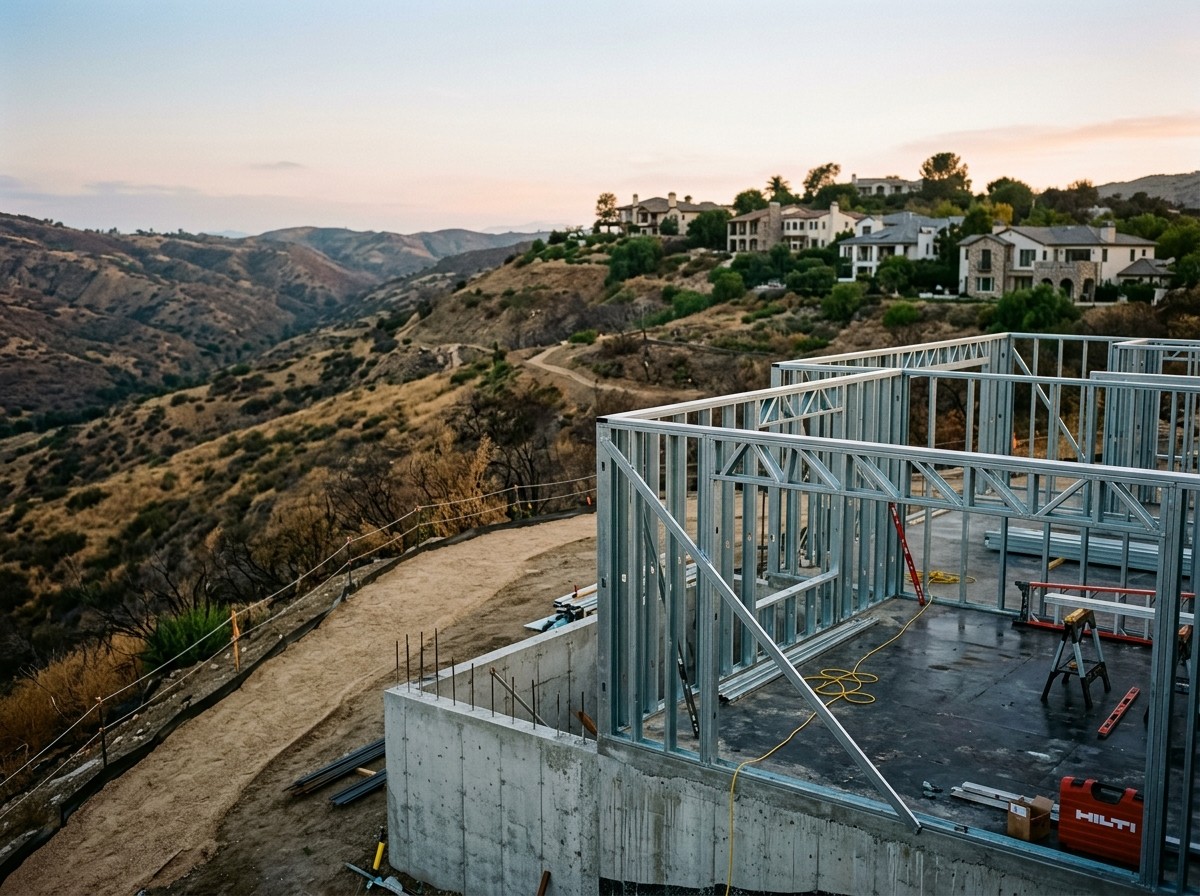
California's January 2025 wildfires destroyed approximately 13,000 homes, killed 31 people, and burned more than 38,000 acres — most of those homes are now being rebuilt as wood-framed replicas.[1]
Builtech Construction Group founder Aaron Liu argues the freeze on resilient rebuilds is structural: insurance settlements typically cover the value of what was lost, not the upgrade cost of a hardened replacement.[1]
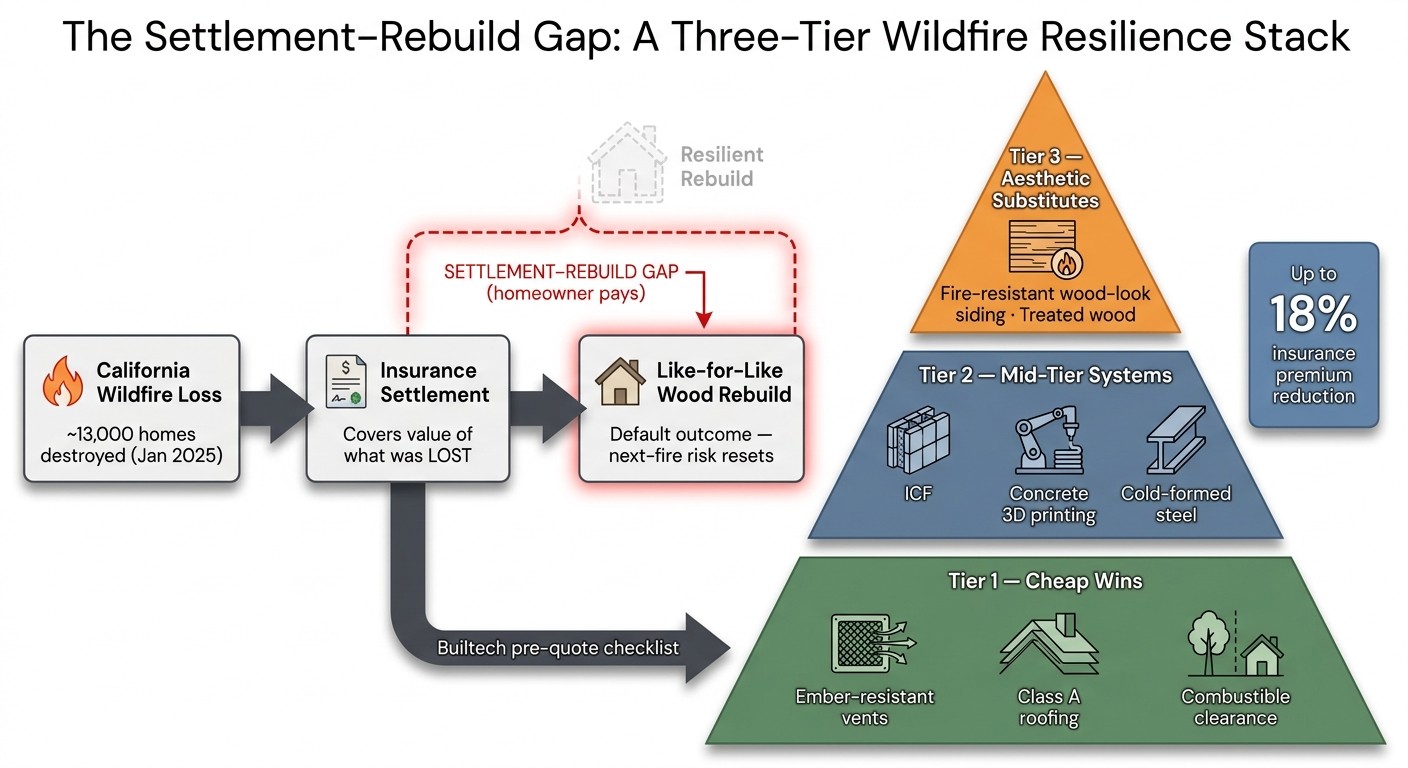
Three layers of mitigation actually move the cost curve: cheap hardening (ember vents, Class A roofing, clearance), mid-tier systems (ICF, concrete 3D printing, cold-formed steel), and fire-resistant siding that protects the traditional aesthetic.[1]
Home-hardening strategies can produce California insurance premium reductions of up to 18%.[1]
For homes that survived, the strongest play is incremental retrofit — not full reconstruction.[1]
The Settlement-Rebuild Gap In One Paragraph
California's January 2025 wildfires destroyed roughly 13,000 homes, killed 31 people, and burned more than 38,000 acres across Pacific Palisades, Malibu, Altadena, and Pasadena.[1] More than a year later, LA County's rebuild is still sluggish — only a limited number of homes are fully reconstructed and a few hundred are under construction.[1] The houses that are going up are largely wood-framed replicas of the houses that burned. Aaron Liu, founder of Builtech Construction Group and a certified wildfire mitigation specialist, has been direct about why in a recent Insurasales field note: insurance settlements typically cover only the value of what was lost, which structurally pushes homeowners toward like-for-like rebuilds and away from the upgrades that would meaningfully reduce next-fire risk.[1] The result is a market-wide pattern Builtech sees on every project intake: not absent will, not absent options, but a settlement-rebuild gap that nobody on the homeowner's side is paid to close.
What Aaron Liu Documented In Insurasales
Liu's Insurasales piece is short, but every sentence is load-bearing for builders working the WUI. He calls out three failure modes Builtech sees in the field: emotional and financial fatigue post-disaster, settlements that are sized to what was lost rather than what should be built, and a baseline awareness gap among homeowners who believe fire-resistant construction is the exclusive territory of high-end builds.[1]
He also lays out a counter-thesis. Cost-effective wildfire resilience is not aspirational — it is available today, in tiers a normal household budget can absorb if planned correctly. The Insurasales note specifically calls out clearance of combustible materials, ember-resistant vents, fire-rated roofing, and a step up to insulated concrete forms (ICF), concrete 3D printing, and cold-formed steel framing.[1] For homeowners who want their rebuild to look like the home they lost, Liu points to fire-resistant siding materials that mimic wood and treatments that improve the resistance of wooden structures.[1]
Why The Settlement Gap Is Structural
Insurance is fundamentally a backward-looking instrument. A settlement on a standard California homeowner's policy is sized to the replacement value of what existed before the loss. That is not a moral failure of the carrier; it is the math the policy was priced on. The problem only emerges when the math collides with a wildfire-prone microclimate where the optimal rebuild is materially different from the structure that just burned.
Liu's point in Insurasales is that this collision is now the rule, not the exception, in places like the Palisades and Altadena.[1] If the original home was wood-framed and the new home is also wood-framed, the settlement closes cleanly and the rebuild starts the next loss clock. If the homeowner wants ICF walls, a cold-formed steel envelope, or a 3D-printed concrete shell, the upgrade cost is on them.
That is the gap Builtech now treats as a primary client conversation, not a footnote. Most of our intake meetings are spent helping a household compare three rebuild scenarios at once, with their actual settlement number as the constraint and resilience tiers as the variable.
The 38,000-Acre Lesson From The January 2025 Fires
The January 2025 fires are not an abstraction for any California builder. Thirteen thousand destroyed homes across four neighborhoods is a once-a-decade industrial reset, and the slow pace of LA County's rebuild — limited fully reconstructed homes, a few hundred under construction more than a year out — tells you a lot about how settlements, permitting, supply chains, and emotional bandwidth are interacting in the real world.[1]
The earlier Mountain fire, which significantly affected Somis and Camarillo, extended that pattern into Ventura County.[1] Each of these neighborhoods has different building stock, different parcel geometry, and different wildfire exposure profiles, but the rebuild dynamic is consistent: the path of least resistance is to put up the same house. The lesson Builtech has taken from the field is that without an active intervention from the builder — a side-by-side cost-plus-resilience presentation, alternative-materials specs, and a frank settlement-gap conversation — the default outcome is a wood-framed replica.
The Awareness Problem: Resilience Is Cheaper Than Most Homeowners Think
The most quietly damaging line in Liu's Insurasales note is the awareness gap. Many homeowners believe fire-resistant construction is prohibitively expensive or only suitable for affluent individuals, when in fact a meaningful share of the resilience curve costs almost nothing relative to the rebuild itself.[1]
That misconception has two costs. First, it discourages homeowners from asking, which means builders never get to make the case. Second, it skews the few conversations that do happen toward the most premium options, which then reconfirm the misconception. The cure is not a marketing campaign — it is a triage conversation at intake, where the homeowner is shown the cheapest 60% of resilience gains explicitly priced against the entire rebuild budget.
Liu's framing reinforces a point Builtech has been making to homeowner clients for years: most of the wildfire-resilience curve is unlocked by simple modifications, not exotic systems.[1] The expensive tier is real, but it is not the entry point.
Builtech's Three-Tier Materials Stack: Cheap Wins, Mid-Tier Systems, Aesthetic Substitutes
The Insurasales note groups Builtech's resilience options into three implicit tiers, and Builtech treats them that way on every project.
Cheap wins. Clearance of combustible materials, ember-resistant vents, and fire-rated roofing.[1] These are line items most homeowners can afford on the standard rebuild budget. They do not require a different framing system or a different aesthetic. They have outsized leverage relative to their cost because they address the most common ignition mechanisms — wind-driven embers entering attics, ignitions from radiant heat through combustible roof assemblies, and ignitions from yard fuel directly adjacent to the structure.
Mid-tier systems. Insulated concrete forms (ICF), concrete 3D printing, and cold-formed steel framing.[1] Each replaces or augments traditional wood framing. ICF gives a poured-concrete wall with stay-in-place insulation; concrete 3D printing produces structural walls in layered courses with reduced framing labor; cold-formed steel removes wood from the framing assembly entirely. None of these are exotic in 2026 — but each requires the homeowner to make the decision early in design, and each lives or dies based on whether the builder is willing to walk through the cost-vs-resilience math honestly. Builtech finds this is where the settlement gap is most visible and where the most negotiation happens.
Aesthetic substitutes. Fire-resistant siding materials that mimic wood, plus treatments for wooden structures that improve resistance.[1] This tier matters because the most common reason homeowners refuse a higher-tier framing decision is not cost — it is the aesthetic. They want the home to look like the home they lost. Fire-resistant siding closes that gap without forcing the homeowner to abandon the look that brought them to the neighborhood in the first place.
The 18% Premium Reduction: What It Actually Buys
Liu's Insurasales note cites premium reductions of up to 18% for homes that employ home-hardening strategies.[1] That number deserves to be unpacked rather than printed in a brochure.
A few things to keep straight. First, up to 18% is a ceiling, not an average; achieving it typically requires meeting multiple discrete hardening criteria, not just one. Second, the 18% applies to the wildfire-relevant portion of the premium, which is the part most subject to year-on-year volatility in California's rate environment. Third, the discount math compounds with whatever broader market shift the carrier is going through: every dollar of premium reduction now is also reducing the base on which next year's increase will be calculated.
For Builtech's purposes, the 18% number is most useful as a planning anchor in the homeowner conversation. If the cheap-wins tier alone produces a meaningful chunk of that ceiling, the marginal cost of those upgrades effectively pays for itself within a knowable window — a number the homeowner can take to their carrier and broker before a rebuild design is locked in. That conversation is impossible if the rebuild is already framed in wood.
Why Building Codes Alone Don't Close The Gap
Liu is explicit that California building codes establish a baseline but may not fully address wildfire risks.[1] For a homeowner, that has a specific operational meaning: a code-compliant rebuild is not, by itself, a wildfire-resilient rebuild. The cheap-wins tier — clearance of combustibles, ember-resistant vents, fire-rated roofing — sits on top of code, not inside it.[1]
This distinction is where most homeowners trip on the rebuild market. Code-compliant feels like a quality bar. It is actually a floor. The carriers that offer hardening discounts are pricing the gap between that floor and the actual hardening profile of the property, which is why Liu's three-tier framing is consistent with how the underwriting side of the industry already thinks.
Closing The Gap: The Builtech Pre-Quote Checklist
Builtech now runs every WUI rebuild client through a pre-quote checklist before any framing decision is made. The checklist is designed to surface the settlement gap before it becomes a sunk cost.
The checklist runs in this order: confirm the actual settlement number and any state or municipal rebuild assistance the household qualifies for; price the cheap-wins tier as a non-negotiable line item; price the mid-tier system options (ICF, concrete 3D printing, cold-formed steel) at a real-cost level rather than a sticker level; price the aesthetic-substitute tier separately, because most homeowners will pay for it once they see the framing-tier savings it unlocks; and finally, run a side-by-side hardening discount estimate with the homeowner's broker before the rebuild design is signed.
This sequence does not magically close the gap on every project, but it surfaces it early enough that the homeowner is choosing rather than defaulting. Builtech's working assumption is that a homeowner who actively chooses a wood-frame rebuild after seeing all three tiers is making a different decision than a homeowner who never saw the tiers at all — and a different decision than the one Liu calls out in Insurasales as the current default.[1]
Retrofitting A Survivor: The Quieter Half Of The Rebuild Market
The Insurasales note also addresses the homes that survived. Liu argues that for surviving homes, enhancing existing structures can meaningfully mitigate future fire risk, and that incremental upgrades to materials and design elements can reduce vulnerability without the cost of full reconstruction.[1]
This is the quieter half of Builtech's 2026 book. Surviving homes have a different settlement dynamic — there is no full rebuild settlement to anchor the conversation, and the upgrades are pure out-of-pocket spend. But they also have the structural advantage of an existing slab, existing framing, and an intact envelope. The cheap-wins tier — clearance, ember vents, fire-rated roof replacement at next reroof — is almost always the right starting point for these projects, because the discount and risk-reduction math is favorable per dollar spent.
For survivor projects, Builtech's order of operations is roof, vents, perimeter clearance, exterior treatment, then any structural intervention if the project budget supports it. That sequence is calibrated to the same insurance-discount logic as the rebuild market — the goal is to monotonically improve the property's hardening profile without forcing the homeowner into a full demolition decision.
The 2026 Outlook
The settlement-rebuild gap is not going to close on its own. Carriers are not going to start sizing settlements to best resilient replacement by default — the industry's pricing logic does not support that, and the regulatory machinery has not yet shifted to require it. The realistic 2026 path is the one Liu is already walking in Insurasales: a builder-led, cost-honest, three-tier conversation that lets the homeowner make a non-default decision before the rebuild is framed.[1]
For Builtech, the 38,000 acres and 13,000 homes are the demand signal. Every wood-framed replica going up in the Palisades, Altadena, Malibu, and Pasadena is a future settlement claim if the next fire arrives on the same wind. The job, every Monday morning, is to get to the next homeowner with the math before the framing crew does.
FAQs
Why are homes destroyed in the January 2025 California wildfires being rebuilt with wood framing?
Most reconstructed homes mirror those destroyed because of two compounding pressures Aaron Liu describes in Insurasales: emotional and financial fatigue after a total loss, and insurance settlements that are sized to the value of what was lost rather than the cost of a more resilient rebuild. The result is structural rather than cultural — wood framing is the path of least resistance once the settlement number is locked in.
Will my California wildfire insurance settlement cover the upgrade to a fire-resistant rebuild?
Generally no. Standard California homeowner settlements are designed to cover the replacement value of what existed at the time of loss, not the marginal cost of a hardened or alternative-material rebuild. If you want ICF walls, cold-formed steel framing, or a 3D-printed concrete shell after a wood-framed home is lost, the upgrade cost typically falls on the homeowner. That gap is exactly what Liu calls out as the settlement-rebuild gap.
What are the cheapest fire-resistant construction upgrades a California homeowner can make?
Per Liu's Insurasales note, the highest-leverage cheap upgrades are clearance of combustible materials around the structure, installation of ember-resistant vents, and selection of fire-rated roofing. These are simple modifications most often available within a normal rebuild budget, and they target the most common wildfire ignition mechanisms — windborne embers, radiant ignition through roof assemblies, and ground-level fuel adjacent to the structure.
What is an insulated concrete form (ICF) and is it suitable for California wildfire zones?
Insulated concrete forms (ICF) are stay-in-place foam blocks filled with reinforced concrete that produce structural walls with high fire resistance and strong thermal performance. Liu's Insurasales note lists ICF among the affordable fire-resilient construction methods Builtech specs in California's wildfire-prone zones. Like any framing decision, ICF is most cost-effective when chosen at design rather than retrofitted later in the project.
How much can California homeowners save on insurance with wildfire home-hardening strategies?
Per Liu's Insurasales note, fire-resistant construction can yield insurance premium reductions of up to 18% when home-hardening strategies are employed. That figure is a ceiling, not an average, and typically requires meeting multiple discrete hardening criteria. The 18% applies to the wildfire-relevant portion of the premium — the volatile component most exposed to California's current rate environment.
Can I keep a traditional wood-look exterior on a fire-resistant California rebuild?
Yes. Liu's Insurasales note specifically points to fire-resistant siding materials that mimic wood and treatments that improve the resistance of wooden structures. These options exist precisely so that homeowners who want their rebuild to look like the home they lost are not forced to choose between aesthetics and resilience. Builtech treats this aesthetic-substitute tier as the bridge that makes the framing-tier conversation realistic.
Is concrete 3D printing actually used for California single-family wildfire rebuilds?
Concrete 3D printing is one of three innovative construction methods Liu's Insurasales note cites as affordable fire-resilient options for California homes, alongside ICF and cold-formed steel framing. Adoption is still scaling, but the method produces structural walls in layered concrete courses with reduced framing labor, which can offset some of the upgrade cost relative to traditional construction. Permitting and contractor availability vary by jurisdiction.
Should homeowners whose houses survived a wildfire upgrade them, or wait for the next event?
Liu argues in Insurasales that surviving homes should be enhanced rather than left at baseline. Incremental upgrades — fire-rated roofing at next reroof, ember-resistant vents, perimeter clearance, exterior treatments — can meaningfully reduce future-fire vulnerability without the cost of full reconstruction. For these projects, Builtech's standing recommendation is to sequence upgrades around the cheap-wins tier first and treat structural interventions as optional based on budget.
Are California building codes alone enough to make a home wildfire-resistant?
No. Liu notes in Insurasales that while building codes establish baseline requirements, they may not fully address wildfire risks. Code compliance is necessary but typically insufficient in high-exposure WUI zones. Closing the gap requires homeowners and builders to add hardening measures on top of code — clearance, ember-resistant vents, fire-rated roofing, and where budget allows, alternative framing systems like ICF or cold-formed steel.
How do I know if a builder is taking the wildfire settlement-rebuild gap seriously?
Look for a builder who runs a pre-quote conversation about your actual settlement number, prices the cheap-wins tier as a non-negotiable line item, presents mid-tier framing alternatives at real cost, separates the aesthetic-substitute tier from the framing decision, and coordinates with your insurance broker on hardening discounts before any framing is signed. If the rebuild quote you receive is a wood-framed like-for-like with no alternatives presented, the gap conversation never happened.
Related resources
Insurasales — Adapting to California's Wildfire Threat: Proactive Construction Solutions — the source field note from Aaron Liu underpinning this playbook.
IBHS Wildfire Prepared Home — the certification standard most often cited as the structural baseline for hardening discount programs.
California Department of Insurance — Wildfire Resources — the state's central hub for wildfire-related insurance regulation, hardening guidance, and discount frameworks.