Wildfire Rebuilds: When $1M in Permits Won't Save Your Home
Homeowners rebuilding after wildfires often spend nearly $1 million on design and permits but end up with vulnerable wood-framed homes. To enhance fire resilience, options like concrete 3D printing, insulated concrete forms, and cold-formed steel framing are now accessible and often competitively priced. Key mitigation strategies include creating a five-foot ember-resistant zone, using ember-resistant vents, and installing Class A roofing, which can also lead to insurance discounts. The focus should be on investing in survivable construction rather than merely meeting code requirements.
Authors:


TLDR
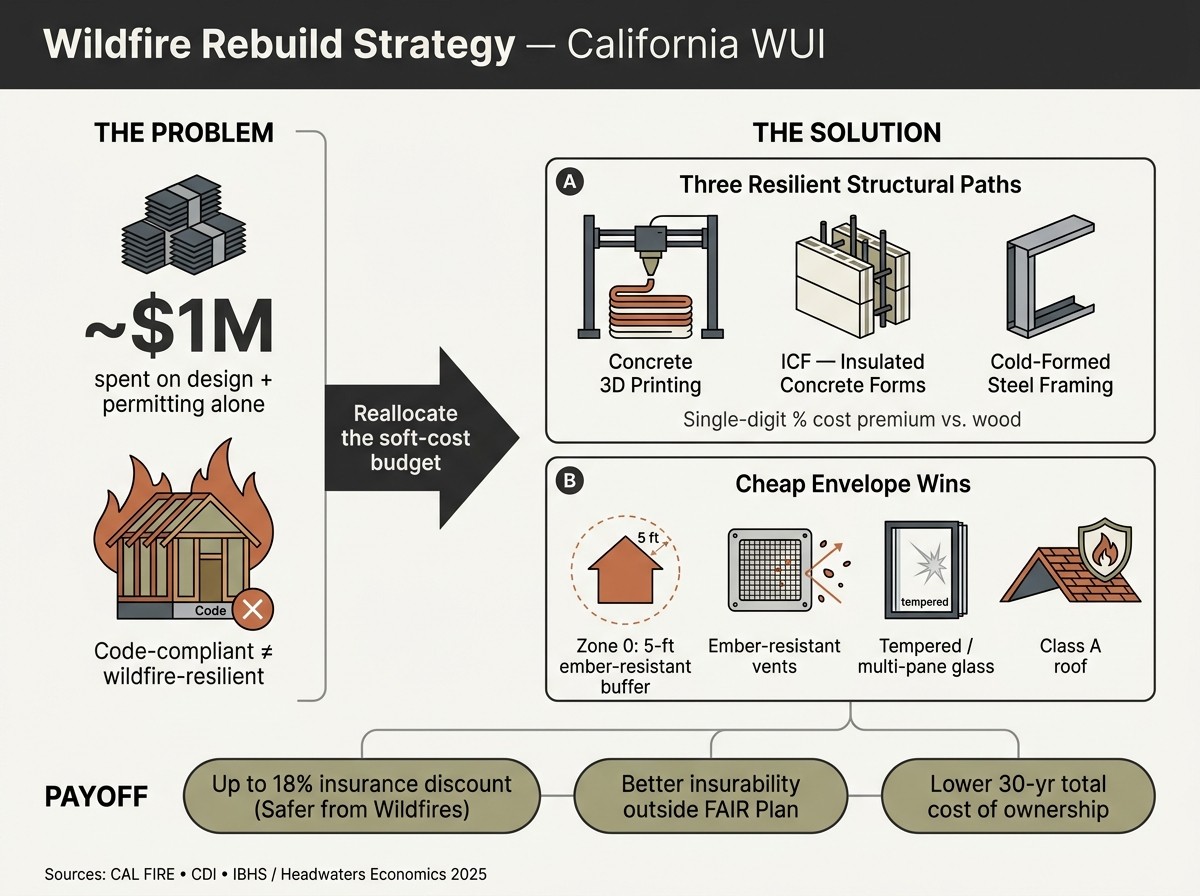
Some California homeowners rebuilding after recent wildfires are spending close to $1M on design and permitting alone, then ending up with code-minimum wood-frame homes that remain vulnerable to the next ember storm.[1]
Code compliance is not wildfire resilience. California building codes set minimums; surviving wind-driven embers requires hardening choices most stock plans never specify.[1][6]
Three non-combustible paths — concrete 3D printing, insulated concrete forms (ICF), and cold-formed steel framing — are now within reach of mainstream rebuild budgets and frequently price closer to wood than homeowners assume.[1][3][4]
The cheapest mitigation gains live in Zone 0, ember-resistant vents, tempered glass, and a Class A roof — and they trigger California's Safer from Wildfires insurance discounts of up to 18%.[1][5][7]
The strategic question after the next fire isn't rebuild fast or rebuild cheap. It's where does the money actually buy survivability? — and the math now favors resilient construction.
The Million-Dollar Mistake Hiding Inside Your Insurance Check
In January 2025, wildfires burned more than 38,000 acres across Pacific Palisades, Malibu, Altadena, and Pasadena, killing 31 people and destroying roughly 13,000 homes. Months earlier, the Mountain fire tore through Somis and Camarillo.[1] More than a year later, fewer than a dozen of those L.A. County homes have been fully rebuilt, and only a few hundred are even under construction.[1][2]
The most expensive line item in many of those rebuilds isn't the framing, the foundation, or the finishes. According to certified wildfire mitigation specialist Aaron Liu, families have reported spending close to a million dollars on design and permitting alone before a single wall goes up.[1] That money buys architects, expediters, plan checks, soil reports, drainage studies, fire-department reviews, utility coordination, and the long tail of revisions that California jurisdictions now require.
What it does not buy is a more survivable home. Most of those plans return a wood-framed structure that meets code — and code, in a wildfire, is a floor, not a ceiling. Homeowners are routinely paying premium-tier fees to reproduce the same building envelope that just burned. The problem isn't the spend. The problem is what the spend is buying.
Why Code-Compliant Wood Framing Is Already Obsolete in WUI Zones
California's Chapter 7A WUI code was a real step forward — Class A roofs, ignition-resistant siding, ember-resistant vents, tempered or multi-pane glazing — but it was written to a baseline. It assumes a fire approaching from a defined direction, a maintained property line, and a building envelope that holds up just long enough. It does not assume what we actually saw in Palisades and Altadena: hours of wind-driven embers landing in attic vents, eaves, deck cavities, and fence-to-wall connections, igniting homes long after the flame front had moved on.[6][10]
A code-compliant wood-frame home in 2026 still has wood studs, wood sheathing, wood blocking, and wood top plates inside the assembly. Once an ember finds a path through a vent, a soffit, or a gap around a window, those materials are fuel. The building burns from the inside out, regardless of how fire-rated the exterior cladding is. Many of the homes that survived recent fires did so not because they passed code, but because their owners went past it — fire-rated walls without eaves, perimeter stone, tempered glass, and concrete construction.[10]
This is the gap the permit set won't tell you about. A plan that meets code and a plan that meaningfully reduces ember vulnerability are two different documents.
Where the Permit and Design Money Actually Goes
When a rebuild file climbs toward seven figures in soft costs, it usually breaks down into a few buckets: architectural and structural design, civil and grading, fire-department and hillside review, plan check and permits, expediters who shepherd the file, and the months of staff time spent on revision cycles. Each bucket is defensible on its own. Stacked together on a custom rebuild in a hillside WUI parcel, they add up fast.[2]
LA County has tried to compress that timeline with like-for-like rebuild paths and AI-assisted plan check pilots. Those tools shave weeks off the permit critical path, but they do not change the underlying envelope — they speed up approval of essentially the same wood-frame house that burned.[2]
The more useful reframe: treat the soft-cost budget as a single pool of capital and ask how much of it could move into the building system itself. Even a 10–15% reallocation from design and permitting toward a non-combustible structural method can be enough to swap wood framing for cold-formed steel or to upgrade a perimeter wall assembly to ICF without changing the overall delivered cost of the project.
The Three Resilient Construction Paths That Out-Earn Their Premium
Three non-combustible structural systems are now mature enough for single-family rebuilds in California, and each plays a slightly different role.
Concrete 3D printing. A robotic gantry extrudes layered concrete walls from a digital model, producing a continuous monolithic envelope with very few seams or cavities for embers to penetrate.[1] The labor footprint is small, the schedule is predictable, and the resulting wall has inherent fire, pest, and seismic performance built in.
Insulated concrete forms (ICF). Hollow polystyrene blocks stack like bricks, get filled with reinforced concrete on site, and yield a load-bearing wall with continuous insulation, very high thermal mass, and a multi-hour fire rating. ICF is the most architect-familiar of the three systems and integrates cleanly with traditional finishes.[1][3]
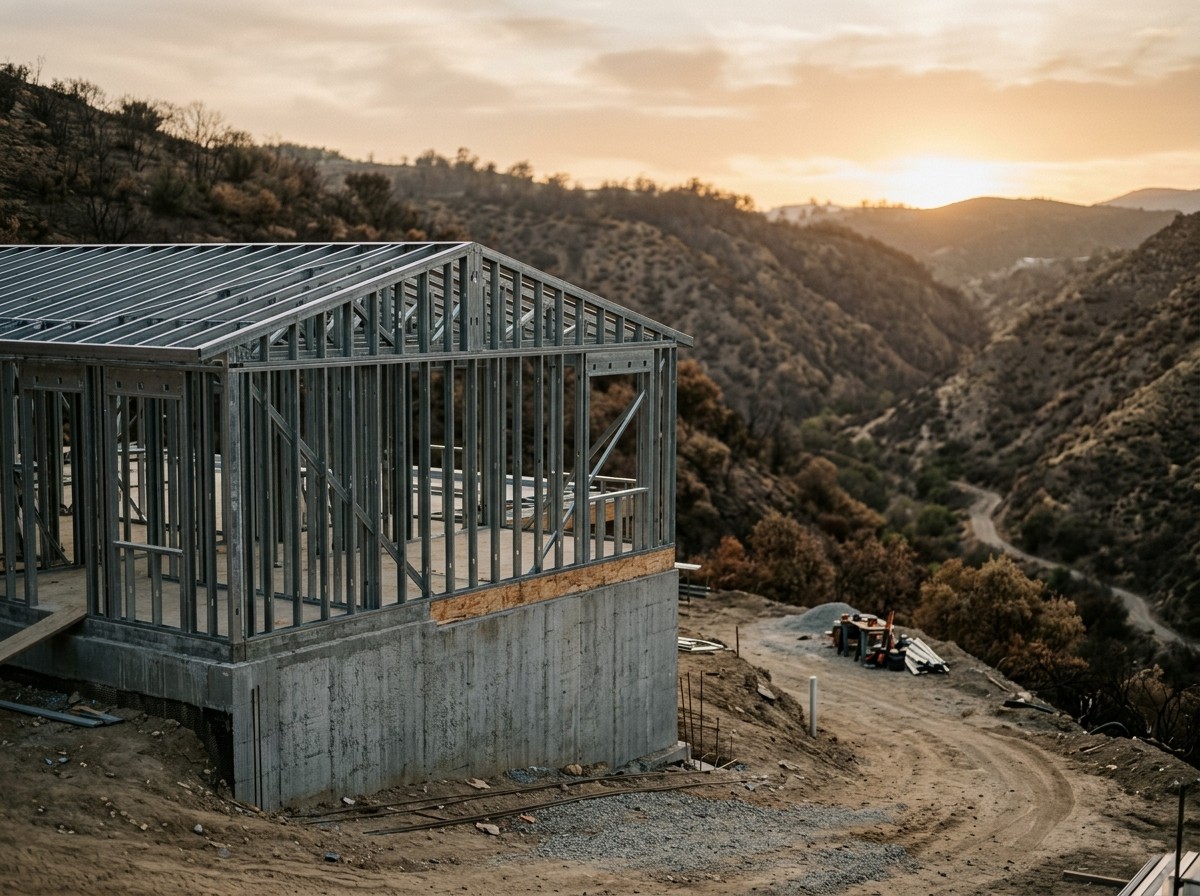
Cold-formed steel framing. Light-gauge steel studs replace dimensional lumber stud-for-stud. The geometry stays familiar to wood-trained framers, the material is non-combustible, and the studs do not warp, shrink, or feed termites. It is often the lowest-friction switch for a builder transitioning out of wood.[1]
Delivered cost varies by builder, design complexity, and finish package, but recent IBHS and Headwaters Economics work shows wildfire-resistant material packages typically add a single-digit percentage to total construction cost — far less than most homeowners assume, and dramatically less than the all-in cost of losing the house twice.[4] For homeowners who want the visual language of a traditional home, fire-resistant siding and treated wood-look cladding can sit on top of any of these structural systems without giving up resilience.[1]
Embers, Vents, and the Five-Foot Zone: Cheap Wins You Can't Skip
Even with the most resilient structure money can buy, the building still loses if the envelope leaks embers. The cheapest mitigation gains in a rebuild aren't structural at all.
Zone 0 — the first five feet. California now treats the area within five feet of a structure as the ember-resistant zone. Hardscape, gravel, and noncombustible fencing replace mulch, wood gates, and shrubs that would otherwise act as wicks straight to the wall.[5] Liu argues that this single five-foot buffer can make the difference between ignition and survival, and it is one of the lowest-cost moves in the entire mitigation toolkit.[1]
Ember-resistant vents. Standard attic and crawlspace vents are the single most common ignition path in WUI events. CAL FIRE recommends replacing them with State Fire Marshal–listed flame- and ember-resistant vents, or covering existing openings with 1/16- to 1/8-inch noncombustible metal mesh.[6]
Tempered glass and Class A roofing. Tempered or multi-pane glazing resists radiant heat long enough to keep curtains and interior fuels from auto-igniting. A Class A roof — concrete tile, metal, or rated composition — refuses ember pile-up at the most exposed surface of the home.[1]
None of these items are exotic. Almost all of them are catalog-grade. They simply have to be specified, drawn into the plan set, and inspected — which is exactly what an expensive permit set should be doing in the first place.
How Insurers Are Quietly Repricing Construction Method
The insurance market is the second leg of the economic case. After the 2022 Safer from Wildfires regulation, California carriers must offer documented premium discounts for specific mitigation actions: Class A roof, ember-resistant vents, defensible space, multi-pane glazing, enclosed eaves, and noncombustible Zone 0.[7] Stack the qualifying upgrades on a single property and the combined wildfire-portion discount can reach 18% or more, depending on insurer.[1]
Research on early implementation has been honest about the limits — for many homeowners the per-line discount is small relative to the cost of retrofits.[8] But the bigger story isn't the discount line; it's insurability itself. Carriers are increasingly cautious about wood-frame homes in the WUI, while documented fire-resistant construction is far easier to bind at competitive rates outside the FAIR Plan.[8][10] For a homeowner deciding between wood and ICF on a hillside parcel, the relevant comparison isn't premium A vs. premium B — it's coverage available vs. coverage not available.
A Real Math: 30-Year Cost of Wood vs. Resilient Builds
For most homeowners, the right horizon for this decision isn't one rebuild. It's the full ownership period.
A standard wood-framed rebuild has a known up-front number, a known monthly insurance trajectory under tightening underwriting, and an unknown but non-zero probability of partial or total loss in the next major event. Recent claims experience tells us the loss path is not just the structure: it is years of permits, temporary housing, design fees, replaced belongings, and life disruption.[1][2]
A resilient rebuild — concrete 3D-printed, ICF, or cold-formed steel — has a slightly higher up-front number, a flatter (and often lower) insurance trajectory under Safer from Wildfires, and a meaningfully lower probability of total loss in the next event.[4][7] Over 30 years, the resilient build wins on expected total cost in any scenario where the structural premium stays in the single-digit percentages — which is exactly where current data places it.[4]
This is not a marketing claim. It is what the IBHS cost study, the CDI discount schedule, and the loss histories of the last two California fire seasons jointly imply. The wood-frame rebuild is the speculative choice; the resilient rebuild is the conservative one.
What to Do This Week If You're Rebuilding Now
If you are mid-rebuild or just starting, three moves are worth making before the next architect meeting.
Ask your designer for a one-page comparison of three structural options at the same square footage and finish level: wood frame, cold-formed steel, and ICF (or 3D-printed concrete where the lot allows). Insist on a single delivered-cost number for each, not an apples-to-oranges quote.
Ask your insurance broker for a Safer from Wildfires worksheet on your draft plan set. Find out which line items already qualify, which can be added with marginal cost, and what the combined discount and insurability impact looks like across two or three carriers.[7][8]
Lock down Zone 0, ember-resistant vents, tempered glazing, and a Class A roof in the spec — not as nice-to-haves, but as non-negotiables in the permit set.[5][6]
For homeowners whose existing homes survived, the same logic applies in retrofit form: harden the envelope now, document the upgrades, file for the carrier discount, and stop assuming the next event will look like the last one.[9]
Wildfires are now part of life in California, and that reality will not change soon.[1] The way we spend the rebuild dollar can. It is almost always cheaper to build stronger now than to rebuild after the next disaster — and the most expensive thing a homeowner can do is pay a million dollars in soft costs to reproduce the house that just burned.
FAQs
How much does it cost to make a California home wildfire-resistant?
Recent IBHS and Headwaters Economics data show that wildfire-resistant material packages typically add only a single-digit percentage to total construction cost compared with a code-minimum wood-frame build.[4] The larger savings come from reallocating soft-cost budget toward non-combustible structure rather than treating resilience as an after-the-fact add-on line item.
What is Zone 0 and why is it required around California homes?
Zone 0 is the five-foot ember-resistant buffer immediately surrounding a structure. California now requires this zone to stay clear of combustible mulch, wood fencing, shrubs, and stored fuels.[5] It is one of the lowest-cost, highest-impact wildfire mitigation moves a homeowner can make and serves as a baseline qualifier for Safer from Wildfires insurance discounts.
Are concrete 3D-printed homes legal and code-compliant in California?
Yes. Concrete 3D-printed homes can meet California building, seismic, and energy codes when designed by a licensed structural engineer and reviewed by the local jurisdiction.[3] Several Palisades and Altadena rebuilds are pursuing 3D-printed envelopes specifically because the monolithic concrete walls have very few seams or cavities for windborne embers to penetrate.
Why do code-compliant wood-frame homes still burn in wildfires?
California's WUI code sets a baseline, not a ceiling. Even code-compliant homes contain wood studs, sheathing, and blocking that act as fuel once embers find a path through vents, eaves, deck cavities, or window gaps.[6] Many recent total losses occurred hours after the flame front had passed, ignited by embers entering an otherwise compliant building envelope.
What insurance discounts can I get for wildfire mitigation in California?
Under the 2022 Safer from Wildfires regulation, California carriers must offer documented discounts for Class A roofing, ember-resistant vents, defensible space, multi-pane glazing, enclosed eaves, and noncombustible Zone 0.[7] Stacking qualifying upgrades can yield combined wildfire-portion discounts of 18% or more and meaningfully improves insurability outside the FAIR Plan.[1]
Should I rebuild with insulated concrete forms or cold-formed steel framing?
ICF delivers a load-bearing concrete envelope with continuous insulation, very high thermal mass, and a multi-hour fire rating. Cold-formed steel framing replaces dimensional lumber stud-for-stud and stays familiar to wood-trained crews.[1] Choose ICF for maximum envelope and thermal performance; choose cold-formed steel when you want lower friction with traditional builders and finishes.
How long does it take to rebuild a home after a California wildfire?
Recovery is slow. More than a year after the January 2025 Los Angeles County wildfires, fewer than a dozen destroyed homes had been fully rebuilt and only a few hundred were under construction.[1][2] Permitting, hillside and fire reviews, utility coordination, and revision cycles drive most of the delay rather than physical construction time itself.
Is it worth retrofitting an existing home instead of rebuilding from scratch?
For homes that survived, targeted retrofits often deliver the best return per dollar. Replacing vents, glazing, and roofing, clearing Zone 0, and enclosing eaves can dramatically reduce ignition risk without a full rebuild.[6][9] Document each upgrade and submit it to your insurer to capture Safer from Wildfires discounts and protect long-term insurability.
What ember-resistant vents are approved for California WUI homes?
California recommends State Fire Marshal–listed flame- and ember-resistant vents for attics, crawlspaces, and soffits, or covering existing openings with 1/16- to 1/8-inch noncombustible metal mesh.[6] Standard louvered vents are the single most common ignition path in WUI events, so vent replacement is one of the highest-impact, lowest-cost mitigation upgrades during any rebuild or retrofit project.
When is the best time to harden a California home against wildfire?
Before the next red-flag event, not during one. Vent replacement, Zone 0 clearance, tempered glazing, and Class A roofing all install faster than a permit cycle and can be staged year-round.[5][6] Mid-rebuild is the cheapest moment to upgrade structural choices like ICF or cold-formed steel, since walls and assemblies are already open and design fees are already committed.
Related resources
Why some homeowners rebuilding from the Palisades Fire are choosing concrete (LAist) — Field reporting on Palisades homeowners switching from wood frame to non-combustible structural systems.
Construction Costs for Wildfire-Resistant Homes — IBHS & Headwaters Economics (PDF) — The current cost benchmark for WFPH and WFPH Plus mitigation packages, including the 0–5 ft noncombustible zone.
"Herd immunity": Pushing a coastal community to become fireproof after the Palisades fire (LA Times) — How block-level adoption of resilient construction changes the risk math for everyone on the street.
References
Aaron Liu, "What to know before the next big blaze," The Camarillo Acorn (March 14, 2026) — https://www.thecamarilloacorn.com/articles/what-to-know-before-the-next-big-blaze
LA Times, "After a rocky start, rebuilding in the Palisades and Altadena is gaining momentum" (December 17, 2025) — https://www.latimes.com/california/story/2025-12-17/after-rocky-start-rebuilding-in-palisades-altadena-is-gaining-momentum
LAist, "Why some homeowners rebuilding from the Palisades Fire are choosing concrete" — https://laist.com/news/housing-homelessness/los-angeles-fire-palisades-eaton-rebuilding-concrete-homes-resistance-insurance
Headwaters Economics & IBHS, "Construction Costs for Wildfire-Resistant Homes" (October 2025) — https://ibhs.org/wp-content/uploads/Construction_Costs_Wildfire_Resistant_Homes_HE-IBHS_Final_2025.pdf
CAL FIRE, "Defensible Space — Zone 0" — https://www.fire.ca.gov/dspace
CAL FIRE, "Home Hardening — Vents" — https://www.fire.ca.gov/home-hardening
California Department of Insurance, "Safer from Wildfires" FAQ — https://www.insurance.ca.gov/01-consumers/105-type/95-guides/03-res/upload/FAQ-Safer-from-Wildfire-Regulation.pdf
Insurance for Good, "Do California Insurers Reward Wildfire Resilience?" — https://www.insuranceforgood.org/blog/do-ca-insurers-reward-wildfire-resilience
LA County Recovers, "Resilient Buildings" — https://recovery.lacounty.gov/rebuilding/resilient-rebuilding/resilient-rebuilding-buildings/
LA Times, "'Herd immunity': Pushing a coastal community to become fireproof after the Palisades fire" (November 12, 2025) — https://www.latimes.com/california/story/2025-11-12/herd-immunity-a-pacific-palisades-neighborhood-wants-to-become-fire-proof