Will a 3D-Printed Concrete ADU Appraise in California?
Pairs the Walnut, CA fire-resistant 3D-printed concrete ADU with Fannie Mae's explicit guidance for 3D-printed homes and the 2026 ADU underwriting refresh. Shows California owners and lenders exactly how a printed, non-combustible ADU is appraised, insured, and financed in the post-LA-fire market.
Authors:


TLDR
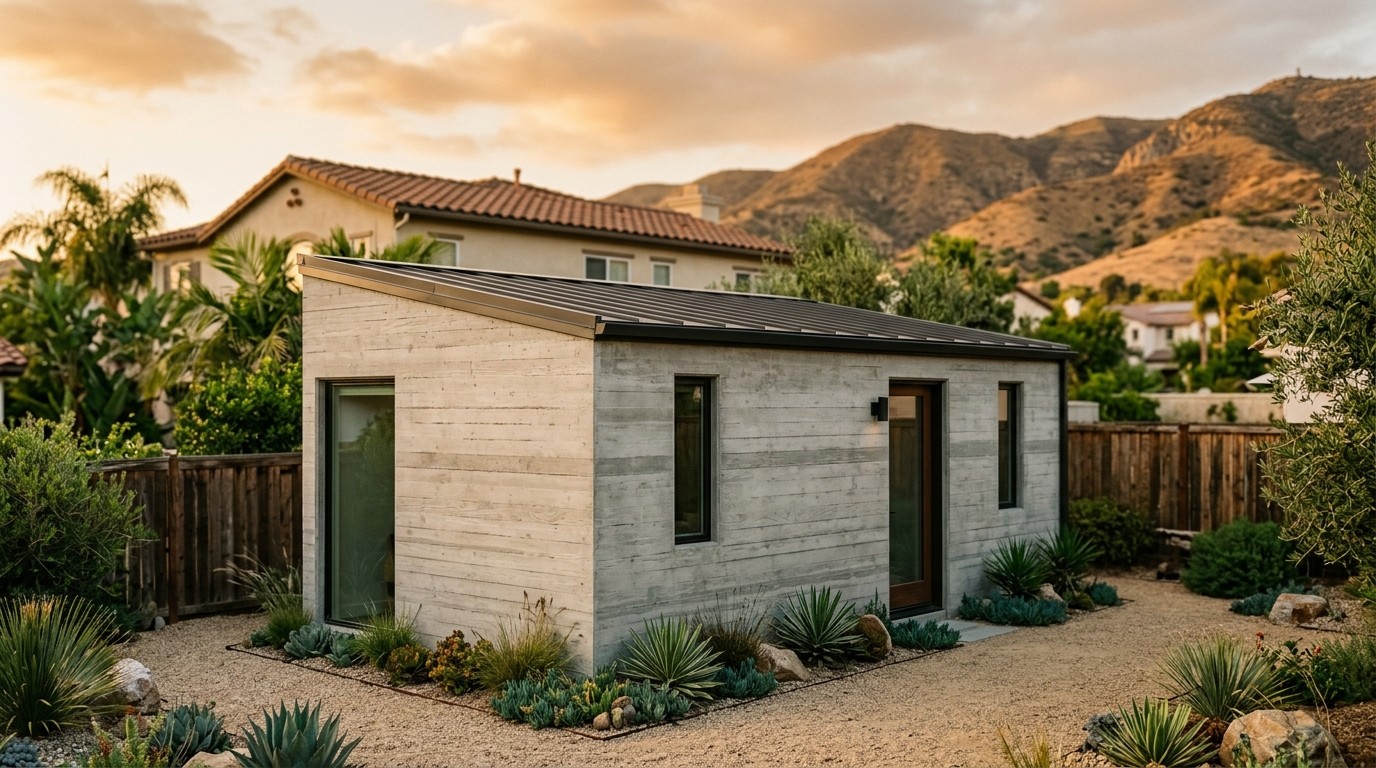
California's first fire-resistant, onsite 3D-printed concrete ADU was built in Walnut by Builtech Construction Group with RIC Technology and K4K Construction Design — a real, permitted, code-tracked structure, not a render.[1][7]
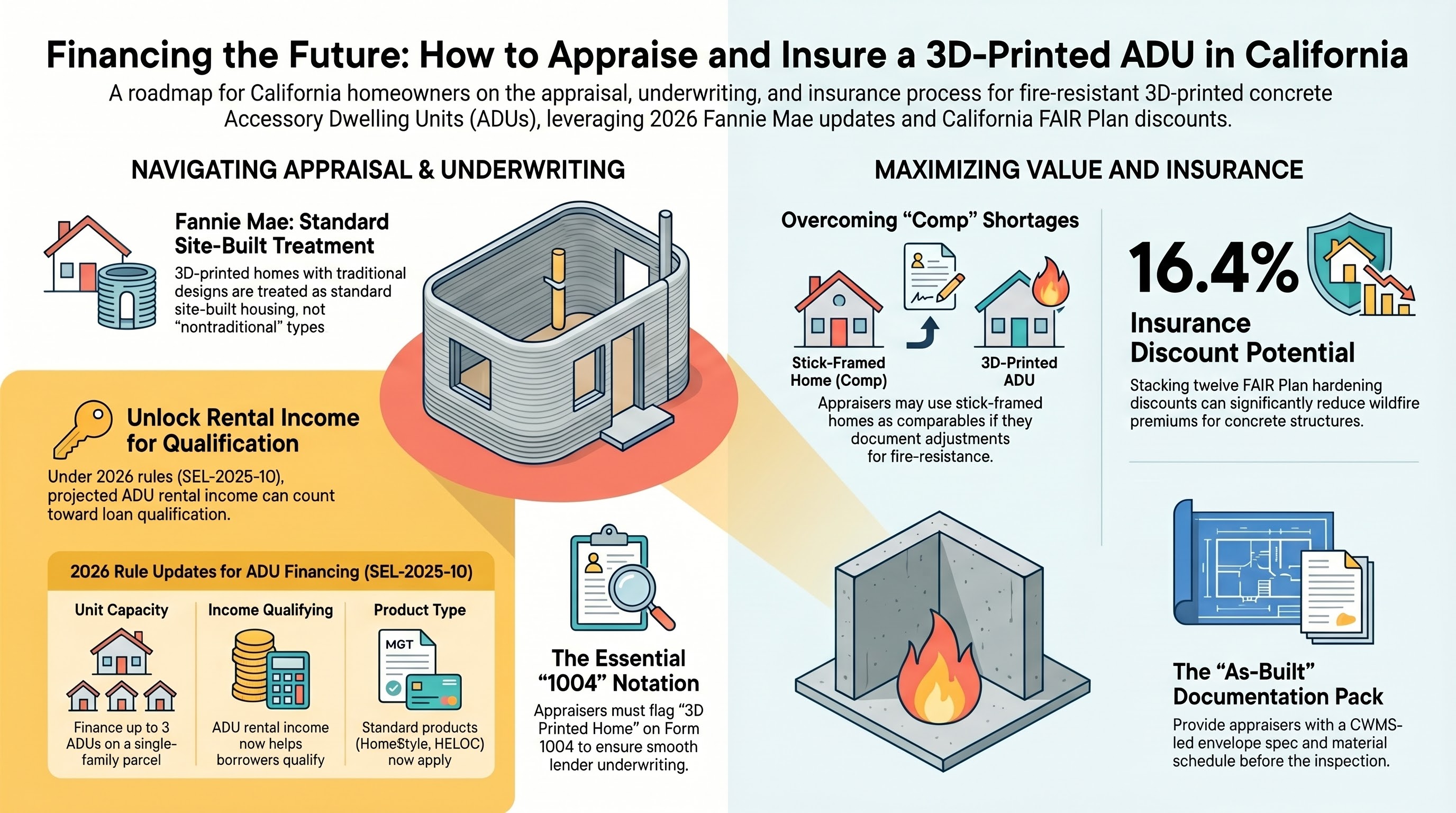
Fannie Mae's Selling Guide explicitly treats a 3D-printed home built with conventional design as standard site-built housing for appraisal and underwriting — provided the appraiser flags the construction method on the 1004.[2]
2026 ADU rule updates (SEL-2025-10) now allow up to three ADUs on a single-family parcel and let ADU rental income count toward qualifying — a structural shift in how a backyard printed unit pencils out.[10]
Fire-resistance is not a free pass with insurers, but stacking the FAIR Plan's twelve hardening discounts can reduce the wildfire portion of premium by up to 16.4% for dwelling fire policies.[6]
The real risk for owners is not the printer — it is thin comparable sales and lender unfamiliarity. The fix is a documented build, a CWMS-led envelope, and an appraiser briefed on Fannie's B4-1.3-05 language before the inspection.
The Walnut ADU is real — financing it is not an afterthought
Most coverage of the Walnut, California 3D-printed ADU treats it as a technology story. The robotic arm, the twenty-day print, the non-combustible walls, the photogenic concrete striations. All real. But for the next California homeowner standing in their backyard wondering whether to commission one, the harder questions sit downstream of the printer: will my lender finance it, will the appraiser value it, and will my carrier insure it.
Those are not abstract concerns. The Walnut unit is roughly 1,200 square feet, two bedrooms and two bathrooms, designed by Builtech Construction Group, printed by RIC Technology's robotic arm with K4K Construction Design handling the print scope, inspected by RKA Group, and permitted in collaboration with the City of Walnut and the Los Angeles County Fire Department.[1][7][8] The envelope is intentional: 3D-printed concrete walls, light steel and sure-board roof, hardened eave vents and windows, no wood, no nails on the main structure. That is a Type-grade fire-resistant assembly, executed in a residential backyard.
The interesting question is no longer whether the assembly works. It is whether the United States residential finance system — built around stick-framed comparables and 1970s appraisal vocabulary — can underwrite it. The short answer is yes. The longer answer is that owners have to know exactly what to ask for.
What Fannie Mae actually says about 3D-printed homes
Fannie Mae addressed 3D-printed housing directly in Selling Guide section B4-1.3-05. The language is narrower than most homeowners realize, and that narrowness is a gift to anyone pursuing a printed concrete ADU: "A 3D printed home with a traditional design and constructed using conventional building materials is not considered a unique or nontraditional housing type. Lenders should follow the standard eligibility and comparable sales selection requirements for site-built housing."[2]
Two phrases carry the load. "Traditional design" means a recognizable residential floor plan and roofline rather than an experimental form. "Conventional building materials" means concrete, steel, and standard glazing — exactly what the Walnut ADU uses. A printed concrete ADU with a rectangular footprint, a pitched or low-slope steel roof, and standard windows clears both bars.
Fannie does require a specific notation: the appraiser must enter "3D Printed Home" in the bottom free-form description field of the Sales Comparison Approach grid for both the subject property and any comparable sales where applicable.[2] Owners should confirm in writing — before the appraiser visits — that this field will be populated. It is a five-second clerical step that has stalled deals when it was missed.
ADU underwriting in 2026: the rules just got friendlier
The second piece of context that changes the math is Fannie Mae's Selling Guide Announcement SEL-2025-10, which took effect in 2026 with material ADU updates.[10] Three changes matter for a printed concrete ADU on a California single-family parcel.
First, single-family parcels may now finance up to three ADUs under conventional underwriting, where the prior limit was lower. For homeowners considering one printed unit today and another tomorrow, the parcel-level cap is no longer the binding constraint.
Second, ADU rental income may help borrowers qualify for the loan. For an owner pursuing the Walnut model — a fire-resistant rental or multigenerational unit in the backyard — the projected rent is now an underwriting input rather than an after-the-fact bonus. That changes which deals pencil.
Third, ADUs across multiple Selling Guide products (standard purchase, refinance, HomeStyle Renovation, and affordable lending) are now treated more flexibly. There is no longer a need for a specialty construction product to finance a backyard build. The standard products work.[3]
The practical implication: a homeowner who couples a printed concrete ADU with a HomeStyle Renovation refinance can finance the build and the existing mortgage in a single conventional transaction, with projected rent counted toward qualifying — provided the appraisal lands.
Why "fire-resistant" still has to clear the appraiser
This is the step owners underestimate. A non-combustible envelope is a real engineering accomplishment. It is also legally invisible to a generalist appraiser who has never seen one. The appraiser values the structure based on what they can document and defend, not what the builder believes is true.
Fire-resistance enters the appraisal in three places. The Improvements section should explicitly note non-combustible exterior wall assembly, non-combustible roof assembly, and ember-resistant openings.[2] The Cost Approach (where used) should reflect the higher unit cost of printed concrete plus steel relative to stick framing. And the Sales Comparison Approach should adjust comparable sales for the fact that the subject is materially less likely to be lost to a wildfire — a difference that, in a Very High Fire Hazard Severity Zone, carries measurable market value.
The appraiser will not do this on instinct. Owners and their general contractor should prepare a one-page "appraiser brief" before the inspection: floor plan, materials schedule, CWMS-led envelope spec, permit history, and the explicit Fannie B4-1.3-05 language. Most appraisers welcome it.
Comparable sales: the problem nobody wants to talk about
The single largest valuation risk for a printed concrete ADU is comparable sales — the comps. In most California neighborhoods there are no recent sales of 3D-printed homes, and very few sales of detached non-combustible ADUs of any kind.
Fannie's guidance is helpful here. "It is not necessary for one or more of the comparable sales to be of the same design and appeal as the property that is being appraised, although appraisal accuracy is enhanced by using comparable sales that are the most similar to the subject property."[2] Translation: the appraiser is allowed to use conventional stick-framed comps with documented adjustments, as long as the analysis is defensible.
The practical strategy is to pre-curate the comp set. Identify three to five recent sales of comparable-size detached ADUs in the same county, ideally including at least one non-combustible build (concrete masonry, ICF, or steel-framed). Document the adjustment rationale for materials and fire-resistance in advance. Hand it to the appraiser. The FHFA's UAD aggregate data on California ADU appraisal trends is a useful reference for establishing baseline ADU value contribution by submarket.[5]
What lenders look for in the 1004 appraisal report
The Uniform Residential Appraisal Report, Form 1004, is where deals live or die. For a printed concrete ADU, lenders are reading for five specific things.
One, the construction-method notation in the Sales Comparison Approach grid: "3D Printed Home." Without it, the underwriter may treat the file as a unique housing type and request a second appraisal.
Two, a clear ADU description in the Improvements section that confirms independent living, sleeping, cooking, and bathroom facilities on the same parcel as the primary dwelling — the qualifying ADU definition under B2-3-04.[4]
Three, documented zoning and permit compliance. A printed ADU permitted under California Residential Code Appendix AW, with documented sign-off from the local AHJ and fire authority, satisfies this cleanly.
Four, comparable selection that supports the value conclusion. As above, this is where pre-work pays off.
Five, no red flags in the Cost Approach. If the appraiser uses a cost approach, the unit costs should reflect printed concrete and steel roofing, not generic wood-framed assumptions.
A file that hits all five sails through. A file that misses one or two enters exception review.
Insurance is not optional — and the FAIR Plan discount stack matters
Lenders require evidence of dwelling insurance at closing. In California's current homeowners market, that is the binding constraint on many WUI transactions, not the mortgage. A printed concrete ADU is unusually well-positioned here.
The California FAIR Plan, the state's insurer of last resort, recently adopted a structured wildfire hardening discount program. Twelve discounts split across four categories — Immediate Surroundings, Structure, Property Level Completion, and Community — can reduce the wildfire portion of premium by up to 16.4% for dwelling fire policies and up to 13.8% for commercial.[6] A printed concrete ADU with a steel roof, ember-resistant vents, hardened openings, and a maintained Zone 0 captures most of the Structure and Immediate Surroundings discounts by design.
More broadly, California's home hardening regime is hardening too. The California Safe Homes Act (AB 888) created a Department of Insurance grant program for hardening measures, and the Wildfire Public Model Act (SB 429) is bringing public wildfire catastrophe modeling online — both signal that underwriters will increasingly price hardened envelopes distinctly from stick-framed ones.[9]
The homeowner action: ask the insurance agent, in writing, which of the twelve FAIR Plan discounts the printed ADU qualifies for, and capture each in the as-built documentation package the appraiser will see.
Financing paths that fit a 3D-printed concrete ADU
For a California homeowner commissioning a printed concrete ADU like the Walnut build, four financing paths cover the realistic cases.
A HomeStyle Renovation loan rolls the ADU build into a single conventional first mortgage based on the as-completed appraised value. This is often the cleanest path for owners with meaningful equity and no existing second.
A cash-out refinance uses current as-is value to extract equity, which then funds the build. Simpler than HomeStyle but caps borrowing at present value, not future value.
A HELOC funds the ADU progressively as the print and finish phases complete. Useful for owners who want a draw structure that mirrors construction milestones.
A construction-to-permanent loan converts a short-term construction loan into a long-term mortgage at completion. Best for owners building on a parcel with no existing primary dwelling or where lender flexibility on milestone draws matters more than rate.
In all four cases, the underwriting is conventional. The construction method is a notation on the appraisal, not a separate loan product.
A homeowner's pre-build checklist for a financeable 3D-printed ADU
The owners who get the cleanest financing outcomes do five things before the first concrete layer goes down.
They choose a contractor with a documented permit-history and a CWMS-certified principal, so the envelope spec is defensible to both fire authority and appraiser. Aaron Liu, Builtech's founder, is NFPA CWMS-certified — that credential is the receipt.[1]
They insist on a printed traditional design with conventional materials, so Fannie's B4-1.3-05 carve-out for site-built treatment applies cleanly.[2]
They assemble an as-built documentation package — permits, inspection reports, materials schedule, CWMS envelope spec, FAIR Plan hardening checklist — and hand it to the appraiser at inspection.
They pre-curate three to five comparable sales of detached ADUs in the same submarket, including at least one non-combustible build, and walk the appraiser through the adjustment rationale.
They loop the lender's underwriter in early, with Fannie's B2-3-04 ADU language and B4-1.3-05 3D-printed-home language flagged, so the file is not a surprise in exception review.[4]
The strategic read for California homeowners
The Walnut ADU's importance is not that it proved a concrete printer can extrude a wall. Several companies had done that. Its importance is that it produced a real, permitted, inspected, fire-resistant, two-bedroom dwelling under California Residential Code Appendix AW, with an NFPA-certified specifier on the GC side and the LA County Fire Department on the AHJ side. That is the missing combination most printed-housing demonstrations have lacked.
For a California homeowner today, especially one inside a Very High Fire Hazard Severity Zone, the relevant question is no longer whether a fire-resistant printed concrete ADU is buildable. It is. The relevant question is whether the financing, appraisal, and insurance scaffolding is mature enough to support replication. As of 2026, with Fannie Mae's explicit 3D-printed-home guidance, the SEL-2025-10 ADU update, the FAIR Plan hardening discount stack, and a documented permit precedent in Walnut, the honest answer is also yes — provided the owner does the documentation work in front, not after.
The owners who treat the appraisal as a project deliverable, not a closing formality, are the ones whose printed concrete ADUs will close on time, insure cleanly, and resell at a defensible value. The technology has caught up to the wildfire problem. The paperwork is finally close behind.
FAQs
Can you get a conventional mortgage on a 3D-printed concrete ADU in California?
Yes. Fannie Mae's Selling Guide section B4-1.3-05 states that a 3D-printed home with a traditional design built using conventional materials is not a unique or nontraditional housing type, so lenders apply standard site-built eligibility and comparable sales rules.[2] A printed concrete ADU on a standard residential parcel — like the Walnut, CA build — qualifies for any Fannie Mae loan product the parent property would qualify for.[3]
How does Fannie Mae treat 3D-printed homes in the appraisal report?
Fannie requires the appraiser to enter "3D Printed Home" in the bottom free-form description field of the Sales Comparison Approach grid on Form 1004, for both the subject property and any comparable sales where applicable.[2] Beyond that notation, the appraiser follows standard site-built procedures: comparable selection, adjustments, and a defensible value conclusion. Missing the notation can trigger exception review or a second appraisal.
What is the appraiser supposed to write on the Form 1004 for a printed ADU?
The appraiser should clearly describe the ADU in the Improvements section, confirming independent living, sleeping, cooking, and bathroom facilities on the same parcel as the primary one-unit dwelling — the qualifying ADU definition under B2-3-04.[4] Construction-method notation goes in the Sales Comparison Approach grid. Materials, permit status, and fire-resistance details belong in the addenda.
Will a fire-resistant 3D-printed ADU reduce my California home insurance premium?
It can. California's FAIR Plan now offers up to twelve wildfire hardening discounts across Immediate Surroundings, Structure, Property Level Completion, and Community categories; dwelling fire policyholders earning all twelve may save up to 16.4% on the wildfire portion of premium.[6] A printed concrete ADU with a non-combustible roof, ember-resistant vents, hardened openings, and Zone 0 compliance captures most Structure-category discounts by design.
How many ADUs can I finance on a single-family parcel under Fannie Mae's 2026 rules?
Under Selling Guide Announcement SEL-2025-10, effective in 2026, single-family homes may finance up to three ADUs through conventional underwriting, and small multifamily properties (2–3 units) may add ADUs up to a total of four units on the parcel.[10] For an owner pursuing the Walnut model, the parcel-level cap is rarely the binding constraint anymore.
Can rental income from a 3D-printed ADU help me qualify for the mortgage?
Yes, under the 2026 SEL-2025-10 updates. ADU rental income may now count toward qualifying income, which materially changes the affordability math for owners financing a backyard build.[10] The income must be documented per Fannie's standard rental income rules, and the ADU must satisfy the qualifying definition in Selling Guide B2-3-04.[4] Borrowers should confirm with their loan officer how the projected rent is treated for their specific product.
Is the California FAIR Plan willing to insure a 3D-printed concrete ADU?
The FAIR Plan writes dwelling fire policies on residential structures regardless of construction method when standard carriers will not. A printed concrete ADU is materially more insurable than a stick-framed equivalent in WUI areas, because its non-combustible envelope qualifies it for the FAIR Plan's structured wildfire hardening discount stack of up to 16.4%.[6] Owners should request a per-discount eligibility letter from their broker.
What comparable sales do appraisers use when there are no other 3D-printed ADUs nearby?
Fannie permits appraisers to use comparable sales that are not the same design or construction method, provided the analysis remains defensible.[2] The standard practice for a printed concrete ADU is to pre-curate three to five recent sales of comparable-size detached ADUs in the same submarket — ideally including at least one non-combustible build like CMU or ICF — and document the materials and fire-resistance adjustments in writing.
Does building a 3D-printed concrete ADU require a special construction loan?
No specialty product is required. A printed concrete ADU can be financed through Fannie Mae's standard products, including HomeStyle Renovation, cash-out refinance, HELOC, or a construction-to-permanent loan.[3] HomeStyle Renovation is often the cleanest path because it underwrites against the as-completed appraised value, which captures the ADU's contribution before disbursement. The construction method is a notation on the appraisal, not a separate loan category.
What happens if the appraiser undervalues my fire-resistant 3D-printed ADU?
The homeowner can request a Reconsideration of Value through the lender, supported by additional comparable sales, materials documentation, and a written summary of the fire-resistance and hardening features. Lenders submit the package to the appraiser for review. Outcomes improve sharply when the documentation references Fannie's B4-1.3-05 language explicitly and includes a per-discount mapping to the FAIR Plan's hardening criteria, both of which appraisers find easier to defend than narrative claims.
Related resources
Fannie Mae Selling Guide B4-1.3-05 — Improvements Section of the Appraisal Report. The authoritative source for how 3D-printed homes are described in the appraisal report.
Fannie Mae — Accessory Dwelling Units financing overview. Plain-language explanation of which Fannie products finance ADU additions and how income is treated.
California FAIR Plan Wildfire Hardening Discounts — FBIA summary. Full per-discount breakdown of the twelve hardening criteria a fire-resistant ADU should be designed against.
References
Primante3D — Une ADU imprimée en béton pour répondre à l'augmentation des incendies en Californie: https://www.primante3d.com/adu-3d-1412023
Fannie Mae Selling Guide B4-1.3-05 — Improvements Section of the Appraisal Report: https://selling-guide.fanniemae.com/sel/b4-1.3-05/improvements-section-appraisal-report
Fannie Mae — Accessory Dwelling Units (ADUs) financing overview: https://singlefamily.fanniemae.com/originating-underwriting/mortgage-products/accessory-dwelling-units
Fannie Mae Selling Guide B2-3-04 — Special Property Eligibility Considerations (ADUs): https://selling-guide.fanniemae.com/sel/b2-3-04/special-property-eligibility-considerations
FHFA — Trends in Median Appraised Value for Properties With ADUs in California: https://www.fhfa.gov/blog/statistics/trends-in-median-appraised-value-for-properties-with-accessory-dwelling-units-in-california
FBIA — California FAIR Plan Wildfire Hardening Discounts: https://fbia.com/blog/fair-plan-wildfire-hardening-discounts/
3D Printing Industry — California's first innovative fire-resistant 3D printed ADU unveiled in Walnut: https://3dprintingindustry.com/news/californias-first-innovative-fire-resistant-3d-printed-adu-unveiled-in-walnut-228854/
RKA Group — First 3D-printed Accessory Dwelling Unit (inspection notes, Walnut CA): https://www.rkagroup.com/NewsDetail.dmx?id=N1002
California Wildfire & Forest Resilience Task Force — New Laws Strengthen Home Hardening, Insurance Access, and Wildfire Risk Transparency: https://wildfiretaskforce.org/new-laws-strengthen-home-hardening-insurance-access-and-wildfire-risk-transparency/
CMG Financial — Unpacking Fannie Mae's ADU Changes (SEL-2025-10): https://www.cmgfi.com/blog/more-units-more-opportunity-unpacking-fannie-mae-s-adu-changes-2026-04-16