3D Printed ADU Subcontracting: A GC's Field Playbook
How a general contractor should structure scope, schedule, and risk when a 3D printed concrete subcontractor handles wall extrusion on an ADU. Uses the Walnut, CA project (Builtech + K4K + RIC) as a working reference for splitting print scope from site work.
Authors:


TLDR
A 3D printed ADU is not a single trade scope — it is at least three: foundation and MEP rough-in, printed walls, and roof and finish tie-in.
The Walnut, California project shows the cleanest split available today: Builtech Construction Group leads as GC and handles plumbing, sewage, and foundation; K4K Construction Design owns the 3D printing scope using RIC Technology's mobile-gantry system.[1]
A 20-day print window is short but unforgiving: any pre-print foundation defect cascades directly into print delay.
Fire-resistant cementitious walls unlock hardening discounts under California's FAIR Plan,[2] but only when the GC, not the print sub, owns the noncombustible roof and tie-in detailing.
Treat the print sub like a structural steel sub: lock slab tolerances, the print window, and the cold-joint protocol in writing before mobilization.
Why GCs Should Care About 3D Printed ADU Scope
The headlines around the Walnut ADU focus on the printer. The interesting thing for a general contractor is the contract under it. RIC Technology's mobile robotic system is a real engineering advance, but the project's durable lesson is structural: the GC scope was deliberately split so that the print specialist did not also own foundation, MEP rough-in, or roof tie-in.[1] That choice is repeatable. It is also the difference between a clean delivery and a contractor sitting on a half-printed shell waiting for a misaligned anchor bolt.
Most early 3D printed home coverage treats the printer as the project. In production, the printer is one trade. A 3D printed ADU still needs a stamped foundation, a permitted electrical service, a plumbing rough-in, a noncombustible roof assembly, finishes, and a final inspection. None of those scopes belong to the print sub. When a GC blends them — usually under pressure from a print vendor pitching a turnkey package — schedule risk concentrates in the one trade with the least conventional construction insurance, the least field supervision depth, and the shortest project history. Splitting the scope is how a GC restores normal risk distribution to a non-normal building method.
The Walnut ADU as a Working Reference
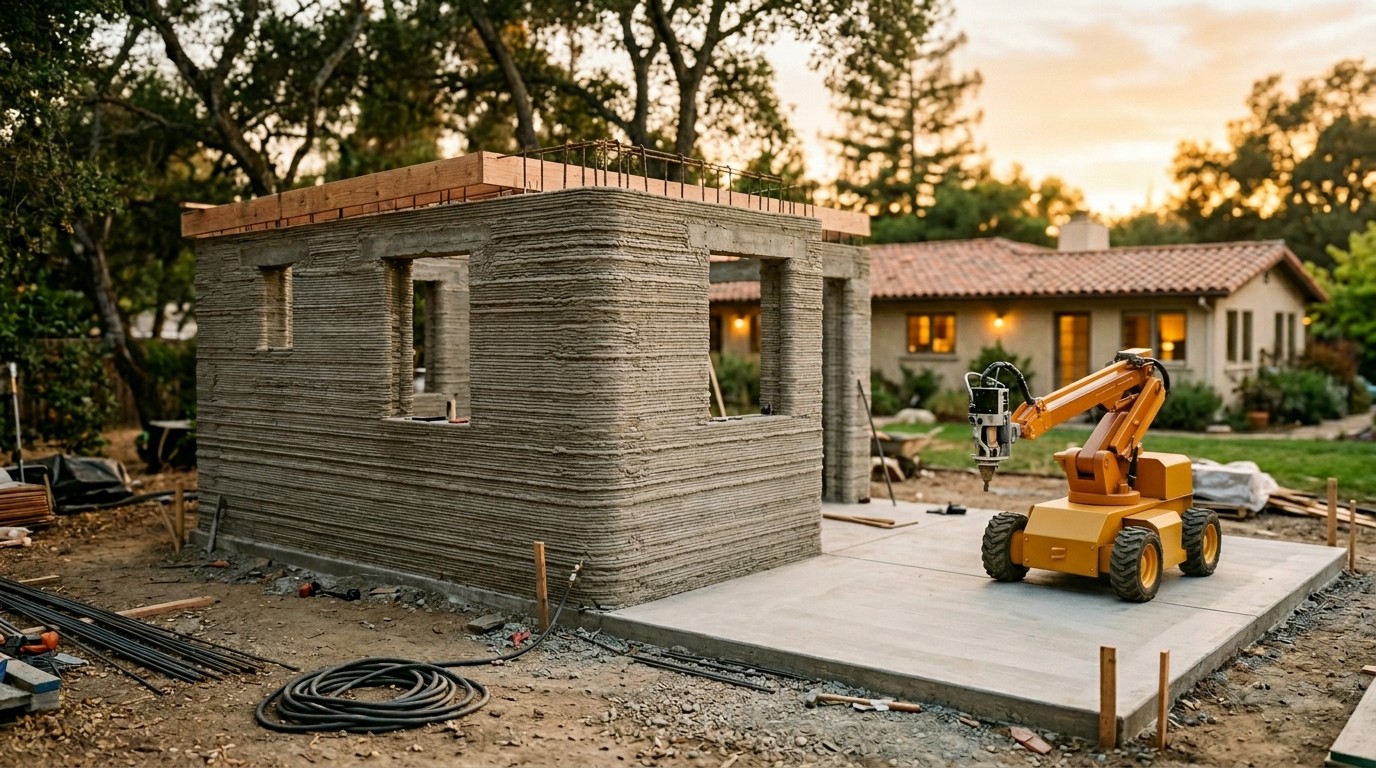
The Walnut, California project is a useful reference because it is small, well-documented, and structured the way most California ADUs will need to be structured. It is a 1,200 sq ft, two-bedroom, 2.5-bath unit on a residential lot, with concrete exterior walls printed on site by a KUKA-on-mobile-gantry system.[1] Builtech Construction Group is the general contractor and is responsible for plumbing, sewage, and foundation; K4K Construction Design handles the 3D printing scope.[3] Roof framing is light steel and sure-boards rather than wood, and the design eliminates structural wood and nails to remove fuel from the building envelope.[3]
For a GC, three details matter more than the headline. First, the slab and underground utilities were complete before printing started — there is no shared sequencing of trenching and printing on the same slab.[5] Second, the print sub mobilizes on a finished surface, not a punch list. Third, the print is scheduled inside a 20-day window for the wall extrusion alone, with foundation, roof, and finishes book-ending it. That sequencing is the contractually meaningful structure of the project, and it is what other GCs should copy on backyard ADUs.
Anatomy of a Split Scope: Print Sub vs. Site Sub
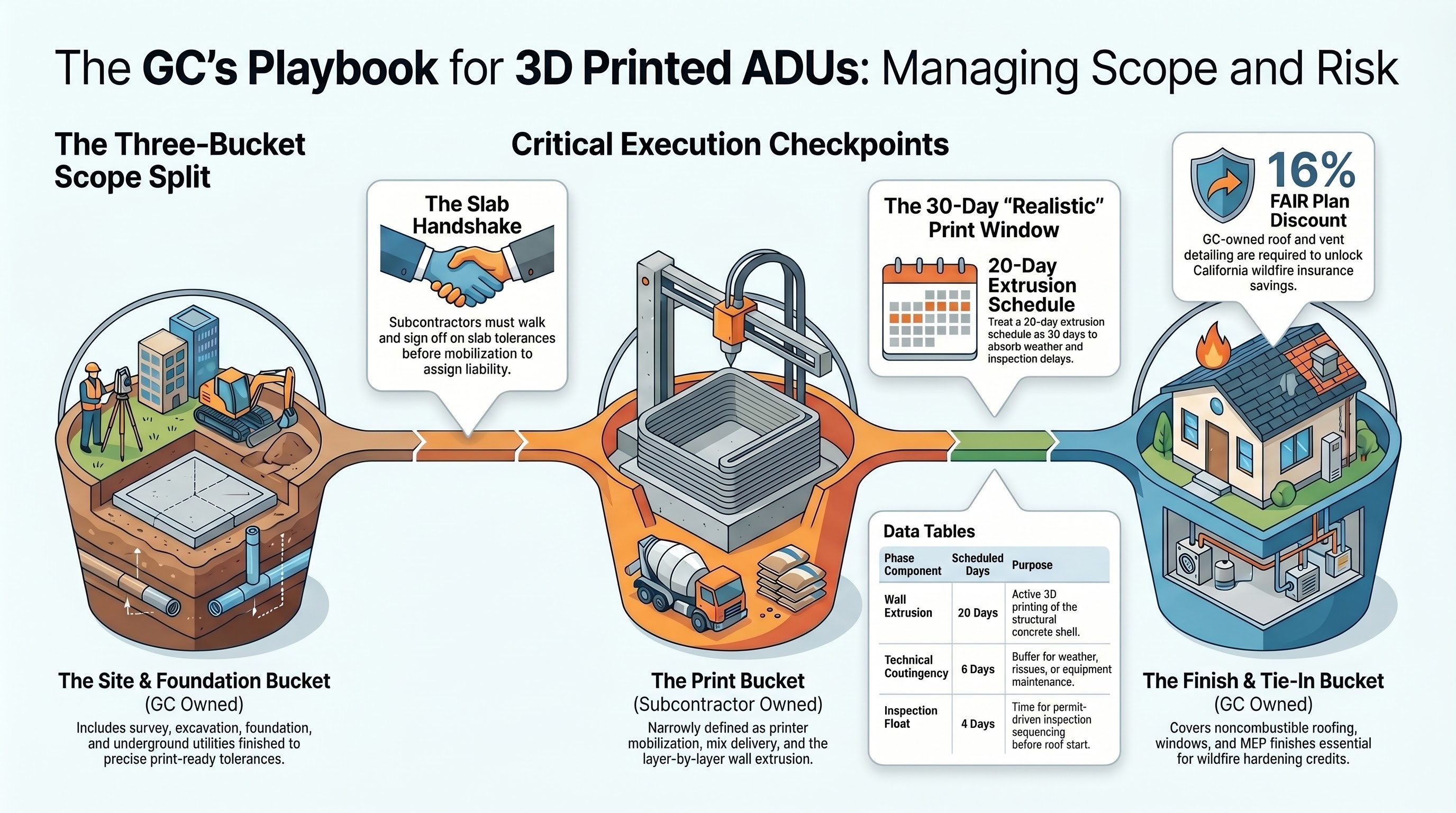
A defensible scope split for a printed ADU has three contractual buckets, each carrying its own schedule risk. The GC owns the relationships across all three.
The site bucket includes survey and layout, excavation, footings and slab, anchor bolt and embed placement, underground plumbing and conduit, utility tie-ins, and any required tie-down or seismic hardware. This scope is conventional, biddable, and should be priced by trades with normal California concrete and plumbing experience. It must finish to a tolerance that the print sub will accept in writing.
The print bucket is narrow on purpose. It covers mix delivery and quality control on print days, printer mobilization and demobilization, programming and toolpathing of the wall geometry, layer-by-layer extrusion, and quality logging of layer thickness, ambient conditions, and cold-joint events. The print sub does not own openings beyond what is geometrically printed: window bucks, lintels, tie-downs, and anchors are GC scope unless explicitly transferred.
The finish-and-tie-in bucket runs after the print is cured and inspected. It includes the noncombustible roof assembly, eave and vent detailing, windows and doors, exterior coatings, interior framing where required, MEP rough-in tie-ins, drywall, and finishes. This is the bucket where most fire-hardening value is locked in, and it must be owned by the GC because the print sub almost certainly does not carry the right insurance for a finished envelope.
Drawing the Scope Line at the Slab
The single most important contract line is the handoff from the site sub to the print sub. The slab is the inspection point. Three documents make this transfer enforceable: a flatness and elevation tolerance schedule (typically tighter than ACI 117 baseline because layered extrusion magnifies defects), an anchor and embed setting plan with a witnessed survey, and a moisture and curing certificate showing the slab is print-ready.
The GC should require the print sub to walk the slab with a checklist before mobilization, sign acceptance, and only then begin. Until that signature, the slab is the site sub's risk. After that signature, any print defect that traces to the slab is a backcharge to the print sub. This mirrors how a structural steel sub accepts a foundation before erecting a frame, and it is the same logic. The point of the line is that neither party can hide schedule slip in ambiguous handoff conditions.
Where this fails in practice is on infill projects with tight access. If the print sub cannot fit a delivery pump beside the slab, that is not a slab defect, but the cost should still land somewhere predictable. Spell out site logistics — pump location, mix delivery routing, water and power tie-ins, neighbor-side noise hours — in the print sub's contract, not the site sub's, because the print sub is the party making the demand.
Schedule Logic When the Walls Print in 20 Days
A 20-day print window looks generous next to a 90-day stick-frame schedule. It is not. Twenty days assumes mix performance on every print day, a stable weather window, no cold-joint correction, and no permit-driven inspection delays. Each of those assumptions has a real probability of failing on a residential lot in California.
GCs should plan a 20-day print window as if it were a 30-day window with three contingency days for weather, three for mix or pump issues, and four for inspection sequencing. Those contingencies are absorbed in float between the print sub's finish and the roof sub's start. If the GC books the roof sub for the day after the projected print finish, the project will be late. If the GC books the roof sub for ten days after, the project is on time more reliably and the print sub is paid against measurable milestones.
This matters financially because California ADU costs sit between $60,000 and $225,000 per unit,[1] and the GC's margin is small relative to a single missed inspection. Every overrun day on a backyard ADU is overrun on access, neighbor management, and security, not just on labor. Schedule discipline on the print is therefore more valuable than schedule discipline on any other single trade.
Insurance, Code, and the Hardening Conversation
Fire resistance is the strongest commercial story a GC can tell about a 3D printed concrete ADU, and it is also the easiest story to mishandle. Concrete's combustion point of about 1,500°C is meaningfully above thermoset alternatives,[1] but a noncombustible wall does not, by itself, deliver an insurable home. The roof, the eave vents, the windows, and the wood framing inside the envelope all have to align with the wall's hardening level for the FAIR Plan story to hold up.
California's FAIR Plan offers wildfire hardening discounts that can stack to roughly 16% off the dwelling fire premium when the assembly meets criteria like Class A roofing, ember-resistant vents, and noncombustible siding.[2] The GC's job is to make sure the design package and the as-built actually clear those criteria, and that the homeowner requests a hardening assessment from their broker after construction. That assessment is the document that turns engineering choices into insurance dollars.
The contractual implication is straightforward: the print sub cannot be the party that signs off on the building envelope's fire performance. The GC owns that performance, because the GC owns the roof, the vents, the windows, and the inspection coordination. Print subs may volunteer technical bulletins on the wall, and those should be filed in the project record, but the hardening conversation with the inspector and the broker is a GC conversation.
Common Mistakes That Blow Up 3D Printed ADU Subcontracts
Four mistakes recur on early 3D printed ADU projects, and all are avoidable.
First, accepting a turnkey scope from a print vendor that bundles foundation, walls, and roof under one trade. This concentrates risk and removes the GC's ability to backcharge any single party. The Walnut model, with foundation and MEP held by Builtech and the print held separately by K4K, is the inverse and is the right pattern.
Second, pricing the print as a per-square-foot wall number without specifying mix, layer height, openings count, and cold-joint protocol. Two print subs can quote the same square foot price and deliver wildly different walls. The contract has to specify the deliverable in print-engineering terms, not architectural terms.
Third, leaving openings, lintels, and embeds in the print scope. Print subs are good at extruding geometry and weak at structural detailing. Anchors, hold-downs, header beams, and window bucks should be GC-furnished and either set before printing or installed against printed pockets.
Fourth, scheduling the roof framer too tight to the print finish. A noncombustible roof is the linchpin of the hardening story; rushing it because the print is late produces detail compromises that cost more than the schedule recovery is worth.
How a GC Should Vet a Print Subcontractor
Vetting a print subcontractor is closer to vetting a structural steel sub than to vetting a concrete sub. Three filters separate viable subs from unproven ones.
The first is project history with a comparable wall geometry, comparable mix, and a real punch list. Demos and showpieces do not count. A vetted print sub can produce a finished, inspected, permitted project at a comparable scale and walk a GC through what went wrong and what they changed.
The second is mix and equipment redundancy. A single printer, a single mix supplier, and a single operator is a single point of failure. Ask what happens on the morning a printer goes down on day eight of a 20-day window. The answer should be specific: a backup printer hours away, a mix supplier with a pre-qualified second source, a published cold-joint plan if the gap exceeds the print window, and a certified field operator who is not also the firm's CEO.
The third is insurance and bonding. A print sub should carry general liability with a completed-operations endorsement appropriate to a residential structure, workers' comp in California with experienced workers' comp class codes for concrete pumping, and the ability to be added to the project's builder's risk policy without exclusions. If a print sub asks the GC to absorb their insurance gaps, that is a refusal disguised as a negotiation.
A GC who applies these three filters will find that the population of qualified print subs in California is small but real, and that K4K, RIC, and the handful of firms doing inspected residential work are the meaningful candidates.[1][4] The GC's job, then, is not to find a long list — it is to write a contract clean enough that a short list can deliver to the GC's standard.
FAQs
How does a GC scope a 3D printed ADU differently from a stick-built ADU?
A 3D printed ADU has three distinct scopes — site/foundation, printed walls, and roof/finish/tie-in — that should be subcontracted separately. Stick-built ADUs let one framer absorb wall scope and tie-in detailing; printed ADUs do not. Treat the print sub like a structural steel sub: narrow scope, tight slab handoff, witnessed acceptance, and explicit ownership of openings, embeds, and the noncombustible roof assembly outside the print contract.
What slab tolerances should a GC require before a 3D print sub mobilizes?
Tighter than baseline ACI 117 because layered extrusion magnifies any defect. The contract should specify flatness and elevation tolerances, anchor and embed setting accuracy verified by survey, and a moisture and curing certificate showing the slab is print-ready. The print sub walks the slab, signs acceptance, and only then mobilizes. After acceptance, slab-traceable defects are a backcharge.
Why does the 20-day 3D print window matter for ADU project scheduling?
Twenty days is the wall-extrusion window only. It assumes weather cooperation, mix performance on every print day, no cold-joint correction, and timely inspections. GCs should plan that window as if it were 30 days with built-in contingency for weather, mix or pump issues, and inspection sequencing. Booking the roof sub the day after projected print completion is the most common cause of preventable schedule slip.
Does a 3D printed concrete ADU qualify for California FAIR Plan wildfire hardening discounts?
Most noncombustible 3D printed concrete ADUs can qualify for stacked hardening discounts of roughly 16% off the dwelling fire premium when the broader assembly clears criteria like Class A roofing, ember-resistant vents, and noncombustible siding. Concrete walls alone do not deliver the discount. The homeowner should request a post-construction hardening assessment through their broker to formalize qualifying credits.
Should the 3D print subcontractor own openings, lintels, and anchors?
No. Print subs are strong at extruding geometry and weak at structural detailing. Anchors, hold-downs, structural header beams, and window and door bucks should be GC-furnished and either set before printing or installed against printed pockets. Leaving these in the print contract concentrates risk on the trade with the least conventional structural detailing depth.
What insurance should a 3D print subcontractor carry on a residential ADU project?
General liability with a completed-operations endorsement scaled to a residential structure, California workers' compensation under the correct concrete-pumping class codes, and the ability to be added to the project's builder's risk policy without exclusions. If the print sub requests that the GC absorb insurance gaps, treat it as a disqualifying signal rather than a negotiable commercial term.
How does the K4K + Builtech model differ from a turnkey 3D printed ADU contract?
The K4K and Builtech model isolates the print sub's scope to wall extrusion and quality logging while the GC retains foundation, MEP, roof, finishes, and inspection coordination. A turnkey print contract bundles all of that under one trade, removing the GC's ability to backcharge a single party for a single defect. The split-scope model is the one that survives a real punch list and a real insurance audit.
What does a print-ready slab actually look like for a 3D printed ADU?
A print-ready slab is finished to specified flatness and elevation tolerances, has all anchors and embeds set per a witnessed plan, has underground utilities tied off and pressure-tested, and has reached a documented moisture and cure state. It also has clear access for the print platform and the mix delivery route, and a defined power and water tie-in. Without all of those, a print sub should not mobilize.
When should the noncombustible roof framer arrive on a 3D printed ADU site?
Not the day after projected print completion. Build float of roughly seven to ten days into the schedule between projected print finish and roof start. That float absorbs weather, mix, and inspection contingencies, and it preserves the roof detail quality that drives the FAIR Plan hardening discount. Rushing the roof to recover print slip almost always damages the fire-hardening story more than it saves on schedule.
Is the California ADU market large enough to justify investing in a 3D printed ADU practice?
Yes. California's ADU market is approximately a $1.3 billion annual opportunity, with permits scaling from 1,000 in 2016 to 23,600 in 2021 and per-unit costs ranging $60,000 to $225,000.[1] Even modest market share supports a regional GC practice, particularly when the practice can credibly deliver hardened, FAIR Plan-eligible units in wildfire-exposed counties.
Related resources
Build in Digital — Robot system to print wildfire-resistant California home — News profile of the Walnut ADU's GC-led delivery model and Builtech's role.
Archinect — America's first 3D printed fire-resistant ADU concept under construction in Southern California — Architecture-side context on design intent and disaster prevention framing.
KTLA — 3D printed fire-resistant ADU being built in Los Angeles County — Local news coverage of the Walnut project with on-site footage and timeline detail.
References
3DPrint.com — Fire-resistant 3D Printed Accessory Dwelling Unit Unveiled by RIC: https://3dprint.com/307742/fire-resistant-3d-printed-accessory-dwelling-unit-unveiled-by-ric
Builtech Construction Group — 3D-Printed Concrete ADU in California: Permit Playbook: https://www.builtechcg.com/articles/3d-printed-concrete-adu-in-california-permit-playbook
Build in Digital — Robot system to print wildfire-resistant California home: https://buildindigital.com/robot-system-to-print-wildfire-resistant-california-home/
Archinect — America's first 3D printed fire-resistant ADU concept is under construction in Southern California: https://archinect.com/news/article/150418404/america-s-first-3d-printed-fire-resistant-adu-concept-is-under-construction-in-southern-california
KTLA — 3D printed fire-resistant ADU being built in Los Angeles County: https://ktla.com/news/california/wildfires/3d-printed-fire-resistant-adu-being-built-in-los-angeles-county/