3D-Printed Concrete ADU in California: Permit Playbook
California's first fire-resistant, onsite-built 3D-printed concrete ADU in Walnut shows that the regulatory and material pathway already exists — through California Residential Code Appendix AW, CWMS-led design choices, and direct collaboration with the local fire authority. This blog breaks down that playbook for owners and builders aiming to replicate it in wildfire-prone communities.
Authors:


TLDR
The Walnut, California ADU is the first onsite-built, fire-resistant, 3D-printed concrete ADU in the U.S. — and the most useful regulatory precedent for California builders.[1][3]
Builtech Construction Group, led by an NFPA-certified Wildfire Mitigation Specialist, anchored the design on the fire triangle: eliminate the only variable a builder controls — fuel.[1][9]
The build cleared permits because California Residential Code Appendix AW, the City of Walnut, and the LA County Fire Department engaged the project as partners, not gatekeepers.[3][7]
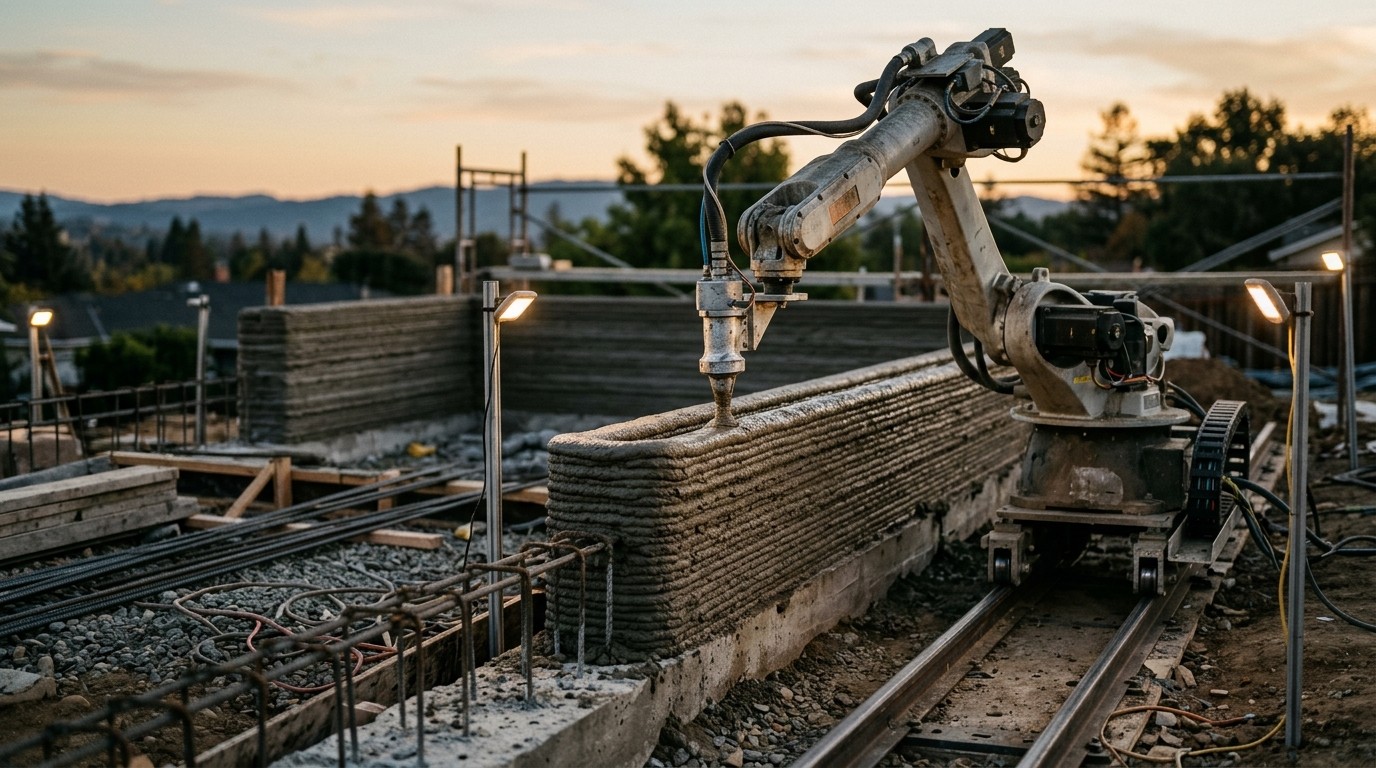
A robotic arm printer — not a gantry — is the only printer architecture that fits the typical California backyard ADU lot.[1]
Replicating the model is now a checklist, not a research project.
Why the Walnut ADU is the reference build for California
The Walnut, California project does not get enough credit for the regulatory work it did, not just the technical work. When RIC Technology's robotic arm 3D printed the exterior walls of a 2 bed / 2.5 bath, 1,200 square foot fire-resistant accessory dwelling unit in early 2024, the headline was the printer.[1][5] The more durable contribution to the California building landscape, however, was the demonstration that an onsite, non-combustible, robotically-printed concrete ADU could clear a permit, pass inspection, and stand up to scrutiny from the Los Angeles County Fire Department under existing code.[3]
For owners, builders, and AHJs (authorities having jurisdiction) trying to make sense of how to actually replicate the model, the Walnut ADU is the reference build. The project's general contractor, Builtech Construction Group, served as the project lead from design through completion. K4K Construction Design handled the printing as a subcontractor.[1] That GC-plus-printing-subcontractor structure is now the most defensible operating model for the next generation of California fire-resistant ADUs, and it is worth dissecting carefully.
The fire-resistance story is not novel on its own; concrete-shell homes have existed for decades. What is novel is that the Walnut ADU collapses three previously-separate workstreams — 3D-printed concrete construction, wildfire-resilient envelope design, and California ADU permitting — into a single, repeatable build sequence. Replicate that sequence in any wildfire-prone California jurisdiction that has adopted Appendix AW, and the cost-of-entry for fire-resilient backyard housing drops materially.[7]
The fire triangle, and why fuel is the only lever a builder controls
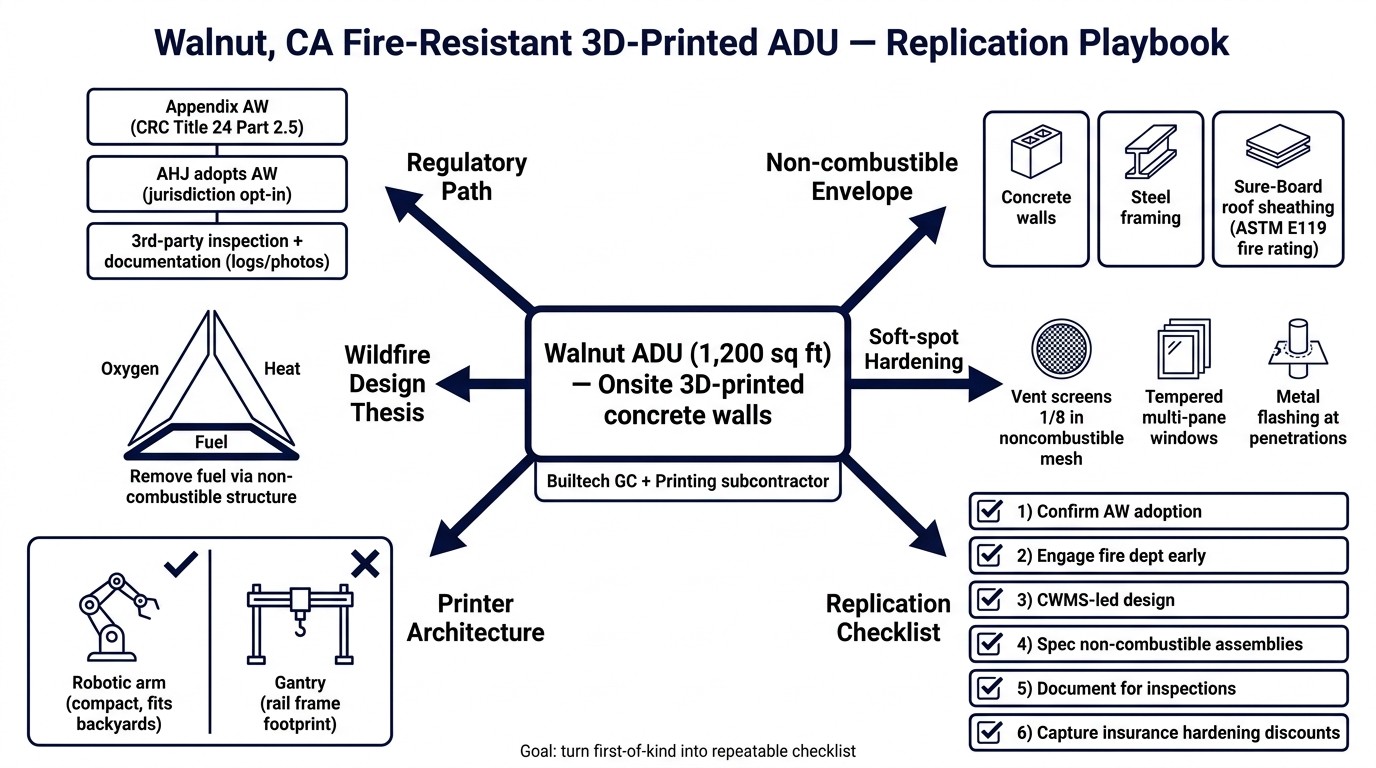
Three elements must be present for fire to sustain itself: heat, oxygen, and fuel.[8] Aaron Liu, CEO of Builtech and an NFPA-certified Wildfire Mitigation Specialist, frames the design problem this way: "During wildfires, 'heat' and 'oxygen', two of the three components of the fire triangle, are beyond control. Therefore, our focus is on eliminating 'fuel,' the unique architectural design and building materials in this case."[1]
That sentence is the operating thesis for the entire build. A builder cannot affect ambient temperature during a wildfire. A builder cannot affect oxygen content of WUI air. What a builder controls is the architectural design and material selection that determines how much fuel a structure adds to a fire that is already moving. That reframing matters. It pushes the conversation away from "how do we fight the fire when it arrives" and toward "how do we build a structure that simply isn't a fuel source."
Concrete walls, steel framing, and non-combustible sheathing are not symbolic decisions. They are the literal removal of one leg of the fire triangle. The Walnut ADU is, structurally, a deliberate exercise in fuel deletion — and the language Builtech uses to describe its work follows the same logic, all the way down to Liu's claim that "the ADU will be built without a single piece of wood or nail – no 'fuel' on the main structure."[1]
Inside California Residential Code Appendix AW
California Residential Code Appendix AW, adopted under Title 24, Part 2.5, is the section of state code that explicitly governs 3D-printed building construction.[7] Without Appendix AW, every 3D-printed residential project would face a permitting fight on first principles. With it, builders and AHJs share a reference for material specifications, structural performance criteria, inspection protocols, and documentation expectations.
Appendix AW is opt-in by jurisdiction, which is the part of the regulatory landscape that gets glossed over in most coverage. The Walnut project succeeded because the City of Walnut and LA County Fire engaged with the appendix and the inspection process directly.[3][6] RKA Consulting Group, the building and safety inspector on the project, has stated publicly that ongoing inspection services were provided for this first-of-its-kind ADU build.[6]
That is the regulatory blueprint: confirm the AHJ has adopted Appendix AW, document the print process to the inspector, and run the standard residential inspection cadence on top of the appendix-specific submittals. Builders who try to skip these steps run into the same problem every first-of-its-kind project hits — code officials default to caution when they have no documentation to lean on. Appendix AW exists precisely so they don't have to.
Why a robotic arm beats a gantry on most California lots
RIC Technology's pitch is structural: "Our compact modular robotic 3D printer overcomes conventional gantry systems' limitations, enabling 3D construction on site, in confined spaces such as people's backyards."[1] That sentence is critical for California ADUs specifically.
Gantry printers require a fixed rail frame larger than the structure being printed; for a typical California single-family backyard, the gantry footprint plus its setback often exceeds the available lot space. Robotic arm printers are mounted on a small base that can sit beside or inside the foundation, freeing up the working envelope. California's HCD ADU Handbook and ADU statute focus on enabling backyard housing, but "enabling" only matters if a printer can physically fit on a real lot.[13]
Robotic arm systems are, for the bulk of California's ADU-eligible parcels, the only practical 3D-construction-printing architecture. The Walnut build proved out the form factor in production conditions. The 20-day printing timeline RIC quoted is meaningful only because the printer was able to operate on an ordinary residential site — a constraint a gantry rig would have failed.[1]
The non-combustible envelope: concrete walls and a steel-plus-Sure-Board roof
The most replicable engineering decision in the Walnut project is what didn't make it into the structure. The exterior walls are 3D-printed using non-combustible concrete.[1] The roof is built from light steel framing with Sure-Board sheathing — a steel-and-gypsum composite tested for 1- and 2-hour fire ratings under ASTM E119.[14]
Most 3D-printed homes still ship with wooden structural roofs, which means the most fire-vulnerable component of the home remains a fuel source. Replacing wood with steel and Sure-Board removes that vulnerability and brings the roof into the same fire performance class as the walls. The Sure-Board system is also seismically and wind-tested, which matters in California more than anywhere else.[14]
For builders evaluating their own roof spec, the question is binary: is the structural roofing system non-combustible end to end, or is there wood somewhere in the load path? If wood is in the load path, the fuel triangle is still incomplete, and the rest of the wildfire-resilience story carries an asterisk. The Walnut ADU does not carry that asterisk.
Reinforcing the soft spots: eave vents, windows, and a wood-and-nail-free interior
"The ADU will be built without a single piece of wood or nail – no 'fuel' on the main structure," Liu told Parametric Architecture.[1] The most overlooked elements in a wildfire-resilient envelope are not the walls and roof — they are the soft spots. Eave vents and window assemblies are the ember entry points that account for a disproportionate share of home loss in WUI fires.[8][12]
Builtech reinforces these vulnerable areas as part of the spec. Best practice, drawn from IBHS and CAL FIRE guidance, is straightforward: 1/8-inch noncombustible mesh on all vent openings, multi-pane tempered glass, metal flashing at every penetration, and ember-resistant detailing where the roof meets the wall.[12][11]
The wood-and-nail-free interior framing decision matters here too. When the structural skeleton inside the wall cavity is steel, an ember that bypasses the envelope still hits a non-combustible substrate. The "main structure" qualifier in Liu's quote is doing real work: cabinetry, doors, and finishes can be wood, but anything load-bearing or in the wall cavity is steel. That distinction is precisely what separates a marketing-grade fire-resistant home from one that holds up under ember storm conditions.
Working with the AHJ: how the LA County Fire signoff actually happens
The Walnut project's permits came together because the AHJs were brought in early. The City of Walnut and Los Angeles County Fire Department were named collaborators on the project, not regulators that had to be convinced after the fact.[1][3][4]
For a builder following Builtech's path, the practical sequence is unambiguous. Identify whether the city's building department has adopted Appendix AW. Engage the local fire department before submitting plans, not after. Loop in a third-party inspector experienced with 3D concrete printing — RKA filled that role in Walnut.[6] Document everything from material data sheets to print parameters in writing.
Photographs and time-stamped print logs are not optional for a first-of-its-kind permit. They are the inspection record. The AHJ's job is to certify that the structure meets code; the builder's job is to give the AHJ the documentation that makes certification straightforward. Treating the fire department as a design partner — not as the last station on the permit assembly line — is the single highest-leverage move in the entire process.
The CWMS-led design discipline that anchors the build
The NFPA Certified Wildfire Mitigation Specialist credential evaluates competence in wildfire hazard mitigation, planning and preparedness, public education, and wildland fire science.[9] Builtech's CWMS lead is not decorative. It anchors the design choices in standards-based wildfire engineering rather than in marketing language.
A CWMS-led design process treats every assembly as a wildfire risk question: what is the fuel? what is the ember exposure? what is the failure mode if a vent screen tears? Most general contractors do not run their decisions through that filter. Hiring a CWMS-credentialed lead, or partnering with one, is the lowest-cost meaningful upgrade an ADU builder can make in a wildfire-prone jurisdiction.
The credential is becoming infrastructure. Public agencies including the City of San Diego's wildfire mitigation function now require CWMS certification within one year of hire for relevant roles. California-based builders aiming to win wildfire-zone ADU work should plan to have at least one CWMS on staff or under retainer. The Walnut project demonstrates how that single role changes the entire build sequence — from material selection to inspection narrative.
The economics of resilience: insurance, recovery, and time on site
Resilience is not free, but the recovery math favors it. RIC Technology's Ziyou Xu put it directly: "It significantly saves time and money in the recovery process if residents' homes survive a wildfire."[1]
The math has three legs. First, insurance. California's FAIR Plan now offers up to twelve wildfire hardening discounts that, stacked, can total roughly 16% off the dwelling fire premium for qualifying construction. A non-combustible 3D-printed ADU should clear most of those criteria by default — Class A roofing equivalent, ember-resistant vents, noncombustible siding, defensible space.
Second, claims avoidance. The post-fire rebuild process for a destroyed home routinely runs years and tens of thousands of dollars in displacement costs, and as Forbes reporting on post-wildfire LA has noted, additive concrete construction is now positioned as the rebuilding path of choice precisely because it shortens that recovery cycle.[15] Avoiding the claim entirely is the highest-leverage outcome.
Third, build cost. RKA's public commentary on the Walnut ADU notes that 3D-printed homes typically range from $10,000 to $400,000 depending on size, location, amenities, and materials, and that on-site concrete construction provides sound dampening, watertightness, termite resistance, and energy efficiency on top of fire performance.[6] The ADU's spec sheet — 2 bed / 2.5 bath at 1,200 sq ft — sits in the same envelope as a comparable conventional Los Angeles ADU, which often runs $175,000 to $400,000+.[5] The total cost of ownership conversation, properly accounting for insurance and avoided rebuild risk, often tilts in favor of the 3D-printed build.
A replication checklist for Builtech-style fire-resistant ADUs
For builders ready to replicate the Walnut model, the operating sequence is concrete:
Lock in the AHJ. Confirm the city or county has adopted Appendix AW. If not, plan for a longer permitting cycle and consider an alternate jurisdiction or a code modification request.[7]
Bring the local fire department into the design conversation early. The Walnut precedent worked because LA County Fire was a partner, not an obstacle.[1]
Engage a CWMS-credentialed lead on design. Document the wildfire mitigation rationale for each material choice in writing.[9]
Spec the envelope as fully non-combustible: 3D-printed concrete walls, light steel plus Sure-Board roof assembly, non-combustible mesh vents, and tempered multi-pane glazing.[1][14][12]
Eliminate wood and nails from the main structural assembly. Treat finishes separately.[1]
Confirm the printer architecture fits the lot. Robotic arm systems unlock the backyards that gantries cannot.[1]
Hire a third-party inspection firm experienced with 3D concrete printing for ongoing inspection.[6]
Document insurance hardening qualifications post-construction so the homeowner can pursue FAIR Plan or carrier-side discounts.
This is the playbook. The Walnut ADU is no longer a one-off demonstration. It is a template for fire-resilient backyard housing in California, and the builders who internalize the sequence first will own the market that follows.
FAQs
Is a 3D-printed concrete ADU legal in California?
Yes. California Residential Code Appendix AW, adopted under Title 24, Part 2.5, governs 3D-printed building construction in jurisdictions that have opted in. The Walnut, California ADU was permitted in February 2024 with active collaboration from the City of Walnut and the Los Angeles County Fire Department, demonstrating that the regulatory pathway is workable when the AHJ engages the appendix and a qualified inspector documents the build.
How long does it take to 3D-print a concrete ADU?
The exterior wall printing for the Walnut ADU was expected to take roughly 20 days using RIC Technology's robotic arm printer. That figure does not include foundation, plumbing, sewage, roofing, finishes, or final inspection — those phases roughly mirror conventional ADU timelines. The 20-day window represents the wall-shell envelope only, and it is faster than equivalent CMU or framing work in most California lot conditions.
Do 3D-printed concrete ADUs qualify for California FAIR Plan wildfire hardening discounts?
Most non-combustible 3D-printed concrete ADUs qualify for several of the California FAIR Plan's wildfire hardening discounts, which can stack up to roughly 16% off the dwelling fire premium. Concrete walls and steel-plus-Sure-Board roof assemblies clear common criteria like Class A roofing, ember-resistant vents, and noncombustible siding. Owners should request a hardening assessment from their broker after construction to maximize applicable discounts.
What's the difference between a fire-resistant home and a fireproof home?
A fire-resistant home is engineered to reduce ignition susceptibility and slow fire spread through non-combustible materials and ember-blocking detailing. A "fireproof" home does not exist in code. Fire-resistant builds, like the Walnut ADU, follow CAL FIRE and IBHS-aligned hardening practices that substantially raise survival odds, but they still depend on defensible space, vent maintenance, and routine upkeep — not on invulnerability.
Can I retrofit my existing ADU to the same fire-resistant standard?
Partially. You can retrofit ember-vulnerable components — vents, windows, eaves, decks, and roof underlayment — to align with CAL FIRE and IBHS guidance, and that captures most of the home-survival benefit. Replacing wall and roof structures wholesale is rarely economical compared to new construction. For owners committed to the full non-combustible envelope, demolition-and-rebuild via 3D printing is often more cost-effective than a deep retrofit.
How much does a 3D-printed fire-resistant ADU cost compared to a conventional ADU?
3D-printed homes typically range from $10,000 to $400,000 depending on size, design, location, and amenities, per RKA Consulting Group commentary on the Walnut project. That puts a 1,200 sq ft non-combustible 3D-printed ADU in roughly the same band as a comparably-sized conventional Los Angeles ADU, which often runs $175,000 to $400,000+. Long-term insurance and recovery savings can shift the lifetime math further in favor of the 3D-printed build.
What are the maintenance considerations for a 3D-printed concrete home?
3D-printed concrete walls are watertight, termite-resistant, and require minimal upkeep. Routine maintenance focuses on the ember pathways: clearing roof and gutter debris, inspecting vent screens, checking sealant at window and door penetrations, and maintaining defensible space within the 0–5 ft Zone 0 around the structure. Skipping that maintenance, even on a non-combustible build, still raises ignition risk during ember storm conditions.
Why use a robotic arm 3D printer instead of a gantry?
A robotic arm printer fits inside or adjacent to a typical California backyard, while a gantry requires a rail frame larger than the structure itself. RIC Technology's CEO Ziyou Xu has stated that the compact modular arm "overcomes conventional gantry systems' limitations, enabling 3D construction on site, in confined spaces such as people's backyards." For ADU work in dense suburban California lots, robotic arm systems are functionally the only viable printer architecture.
Is a CWMS certification required to build a wildfire-resilient ADU?
No, the NFPA Certified Wildfire Mitigation Specialist credential is not legally required to build a wildfire-resilient ADU. It is, however, becoming a de facto credential for builders working in WUI zones. A CWMS-led design discipline applies standards-based wildfire mitigation logic to every material and assembly choice, which is precisely why Builtech anchors its fire-resistant builds on a CWMS-credentialed lead.
Will insurance carriers cover a 3D-printed concrete home?
Most carriers will cover a 3D-printed concrete home that has been permitted and inspected by the local AHJ under California Residential Code Appendix AW. The structure's non-combustible envelope and inspection record typically simplify underwriting. Owners should share the construction documentation, inspection reports, and Appendix AW compliance evidence with their broker, and confirm the underwriter classifies the build as masonry rather than wood-frame.
Related resources
How Concrete Homes Are Built With A 3D Printer | Insider Art (YouTube) — A working walkthrough of a concrete printing build, useful for owners who want to see the process before committing.
California Residential Code Appendix AW – 3D Printed Building Construction (ICC Digital Codes) — The actual code text governing 3D-printed builds in California.
CAL FIRE Home Hardening Guide — California's official playbook for non-combustible construction details and ember-resistant assemblies.
References
3D Printing Industry, California's first innovative fire-resistant 3D printed ADU unveiled in Walnut
Disaster Recovery Journal, U.S.'s First Fire Resistant 3D Printed Concrete ADU Starts Construction
KTLA, 3D printed fire-resistant home being built in Los Angeles County
RKA Consulting Group, First 3D-printed Accessory Dwelling Unit
ICC Digital Codes, Appendix AW – 3D Printed Building Construction (2022 California Residential Code)
Wildfire Risk to Communities (USDA Forest Service), Ignition-Resistant Homes
IBHS, Wildland Fire Embers and Flames: Home Mitigations That Matter
California HCD, Accessory Dwelling Unit Handbook (March 2026)
Forbes, Why Construction 3D Printing Is Gaining Ground In Post-Wildfire LA