3D-Printed Fire-Resistant ADU: Why Roofs Decide Survival
The Walnut, CA 3D-printed fire-resistant ADU is being celebrated for its concrete walls, but the real engineering story is the steel-and-Sure-Board roof, hardened eave vents, and upgraded windows. This blog argues that for builders and insurers in California's WUI, the systems-level detailing — not the printer — is what moves wildfire risk.
Authors:


TLDR
The U.S.'s first fire-resistant 3D-printed ADU, in Walnut, California, is a meaningful regulatory and engineering precedent — but the headline buries the real story.[1]
Concrete walls are the visually impressive part. They are not the part that decides whether a home survives a wildfire.
Roofs, eave vents, and windows are the failure modes responsible for the majority of structure loss in California's recent fire seasons.[2]
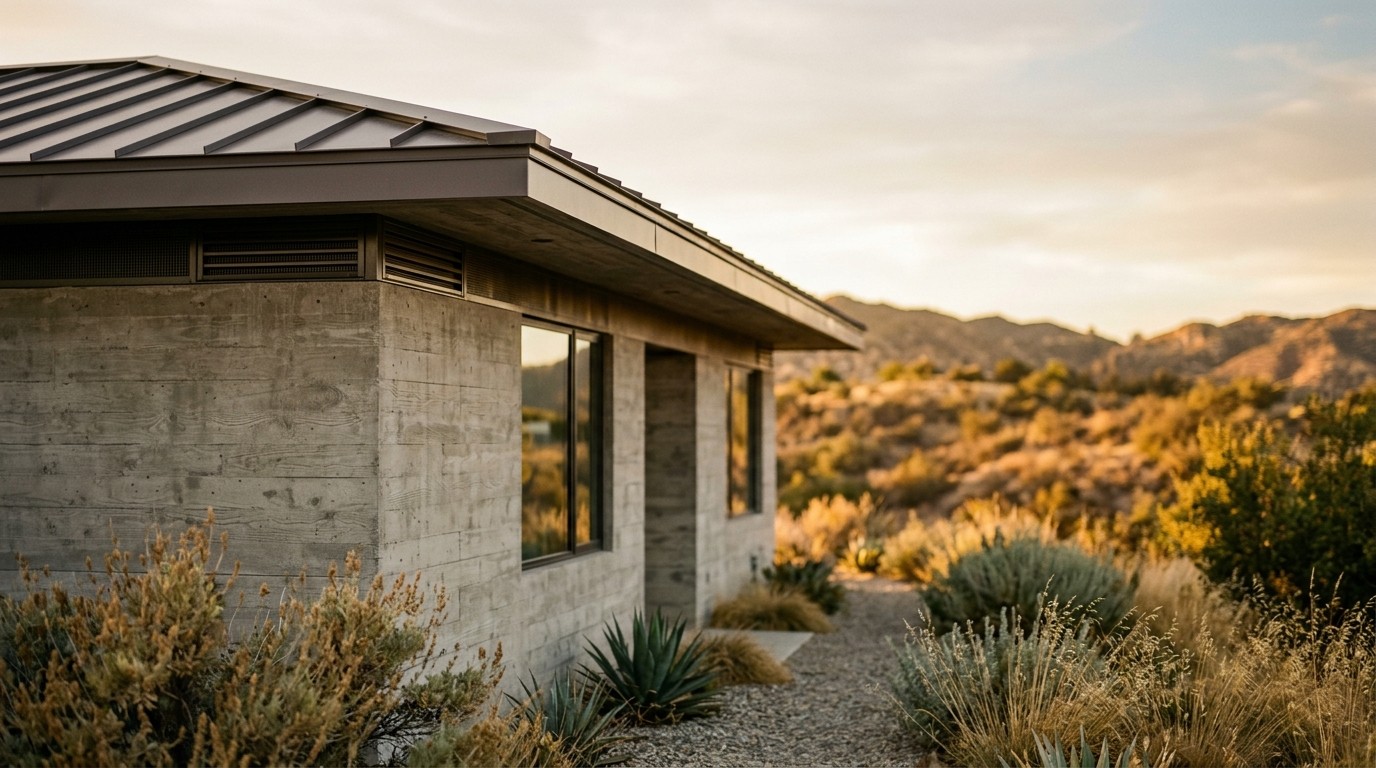
The Walnut build pairs a printed concrete shell with a steel-and-Sure-Board roof, hardened eave vents, and upgraded openings. The unglamorous detailing is what moves the risk needle.
For builders, insurers, and homeowners in the wildland-urban interface, the lesson is the systems-level design — not the printer.
The Walnut Project in One Paragraph
In early 2024, Builtech Construction Group, the City of Walnut, and the Los Angeles County Fire Department broke ground on the first onsite 3D-printed fire-resistant accessory dwelling unit (ADU) in the United States.[1] The 1,200 sqft, two-bedroom, two-and-a-half-bath structure sits in the backyard of a Walnut couple who wanted to do something tangible about wildfire risk. Subcontractor K4K Construction Design ran the print using RIC Technology's compact, modular robotic-arm concrete printer, which laid the exterior walls in roughly twenty days.[1][7] The project cleared California's stringent Chapter 7A WUI permitting in February 2024. That alone is a notable institutional outcome. But the design choices that matter most to wildfire survival are not in the walls.
Why Walls Are the Easy Part of a Fire-Resistant Home
A poured or printed concrete wall is, by default, non-combustible. It does not feed flame, it does not off-gas, and it does not fail catastrophically under brief radiant exposure. That is why almost every "fire-resistant" home story leads with concrete: it is the easiest, most photogenic detail to point to. RIC Technology's robotic 3D printer makes that detail faster and cheaper to deliver, especially on confined sites like a Southern California backyard, where a traditional gantry system simply will not fit.[1]
But walls are rarely the first thing to fail in a wildfire. According to the USDA Forest Service's Wildfire Risk to Communities resource hub, most homes destroyed in wildfires are initially set ablaze by embers and minor flames — not by a wall of advancing flame.[1] Embers travel up to a mile ahead of a fire front, settle on roofs, drift through eave vents, and ignite combustible interiors before the flames ever touch the wall. A concrete wall in front of a wood-framed roof, an open soffit, and single-pane windows is a concrete wall around a kindling box.
This is the part of the story that most coverage of 3D-printed homes skips, and it is where the Walnut project quietly distinguishes itself.
The Roof Is the Real Test
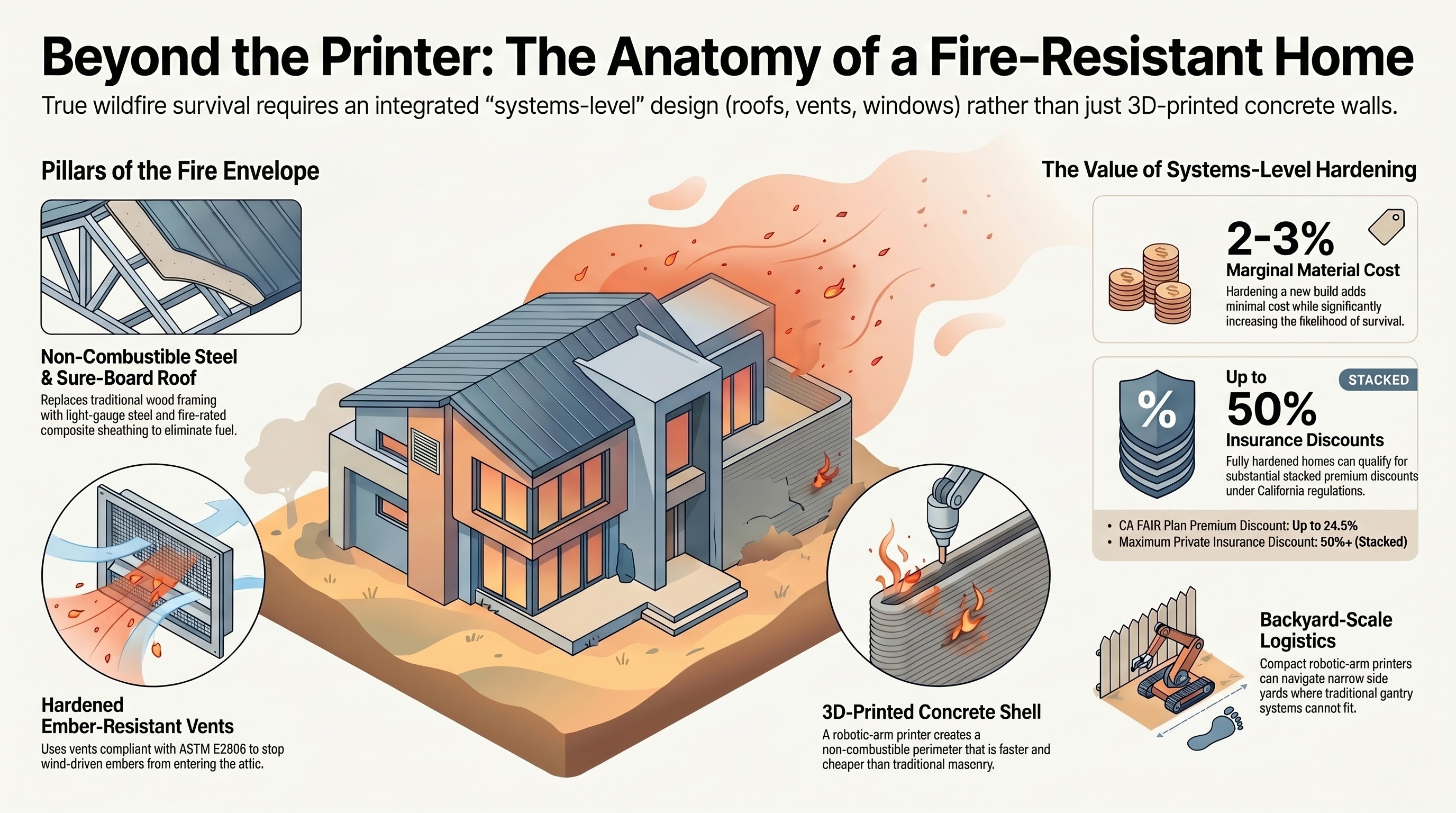
The Walnut ADU does not have a wood roof. It does not have a wood deck. It does not, by Aaron Liu's own description, contain a single piece of wood or nail on the main structure.[1] The roof assembly uses light-gauge steel framing with Sure-Board sheathing — a non-combustible composite that pairs a steel sheet with gypsum to deliver structural performance without contributing fuel.
That detail is more consequential than the printed walls. Class A roofing is the single most cost-effective home hardening upgrade in the IBHS Wildfire Prepared Home standard, and roof ignition is the most common cause of total structure loss in WUI fires.[4] Most 3D-printed homes built to date have used wood-framed roofs sitting on top of their concrete shells, leaving the most ignition-prone assembly in the entire structure unmodified. The Walnut project breaks that pattern. By treating the roof as part of the fire envelope rather than as a finishing detail, Builtech moved the home from "concrete walls are nice" to "the entire envelope is non-combustible."
That is a different category of home.
Eaves: The Ember Highway Most Builders Miss
Under almost every roof overhang sits a pair of details that quietly decide ember outcomes: the soffit and the eave vent. CAL FIRE's home hardening guidance is unambiguous on this — open eave construction with gaps between rafter tails and blocking, and vents in eaves with even minor penetrations, are entry points for embers.[2] IBHS's controlled wind tunnel research has shown that vent type, configuration, and orientation significantly affect ember penetration into attic spaces.[3] Once embers are in the attic, the structure is functionally lost.
The Walnut design treats eave vents as a primary engineering surface, not an afterthought. Builtech publicly committed to extra measures to strengthen areas of the home that are traditionally vulnerable to fires, such as eave vents and windows.[1] In practice, that means ember-resistant vent products that meet ASTM E2886 or California State Fire Marshal listings, paired with enclosed soffits in non-combustible material, and inspected gap closures around rafter blocking. None of that is novel as a hardening practice. What is novel is doing it as part of an integrated 3D-printed home — and not allowing the printed concrete to become an excuse to skip the boring detailing.
Windows: The Other Failure Mode
Windows are the second most common ignition pathway after vents and roof assemblies. A single-pane window can shatter under radiant heat from an exterior fuel package burning ten or twenty feet away, opening the interior of the home directly to flame and ember intrusion. The California Department of Insurance's Safer from Wildfires program lists upgraded multi-pane windows as one of its ten qualifying mitigation steps for premium discounts.[5]
The Walnut ADU's windows are explicitly part of the home hardening scope. They are not specified in the public reporting in granular detail, but the project's commitment to strengthen areas of the home that are traditionally vulnerable to fires, such as eave vents and windows signals tempered or dual-pane assemblies with metal frames and minimal combustible trim.[1] For homeowners trying to replicate this build in their own WUI lot, this is the line item to push back on. A printed concrete wall with a builder-grade vinyl-frame, single-pane sliding window in it is not a fire-resistant assembly.
Why Robotic-Arm Printing Matters Here
The Walnut ADU is also a test of construction logistics. Most concrete 3D printing demonstrations to date have used gantry systems — large rectangular frames that ride above the print envelope. Gantries are precise and fast, but they need a footprint, an access road, and frequently a slab that is large enough to host them.[7] Backyards in Walnut, California do not have any of those things.
RIC Technology's compact modular robotic arm sidesteps this constraint. Per founder Ziyou Xu, the system was designed specifically to overcome conventional gantry systems' limitations, enabling 3D construction on site, in confined spaces such as people's backyards.[1] That matters less for novelty and more for replication: California's ADU market is a backyard market. Any printing technology that requires a gantry-scale staging area effectively excludes the existing-home retrofit segment, which is where the volume sits. A robotic arm that fits down a side yard and plants on a small foundation is the only form factor that can scale fire-resistant printed ADUs into the WUI lots that already exist.
What an NFPA Wildfire Mitigation Specialist Designs Around
Aaron Liu, the CEO of Builtech, is an NFPA-certified Wildfire Mitigation Specialist (CWMS).[1][6] That credential matters because it changes the design checklist. A CWMS is trained to think in terms of the fire triangle (fuel, heat, oxygen) and to systematically remove fuel from the structure. We significantly minimize the likelihood of fire entering the home, reducing its susceptibility to fire, Liu told reporters during the Walnut build.[1]
In practice, the CWMS lens treats the home as a connected system of fuel pathways. Walls are one pathway; the others are the roof, the eave/soffit assembly, the vents, the windows, the deck, the 0–5 foot noncombustible zone around the home, and the gutters. A printer that solves only the wall pathway leaves the rest of the system intact. The Walnut build is interesting because it pairs the printer with a CWMS-grade design checklist for everything the printer does not touch. That is the replicable pattern, not the printer brand.
How the Walnut Build Maps to California's Fire Code
California's Chapter 7A and Wildland-Urban Interface building requirements are among the most rigorous in the country. The fact that the Walnut ADU received a construction permit in February 2024 demonstrates that an integrated printed-concrete plus non-combustible-roof plus hardened-vent assembly can clear that bar.[1] That is a meaningful precedent for design and engineering teams working on subsequent printed ADUs in Los Angeles County and other WUI-designated jurisdictions.
The permit was not granted because the walls were printed. It was granted because the entire assembly satisfied Chapter 7A's prescriptive and performance criteria for ignition-resistant construction — roofing, eaves, vents, windows, exterior walls, and underfloor space all in one filing. Builders preparing a similar permit package should expect the plan check to focus far more on the roof and the openings than on the printed walls.
The Insurance Math
California's insurance market has spent the last three years explicitly pricing wildfire mitigation. Under the California Department of Insurance's Safer from Wildfires regulation, insurers must offer premium discounts for the twelve listed mitigation measures, including Class A roofs, enclosed eaves, ember-resistant vents, multi-pane windows, and noncombustible six-inch wall bases.[5] The maximum stacked discounts for fully hardened homes range from a few percent to over fifty percent depending on carrier.[8] The California FAIR Plan now offers wildfire-premium discounts of up to 24.5%.[8]
A Headwaters Economics and IBHS analysis published in 2025 shows that hardening upgrades — roofing, eaves, siding, windows, and 0–5 foot landscaping — typically add only 2–3% to total material cost on new builds.[4][9] For a 3D-printed ADU, the printer already absorbs much of the labor cost on the wall package. The remaining hardening detailing — non-combustible roof, enclosed soffits, ember-resistant vents, dual-pane metal-frame windows — is the line item that unlocks the largest insurance and survivability return on the smallest incremental spend.
What This Replicates To
The Walnut ADU is not interesting because one home was printed. It is interesting because it sets a replication pattern for the next thousand. The pattern is: a robotic-arm printer that fits in a backyard, a non-combustible roof, hardened eave vents and soffits, upgraded windows, and a CWMS-led design checklist that treats the home as a system. Any one of those elements is available off the shelf. The novelty is integrating them and getting a stringent California jurisdiction to permit the result.
For builders, the takeaway is that the printed wall is necessary but not sufficient. For homeowners in WUI zones, the takeaway is to spend the marginal hardening dollar on the roof and the openings before the wall finish. For insurers, the takeaway is that printed concrete alone is not a discount trigger — the rest of the envelope has to come with it. The Walnut project is most useful read this way: not as a gee-whiz 3D printing demo, but as a design template for the unglamorous, system-level work that decides who is still standing after the next ember storm.
FAQs
Is a 3D-printed concrete house actually fireproof?
No home is truly fireproof, but a 3D-printed concrete home like the Walnut ADU can be highly fire-resistant when paired with the right roof, vents, and windows. The printed concrete walls themselves are non-combustible, but the home's overall wildfire performance depends on whether the roof, eave vents, soffits, and openings are also hardened. A printed wall behind a wood-framed roof or open eaves is not a fire-resistant home.
How long does it take to 3D-print an ADU in California?
The exterior wall printing on the Walnut, California ADU took roughly 20 days using RIC Technology's robotic-arm concrete printer. Total project timelines, including foundation, plumbing and sewage, roof installation, window and door fitting, interior finishes, and inspections, run substantially longer — typically several months. The printing itself is the fastest part; permitting and integrated wildfire hardening detailing are usually the schedule drivers in WUI jurisdictions.
What is an NFPA Certified Wildfire Mitigation Specialist (CWMS)?
The NFPA Certified Wildfire Mitigation Specialist credential, or CWMS, is a professional certification administered by the National Fire Protection Association for practitioners trained in wildfire risk assessment and home hardening. CWMS holders evaluate structures, vegetation, and the wildland-urban interface, and recommend ignition-resistant materials and detailing. Builtech CEO Aaron Liu is a CWMS, which is why the Walnut ADU's design treats the home as an integrated system rather than a single material upgrade.
Why are eave vents so dangerous in a wildfire?
Eave vents create a direct airflow path from outside the structure into the attic. During a wildfire, wind-driven embers can travel up to a mile and easily enter unprotected vents, igniting insulation, framing, and stored items inside the attic. Once an attic ignition starts, structural collapse usually follows. CAL FIRE and the Insurance Institute for Business and Home Safety both identify eave vents as one of the highest-priority hardening targets.
What is Sure-Board and why is it used in fire-resistant homes?
Sure-Board is a non-combustible composite sheathing panel that bonds a steel sheet to a gypsum board substrate. It contributes structural shear capacity while resisting flame and high heat, making it well suited as a roof or wall sheathing in fire-hardened assemblies. The Walnut 3D-printed ADU uses light-gauge steel framing with Sure-Board sheathing on the roof, eliminating wood from the most ignition-prone assembly in the home.
Can a 3D-printed ADU be permitted in a California WUI zone?
Yes. The Walnut, California 3D-printed fire-resistant ADU received a construction permit in February 2024 under California's Chapter 7A wildland-urban interface building requirements. The permit was issued because the integrated assembly — printed concrete walls, non-combustible roof, hardened eave vents, and upgraded windows — satisfied the prescriptive and performance criteria for ignition-resistant construction. The printing technology itself was secondary to the systems-level fire detailing.
How much does it cost to add wildfire resistance to a new home?
A 2025 analysis by Headwaters Economics and the Insurance Institute for Business and Home Safety found that upgrading new construction to wildfire-resistant standards adds only about 2–3% to total material costs. Most of that increment is concentrated in roofing, eaves, siding, windows, and the 0–5 foot noncombustible landscape zone. For 3D-printed homes, the printer absorbs much of the wall-package labor, so the marginal hardening spend largely goes toward roofs and openings.
Will I get an insurance discount for a fire-hardened ADU in California?
Likely yes. Under California's Safer from Wildfires regulation, insurers must offer discounts for hardening measures including Class A roofs, enclosed eaves, ember-resistant vents, upgraded windows, and a noncombustible zone around the home. The California FAIR Plan offers wildfire-premium discounts of up to 24.5%, and stacked private-carrier discounts can exceed 50% in some cases. Discounts vary by insurer and depend on documentation that each measure is in place.
Why does a robotic-arm printer matter for backyard ADUs?
Gantry-style 3D concrete printers are precise but require a large staging footprint and access path that most existing residential lots cannot accommodate. A compact robotic arm, like the system RIC Technology used in Walnut, fits in confined backyard sites and can plant on a smaller foundation, which is why it is more compatible with California's actual ADU market — which is overwhelmingly a backyard retrofit market on already-developed lots.
Should I prioritize the roof or the walls when fire-hardening my home?
Prioritize the roof, eave vents, and windows first. The vast majority of homes lost in California wildfires are ignited by embers entering through roof assemblies, vents, or shattered windows — not by direct flame contact with a wall. Even an unhardened wall behind a Class A roof, ember-resistant vents, and dual-pane metal-frame windows is significantly less likely to ignite than a concrete wall paired with a wood-framed roof and open soffits.
Related resources
Build in Digital — Robot system to print wildfire-resistant California home — Independent reporting on the Walnut ADU build with quotes from RIC Technology's Ziyou Xu.
CAL FIRE — Home Hardening — California's authoritative homeowner-facing guidance on roofs, eaves, vents, windows, and decks.
IBHS — Construction Costs for Wildfire-Resistant Homes (2025) — Joint Headwaters Economics / IBHS analysis of the marginal cost of wildfire hardening on new builds.
References
[1] Inceptive Mind — U.S.'s first 3D-printed fire-resistant ADU starts construction: https://www.inceptivemind.com/u-s-first-3d-printed-fire-resistant-adu-starts-construction/36781
[2] CAL FIRE — Home Hardening: https://www.fire.ca.gov/home-hardening
[3] IBHS — Ember Entry: Vents: https://ibhs.org/wildfire/ember-entry-vents/
[4] Headwaters Economics & IBHS — Construction Costs for Wildfire-Resistant Homes (2025): https://ibhs.org/wp-content/uploads/Construction_Costs_Wildfire_Resistant_Homes_HE-IBHS_Final_2025.pdf
[5] California Department of Insurance — Safer from Wildfires: https://www.insurance.ca.gov/01-consumers/200-wrr/Safer-from-Wildfires.cfm
[6] NFPA — Certified Wildfire Mitigation Specialist (CWMS): https://www.nfpa.org/for-professionals/certification/cwms
[7] Build in Digital — Robot system to print wildfire-resistant California home: https://buildindigital.com/robot-system-to-print-wildfire-resistant-california-home/
[8] Epicenter Insights — Can Home Hardening Discounts Ease the Insurability Crisis?: https://www.epicenterinsights.com/can-home-hardening-discounts-ease-the-insurability-crisis/
[9] Headwaters Economics — Construction Costs for Wildfire-Resistant Homes: https://headwaterseconomics.org/natural-hazards/wildfire/construction-costs-for-wildfire-resistant-homes/