3D-Printed Fire-Resistant Homes: The Wood Roof Problem
California's first onsite fire-resistant 3D-printed ADU (Walnut, by Builtech + RIC Technology) is unique not because of its concrete walls, but because Builtech replaced the wood-truss roof that almost every other 3D-printed 'fire-resistant' home still uses. This blog argues that for wildfire-prone California buyers, the relevant spec is not '3D-printed' — it's a wood-free envelope from slab to ridge.
Authors:


TLDR
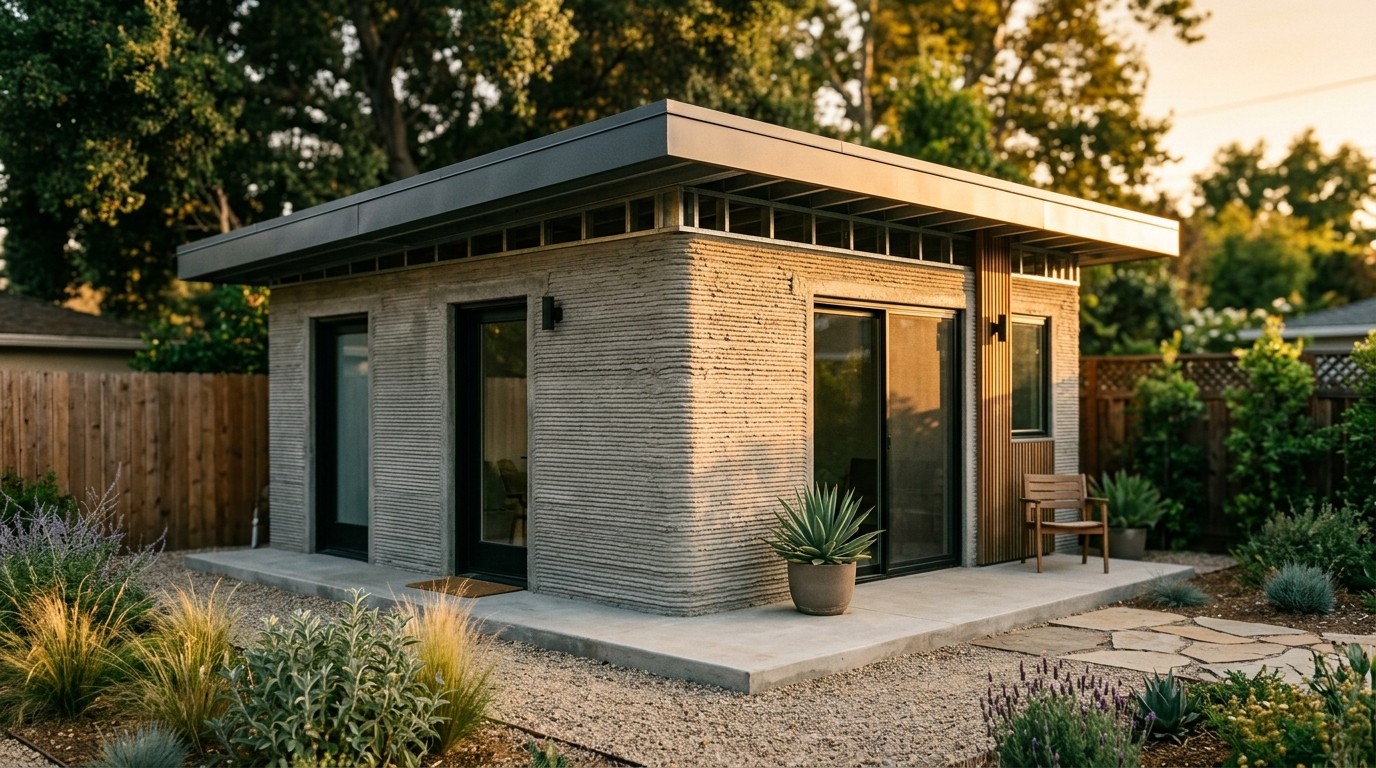
California's first onsite fire-resistant 3D-printed concrete ADU was completed in Walnut by Builtech Construction Group with RIC Technology and K4K Construction Design.
Concrete walls only address one leg of the fire triangle — fuel in the wall assembly. They do not address the roof, eaves, vents, or windows that statistically ignite first.
Most "fire-resistant" 3D-printed homes in North America still ship with wood-truss roofs, leaving them exposed to ember ignition from above.
Builtech's Walnut ADU is unusual because it replaced lumber with light steel framing and sure-boards, and reinforced the eave vents and windows that embers typically exploit.
For wildfire-prone California buyers, the relevant spec is not "3D-printed" — it is a wood-free envelope from slab to ridge.
The 3D-Printed Wildfire Home Has a Hidden Weakness
The headline is by now familiar. A robotic arm extrudes concrete in horizontal beads. In about three weeks the exterior walls of a small home are standing.[1] A press release follows. Local news arrives with a camera. The phrase fire-resistant gets attached to the build, and a wildfire-anxious public assumes that 3D-printed concrete equals safety.
The reality is more careful. The walls are doing exactly what they advertise: non-combustible mass, no studs, no cavity, no fuel buried inside the assembly. That part is real. It is also incomplete.
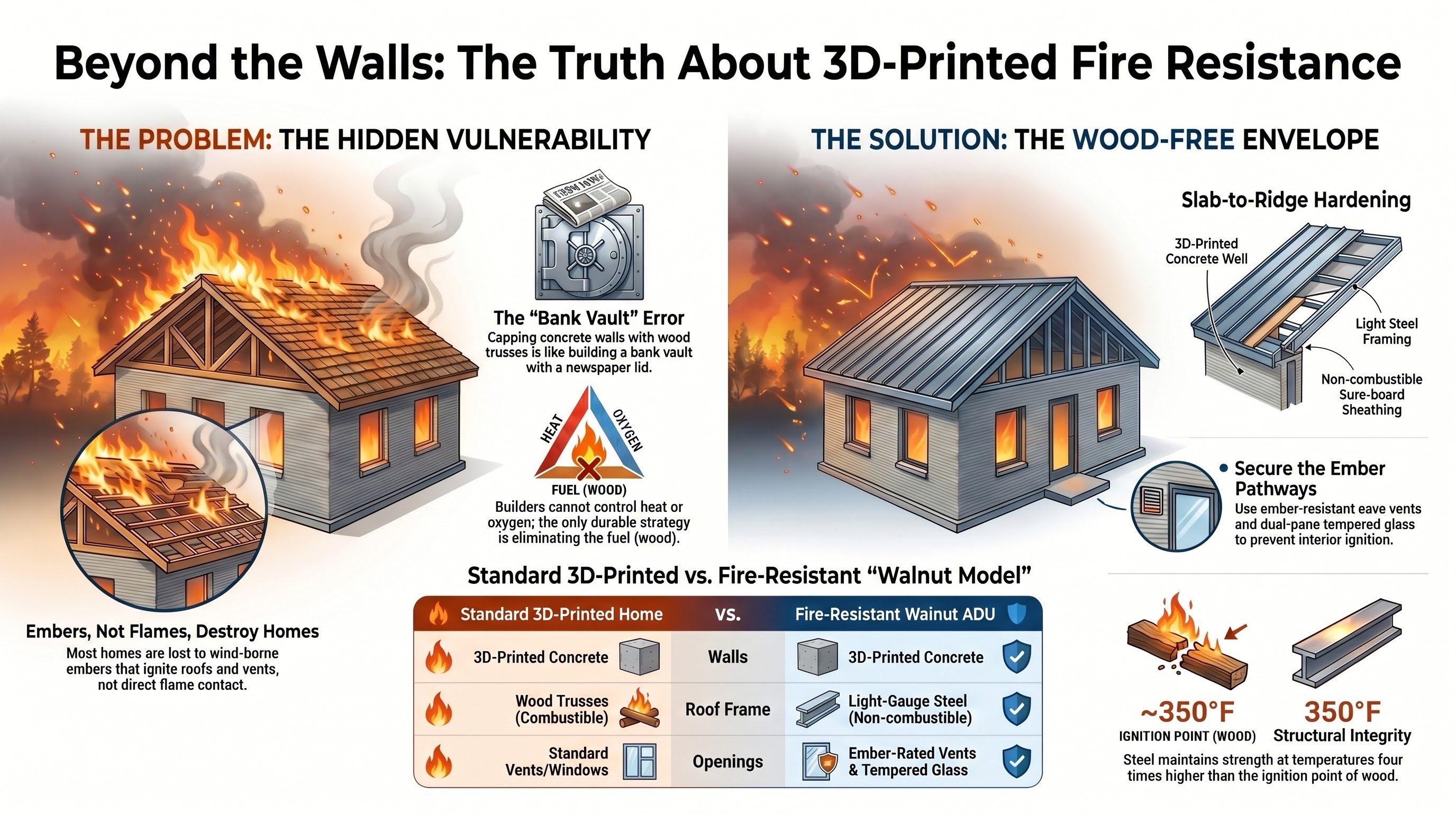
In a wildfire, the wall is rarely where the fight is lost. Post-event forensic work from research bodies like the USDA Forest Service's Wildfire Risk to Communities initiative and the Insurance Institute for Business and Home Safety has converged on a single pattern for decades: most homes destroyed by wildfire are ignited by embers, not by direct flame contact.[11] Embers reach the home from far ahead of the fire front, ride wind into vents and onto roofs, settle in receptive places — accumulated debris, dry vegetation, exposed wood members — and start a small fire that the home itself then feeds.
A 3D-printed concrete wall is a poor receptacle for embers. A wood-truss attic underneath an asphalt roof is an excellent one. That gap is the subject of this article.
Concrete Walls Solve One Side of the Fire Triangle, Not All Three
The fire triangle is the textbook formulation: heat, oxygen, fuel. Take one leg away, no fire. Aaron Liu, the NFPA-certified Wildfire Mitigation Specialist who leads Builtech Construction Group, puts the construction implication plainly: in a wildfire event, the builder cannot control the heat or the oxygen, so the only durable strategy is to eliminate the fuel.[1]
That sounds obvious. It is rarely executed end-to-end. A 3D-printed concrete wall removes fuel from the wall assembly. A homeowner standing in front of that wall after a wildfire could still be standing in front of a charred slab if the eave vent above admitted an ember, ignited the attic, and let the structural roof — almost always wood-framed in standard residential practice — collapse the rest of the building from the top down.
The architecturally honest question is not "is the home built of concrete?" but "where is the fuel?" In nearly every 3D-printed home built in North America to date, the answer is the roof.
Why Most 3D-Printed Fire-Resistant Homes Still Use Wood Roofs
Walk through the published gallery of well-publicized concrete 3D-printed builds in North America and a pattern emerges. The walls are concrete. The roofs are not.
Emergent's Redding project — California's first 3D-printed primary dwelling — paired COBOD-printed concrete walls with conventional roof construction.[9] COBOD's Colorado mountain-community homes feature 3D-printed concrete walls and traditional finishing for the upper structure.[9] ICON's resilience testing emphasizes its 2-bead wall system, which has achieved a 2-hour fire rating — a meaningful spec, but again, at the wall.[8] PCI Builders' Los Angeles 3D-printed concrete home with NFPA 13D-equivalent active fire suppression installs interior fire-defense systems as a complement to conventional roofing, not as a replacement for a non-combustible roof envelope.[7]
There are reasonable explanations. Wood trusses are cheap. They are familiar to local framers. They are easy to permit. They engineer fast. A 3D-printed wall is a novel cost; pairing it with a novel roof is two novel costs in one build, which makes lenders nervous and projects slow.
Every one of those explanations is about builder convenience, not occupant safety. From a wildfire engineering standpoint, capping a concrete shell with a wood truss assembly is the equivalent of building a bank vault and lining the lid with newspaper.
What Wood Truss Roofs Actually Do in a Wildfire
Wood shakes ignite at roughly 375°F.[6] Asphalt shingles begin to ignite around 400°F.[6] Mass embers arriving from a wildfire arrive with surface temperatures well above both. A wind-borne ember lands on a roof, finds receptive material in a gutter or a roof valley, or filters through an unscreened eave vent into the attic, and the next item it meets is a wood truss.
A wood truss is engineered for load, not for fire. Once involved, it loses structural capacity quickly. Roof collapse follows. From the moment of collapse, the concrete walls that were supposed to protect the home are simply walls around an open burn.
This is the part of the model that gets lost in marketing photos of finished 3D-printed walls. The structural roof is the highest-elevation, largest-surface, most ember-exposed plane on the home. Building a wildfire-resistant home and then crowning it with combustible structural members is a category error.
The remediation is straightforward in principle and difficult in practice: replace dimensional lumber with cold-formed light steel, replace OSB or plywood roof sheathing with non-combustible sure-board panels, and pair both with a Class A roof covering. Steel maintains structural integrity at temperatures approaching 1,400°F — roughly four times the ignition point of common wood roof components.[6]
The Light Steel and Sure-Board Roof: A Different Engineering Decision
The Walnut ADU departs from the 3D-printed convention precisely at the roof. The exterior walls are 3D-printed concrete. The structural roof is light steel framing and sure-boards.[3] There is no dimensional lumber and no nail in the main structure of the home.[1]
This is a smaller engineering decision than the headline suggests and a larger one than it appears. Smaller, because steel-framed residential roofs are not exotic — they are standard in commercial construction and increasingly common in fire-prone residential rebuilds. Larger, because pairing the steel roof with a 3D-printed concrete wall on a permitted, occupied California home is genuinely first-of-kind.[2][10]
What the choice yields is an envelope where every primary structural element resists wildfire ignition by being something that does not burn. Concrete walls. Steel and non-combustible sheathing above. Reinforced eaves and openings, discussed below. The home is not fire-proof — nothing is. The fuel load of the structure has been reduced approximately to its slab — the gypsum, the finishes, the interior cabinetry — none of which a wildfire can reach until the exterior envelope is breached.
Eave Vents and Windows: The Ember Pathways Most Builders Underestimate
A non-combustible envelope is necessary but not sufficient. Two specific details are responsible for an outsized share of post-wildfire home losses: eave vents and windows.
Eave vents exist for legitimate reasons. They balance attic pressure and prevent the moisture buildup that produces mildew and rot. In a wildfire, they also act as ember intakes. Research from the Insurance Institute for Business and Home Safety has shown that standard, unscreened vents readily admit embers capable of igniting attic combustibles.[11] In a home where the attic is framed in wood, that is a fatal pathway. In a home with a steel-framed attic and non-combustible sheathing, it is much less so — provided the vents themselves are designed to resist ember penetration.
Windows fail by a different mechanism. Single-pane glass cracks under sustained radiant heat from a nearby fire, exposing the interior. Once the interior is exposed, anything combustible inside — furniture, drapes, books, flooring — becomes the ignition source.
The Walnut ADU reinforces both. Eave vents and windows are treated as wildfire-rated assemblies, not afterthoughts.[3] In a structural sense the wall may be the most photogenic feature of the home, but in a fire-survival sense, the vents and openings determine the outcome.
The Walnut ADU Build: What Wood-Free Looked Like in Practice
The Walnut ADU is 1,200 square feet — two bedrooms and 2.5 bathrooms — built in the backyard of a homeowner couple, Philips and Constance, who explicitly wanted their property to contribute to local wildfire defense.[1] The collaboration brought the City of Walnut and the Los Angeles County Fire Department in on the permitting and inspection side, with RIC Technology supplying the robotic 3D printer and K4K Construction Design printing the walls, while Builtech led from design through finish.[1]
Getting a full permit and full inspection on a wood-free, 3D-printed concrete home was non-trivial. In Aaron Liu's own words, "It's very tough to get the permit, but we did it."[2] That sentence is more than a quote. It is the actual regulatory pathway every subsequent project of this type in California can now point to.
The Walnut build proved three things at once. First, that an end-to-end wood-free residential envelope is constructable today, not in a research environment but on a normal lot in Los Angeles County. Second, that local jurisdictions will permit and inspect that envelope when the design package is rigorous. Third, that the cost and time penalty for swapping wood out of the roof is bounded — the project went from foundation to printed walls in a matter of weeks.[4]
What This Means for Insurance, Permits, and Resilience Math
There is a quieter implication that affects every California homeowner reading this. Insurance markets have spent the last several years repricing wildfire risk. Carriers have non-renewed policies, exited zip codes, and increasingly indexed pricing to home-hardening features. The California FAIR Plan has become a backstop for properties that no longer qualify for standard coverage.
Regulators and insurers do not pay full attention to "3D-printed" as a category. They pay attention to envelope characteristics: roof class, vent rating, window rating, defensible space, ignition-resistant siding. A home with concrete walls and a wood roof checks the wall box and fails the roof box.[11] A home with concrete walls and a steel-framed non-combustible roof and ember-resistant vents and tempered windows checks all four. The economic value of the second home, in a market increasingly priced by mitigation score, is structurally different.
For the city or county, the implication is bigger. If a hardened residential envelope can be permitted and built at ADU scale, it can be built at neighborhood scale. The 2018 Camp Fire essentially erased the town of Paradise; five years later, residents who stayed were still living in RVs while they recovered.[1] A wildfire-prone county that ends each fire season with a higher proportion of homes intact spends less on emergency response, less on temporary housing, less on long-tail recovery, and absorbs fewer permanent residents lost to the region.
How to Evaluate a 3D-Printed Home Spec Before You Build
If you are a California homeowner evaluating a 3D-printed home or ADU, the marketing materials will dwell on the concrete extrusion process and the speed of the wall build. Those are true. They are also not the questions that determine whether your home survives a fire.
Five questions to ask any 3D-printed home builder, in order:
What is the structural roof system? If the answer involves dimensional lumber or wood trusses, the envelope is not wildfire-grade. Acceptable answers involve light-gauge steel framing with non-combustible sheathing or a comparable engineered assembly.
What is the roof covering's fire rating? Class A is the modern minimum. Anything less is a regression.
Are the eave vents ember-resistant and rated? The vendor and rating should be on paper, not in a sales script.
What is the window glazing spec? Dual-pane tempered glass at minimum; a wildfire-rated assembly is better.
Is the main structure wood-free? The honest answer is yes or no. There is no "mostly."
Builders who can answer all five precisely are building a home for the fire environment California actually has. Builders who change the subject to print speed or aesthetic options are selling a feature, not a defense system.
Where the Industry Goes From Here
The next phase of 3D-printed residential construction in wildfire country will be decided at the roof, not the wall. The wall is already solved at the materials level — concrete extrusion has matured enough that any serious player can produce a printed wall that meets or exceeds the fire performance of stucco-over-frame. The differentiation is now in the parts of the home the printer does not touch.
That is where Builtech's collaboration with RIC Technology becomes a useful template. The print partner brings the wall innovation. The contractor brings the mitigation logic — the CWMS-led decisions about roof system, vents, and openings that turn a printed shell into a wildfire-rated home. Both are necessary. Neither is sufficient.
The Walnut ADU does not solve California's wildfire problem. It demonstrates a buildable, permittable, occupied prototype of a home that takes the entire fire triangle seriously, not just the photogenic side. For homeowners and policymakers planning the next decade of construction in the wildland-urban interface, that prototype is the relevant reference point — not the conventional 3D-printed home with the wood crown.
FAQs
Are 3D-printed concrete homes actually fire-resistant?
The concrete walls themselves are non-combustible and do not contribute to fire spread, but whether the whole home is fire-resistant depends on the rest of the envelope. A 3D-printed home with a wood-truss roof, unscreened eave vents, and standard windows is not meaningfully more wildfire-resistant than a conventional stucco-clad home. A 3D-printed home with steel framing, non-combustible sheathing, and ember-rated openings is.
Why do 3D-printed homes still use wood roofs if concrete walls do not burn?
Wood trusses are cheaper, faster to engineer, and familiar to local framers and inspectors. Most 3D-printed home builders treat the print as the innovation and revert to conventional residential framing above the wall plate. The Walnut ADU is unusual specifically because Builtech swapped lumber for light steel and sure-boards at the roof level.
What is a sure-board, and why does it matter for fire resistance?
A sure-board is a non-combustible structural sheathing panel used in place of plywood or OSB. In a wildfire context, the roof deck is one of the highest-exposure surfaces on the home. Replacing wood-based sheathing with a sure-board removes a major fuel source and pairs cleanly with a Class A roof covering and steel framing underneath.
How much does a fire-resistant 3D-printed ADU cost compared to a standard ADU?
Costs vary by region and finish level. Published comparable 3D-printed homes in the U.S. range from roughly $10,000 for very small builds to $400,000 or more for larger primary dwellings.[5] COBOD's Colorado mountain-community homes priced near $625,000, in line with regional housing values.[9] The fire-resistant envelope premium — steel roof, non-combustible sheathing, rated vents and openings — is meaningful but bounded, and is increasingly offset by insurance availability.
How long does it take to build a 3D-printed concrete ADU?
The exterior wall print typically takes about three weeks once the foundation is in place.[4] The full build — foundation, plumbing, electrical, roof, finishes, inspections — runs several months. Speed claims like built in 16 days usually refer to the superstructure portion of the build, not the full move-in timeline.
Are 3D-printed homes approved by California building codes?
Yes, when they meet structural, fire, and energy requirements like any other home. The Walnut ADU received a full permit and full inspection from Los Angeles County authorities, and subsequent projects in the state have followed similar pathways.[2] Approval is not automatic. The design package must satisfy the same code surface as conventional construction.
What is an NFPA-certified Wildfire Mitigation Specialist?
A Certified Wildfire Mitigation Specialist (CWMS) is a credential offered through the National Fire Protection Association recognizing professionals trained to assess and reduce wildfire risk on residential and commercial properties. The credential matters in construction because mitigation decisions — roof, vents, defensible space, siding — are technical and frequently misapplied by general framers.
Do 3D-printed homes need defensible space landscaping like other homes?
Yes. A non-combustible envelope removes one major ignition pathway, but embers can still ignite vegetation, fencing, mulch, and stored materials within the first five feet of the home. The 0-5 foot noncombustible zone remains a baseline expectation in California's wildland-urban interface.[11]
Can a fire-resistant 3D-printed ADU help with home insurance in California?
It can, particularly as carriers and the California FAIR Plan increasingly index pricing and availability to documented home-hardening features. An ADU with a rated roof, rated vents, and a non-combustible envelope provides a clearer underwriting profile than a conventional residential structure in the same fire hazard severity zone. Homeowners should request a written mitigation assessment to support that case.
How does a 3D-printed ADU help with the housing shortage and wildfire resilience at the same time?
ADUs add housing density on existing lots without requiring new subdivision, which addresses California's housing supply problem at the parcel level. When those ADUs are built with non-combustible envelopes, they also incrementally raise the wildfire resilience of the surrounding neighborhood — every hardened structure is one less fuel source during an event. The Walnut ADU illustrates that the two goals are compatible in a single build.
Related resources
California's first innovative fire-resistant 3D printed ADU unveiled in Walnut — 3D Printing Industry — Independent industry coverage of the Walnut ADU project.
Wildfire Risk to Communities — USDA Forest Service — Authoritative reference on ignition-resistant home design and the 0-5 foot noncombustible zone.
Fire Resistant 3D Printed Home in LA — YouTube — Video walkthrough of the move-in-ready fire-resistant 3D-printed home in Los Angeles.
References
Highways Today — Building fire-resistance with 3D Printed Concrete Homes in Los Angeles — https://highways.today/2024/01/03/3d-printed-concrete-homes
Davis Vanguard — California Builders Embrace Fire-Resistant Construction Amid Rising Risks — https://davisvanguard.org/2026/05/san-jose-fire-resistant-adu/
Build in Digital — Robot system to print wildfire-resistant California home — https://buildindigital.com/robot-system-to-print-wildfire-resistant-california-home/
KTLA — 3D printed fire-resistant home being built in Los Angeles County — https://ktla.com/news/california/wildfires/3d-printed-fire-resistant-adu-being-built-in-los-angeles-county/
RKA Consulting Group — First 3D-printed Accessory Dwelling Unit — https://www.rkagroup.com/NewsDetail.dmx?id=N1002
BarrierBoss — Fire-Resistant Metal Roofing: A Critical Defense Against Modern Wildfires — https://barrierbossusa.com/blogs/news/fire-resistant-metal-roofing-a-critical-defense-against-modern-wildfires
BusinessWire — Sonic Fire Tech Included in Los Angeles County's First-Ever Approved 3D-Printed Concrete Home Permit — https://www.businesswire.com/news/home/20260420585460/en/
ICON — Building Resilient 3D-printed Homes: Testing for Fire, Hurricanes and High Wind — https://www.iconbuild.com/newsroom/building-resilient-3d-printed-homes-testing-for-fire-hurricanes-and-high-wind
COBOD — Fire-Resistant Homes 3D Printed in Colorado to Construct Safer Houses — https://cobod.com/fire-resistant-homes-3d-printed-in-colorado/
3D Printing Industry — California's first innovative fire-resistant 3D printed ADU unveiled in Walnut — https://3dprintingindustry.com/news/californias-first-innovative-fire-resistant-3d-printed-adu-unveiled-in-walnut-228854/
USDA Forest Service / Wildfire Risk to Communities — Ignition-Resistant Homes — https://wildfirerisk.org/reduce-risk/ignition-resistant-homes/