Concrete vs Mycelium vs Earth Block Fire-Resistant ADUs
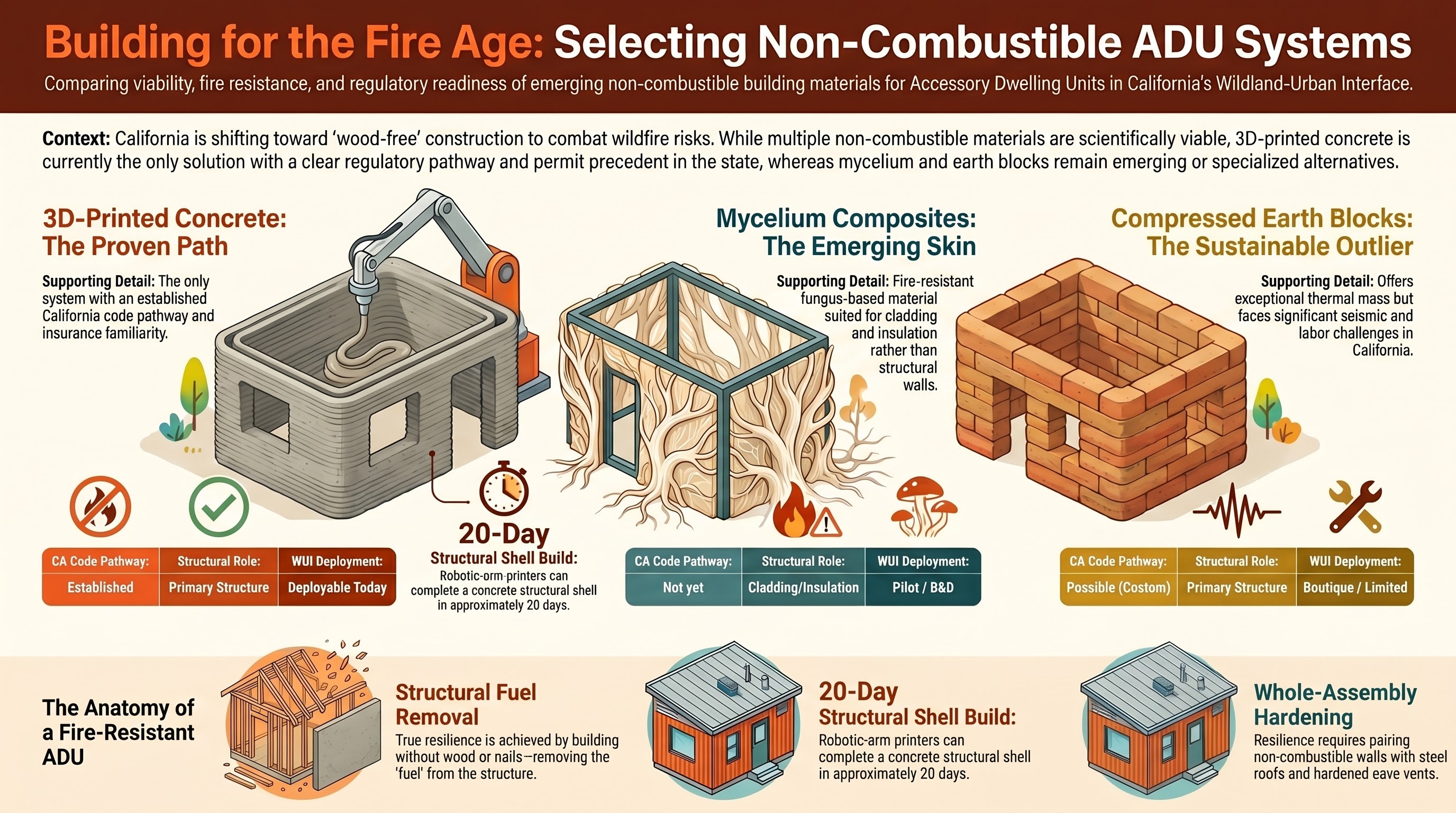
A comparison of three non‑combustible building systems for fire‑resistant ADUs shows 3D‑printed concrete as the only material with an established California code pathway, permit precedent, insurance familiarity, and seismic suitability, making it the default choice today, while mycelium composites serve as emerging cladding/insulation and compressed earth blocks offer low‑carbon benefits but face seismic, labor, and permitting challenges.
Authors:


TLDR
California's first wood-free, fire-resistant 3D-printed ADU went up in Walnut, CA, with printed concrete walls and a wood-and-nail-free roof[1] — but the same coverage flagged two parallel paths: mycelium cladding from Australian researchers and compressed earth blocks from a Colorado startup.
All three materials are non-combustible. Only printed concrete currently has a permitted, code-compliant California ADU precedent on the ground.
Mycelium is legitimate fire science, but it sits at the cladding layer, not the structural-wall layer — so it pairs with a non-combustible system, it does not replace one.
Compressed earth blocks (CEBs) are fire-tolerant, thermally exceptional, and historic, but they collide with California's seismic regime and lack a streamlined ADU permit pathway.
For California WUI builds in 2026, 3D-printed concrete is the only material that combines non-combustibility with a buildable, financeable, insurable spec at ADU scale today.
Walnut, CA Set the Reference Build for Fire-Resistant ADUs
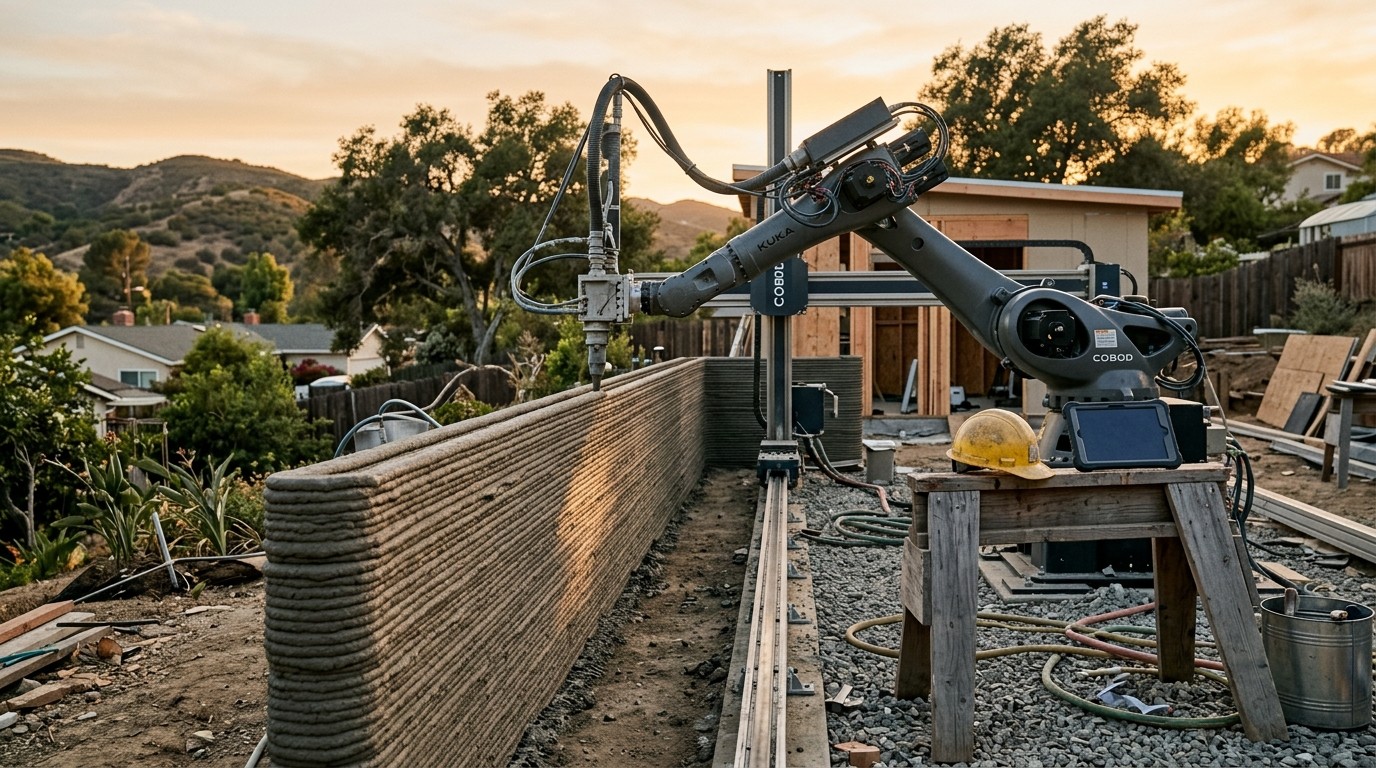
The story that surfaced in early 2024 about a Walnut, California couple moving into the state's first fire-resistant 3D-printed ADU was not a tech-demo headline — it was a regulatory milestone.[1] Builtech Construction Group, the project's general contractor, partnered with RIC Technology and the City of Walnut and worked alongside the Los Angeles County Fire Department to deliver a two-bedroom, two-and-a-half-bathroom backyard ADU that, per Builtech CEO Aaron Liu, was built "without a single piece of wood or nail — no 'fuel' on the main structure." [1]
That sentence is the entire materials thesis of the project. The fire-resistance argument is not a coating, not a treatment, and not a sprinkler system. It is structural fuel removal. The exterior walls are 3D-printed concrete. The roof is light steel and Sure-Board, replacing the wooden structural roofs common to most other 3D-printed homes. Eave vents and windows — the textbook ember-intrusion failure points — are hardened.[1]
The broader article is also generous to two emerging alternatives. Australian scientists are advancing mycelium-based fire-resistant cladding. A Colorado startup is building modern homes from compressed earth blocks. Both are real research lanes. Neither has yet shipped a permitted California ADU at scale. That asymmetry is the reason this comparison exists: builders, homeowners, and county fire authorities want to know — for a real Wildland-Urban Interface (WUI) build, which of these three non-combustible material systems is actually deployable now, and which are still in pilot?
Why "Non-Combustible" Became the Central Spec
In California's WUI footprint, the wildfire failure mode is rarely the wall itself. It is ember intrusion, radiant ignition of attached combustibles, and roof-deck ignition under direct flame contact. CAL FIRE's home-hardening guidance and the Insurance Institute for Business & Home Safety (IBHS) both emphasize that ignition resistance is a whole-assembly property — not a single material's heroics.[2][3]
Non-combustible materials matter for two reasons. First, they remove the fuel that turns an ember intrusion into a structure-loss event. Second, they preserve the geometry of the assembly under heat — vents stay open the right amount, windows do not soften prematurely, roof decks do not delaminate. The Walnut team's choice to eliminate wood and nails in the main structure is a direct application of that logic: if the structural assembly cannot ignite, the ember has fewer places to do harm.[1]
2023 was a clarifying year. California wildfires burned 323,025 acres and killed four people, and 2022 federal firefighting costs exceeded $4 billion.[1] Suppression alone is a losing economic bet. Reducing structural ignition probability — and, just as importantly, reducing post-fire recovery time — is where the math actually closes. That is the lens through which all three materials below should be judged.
Material 1 — 3D-Printed Concrete: The Proven Path
The Walnut ADU's exterior walls are 3D-printed using concrete, a non-combustible material laid down by RIC Technology's robotic-arm printer.[1] Print durations for similar projects in California have run roughly 20 days for the structural shell, with the balance of construction handled through standard trades.[4]
The fire-resilience case for printed concrete is simple. Concrete does not burn. Its dense matrix offers excellent thermal resistance and predictable behavior under radiant heat exposure.[5] Combined with a non-combustible roof system and hardened openings, a printed concrete shell removes the largest combustible mass from a typical California ADU envelope.
What sets printed concrete apart from the alternatives is not its fire performance — all three materials in this comparison are non-combustible — but its readiness profile.
Code: Printed concrete falls under existing structural-concrete code pathways and California Residential Code provisions for non-combustible exterior walls.
Permits: The Walnut ADU received construction permits and was delivered in collaboration with the LA County Fire Department, which gives counterparts in other California jurisdictions a defensible reference build.[1]
Insurance: Underwriters know how to price concrete walls. Mycelium and CEBs do not have the same actuarial track record at the residential ADU scale.
Trades: The print scope is novel, but the surrounding trades (foundation, MEP, finish, roofing) are conventional. A general contractor can subcontract the print without re-architecting the rest of the project.
The trade-offs are also real. Concrete's embodied carbon is high. Print speed is excellent for the shell but irrelevant if foundation and finish work do not keep pace. And printed concrete requires non-combustible roof and opening detailing to deliver the fire-resilience claim — a printed-wall-only approach is not enough.
Material 2 — Mycelium Composite Cladding: The Emerging Contender
Mycelium — the root-like structure of fungi — is at the center of a growing research stream on fire-resistant building materials. Australian researchers profiled in IMechE coverage have produced mycelium composites that, under fire or radiant heat, decompose into a thermally protective char layer rather than igniting and spreading flame.[6] University of Colorado work cataloged in the Natural Hazards Center's Mitigation Matters report shows that mycelium specimens treated with 1–2% silicon retardant achieved significantly higher ignition temperatures and reduced flame heights, and that fungi-based insulation delivered annual cooling-energy savings of 12.57–344.80 kWh across tested climate zones.[7] A peer-reviewed review reported maximum charring depth of less than 1 mm under short-term fire exposure.[8]
This is real fire science. It is not, today, a structural-wall solution.
Mycelium composites are a cladding and insulation class. They sit on the outside of, or inside of, a structural assembly. For a California WUI ADU, mycelium would augment a non-combustible structural system — not replace one. That positioning has two implications:
Mycelium can plausibly contribute to ember-resistant exterior cladding, ignition-resistant insulation, or fire-rated panel layers in concert with code-approved structural materials.
Mycelium does not yet have a California ADU code pathway as a primary wall material, and underwriting and permit familiarity at the residential ADU scale lag well behind concrete.
For builders, mycelium is a promising five-to-ten-year horizon technology that may complement printed concrete or steel-framed assemblies. It is not a replacement for either.
Material 3 — Compressed Earth Blocks: The Historic Outlier
Compressed earth blocks (CEBs) are exactly what the name suggests: stabilized soil pressed into masonry units. The Colorado startup referenced in the source coverage uses CEBs to build modern homes that are fire-resistant, wind-resistant, and thermally massive — properties that help regulate indoor temperatures in extreme climates.[1]
CEBs are non-combustible. Their fire performance is excellent for the same reason concrete's is: dense, inert mineral mass with no organic fuel content. They also have an embodied-carbon profile that is generally lower than Portland-cement concrete, and they perform well thermally — useful in California's hot inland WUI climates.
For California ADU work, CEBs face three serious headwinds:
Seismic. California's seismic design categories impose significant lateral-load demands on masonry assemblies. CEB walls require thoughtful reinforcement detailing and engineering review. This is solvable but adds design and permit friction relative to printed concrete shells engineered for the same conditions.
Permit familiarity. Most California building departments have processed thousands of concrete ADU permits and almost no CEB ADU permits. That asymmetry shows up in plan-check timelines and conditions of approval.
Labor scarcity. The trades that know how to lay, mortar, and finish CEB walls are concentrated in a small number of regional shops. Print scopes can be subcontracted to a single specialty firm; CEB scopes often cannot.
None of this disqualifies CEBs. For owner-builders, custom-home clients, or rural California sites with the right soil profile and a patient permit window, CEBs can be a strong fit. For a typical urban California ADU under standard procurement, CEBs are still the harder path.
How the Three Materials Compare on California's Critical Build Dimensions
The table below uses the dimensions that actually move the needle in California ADU procurement. Ratings are directional and based on current 2026 market readiness for typical California WUI ADU builds.
Dimension | 3D-Printed Concrete | Mycelium Composite | Compressed Earth Block |
|---|---|---|---|
Non-combustible | Yes | Yes (chars rather than ignites) | Yes |
California ADU code pathway | Established (concrete + Chapter 7A) | Not yet | Possible but custom |
Permit precedent in California | Yes (Walnut, LA County) | None at ADU scale | Limited |
Structural / load-bearing role | Primary structure | Cladding / insulation only | Primary structure |
Seismic suitability (CA) | Strong with engineered reinforcement | N/A (non-structural) | Demanding; needs detailing |
Build speed (shell) | ~20-day print window typical | Varies; panel-install | Slower; mason-paced |
Insurance underwriting familiarity | High | Low | Low–medium |
Embodied carbon | High (Portland cement) | Low (bio-based) | Low–medium |
Thermal mass | High | Low–medium | Very high |
WUI deployable today | Yes | Pilot / R&D | Boutique / limited |
Three implications fall out of this matrix.
First, all three materials are non-combustible. The fire-science argument does not pick a winner among them. The deployability argument does.
Second, only printed concrete clears every dimension at production scale today: structure, code, permit precedent, insurance, and trade availability. That is why the Walnut, CA pilot is a printed concrete pilot.
Third, mycelium and CEBs are not future replacements for printed concrete. They are likely future complements — mycelium as a bio-based ember-resistant cladding or insulation layer, CEBs as a thermally exceptional alternative for owner-builder, rural, or low-carbon-priority projects.
Why the Walnut Team Chose Printed Concrete
Reading the source coverage closely, the Walnut team's choice was not a vote against mycelium or earth blocks. It was a vote for the material that lets the project deliver in 2024–2025 in a Southern California municipality with a partnered fire department.[1] Three factors drove that.
Permit certainty. RIC Technology's robotic-arm system produces concrete walls that fit into existing California Residential Code pathways. Builtech, with an NFPA-certified Wildfire Mitigation Specialist on point as CEO, was able to walk LA County Fire and the City of Walnut through a code-aligned design.[1] That conversation is much harder with a material the AHJ has never seen.
Whole-assembly logic. The roof is light steel and Sure-Board. Eave vents and windows are hardened. The wall is non-combustible. Each component reinforces the others, and concrete is the structural material that the rest of the assembly is built around.[1] Substituting mycelium or CEB at the wall layer would have forced re-engineering of every adjacent assembly.
Recovery economics. Aaron Liu's framing — that fire-resistant homes save the most money in the recovery phase, not during the fire itself — is the strategic case for any material choice that holds up under repeat WUI exposure.[1] Concrete walls survive radiant exposure and ember showers with predictable, repairable damage modes. That is a known quantity. The other two materials are still building that track record.
Where Mycelium and Compressed Earth Blocks Still Matter
Builders who write these materials off entirely are also missing real opportunities.
Mycelium composites have a genuinely promising future as ember-resistant cladding panels and as fire-rated insulation in WUI assemblies, especially for clients with sustainability mandates and for rebuild work where bio-based materials carry insurance or rebate advantages over time.[7][6] As the underwriting catches up with the fire-test data, expect mycelium-cladded ADUs to appear inside California pilot programs.
CEBs deserve a closer look on rural, owner-builder, and ultra-low-carbon projects where the soil resources are local and the design schedule absorbs the permit friction. The combination of non-combustibility, thermal mass, and low embodied carbon is hard to match.[5]
The right framing is not concrete or the alternatives. It is concrete now, with mycelium and CEB as the next two materials a serious California WUI builder should be tracking through 2026 and beyond.
What This Means for California General Contractors
The Walnut ADU is a reference build, not a one-off. For California GCs operating in WUI counties, three operational moves follow from this comparison.
Default to non-combustible at the wall and roof layers. The Headwaters Economics analysis shows that wildfire-resistant construction costs are similar to typical construction when designed in from the start.[9] Treating non-combustibility as a value-engineering downgrade is the wrong instinct in WUI ZIP codes.
Treat the print scope as a subcontracted specialty trade. The general contractor stays accountable for the foundation, MEP rough-in, hardened openings, roof tie-in, and finish. The print sub owns the wall envelope. This split is what made the Walnut project replicable.
Track mycelium and CEB pilot projects through 2026. When AHJs and underwriters move on those materials, the GCs who already understand the trade-offs will own the segment.
For homeowners in California's wildfire-prone communities — especially those weighing a backyard ADU against a more conventional addition — printed concrete is, for now, the only material in this comparison that is buildable, financeable, insurable, and supported by a working California precedent. That precedent has a Walnut, CA address.
FAQs
Is a 3D-printed concrete ADU actually fireproof?
No. "Fireproof" is not a recognized building-code term. The Walnut, CA ADU is described as fire-resistant, which is the correct framing.[1] Concrete walls do not ignite, but a complete wildfire-resistant home depends on the entire assembly, including roof, eave vents, windows, decking, and defensible space, working together to block ember intrusion and resist radiant heat.[2]
How does mycelium compare to concrete for fire resistance in homes?
Mycelium composites perform well in fire testing — they char rather than ignite, with charring depth of less than 1 mm under short-term exposure in published research.[8] However, mycelium currently functions as cladding or insulation, not as a primary structural material. It complements a non-combustible structural system rather than replacing one. Concrete remains the load-bearing answer in 2026; mycelium is the emerging skin layer.
Why are compressed earth blocks not used more for California ADUs?
Compressed earth blocks (CEBs) are non-combustible and thermally exceptional, but California's seismic design requirements, limited specialized labor, and unfamiliar permit pathways make CEB ADUs slower and more expensive to deliver in most California jurisdictions. They are a strong fit for rural, owner-builder, or sustainability-prioritized projects, but not yet a default WUI option.[5]
What roof do you pair with a 3D-printed concrete ADU in California?
The Walnut ADU uses light steel framing and Sure-Board sheathing rather than a wooden structural roof — that is the entire point of the "no wood, no nails" claim.[1] In California Chapter 7A WUI zones, the roof assembly should be Class A rated, and eave vents should use ember-resistant designs with fine stainless mesh and baffle systems.[2]
How long does it take to build a fire-resistant 3D-printed concrete ADU?
The printed wall shell typically prints in roughly 20 days, based on coverage of similar California projects.[4] However, total ADU delivery — including foundation, MEP rough-in, hardened openings, roof, finishes, inspections, and final permits — runs months, not weeks. The print is the headline; the surrounding trades and inspections are the schedule.
Are 3D-printed concrete ADUs more expensive than wood-framed ADUs?
Not necessarily. Headwaters Economics' analysis of California-style wildfire-resistant builds found total construction costs are similar to typical construction when wildfire-resistant materials are designed in from the start rather than retrofitted in.[9] Concrete, hardened openings, and non-combustible roofing carry premiums that are partially offset by reduced framing and finish work, and increasingly by insurance and recovery economics.
Will my insurance company recognize a 3D-printed concrete ADU as fire-resistant?
Underwriters are familiar with concrete construction and the IBHS / NFPA hardening framework, which gives a printed concrete ADU with a Class A roof and ember-resistant openings a substantially better story than a conventional wood-framed ADU.[3][10] Specific premium impact varies by carrier, ZIP code, and California FAIR Plan status. Document the assembly choices in the build file from day one.
Can a fire-resistant ADU survive a major California wildfire?
There are no guarantees in a major wind-driven wildfire event. Fire-resistant construction shifts the probability — it raises ignition thresholds, reduces ember-intrusion failure modes, and shortens post-event recovery. Aaron Liu's framing in the Walnut coverage is the right one: the ADU significantly minimizes the likelihood of fire entering the home and reduces post-event recovery time.[1] The home still depends on defensible space, vent maintenance, and routine inspection.
Should I build a fire-resistant ADU instead of expanding my main house?
For California homeowners in WUI ZIP codes, a non-combustible ADU can pull double duty: additional living space today, and a fire-resilient secondary structure that may serve as transitional housing during a future rebuild. ADUs also benefit from California's streamlined permit pathways relative to major main-house additions. The choice should weigh property layout, defensible-space implications, and your county's WUI overlay — not just budget.
What questions should I ask a California GC about a fire-resistant 3D-printed ADU?
Four questions surface a serious bidder. First, who owns the print scope and who owns the rest of the trades? Second, what is the roof assembly and which Class A product is specified? Third, how are eave vents and windows hardened? Fourth, does the GC have an NFPA Certified Wildfire Mitigation Specialist (CWMS) on the team or in a consulting role, as Aaron Liu was on the Walnut project?[1] Vague answers on any of those four are a red flag.
Related resources
CAL FIRE — Home Hardening — California's official guidance on hardening homes against wildfire ignition.
IBHS — Wildland Fire Embers and Flames: Home Mitigations That Matter — Insurance Institute research on which mitigation measures actually move loss probabilities.
Headwaters Economics — Building a Wildfire-Resistant Home: Codes and Costs — RSMeans-grounded modeling showing wildfire-resistant builds cost similarly to typical construction when designed in from the start.
References
The Cool Down — A couple in California is about to become the first family to move into a 3D-printed home of the future: https://www.thecooldown.com/green-home/fire-resistant-homes-california-adu-3d-print
KTLA — 3D printed fire-resistant home being built in Los Angeles County: https://ktla.com/news/california/wildfires/3d-printed-fire-resistant-adu-being-built-in-los-angeles-county/
CAL FIRE — Home Hardening: https://www.fire.ca.gov/home-hardening
IBHS — Wildland Fire Embers and Flames: Home Mitigations That Matter: https://ibhs.org/wildfire/wildland-fire-embers-and-flames-home-mitigations-that-matter/
NFPA — Preparing Homes for Wildfire: https://www.nfpa.org/education-and-research/wildfire/preparing-homes-for-wildfire
IMechE — Fireproof fungus offers sustainable cladding alternative: https://www.imeche.org/news/news-article/fireproof-fungus-offers-sustainable-cladding-alternative
ResearchGate — A Review of Mycelium-Based Composites as a High Fire-Rated Construction Material: https://www.researchgate.net/publication/402209637_A_Review_of_Mycelium-Based_Composites_as_a_High_Fire-Rated_Construction_Material
Natural Hazards Center, University of Colorado — Fire-Resistant and Energy-Efficient Fungi-Based Building Materials: https://hazards.colorado.edu/mitigation-matters-report/fire-resistant-and-energy-efficient-fungi-based-building-materials
Faswall — Fire-Resistant Building Materials List: https://faswall.com/fire-resistant-building-materials-list/
Headwaters Economics — Building a Wildfire-Resistant Home: Codes and Costs: https://headwaterseconomics.org/natural-hazards/wildfire/homes-risk/building-costs-codes/