Fire-Resistant 3D-Printed ADUs: California's WUI Fix
California's ADU permit surge is concentrated in the same WUI footprint losing the most homes to wildfire. The Walnut, CA pilot — Builtech + RIC Technology — proves a wood-free, nail-free, code-compliant 3D-printed ADU is buildable today. The strategic case is materials reform, not print speed.
Authors:


TLDR
California's ADU boom — roughly 1,300 permits in 2016 to over 25,000 in 2022 — is concentrated in the same WUI footprint that loses the most homes to wildfire.
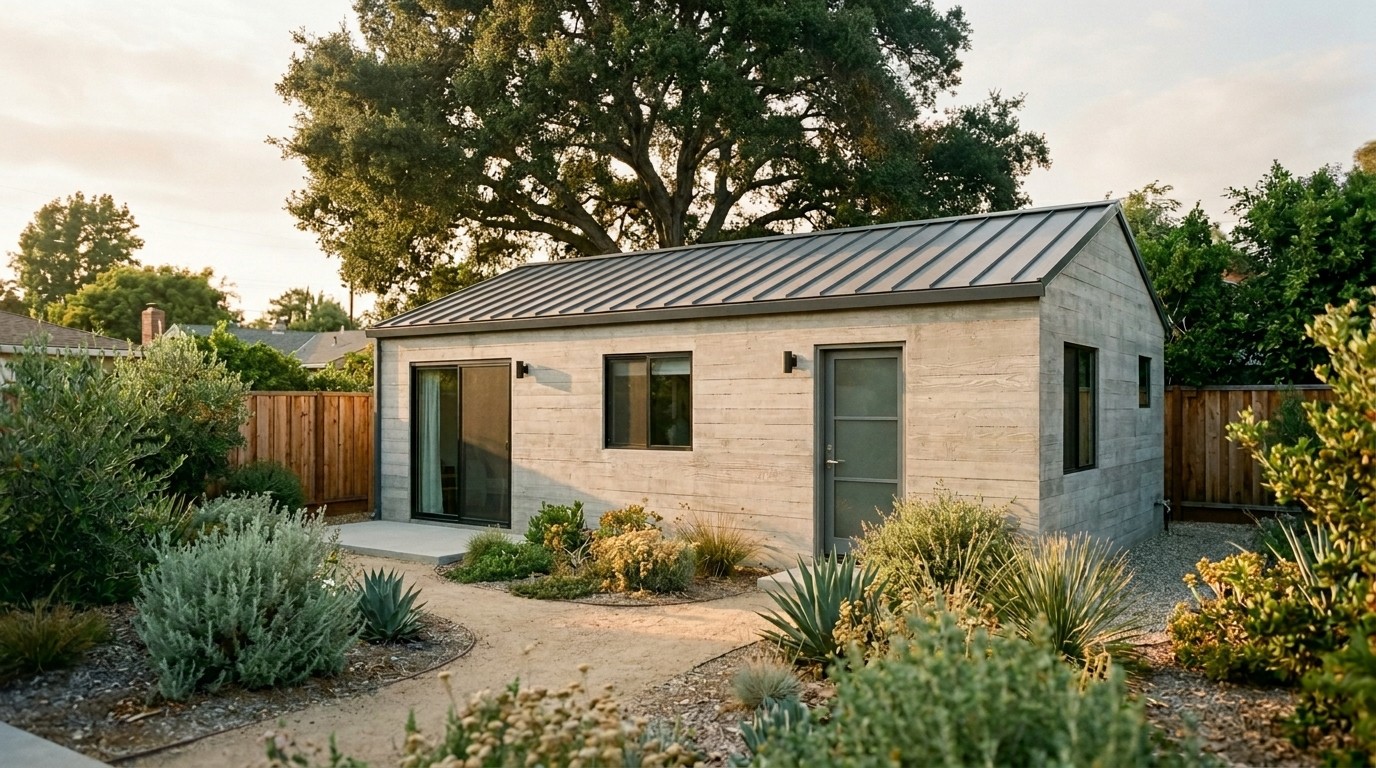
The first onsite 3D-printed, fire-resistant ADU in the U.S., built in Walnut, California by Builtech Construction Group with RIC Technology, demonstrates a wood-free, nail-free, code-compliant 1,200-sq-ft envelope.
The strategic story is structural fuel-load reduction, not 20-day print speed. Concrete walls, steel-and-Sure-board roof, and hardened openings remove the accelerants that turn an ember intrusion into a total loss.
For California to absorb projected ADU growth without compounding wildfire exposure, non-combustible by default needs to become the assumption in WUI zones — not a premium upgrade.
General contractors who learn the print-plus-finish scope split now will own the fire-hardened ADU segment as it scales.
The ADU boom is colliding with California's fire reality
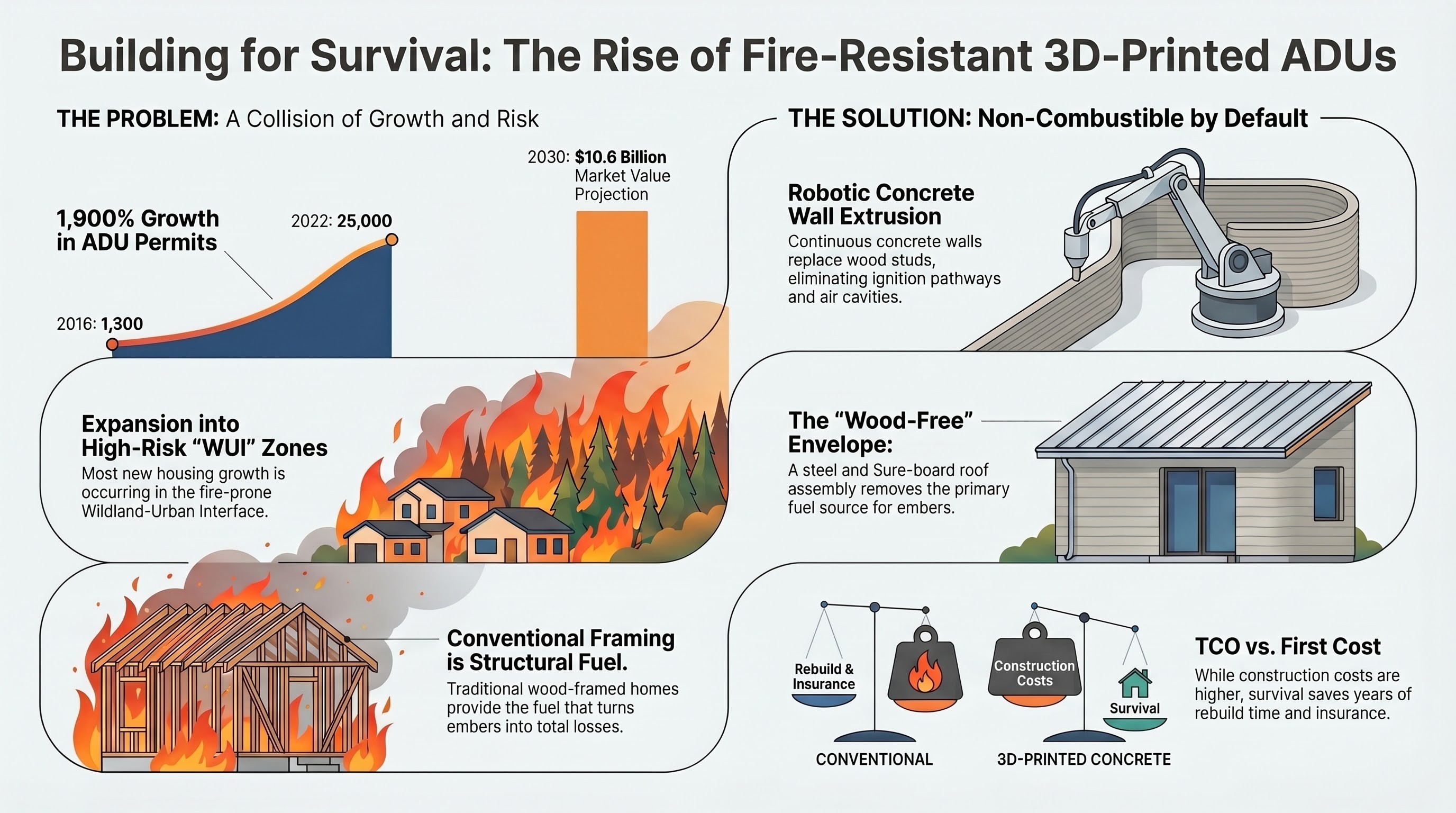
California's accessory dwelling unit numbers are not a trend line — they are a step change. Permits rose from roughly 1,300 in 2016 to more than 25,000 in 2022, a near-twentyfold increase in six years[1]. National forecasts add fuel to the trajectory: the ADU market is projected to expand at an 18.6% compound annual growth rate to roughly $10.6 billion by 2030[1].
That growth is being delivered into the same map California is losing to fire. Peri-urban expansion — homes pushed deeper into the wildland-urban interface — has put more dwellings adjacent to the fuels that drive ember-driven losses. Adding tens of thousands of new ADUs in the WUI without changing what those structures are made of is, mathematically, a slow-motion underwriting problem and a fast-motion wildfire problem at the same time.
The Joint Center for Housing Studies at Harvard University has argued that the permit surge is a direct response to proactive zoning reform, and has called for further production paired with more flexible and inclusive zoning regulations[1]. That argument is right, and it is incomplete. Zoning reform without materials reform finishes only half the project. A 25,000-permit year built out of conventional 2x6 framing under Class A roofs is still a 25,000-home year of wood structural envelopes seated next to chaparral.
The policy question is no longer whether California should permit more ADUs. The policy question is what those ADUs should be built out of — and where in the state the answer needs to change.
What the Walnut, California pilot actually proves
In early 2024, Builtech Construction Group, RIC Technology, the City of Walnut, and the Los Angeles County Fire Department broke ground on what is described as America's first onsite 3D-printed fire-resistant ADU[1]. The unit is 1,200 square feet, two bedrooms and 2.5 bathrooms — a real California ADU envelope, not a research pavilion or a one-off demonstration shell[1].
The pilot answers three questions every general contractor and authority having jurisdiction has been asking quietly:
Will a non-combustible, robotically-printed concrete envelope clear a California permit? On this lot, yes — under California's stringent residential code[4].
Will fire departments cooperate on the design? Walnut and the Los Angeles County Fire Department did, and the project is positioned as a template for further partnerships[2].
Will the print process integrate with conventional foundation, MEP, roofing, and finish trades? The Walnut sequence — foundation and rough-in first, ~20-day wall print, then conventional roof and finishes — proves the integration is achievable inside today's trade structure[3].
Those answers matter more than the photograph. They are the conditions every AHJ in a WUI county needs to see before approving a second, third, or hundredth project. The Walnut ADU does not need to be the most beautiful or the most efficient ADU in California to be the most important one. It only needs to be the first one a city, a fire department, a building official, and a general contractor jointly stamped as buildable.
That is what it is.
The fire triangle, applied to a 1,200-square-foot home
RIC Technology founder Ziyou Xu and Builtech CEO Aaron Liu both frame the design around the same idea: remove the fuel side of the fire triangle from the structure itself[1]. "The ADU will be built without a single piece of wood or nail — no 'fuel' on the main structure," Liu said. "So we significantly minimize the likelihood of fire entering the home, reducing its susceptibility to fire."[1]
That sentence is the building-code argument compressed into one line. Three implementation details carry it:
Printed concrete walls. Robotic concrete extrusion produces continuous, dense exterior walls without the sheathing layers, paper backers, and stud cavities that act as ignition pathways in conventional WUI homes. The wall is the fire-rated assembly, not a sandwich of combustibles wrapped in fire-rated finishes.
Steel and Sure-board roof. Replacing engineered wood trusses and OSB sheathing with a steel structure and Sure-board substrate eliminates the assembly that dominates loss data in ember-driven fires[1]. It is one of the highest-leverage substitutions available to a WUI ADU and one of the least understood by homeowners.
Hardened openings. Bolstered eave vents and windows close the two paths embers most reliably exploit on otherwise-survivable homes[1]. Most homes that burn in WUI events are not engulfed by direct flame contact; they are ignited from the inside by embers landing in vents or breaching glass.
Each move is small in isolation. Together they remove the assembly-level fuel load that turns isolated ember intrusion into total loss — which is the failure mode that drives almost every dollar of WUI residential insurance loss[5].
Why the 20-day print is not the headline
Public coverage has fixated on the 20-day print window for the wall shell after foundation completion[1]. It is a real number and worth knowing. It is not the strategic story.
First, a 20-day print is a wall-shell envelope, not a project schedule. Foundation, MEP rough-in, roof, finishes, and inspections still run on conventional sequences. Realistic project totals look much closer to a conventional ADU than the headline implies, because the print compresses one trade — masonry — and not the whole project. General contractors who price 3D-printed ADUs against a 20-day total will lose money. The 20-day window is a pacing tool inside a 90-to-120-day total, not a substitute for one.
Second, speed without fire performance is the wrong sell to a WUI homeowner. The Walnut project's lasting value is the structural fire performance of the assembly, not the calendar of the wall shell. Owners replacing a burned home, or hardening a lot against fire risk, weigh survivability and insurance recovery far above print duration. The marketing emphasis should follow that priority order: protection first, schedule second.
Third, the schedule story collapses the moment a single inspection, weather event, or mix-performance issue lands inside the 20-day window. A robotic printer is faster than a framing crew on a clean day. It is not faster than a stalled inspection cycle. The right way to scope a 20-day print on a real California lot is as a 30-day envelope with float reserved for weather, mix, and inspection sequencing. Schedules built on the 20-day headline number are the most predictable way to lose trust with the AHJ and the homeowner simultaneously.
Where current building codes still fall short
California's residential code already addresses some of the components a fire-resistant ADU uses — Class A roofing, ember-resistant vents, noncombustible siding — through hardening provisions for designated fire hazard severity zones. Those provisions are necessary and not sufficient.
The gap is structural. A code-compliant WUI home today can still be wood-framed under a Class A roof, with ember-resistant vents masking a combustible wall assembly underneath. That envelope satisfies the letter of hardening rules while preserving the fuel load the rules were written to displace. Once an ember finds its way past a vent or breaches a window, the wall cavity behind the gypsum becomes the fire's primary fuel — and the rest of the assembly is exactly the assembly the rules were trying to keep ignited material away from.
The Walnut ADU shows what a structural answer looks like in practice: replace the fuel itself, not just the surfaces around it. A printed concrete wall has no cavity. A steel-and-Sure-board roof has no rafter run. The hardening provisions and the structural assembly point in the same direction — instead of working in opposition.
A reasonable next code move is to define a non-combustible structural envelope option for new ADUs in very high fire hazard severity zones — printed concrete, ICF, CMU, or steel — and route insurance, permitting fast-tracking, and post-disaster rebuild incentives toward it. That is a policy step the Walnut project makes legible. It is also one of the few code moves in California's residential rulebook that would meaningfully reduce expected WUI loss without slowing housing production. The tools and the code-compliant precedent both already exist; what is missing is the policy that names them.
The economics of non-combustible by default
The economic argument typically gets stuck on first cost. A printed concrete shell is more expensive per square foot than 2x6 framing in many California markets today. That is the wrong frame.
Three numbers reframe the calculation:
Total replacement risk. A WUI home in the path of a fast-moving fire is not a 1.5x cost story; it is a binary outcome. Total loss versus survival changes a 30-year cost curve more than any single material decision a homeowner can make. The right comparison is total cost of ownership across a 20-year horizon that includes a non-zero probability of a fire event — not first cost in year one.
Insurance behavior. California's FAIR Plan and admitted-market underwriters increasingly weight noncombustible construction, Class A roofs, and ember-resistant assemblies. A non-combustible envelope is the cleanest way to clear those criteria simultaneously, and the discounts they unlock stack across the dwelling premium.
Recovery time. Survival is the difference between continuing to occupy a home and entering an 18-to-36-month rebuild cycle. That delta is rarely modeled at all in homeowner cost comparisons, which is why those comparisons systematically understate the value of fire performance. A surviving home is also one that retains its insurability, neighborhood stability, and rental income — none of which appear on a single-line cost-per-square-foot quote.
For a Builtech client comparing a wood-framed ADU and a 3D-printed concrete one, the right comparison is not first cost. It is total cost of ownership including the probability of a loss event, the underwriting it earns, and the recovery curve it avoids. On that framing, non-combustible by default is the conservative choice in a WUI zone — not the premium one.
What general contractors and owners should do next
For general contractors:
Learn the print-plus-finish scope split. The print sub handles wall extrusion. The general contractor retains foundation, MEP, roofing, and finishes. Treat the print like a specialty trade with measurable milestones, not a magic black box. The contracts, the schedule, and the payment terms should match how the rest of the project is run — not how a tech demo is run.
Schedule the 20-day window with contingency. Plan as a 30-day envelope with float reserved for weather, mix performance, and inspection sequencing. Book the roof sub on the realistic finish, not the optimistic one. The fastest way to lose money on a 3D-printed ADU is to over-promise the calendar.
Quote on total fire performance. Sell the assembly — printed walls, steel-and-Sure-board roof, hardened openings, ember-resistant vents — as one product. That is what insurance and AHJ reviewers evaluate; it should be how owners buy. Component-by-component pricing trains owners to value-engineer the assembly back into a conventional one, which is the opposite of the project they came in for.
For owners in WUI counties:
Treat your ADU lot as a fire-hardening opportunity, not just a rental unit. A non-combustible ADU in the backyard is a structural firebreak between the wildland edge and your primary structure.
Ask your insurer about hardening discounts before you design. The discounts available under California FAIR Plan hardening criteria are real, and they stack when concrete walls, Class A roofing, and ember-resistant vents are specified together. The design that earns the most discount is also the design with the most assembly-level fire performance — these are the same line item.
Demand documentation. Your AHJ and your insurer will both ask for assembly-level evidence: roof rating, vent product data, wall section drawings. Choose a general contractor who already produces it as a deliverable, not as an afterthought.
The Walnut ADU is one project on one lot. The reason it matters is that it makes the rest of the argument concrete: California's ADU growth and California's fire exposure are the same map, and the building code that connects them is non-combustible by default. The builders, the technology, and the precedent already exist. What is left is to scale them.
FAQs
What makes a 3D-printed concrete ADU fire-resistant compared to a wood-framed ADU?
A 3D-printed concrete ADU replaces the combustible structural envelope with a non-combustible one. Walls are continuous extruded concrete instead of stud cavities, the roof is steel and Sure-board instead of OSB on wood trusses, and vents and windows are ember-hardened. The result is an assembly that does not contribute fuel to a fire — which is the single largest difference between homes that survive WUI events and homes that do not[1].
How long does it take to build a 3D-printed concrete ADU in California?
The wall-print window for the Walnut, California pilot was approximately 20 days after foundation completion[1]. That covers extrusion of the exterior walls only. Foundation, MEP rough-in, roof, finishes, and inspections still run on conventional schedules, putting realistic total project durations closer to 90–120 days. The print compresses one trade, not the entire build.
Are 3D-printed concrete ADUs allowed under California building codes?
Yes — within the limits of the existing residential code and AHJ review. The Walnut ADU received construction permits in February 2024 under California's standard residential code, in coordination with the City of Walnut and the Los Angeles County Fire Department[4]. Permitting still requires assembly-level documentation, fire-department coordination, and standard inspections.
Do 3D-printed concrete ADUs qualify for California FAIR Plan wildfire hardening discounts?
In many cases yes. A non-combustible 3D-printed concrete ADU with a Class A roof, ember-resistant vents, and noncombustible siding clears multiple FAIR Plan hardening criteria simultaneously. Owners should confirm the specific discounts available for their address with their broker and request a hardening assessment after construction to maximize stacked credits.
How much does a 3D-printed fire-resistant ADU cost compared to a traditional ADU?
First cost per square foot is typically higher than 2x6 wood framing in California today. Total cost of ownership across a 20-year horizon — including insurance behavior, replacement risk, and recovery time after a fire event — frequently favors the non-combustible envelope, particularly in very high fire hazard severity zones. Owners should compare on TCO, not first cost.
Can a 3D-printed ADU be built in a typical California backyard?
Yes. RIC Technology's compact modular robotic 3D printer is designed to operate in confined spaces such as residential backyards, which is one of the project's specific advantages over gantry-based systems[3]. Site access, foundation logistics, and AHJ approvals still apply.
Why is the roof, not the walls, often the most important part of a fire-resistant ADU?
Most homes lost in WUI events are ignited by embers landing in the roof assembly, the vents, or the eaves — not by direct flame contact with walls. A steel-and-Sure-board roof with hardened vents removes the flammable assembly that dominates loss data in ember-driven fires[1]. Concrete walls without a hardened roof are still vulnerable.
What is the wildland-urban interface and why does it matter for ADUs?
The wildland-urban interface (WUI) is the area where developed land meets undeveloped wildland fuels. California's ADU permit growth — from ~1,300 in 2016 to over 25,000 in 2022 — is concentrated in counties with significant WUI exposure[1]. That overlap is why materials choice matters at policy scale, not just per-project.
Is concrete 3D printing a more sustainable alternative to wood framing in California?
It depends on the comparison. On-site robotic printing reduces framing waste, uses precise material volumes, and supports recycled or locally-sourced concrete mixes. It also avoids the embodied wood demand of conventional framing. The honest answer is that it is a sustainability tradeoff, not a free win — and the WUI-survivability case is typically the stronger argument in California today.
Should homeowners rebuild burned WUI homes as 3D-printed ADUs or full homes?
If the lot is in a very high fire hazard severity zone and the homeowner is rebuilding from a total loss, a non-combustible 3D-printed envelope — at ADU scale or full-home scale — is one of the most defensible choices available under current California code. The Walnut pilot validates the ADU envelope; the same approach scales to larger primary residences with appropriate engineering.
Related resources
3D printed fire-resistant home being built in Los Angeles County (KTLA) — Local broadcast coverage of the Walnut ADU build, with on-site footage of the RIC robotic arm.
Why Construction 3D Printing Is Gaining Ground In Post-Wildfire LA (Forbes) — Industry-side analysis of additive construction's role in post-wildfire rebuilding across Los Angeles County.
Ignition-Resistant Homes (Wildfire Risk to Communities, USDA Forest Service) — Federal resource on home-hardening fundamentals, ember intrusion pathways, and the assembly-level moves that drive WUI survivability.
References
[1] Archinect — America's first 3D printed fire-resistant ADU concept is under construction in Southern California: https://archinect.com/news/article/150418404/america-s-first-3d-printed-fire-resistant-adu-concept-is-under-construction-in-the-bay-area
[2] KTLA — 3D printed fire-resistant home being built in Los Angeles County: https://ktla.com/news/california/wildfires/3d-printed-fire-resistant-adu-being-built-in-los-angeles-county/
[3] Build in Digital — Robot system to print wildfire-resistant California home: https://buildindigital.com/robot-system-to-print-wildfire-resistant-california-home/
[4] 3D Printing Industry — California's first innovative fire-resistant 3D printed ADU unveiled in Walnut: https://3dprintingindustry.com/news/californias-first-innovative-fire-resistant-3d-printed-adu-unveiled-in-walnut-228854/
[5] Wildfire Risk to Communities (USDA Forest Service) — Ignition-Resistant Homes: https://wildfirerisk.org/reduce-risk/ignition-resistant-homes/