Insurance Math for Non-Combustible 3D-Printed ADUs
A non‑combustible 3D‑printed ADU in California provides rapid, fire‑resistant construction while unlocking significant insurance benefits: it meets most Safer from Wildfires mitigation criteria at occupancy, qualifying for 4%–40% discounts on the wildfire portion of premiums and up to ~16.4% FAIR Plan hardening discounts. This reduces homeowners’ insurance costs, lowers non‑renewal risk, and adds appraisal and rental value, making the ADU a financially advantageous addition in WUI zones despite higher upfront build costs.
Authors:


TLDR
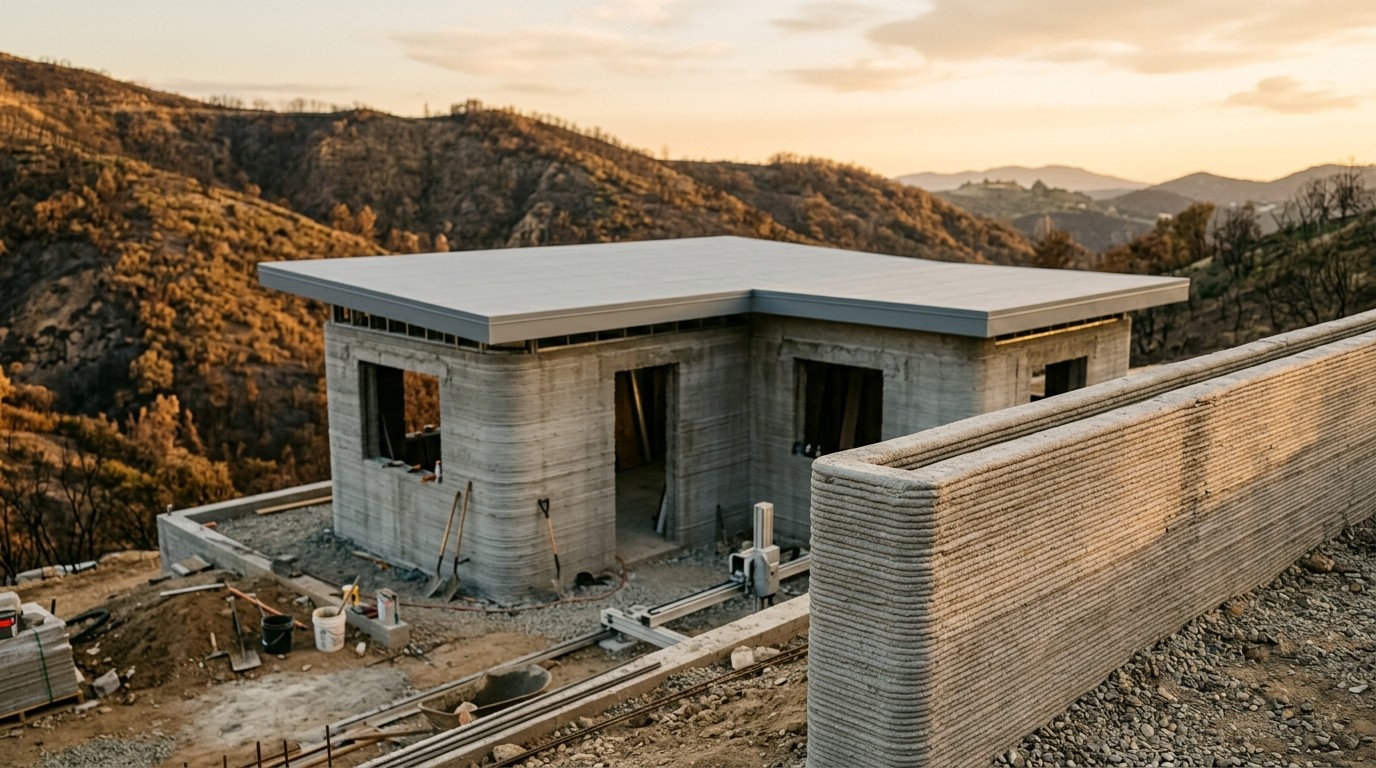
America's first onsite 3D printed, fire-resistant ADU is under construction in Walnut, CA — 1,200 sq ft, 2 bed / 2.5 bath, no wood, no nails, ~20-day print window.[1]
The standard story is fire safety. The under-told story is insurance economics: California's Safer from Wildfires regulation now mandates wildfire-mitigation discounts of 4–40%, and FAIR Plan offers up to ~16.4% off the wildfire premium portion for hardened dwellings.[2][3]
Concrete-walled, steel-roofed, ember-hardened ADUs hit nearly every Safer from Wildfires criterion at construction time — meaning the discount is engineered in, not retrofitted.
For California homeowners in WUI ZIP codes, a non-combustible ADU is starting to behave like a financial instrument: rental yield + appraisal lift + a structurally lower wildfire risk profile across the parcel.
Builtech's Walnut project is a working reference for what that math actually looks like in 2026.
A wildfire-hardening story is hiding an insurance-pricing story
The Walnut, California 3D printed ADU is usually framed as a construction milestone. A robotic arm from RIC Technology lays concrete walls in roughly 20 days. Builtech Construction Group manages the foundation, plumbing, sewage, steel-and-sure-board roof assembly, and final finishes. There is, by design, not a single piece of wood or a single nail in the main structure.[4][5]
That reads as an architecture-and-robotics story. It is also, more importantly, an insurance-pricing story.
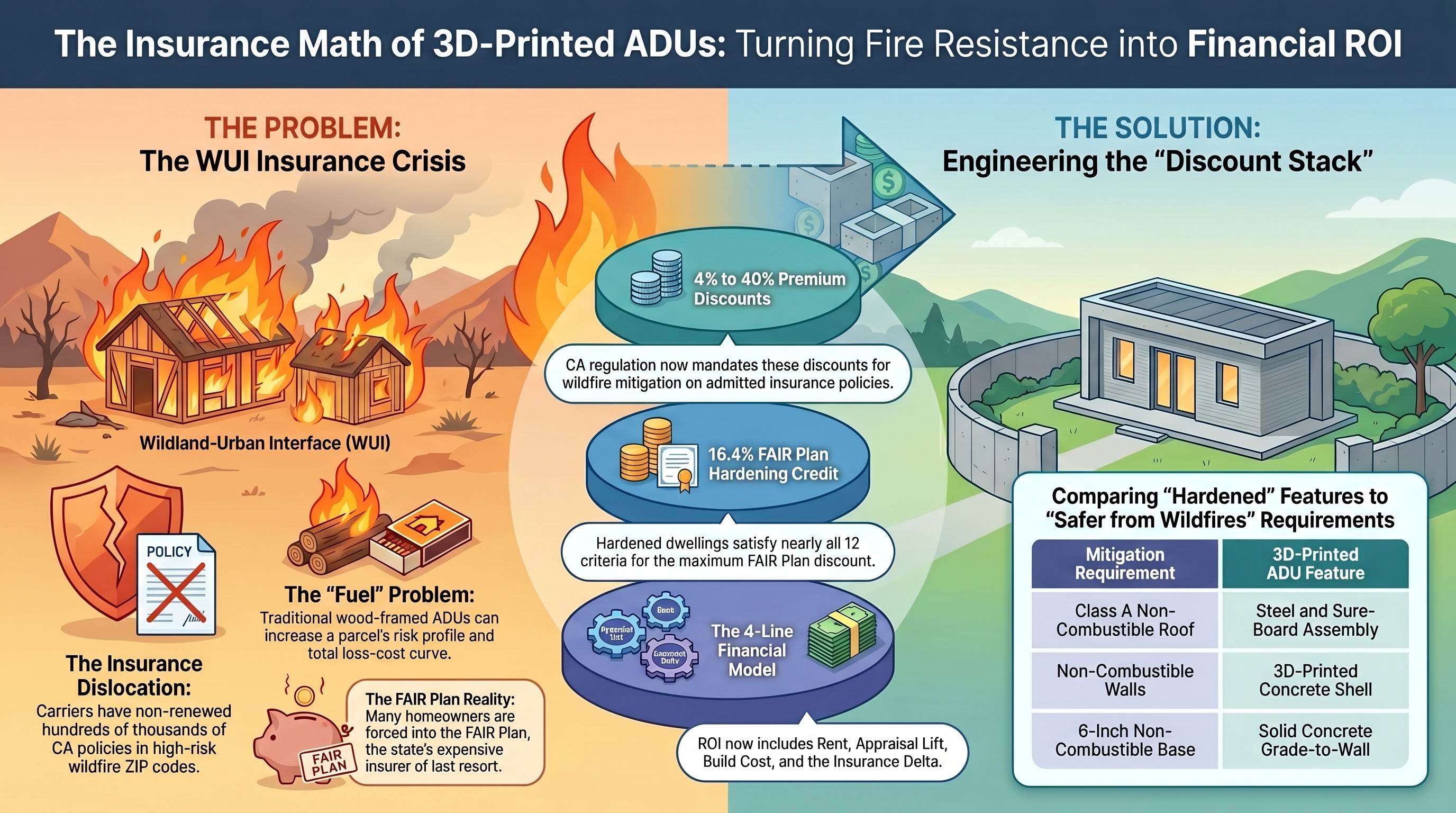
California is in the middle of the most severe homeowners-insurance dislocation in the country. Carriers have non-renewed hundreds of thousands of policies in wildfire-exposed ZIP codes; the FAIR Plan — the state's insurer of last resort — has absorbed the overflow. In 2022, the California Department of Insurance adopted the Safer from Wildfires regulation, which forces every admitted carrier writing wildfire risk to file mitigation-based discounts on the wildfire portion of premium. As of CDI's March 2026 community-resilience briefing, those discounts now range from 4% to 40%, with the largest discounts directed at the highest-risk homes.[6]
A wood-framed, asphalt-shingle ADU has to earn those discounts retrofit by retrofit. A concrete, steel-roofed, ember-hardened, 3D printed ADU starts at the top of the discount stack on day one of occupancy. That is the math nobody is putting on the page.
How Safer from Wildfires actually scores a structure
Safer from Wildfires defines ten mitigation actions across the structure and the immediate landscape. The structural list — Class A roof, enclosed eaves, ember-resistant vents, multi-pane windows, six inches of non-combustible wall base, no combustible material in the first five feet of clearance — is essentially a bill of materials for the Walnut ADU.[2]
A 3D printed concrete shell is, by construction, fully non-combustible at the wall. The light-steel and sure-board roof is non-combustible at the roof. The eaves are bolstered. The vents are ember-resistant. The windows are multi-pane. The first six inches above grade is concrete, not stucco-on-wood-furring.
In underwriting language: the ADU clears the structural half of the rubric at certificate of occupancy. That is a categorically different posture than a homeowner trying to retrofit a 1970s wood-framed cottage one Class A roof at a time.
FAIR Plan: where the math gets concrete
The FAIR Plan, often a homeowner's only option in red-zone ZIP codes, published its dwelling-fire wildfire-hardening discount schedule in late 2025. A policyholder who documents all twelve hardening actions can claim up to ~16.4% off the wildfire portion of premium on dwelling-fire policies (commercial: up to ~13.8%).[3]
That 16.4% is not a marketing line; it is a regulated, filed discount table. For a Walnut-style ADU, almost every line item in that table is satisfied at construction. The owner is not paying a contractor to chase the discount — the printer and the steel-roof crew already earned it.
The FAIR Plan has historically been a thin, expensive policy. Adding a wraparound difference-in-conditions policy on top is the standard pattern in WUI ZIP codes. Both layers underwrite to the structural rubric. A non-combustible ADU compresses both layers' wildfire-portion premium simultaneously.
Why the early carrier discounts looked tiny — and why that's about to change
In 2023–2024, early Safer from Wildfires filings were embarrassingly small. State Farm's initial fire-resistant-window discount worked out to roughly $14 a year on a $13,800 premium — about 0.1%.[7] Critics rightly called the discounts immaterial.
What changed: CDI's March 2026 briefing pushed the regulated discount band up to 4–40% and tied the largest discounts to the highest-risk homes. Carriers committing to the state's Sustainable Insurance Strategy must write more policies in WUI areas in exchange for the right to use forward-looking, AI-assisted catastrophe models to price them.[6]
Those forward-looking models reward structures whose ignition probability is structurally low, not merely whose vegetation has been recently cleared. A non-combustible 3D printed ADU is one of the few asset profiles that scores well on both dimensions, simultaneously and durably.
The total cost of ownership reframe
A homeowner evaluating an ADU normally sees three line items: build cost, rental income, and resale lift. Wildfire insurance does not appear in the underwriting model — it is treated as a fixed cost outside the ADU decision.
In a WUI parcel, that framing is wrong. The ADU is part of the parcel's wildfire risk profile. A wood-framed ADU may raise the parcel's modeled exposure (more combustible square footage, more openings, more attic vents). A non-combustible 3D printed ADU shifts the parcel toward the lower band of the carrier's loss-cost curve.
That is a four-line model, not three:
Build cost (printer time + foundation + non-combustible roof + finishes)
Rental income (CA rents + ADU-specific demand)
Appraisal lift (FHFA data shows ADU-equipped CA properties commanding measurable premium growth across 2013–2023)[8]
Insurance delta (discount stack on the wildfire portion of premium, plus reduced moratorium/non-renewal exposure on the parcel)
That fourth line is precisely where the conversation about 3D printed ADUs has been thinnest.
What the ADU market backdrop is doing to this calculus
The macro backdrop matters. Verified Market Research projects the global ADU market growing from roughly $3.3B in 2023 to $10.6B by 2030 at an 18.6% CAGR.[9] California permits rose from 1,300 in 2016 to over 25,000 in 2022, and Shovels' national permit dataset shows California ADUs now equal 127% of new single-family permits — meaning the state is permitting more ADUs than primary homes.[1][10]
That permit volume is happening on top of an insurance market that cannot continue absorbing wood-framed-ADU loss costs at the current pace. The supply-side answer the market has converged on — print concrete walls, install a non-combustible roof, harden eaves and vents — happens to be the same answer the demand side (carriers, FAIR Plan, CDI) is pricing for.
A working reference: the Walnut, CA project
The Walnut ADU is what that convergence looks like in the field. A local couple donated their site. The City of Walnut and the LA County Fire Department co-piloted the design review. RIC Technology printed the concrete walls in roughly 20 days after foundation, plumbing, and sewage were complete. Builtech served as general contractor end-to-end, with Aaron Liu describing the structure as one with no "fuel" on the main assembly.[4][5]
What makes the Walnut project useful as a reference is not the novelty of the printer; it is the alignment between the structure and California's emerging insurance regime. Permits were issued under the state's existing residential framework. The fire department was inside the design loop, not auditing it after the fact. The build sequence — foundation → print → non-combustible roof → ember-hardened openings → finishes — maps cleanly onto both the WUI code (Chapter 7A) and the CDI/FAIR Plan discount tables.
What homeowners and builders should do with this
For California homeowners weighing a backyard ADU in or near a WUI ZIP code, three things follow:
Treat insurance as a primary design constraint, not an afterthought. The structural and roof choices that earn the largest Safer from Wildfires and FAIR Plan discounts are also the choices that determine whether the ADU is buildable and insurable in the first place.
Document mitigation actions during construction, with photos, product datasheets, and inspector sign-offs, in a single dossier. That dossier is what gets handed to the insurance broker — it is the difference between deserving the discount and receiving it.
Underwrite the ADU on the four-line model above, not the three-line one. A non-combustible 3D printed ADU may pencil where a wood-framed equivalent cannot, once insurance is on the page.
For general contractors, the Walnut project is a template. It pairs a robotic-printing subcontractor with a Type-IA-leaning structural detail set, fire-department co-design, and a clear path through California's existing permitting framework. The print itself is fast; what unlocks the project is the boring institutional work around it.
The strategic frame
The industry framing of "3D printed homes" usually leans on construction speed and labor scarcity. Both are real. Neither is the highest-leverage argument in California in 2026.
The highest-leverage argument is that the structures California is now building — driven by ADU permitting volume that already exceeds new single-family permits — must price correctly inside the state's wildfire insurance regime, or the regime will continue to crack. Non-combustible 3D printed ADUs are one of the very few new construction products that solve both sides of that equation: they get built fast and they fit cleanly into the discount stack the regulator has already filed.
The Walnut, California ADU is the first physical proof point. The math behind it is the part that scales.
FAQs
How much can a non-combustible 3D-printed ADU actually save on California wildfire insurance?
Savings depend on ZIP code, carrier, and documented mitigation actions, but the regulated bands are public. California's Safer from Wildfires regulation now requires admitted carriers to offer 4%–40% discounts on the wildfire portion of premium for qualifying mitigation, with the largest discounts targeted at the highest-risk homes.[6] FAIR Plan dwelling-fire policies can stack hardening discounts up to roughly 16.4%.[3] A non-combustible build clears most criteria at certificate of occupancy.
Does the California FAIR Plan cover 3D printed concrete ADUs?
The FAIR Plan provides basic dwelling-fire coverage to properties that cannot obtain coverage in the admitted market, regardless of construction method, as long as minimum underwriting standards are met. A non-combustible 3D printed concrete ADU typically meets or exceeds those standards. Owners should pair FAIR Plan coverage with a difference-in-conditions wraparound for liability and non-fire perils, and document hardening actions to claim the FAIR Plan's 2025 wildfire-hardening discount schedule.
How does Safer from Wildfires score a 3D printed ADU?
Safer from Wildfires defines ten mitigation actions, half structural and half landscape. A 3D printed concrete ADU with a non-combustible roof, enclosed eaves, ember-resistant vents, multi-pane windows, and a six-inch non-combustible base satisfies the structural half almost in full at construction.[2] Landscape actions — five-foot non-combustible clearance, defensible space, vegetation management — must still be implemented and maintained on site.
Is a 3D printed ADU more expensive than a wood-framed ADU in California?
Upfront, a 3D printed concrete ADU often carries a premium over an entry-level wood-framed equivalent, though the gap closes as printing crews scale and concrete logistics improve. The honest comparison includes insurance: in a WUI ZIP code, a non-combustible structure can compress the wildfire portion of premium by double-digit percentages year over year, plus reduce non-renewal risk. Total cost of ownership, not nameplate build cost, is the right yardstick.
How long does it take to build a fire-resistant 3D printed ADU?
On the Walnut, California project, the printing of the exterior concrete walls took approximately 20 days using RIC Technology's robotic-arm printer.[5] Total project duration is longer once you include foundation, plumbing and sewage, the non-combustible roof assembly, ember-hardened openings, interior finishes, and inspections — typically several months. Print time is rarely the schedule bottleneck; permitting and integrated wildfire detailing usually are.
What roof and opening details does a 3D printed ADU need to qualify for wildfire discounts?
A Class A non-combustible roof assembly (light steel and sure-board on the Walnut project), enclosed soffited eaves, ember-resistant vents, and multi-pane glazing are the core requirements. These align with both California Building Code Chapter 7A for the WUI and the structural side of the Safer from Wildfires discount rubric.[2] Specifications should be documented in the project dossier and shared with the insurance broker.
Why are 3D printed concrete ADUs being built in Walnut and Los Angeles County specifically?
LA County combines extreme wildfire exposure with extreme housing demand and recent rebuilding pressure post-2025 wildfires. The Walnut project was co-piloted with the City of Walnut and the LA County Fire Department, giving the design review a direct line to the fire authority that would otherwise inspect it after the fact.[1] CDI's March 2026 briefing made LA-specific community-resilience modeling a state priority.[6]
Will adding a 3D printed ADU raise or lower my homeowners insurance premium?
It depends on construction. A wood-framed ADU typically increases insured square footage and exposure, which raises premium. A non-combustible 3D printed ADU adds insured value while pushing the parcel toward a lower band of the carrier's wildfire loss-cost curve and qualifying for Safer from Wildfires and FAIR Plan hardening discounts. The net effect, especially in WUI ZIP codes, can be a smaller premium increase than the construction cost alone would suggest.
What documentation should homeowners keep to claim wildfire mitigation discounts?
A single project dossier is the cleanest approach. Include the building permit, structural drawings showing non-combustible assemblies, product datasheets for roof, vents, and windows, photos taken at each construction phase, the certificate of occupancy, and signed inspection records. Brokers submit this to the carrier or FAIR Plan to substantiate each mitigation action and unlock the corresponding line item on the discount table.
When should a homeowner consider a 3D printed ADU instead of a traditional ADU?
Three conditions tilt the decision toward 3D printed concrete: the parcel is in a designated WUI or very-high fire hazard severity zone, the homeowner has been non-renewed or placed on the FAIR Plan, or the parcel sits adjacent to a primary residence the owner wants to de-risk using the ADU as a structural firebreak. Outside those conditions, traditional construction may still pencil; inside them, the insurance math often makes the non-combustible option the cheaper long-term path.
Related resources
Forbes — Why Construction 3D Printing Is Gaining Ground In Post-Wildfire LA — Industry-wide overview of additive construction's post-fire role in Southern California.
California Department of Insurance — Safer from Wildfires — The regulator's primary explainer on the ten mitigation actions tied to wildfire-portion discounts.
California FAIR Plan — Wildfire Hardening Discounts (Nov 2025) — The current FAIR Plan discount schedule for dwelling-fire and commercial policies.
References
[1] Archinect — America's First 3D Printed Fire-Resistant ADU Concept Is Under Construction
[2] Disaster Recovery Journal — U.S.'s First Fire Resistant 3D Printed Concrete ADU Starts Construction
[3] Build in Digital — Robot system to print wildfire-resistant California home
[4] Forbes — Why Construction 3D Printing Is Gaining Ground In Post-Wildfire LA
[5] California Department of Insurance — Safer from Wildfires
[6] California Department of Insurance — Mandatory One-Year Moratorium on Non-Renewals
[7] California FAIR Plan — Wildfire Hardening Discounts for Dwelling Fire & Commercial Policies (Nov 2025)
[8] CDI — Wildfire Safety & Insurability: New Data on Community-Wide Wildfire Resilience for LA (March 2026)
[9] FHFA — Trends in Median Appraised Value for Properties With ADUs in California
[10] Verified Market Research — Accessory Dwelling Unit (ADU) Market
[11] E&E News / POLITICO — California insurers begin giving discounts for fire-proofed homes
[12] Shovels — America's ADU Boom: What 2.8 Million Permits Reveal