The Two-Material Home: Wildfire-Safe ADUs Without Wood
Builtech Construction Group's Walnut ADU pioneers a two-material home — concrete walls, steel-and-sure-board roof, zero structural wood or nails. The thesis: eliminating fuel from the entire envelope, not just one assembly, is the most defensible specification for wildfire-prone California ADUs.
Authors:


TLDR
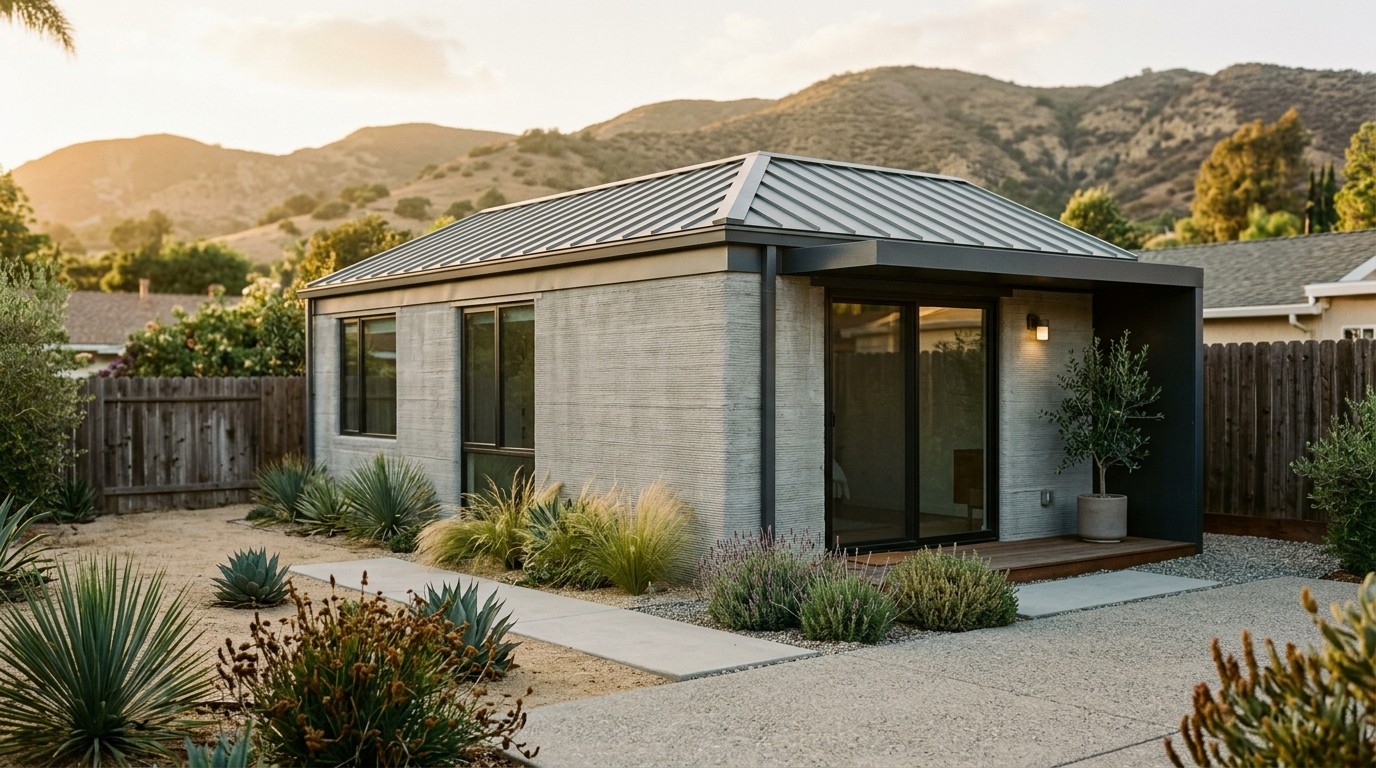
The U.S.'s first onsite-built, fire-resistant 3D-printed ADU is a 1,200 sq ft, 2BR/2.5BA structure in Walnut, California, led by Builtech Construction Group.[1]
It is built with no wood and no nails on the main structure — concrete 3D-printed walls plus a steel and sure-board roof.[1]
We call this a two-material home: a unified envelope of concrete and steel, engineered to deny wildfire its fuel.
The framework also hardens the two weakest points on most California homes — eave vents and windows — at the same time the envelope is built.[1]
Compact modular robotic 3D printing makes the build economically viable in tight backyards where conventional gantry systems can't fit.[1]
Wildfire Math California Can't Outrun
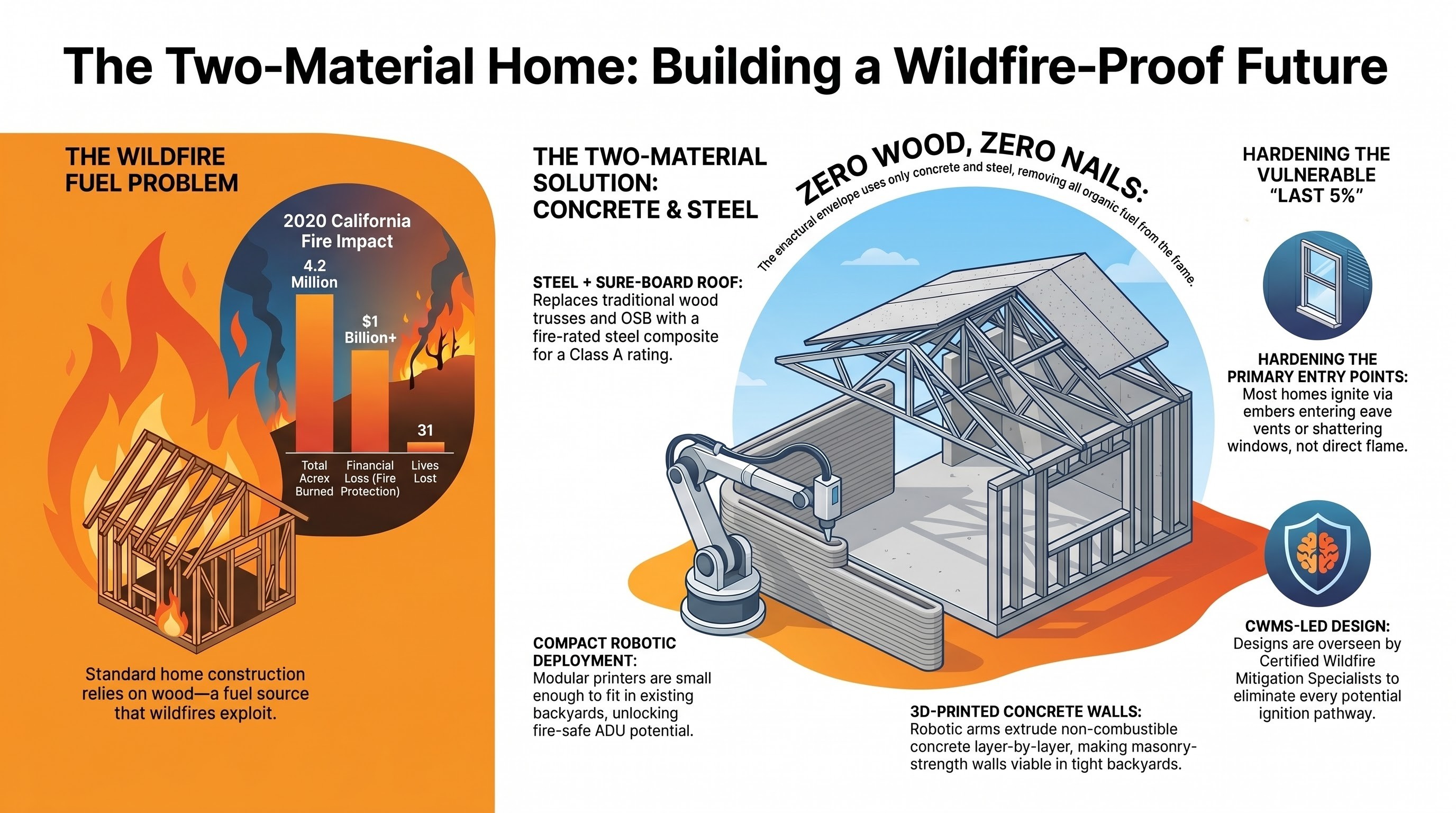
California's wildfire problem is not a forecast — it is a settled accounting line. Wildfires burned 4.2 million acres across the state in 2020 alone, the fire protection bill exceeded $1 billion, and 31 lives were lost in that single season.[1] That math reframes what "affordable housing" actually means in wildfire-prone regions. A cheaper structure that burns is not cheap. A more expensive structure that survives is the only honest baseline.
That is the context behind the Walnut, California ADU that Builtech Construction Group is leading with subcontractor K4K Construction Design and printer manufacturer RIC Technology.[1] It is the U.S.'s first onsite-built, fire-resistant 3D-printed ADU, and it was commissioned by a private Walnut couple — Philips and Constance — who wanted to support fireproof construction in their own backyard.[1]
The reason that project matters is not the printer. It is the specification choice behind every assembly of the home.
What "Two-Material Home" Actually Means
The Walnut ADU is best understood not as a 3D-printed home, but as a two-material home. Its structural envelope is built from only two materials: concrete for the walls and steel for the roof framing, with a Sure-Board composite as the sheathing on top of the steel.[1]
That is a deliberate departure from how most American homes are built. The standard residential wall assembly relies on wood studs. The standard residential roof assembly relies on wood trusses and OSB sheathing. The standard residential eave is open soffit framing. Every one of those choices feeds fuel into the structural envelope.
Aaron Liu, CEO of Builtech Construction Group and an NFPA-certified Certified Wildfire Mitigation Specialist (CWMS), described the design philosophy in a single line: "The ADU will be built without a single piece of wood or nail – no 'fuel' on the main structure."[1]
The two-material home thesis is simply: if the structural envelope contains no fuel, the structural envelope cannot meaningfully burn. That is not a slogan. It is a procurement and detailing discipline applied to every assembly that touches the load path.
Why Concrete Walls Belong in Wildfire Country
Concrete is non-combustible. That is the entire reason it sits at the center of the two-material home framework. Ziyou Xu, founder and CEO of RIC Technology, framed it directly: "3D printing is well-suited for constructing fire-resistant homes due to the non-combustible nature of the concrete we use to print."[1]
The more interesting question is why concrete walls have historically been rare in California single-family construction. The honest answer is economics, not performance. Tilt-up and CMU walls require crews, equipment, and lead time that are uneconomic at single-family scale, especially on small infill lots. Robotic concrete 3D printing collapses that constraint because it brings concrete wall construction into the same labor and timeline envelope as conventional framing — but with a non-combustible exterior wall as the deliverable.[1]
The walls of the Walnut ADU are extruded layer by layer in concrete by RIC Technology's robotic arm.[2] What homeowners receive at the end of that process is a structural envelope that does not contribute fuel to a fire event, regardless of what is happening on the other side of the wall.
The Roof Problem 3D Printers Don't Solve
The weakness of most existing 3D-printed homes is the same weakness as most stick-built homes: the roof. Walls can be poured, printed, blocked, or formed out of non-combustible material, but if the roof above them is wood-framed and sheathed in wood panels, the entire envelope is back to being fuel-loaded.
The Walnut ADU is unusual in that the roof is intentionally not wood. "The roof will be made from steel and sure-boards, distinguishing it from other 3D-printed homes that often feature wooden structural roofs," the source coverage notes.[1]
This is the most under-discussed detail in the entire project, and it is the load-bearing element of the two-material thesis. A non-combustible wall paired with a wood-framed roof is still a partially combustible home. Once you commit to the two-material home, you commit to replacing the most common roof assembly in California with a cold-formed steel framing system and a fire-rated composite sheathing.
Steel + Sure-Board: Building a Class A Roof Without Wood
The Walnut roof uses light-gauge steel framing with Sure-Board sheathing. Sure-Board is a composite panel that bonds a steel sheet to a gypsum-board substrate. The pairing solves three problems at once: it provides structural shear capacity, resists flame and high heat, and eliminates wood from the most ignition-prone assembly in the home.
For homeowners thinking in resale and insurance terms, the practical takeaway is that this assembly aims for a Class A roof — the highest UL roof classification for fire performance — without relying on a wood substrate underneath the finish material. Most California homes that advertise a Class A roof still have a wood deck underneath the Class A covering. The Walnut ADU does not.[1]
The broader point is that the two-material home only works if the roof is treated as a primary fire boundary, not as a secondary covering on top of a wood deck.
Eave Vents and Windows: The Last 5% That Decides Survival
IBHS and CAL FIRE post-fire forensics keep arriving at the same conclusion: most homes that ignite in a wildfire do so because of embers entering through vents or shattering through windows, not because flames touched the wall.[3] You can build a non-combustible envelope and still lose the home if the openings in that envelope are unhardened.
The Walnut ADU acknowledges this directly. Builtech "will also strengthen the areas of a home that are traditionally vulnerable to fires, such as eave vents and windows."[1] That is the last 5% of a wildfire-resistant home — the small detailing that determines whether a non-combustible structure survives an ember storm or merely survives direct flame.
In practice, that means ember-resistant vent assemblies designed and tested for WUI exposure, dual-pane tempered glass on exterior windows, metal-frame window assemblies, and tight detailing at every penetration through the envelope. Those choices are inexpensive relative to the build. The expensive part — the structural envelope — is already done by the printer and the steel framers. The cheap part is what most homes still get wrong.
Why Compact Modular Printing Made the Walnut Build Possible
A two-material home is academically appealing, but it would not have been buildable in a Walnut backyard with a conventional construction 3D printer. Gantry systems require the printer to be larger than the structure it is printing. On crowded residential lots, that is a non-starter.
RIC Technology's compact modular robotic 3D printer is designed for this exact constraint. As Ziyou Xu put it: "Our compact modular robotic 3D printer overcomes these limitations, enabling 3D construction in people's backyards."[1]
The form factor matters because it is what unlocks the ADU use case. The U.S. housing shortage is most acute in established residential areas where new construction has to fit on existing lots. ADUs are one of the few politically and economically tractable answers to that shortage, and a backyard-deployable concrete printer is what turns the two-material home from a custom-home flourish into a repeatable ADU specification.[1]
The CWMS Lens: Designing the Envelope, Not Just the Walls
A two-material home is not just a materials list. It is a design lens that says every assembly is evaluated against ember and flame exposure first, and against everything else second.
Aaron Liu's credential matters here. As an NFPA-certified Certified Wildfire Mitigation Specialist, his job is to look at the entire home as an ignition system and design out the pathways embers use to reach combustible material.[4] That perspective is what produces decisions like "replace the wood-framed roof with steel and Sure-Board" and "harden the eave vents and windows at the same time as the wall print," instead of treating fire-hardening as an upgrade applied later.
The practical implication for homeowners is that the wildfire mitigation lens has to be in the room during design, not after permitting. A two-material home cannot be retrofitted out of a wood-framed home; it has to be designed in from the foundation up.
The Builder-Printer Partnership Model
The Walnut ADU is also a quietly important precedent for how 3D-printed homes get delivered. The project has three coordinated roles: Builtech Construction Group leads the project end to end as the general contractor, K4K Construction Design executes the 3D printing as the subcontractor, and RIC Technology provides the robotic printer.[1]
That separation matters. A printer manufacturer can sell hardware. A print subcontractor can extrude walls. Neither of those roles, on their own, is positioned to design a fire-resistant envelope, navigate permitting, integrate trades, and stand behind the finished home. The general contractor has to own the envelope thesis.
The two-material home is therefore a builder-led specification, not a printer-led one. RIC Technology's compact modular printer makes the wall economics work, but Builtech is the actor responsible for choosing steel and Sure-Board over wood, hardening the eaves, specifying the windows, and certifying that the finished structure performs against wildfire.
What Homeowners Should Ask Before Building a Fire-Resistant ADU
If you are a California homeowner evaluating an ADU in a wildfire-prone area, the value of the two-material home framework is that it gives you a small, sharp checklist for separating real fire-resistant construction from marketing. Ask any builder these five questions:
What material is the wall, and is it non-combustible from the inside face to the outside face?
What material is the roof structure, and is there any wood in the load path?
What is the WUI rating of every vent and window opening in the envelope?
Who on the design team holds an NFPA CWMS or equivalent wildfire mitigation credential?[4]
Will the finished home meet a recognized Class A roof and hardened-opening specification on paper, not just informally?
The Walnut ADU answers all five questions in the same direction: concrete walls, steel-and-Sure-Board roof, hardened eave vents and windows, CWMS-led design, and an envelope engineered to deny wildfire its fuel.[1] That alignment is the entire point of the two-material home — a single coherent specification that is easy to verify and difficult to fake.
FAQs
What is a two-material home in wildfire-prone California?
A two-material home is a residential structure whose entire load-bearing envelope is built from only concrete and steel — no structural wood, no nails. The Walnut, California ADU led by Builtech Construction Group is the U.S.'s first onsite-built fire-resistant 3D-printed ADU and is designed to this framework, with 3D-printed concrete walls and a light-steel-and-Sure-Board roof, eliminating fuel from the main structure.[1]
Are 3D-printed concrete ADUs actually fire resistant?
The walls are inherently fire resistant because the concrete used to print them is non-combustible. RIC Technology's CEO has emphasized this directly: 3D printing is well-suited to fire-resistant homes because of the non-combustible nature of the concrete being extruded.[1] Whole-home fire resistance, however, depends on how the roof, eaves, vents, and windows are detailed — not the walls alone.
Why does the Walnut ADU use a steel roof instead of wood?
Most 3D-printed homes still rely on a wooden structural roof, which reintroduces fuel above non-combustible walls. The Walnut ADU instead uses a roof built from steel and Sure-Board panels, distinguishing it from other 3D-printed homes that often feature wooden structural roofs.[1] That choice is what makes the two-material home thesis coherent across walls and roof, not only walls.
What is Sure-Board and why is it used in fire-resistant roofs?
Sure-Board is a composite sheathing panel that bonds a steel sheet to a gypsum-board substrate. It contributes structural shear capacity, resists flame and high heat, and replaces traditional wood sheathing in fire-hardened roof and wall assemblies. The Walnut ADU pairs light-gauge steel framing with Sure-Board sheathing on the roof, eliminating wood from the most ignition-prone assembly in the home.[1]
How small a backyard can fit a robotic 3D printer for an ADU?
Compact modular robotic 3D printers like RIC Technology's are designed specifically to fit in residential backyards where traditional gantry-style construction printers cannot. The printer ships disassembled and reassembles inside the build footprint, which is why it can be deployed for ADU projects in established residential neighborhoods rather than only on greenfield sites.[1]
Is a 3D-printed concrete ADU more expensive than a stick-built ADU?
The right comparison is total cost of ownership in a wildfire-prone region, not nominal first cost. California absorbed over $1 billion in fire protection spending in 2020 and lost 4.2 million acres and 31 lives in that single season.[1] A non-combustible envelope reduces the probability of a total loss and the post-fire recovery cost, which changes the long-run economics meaningfully even when initial pricing is comparable.
Why are eave vents so dangerous in a wildfire?
Eave vents are designed to ventilate attics, but they also create a direct pathway for wind-driven embers to enter the structure and ignite combustible material from inside the envelope. CAL FIRE's home hardening guidance specifically calls out vents as a primary ignition pathway in wildfire events.[3] The Walnut ADU therefore strengthens eave vents at the same time as the wall print to close that pathway.[1]
Do 3D-printed ADUs need a wildfire mitigation specialist on the team?
If the goal is a verifiable fire-resistant home rather than a marketing claim, yes. A Certified Wildfire Mitigation Specialist (CWMS) is an NFPA-credentialed professional who evaluates ignition pathways and designs them out of the home.[4] Builtech CEO Aaron Liu holds CWMS certification and led the Walnut ADU specifically as a wildfire-resilient build.[1]
Can a 3D-printed fire-resistant ADU be permitted in California?
The Walnut ADU demonstrates that it can. The project is being delivered by Builtech Construction Group as general contractor, with K4K Construction Design as the printing subcontractor, on a private residential lot in Walnut, California — and is the U.S.'s first onsite-built fire-resistant 3D-printed concrete ADU.[1] The pathway exists; the design and documentation work is what makes it executable.
How does a two-material home perform on resale and insurance compared to a wood-framed ADU?
A two-material home replaces the most ignition-prone parts of a typical residential envelope with non-combustible alternatives, which is the direction California building codes, insurers, and CAL FIRE home-hardening guidance are all moving toward.[3] As insurance carriers continue to reweight risk in wildfire-prone ZIP codes, structural specifications that visibly comply with hardened-home guidance are positioned to retain value better than equivalent wood-framed structures.
Related resources
RIC Technology — The manufacturer of the compact modular robotic 3D printer used on the Walnut ADU.
CAL FIRE Home Hardening guidance — California's official guidance on hardening vents, roofs, eaves, and windows against wildfire.
NFPA Certified Wildfire Mitigation Specialist (CWMS) program — The certification framework that defines wildfire mitigation competence in the U.S.
References
Inceptive Mind — Robotic 3D printer to build [UK's] first fire-resistant home: https://www.inceptivemind.com/robotic-3d-printer-build-uk-first-fire-resistant-home/35894
RIC Technology: https://www.rictechnology.com/
CAL FIRE — Home Hardening: https://www.fire.ca.gov/home-hardening
NFPA — Certified Wildfire Mitigation Specialist (CWMS): https://www.nfpa.org/for-professionals/certification/cwms
Builtech Construction Group: https://www.builtechconstructiongroup.com/