Wildfire-Resistant Home Design: Roofs, Eaves, Windows
Builtech Construction Group's first-in-the-U.S. 3D-printed wildfire-resistant ADU in Walnut, California is usually told as a wall story. The real innovation is the envelope around the walls — a light steel and sure-board roof, hardened eave vents, and reinforced windows — which is what actually decides whether a home survives a wildfire.
Authors:


TLDR
The story of fire-resistant 3D-printed homes is usually told as a wall story — but walls aren't where most homes lose to wildfire.
Builtech Construction Group's Walnut, California ADU is the first U.S. on-site 3D-printed concrete ADU, and its real innovation is what wraps the walls: a light steel and sure-board roof, hardened eave vents, and reinforced window assemblies — with no wood or nails in the main structure.
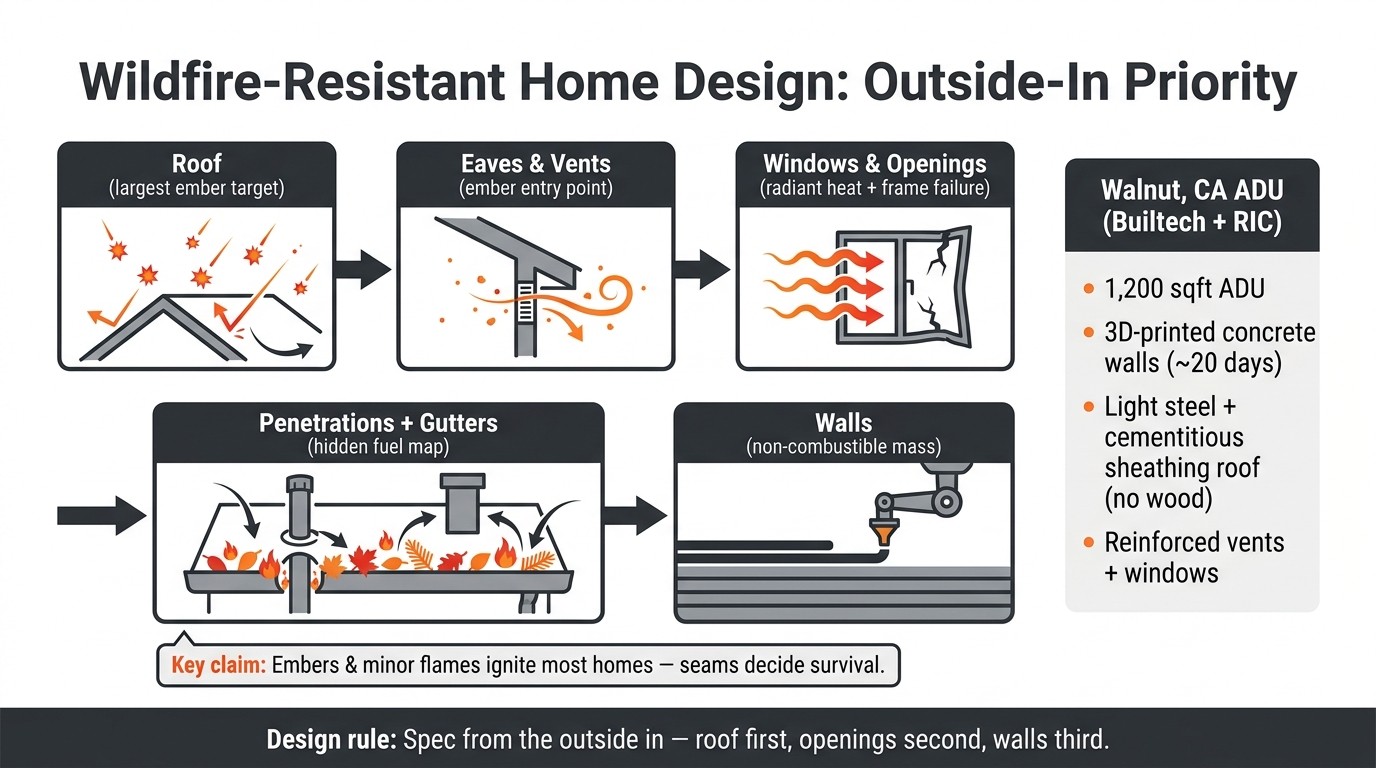
Embers and minor flames cause most home ignitions during wildfires, so design decisions at the roof, eaves, and openings dictate survival far more than the bulk of the wall material.
Robotic on-site 3D printing makes a non-combustible shell feasible inside a 1,200 sqft suburban backyard in roughly 20 days — but the wildfire resistance is a system, not a product.
Builders, contractors, and homeowners working in California's wildland-urban interface should spec from the outside in: roof first, openings second, walls third.
The Walls Were Always the Easy Part
The most photographed image in 3D-printed construction is a robotic arm extruding a curved concrete wall. It is also the most misleading. In a wildfire, walls are rarely the part of a home that fails first. They are heavy, dense, and hard to ignite. The pieces that fail first are the parts most coverage barely mentions: the roof, the eave vents, the windows, and the small openings where a building meets the air around it.
Builtech Construction Group's accessory dwelling unit (ADU) in Walnut, California makes that point in concrete and steel. The 1,200 sqft, two-bedroom, two-and-a-half-bath structure is being delivered in collaboration with the City of Walnut and the Los Angeles County Fire Department, with subcontractor K4K Construction Design running RIC Technology's robotic arm 3D printer for the exterior walls.[1][2] The walls are the headline. They are not the lesson.
The lesson is in the assembly choices around them. Builtech is building this home without a single piece of wood or nail in the main structure. The roof is light steel and sure-boards, not the wooden structural roof typical of other 3D-printed homes. Eave vents and windows — the parts of a house that statistically catch fire first during wildfire events — are reinforced with non-combustible detailing.[1][3][4] That envelope-first thinking is what turns a 3D-printed concrete shell from a marketing visual into a wildfire defense system.
For builders working in California's wildland-urban interface, the design lesson is simple: a non-combustible wall does not save a home if the roof above it carries fire, the eaves beneath the roof inhale embers, or the windows beside the wall fail under radiant heat. Survival is decided at the seams.
Why Embers Decide Which Homes Burn
Most homes destroyed in wildfires do not burn from the outside in. They burn because embers — burning fragments carried on the wind — find a way inside. Wildfire Risk to Communities, the resource hub created by the USDA Forest Service, is unambiguous: most homes destroyed in wildfires are initially set ablaze by embers and minor flames.[5] That single statistic should drive the design hierarchy of any wildfire-resistant home.
Embers are not a fringe failure mode. They cast miles ahead of an active fire front, and they slip through openings designed for ordinary conditions: ridge vents, eave vents, foundation vents, weep holes, gutters clogged with leaves, decks and patios with combustible substructure, and window frames that warp under heat. The structure that catches the ember controls the outcome.
Aaron Liu, chief executive of Builtech Construction Group and an NFPA Certified Wildfire Mitigation Specialist (CWMS), frames the design challenge in terms of the fire triangle. "During wildfires, 'heat' and 'oxygen,' two of the three components of the fire triangle, are beyond control," Liu told reporters. "Therefore, our focus is on eliminating 'fuel': the unique architectural design and building materials in this case."[1][2] That framing is more than a soundbite. It is the entire design discipline. If a home offers no fuel, an ember has nothing to start.
For practitioners, the operational implication is direct. Once the fire is in the air, the only variable a builder controls is what the ember lands on. The roof is the largest target. The eaves are the most reliable entry points. The windows are the most fragile boundary. Walls are not where the contest is decided.
Builtech's Roof: Light Steel and Sure-Boards Instead of Wood
Most 3D-printed homes in the United States still use wood-framed roof systems sitting on top of concrete walls.[3][4] That choice is a quiet contradiction. The wall material is non-combustible. The structural component above it is the most combustible element in the home. An ember that lands on a wood roof has found exactly the fuel it needs.
Builtech designed the Walnut ADU's roof out of light steel and sure-boards — a non-combustible cementitious sheathing system commonly specified for fire-rated assemblies. The light steel handles the structural span. The sure-boards provide the deck. Neither material adds to the home's fuel load.[1][4]
The design decision matters for two reasons. First, it removes the largest contiguous fuel surface from the building. A typical wood-roof assembly presents hundreds of square feet of combustible material to wind-driven embers. A light steel and sure-board assembly presents none. Second, it changes the failure mode under prolonged heat exposure. Wood-roof assemblies char and lose load capacity as fire propagates. Steel does not ignite, and properly detailed cementitious decks resist surface combustion long enough to survive the brief, intense passage of a wildfire's flame front.
The trade-offs are real but manageable. Steel roofing requires careful detailing for thermal expansion, condensation, and acoustic comfort. Sure-board assemblies must be specified with attention to seam and penetration detailing, since a high-performance deck is only as fire-resistant as its weakest joint. None of those constraints is novel — they are well-understood within commercial fire-rated construction. Importing them to single-family ADU construction is the move.
For Builtech, the roof is the reason the rest of the assembly works. A 3D-printed concrete wall under a wood roof is still a wood-roof house. Under light steel and sure-boards, the home stops feeding fire from the top down.
Eave Vents: The Smallest Opening, the Largest Risk
Eave vents look harmless. They are small, recessed, and easy to forget. They are also one of the most reliable ways a home loses to a wildfire. An eave vent's job is to draw outside air into the attic. During a wildfire, that outside air is loaded with embers. The vent does what it was built to do: it inhales.
Once inside an attic, embers find a different building entirely. Insulation, framing offcuts, dust, stored material — the attic is rarely held to the same fire-resistance standard as the visible exterior. A single vent failure can lead to interior ignition while the exterior of the home appears intact. Standard mesh sizes, intended for keeping pests out, are not adequate for keeping embers out.
Builtech's Walnut ADU treats eave vents as a primary design surface, not an afterthought. The company has stated explicitly that areas traditionally vulnerable to fires — eave vents and windows — are being reinforced as part of the build.[1][3][4] In practice, that means specifying ember-resistant vent assemblies with fine mesh, adding flame-and-ember-resistant baffles where allowed by code, and rethinking the geometry of the eave so that the vent is not a direct funnel into a combustible cavity.
It also means reconsidering whether vents are necessary in the same locations or quantities. With a non-combustible roof deck and a sealed concrete shell, the ventilation strategy can shift toward continuous low-flow vents in less ember-exposed positions, mechanical ventilation, or fully sealed attic assemblies that meet local energy code without conventional eave vents at all.
For wildfire-resilient design, eave vent detailing is a leading indicator of how seriously a builder takes the rest of the envelope. It is small. It is unglamorous. It is decisive.
Windows in a Wildfire: Glass, Frames, and Radiant Heat
Windows fail in wildfires for two reasons that have nothing to do with flame contact. The first is radiant heat. A wildfire passing within tens of feet of a structure can deliver enough thermal energy to crack untempered glass before any flame touches the building. Once the glass fails, the interior — full of curtains, furniture, and synthetic materials — is exposed directly to embers and convective heat. The second is frame failure. Vinyl-framed windows soften and warp at temperatures well below combustion, allowing the glazing to drop out of the assembly even when the glass itself remains intact.
This is why Builtech's commitment to reinforcing windows in the Walnut ADU is not a cosmetic choice.[1] Reinforced window detailing in a wildfire context typically means dual-pane tempered glazing rated for elevated radiant heat, non-combustible frame materials such as steel or fiberglass, and careful flashing detailing that integrates the window into the surrounding non-combustible envelope. The window-to-wall transition needs to be ember-tight as well as water-tight.
The connection to the 3D-printed concrete wall matters here. A robotic arm 3D printer can hold tighter geometric tolerances than rough framing on standard wood-framed construction, which gives the window installer a more predictable rough opening. That precision can be used to design ember-tight window flashing as a deliberate assembly rather than as a field-improvised detail. The same printer that simplifies the wall pour can simplify the window seal — but only if the design treats the window as a system, not a punched opening.
The design principle generalizes. A wildfire-resistant home does not have "fire-resistant walls" and "ordinary windows." It has a continuously detailed envelope where every opening is engineered to survive the same exposure as the surface around it.
Penetrations, Gutters, and the Hidden Fuel Map
Beyond walls, roofs, eaves, and windows, every exterior penetration is a candidate failure point. Plumbing vents, electrical conduits, HVAC penetrations, dryer vents, and exterior outlets all create paths through the envelope. In a wood-framed home, these penetrations are usually field-detailed with sealants and trim that are not rated for wildfire exposure. The same is true for gutters, which collect dry leaf litter that smolders into ignition under ember rain.
A 3D-printed wildfire-resistant home cannot afford field-improvised detailing at penetrations. Each penetration must be planned during the print job — sleeves cast into the concrete during printing, fire-rated mastics specified for the seal, and metal cover plates used in place of plastic. None of those details is exotic, but every one of them is a habit shift for general contractors used to wood-frame construction.
Gutters and roof-edge detailing deserve their own design pass. A non-combustible roof drained by a gutter full of dry oak leaves is still vulnerable. Gutter guards rated for ember resistance, metal gutter materials, and a gutter geometry that drains rather than holds debris are all part of the same envelope discipline that drives the rest of the home's specification.
The pattern is consistent. Where designers think "small detail," wildfires think "entry point." A wildfire-resistant home is the sum of its smallest decisions, and 3D-printed construction is only as resilient as the detailing the builder commits to around the printed shell.
What 3D-Printed Concrete Walls Actually Buy You
If walls are not the headline, what does 3D-printed concrete actually contribute? Three things.
First, scale and economics. RIC Technology's compact modular robotic arm is designed to operate in the kind of confined backyard footprint that ADUs require. CEO Ziyou Xu has described the system as overcoming the limitations of conventional gantry 3D concrete printers, enabling on-site construction in spaces where a gantry simply could not be deployed.[1][9] The printing process for the Walnut ADU's walls is expected to take roughly 20 days from start to finish.[1][2] For a 1,200 sqft footprint, that is a viable timeline for affordable, replicable suburban infill.
Second, material resilience. Concrete is non-combustible — its combustion threshold is roughly 1,500°C, well above the temperatures sustained by even an intense wildfire flame front.[9] A printed concrete wall does not melt, soften, or feed flame. It also resists ember accumulation along its surface in a way that lap-sided wood walls do not.
Third, geometric control. Layer-by-layer extrusion produces walls with predictable openings, predictable thicknesses, and a digital record of how the wall was built. That predictability is the foundation for the envelope-detailing discipline this article has argued for. Field-built walls vary; printed walls do not. When window openings are dimensionally consistent, ember-tight flashing is reproducible. When penetration sleeves are cast in the print job, post-print drilling is unnecessary.
What 3D-printed walls do not buy you is the rest of the house. The walls are a precondition for a non-combustible envelope, not a substitute for one. A homeowner shopping for "fire-resistant 3D-printed homes" should ask, before anything else, what the roof is made of, how the eaves are vented, and how the windows are glazed and framed.
Replicating the Walnut Playbook in Wildland-Urban Interface Communities
The Walnut ADU is being framed as a pilot, not a one-off. RIC Technology has stated its intent to continue partnering with Builtech to develop non-combustible, fire-resistant homes in wildfire-prone areas.[1] The City of Walnut and the Los Angeles County Fire Department's involvement signals that the project is being designed with replicability in mind — not just structural replicability, but regulatory and inspection replicability. That detail matters for any community trying to reproduce the model.[2]
For a builder or municipality considering a similar program in California's wildland-urban interface (WUI), the playbook is becoming clear. Specify a non-combustible main structure (concrete, masonry, or 3D-printed concrete) with a non-combustible roof assembly. Specify ember-resistant vent and gutter assemblies. Specify reinforced window glazing and non-combustible frames. Specify cast-in-place penetrations rather than field-cut openings. Coordinate with the local fire authority on inspection and acceptance criteria so that the assembly is not only fire-resistant but also legally documented as such for insurance and resale.
Each of those steps is independently available today using conventional construction. What 3D-printed walls add is the ability to deliver a non-combustible shell on a tight timeline, in a constrained suburban footprint, at a cost structure compatible with affordable backyard ADUs. That combination is what makes the Walnut model worth replicating beyond a single Walnut backyard.
For homeowners in WUI zones, the practical next step is asking any builder a single question: how does your envelope perform against ember exposure, not flame contact? If the answer focuses only on wall material, the design is incomplete.
How to Spec a 3D-Printed Wildfire-Resistant Home From the Outside In
The Walnut ADU's design priority order is the order other projects should follow.
Start with the roof. Specify a non-combustible deck and structural system before specifying the wall print. A wood roof on a printed concrete wall is a fire-vulnerable home with extra steps.
Specify the eaves and vents next. Choose ember-resistant vent assemblies, fine-mesh screens, and sealed attic strategies where possible. Treat the soffit as a continuous fire-resistant surface, not a trim element.
Specify the windows and openings third. Use tempered glazing, non-combustible frames, and ember-tight flashing detailed for the opening tolerances the printer can hold.
Specify the wall material and printing process last. Once the envelope discipline is decided, choose the wall system that delivers the required non-combustible mass at the required cost and schedule. For a confined backyard, a compact robotic 3D printer is the obvious choice. For a larger lot, gantry printing or precast concrete may be more economical.
Across all of those steps, treat penetrations as design objects rather than field details, and treat the local fire authority as a design partner rather than an inspection hurdle. Builtech's collaboration with the Los Angeles County Fire Department is not a marketing relationship — it is part of how the project converges on a buildable, inspectable, repeatable wildfire-resistant home.[1][2]
The walls will get the photo. The roof, the eaves, and the windows will save the home.
FAQs
How does a 3D-printed home become wildfire-resistant beyond just having concrete walls?
A 3D-printed concrete wall is non-combustible, but a wildfire-resistant home requires the entire envelope to be non-combustible: a steel-and-cementitious-board roof, ember-resistant eave vents, reinforced windows, sealed penetrations, and metal gutters. Builtech's Walnut, California ADU pairs printed concrete walls with all of those details, which is what turns a fire-resistant wall into a fire-resistant home.
Why are eave vents such a big risk during a wildfire?
Eave vents pull outside air into the attic. During a wildfire, that air is loaded with embers, and a standard pest mesh does not stop them. Once embers reach attic insulation and framing residue, the home can ignite from the inside while the exterior still looks intact. Specifying ember-resistant vents is one of the highest-leverage decisions in wildfire-resistant design.
What is the fire triangle, and how does Builtech use it as a design tool?
The fire triangle is the three components needed for combustion: heat, oxygen, and fuel. Builtech CEO Aaron Liu, an NFPA Certified Wildfire Mitigation Specialist, has stated that during a wildfire, heat and oxygen are uncontrollable, so the design strategy must focus on eliminating fuel — meaning no wood or nails in the main structure and non-combustible material at every envelope component.
Why is the roof more important than the walls in wildfire-resistant home design?
Embers fall vertically. The roof is the largest horizontal target on a home and accumulates ember exposure across its entire surface. Wood roof assemblies provide hundreds of square feet of available fuel; light steel with cementitious sure-boards provide none. Replacing a wood roof with a non-combustible assembly often delivers more fire-survival benefit than upgrading any other single building component.
What does a robotic arm 3D printer add over a gantry-style 3D concrete printer?
Robotic arm 3D printers are compact and modular, which lets them operate in tight residential lots and backyards where a gantry system cannot be set up. RIC Technology's robotic arm system was selected for the Walnut ADU specifically because the project sits in a confined suburban backyard, and the printer can be deployed and relocated without dedicated industrial infrastructure.
How long does it take to 3D print the walls of a wildfire-resistant ADU?
For the Walnut, California ADU's 1,200 sqft footprint, RIC Technology's robotic arm 3D printer is expected to print the exterior walls in roughly 20 days after the foundation, plumbing, and sewage systems are in place. That timeline does not include design, permitting, foundation, roof, finishes, or interior work, all of which run on conventional construction schedules.
Are 3D-printed concrete homes more expensive than traditional wood-framed homes?
Concrete and 3D-printed concrete construction generally carries a higher upfront material cost than light wood framing in the United States, but compresses on-site labor and timeline, and reduces long-term insurance, fire-loss, and maintenance exposure in wildfire-prone regions. The total cost picture depends heavily on local labor rates, code requirements, and whether the project sits in a wildland-urban interface zone.
What is an NFPA Certified Wildfire Mitigation Specialist (CWMS)?
The Certified Wildfire Mitigation Specialist (CWMS) is an NFPA credential that verifies a professional's competency in wildfire hazard mitigation, planning and preparedness, communication, and fire science. Most CWMS holders work as consultants or fire-service professionals; Builtech CEO Aaron Liu is unusual in holding the credential as the head of a general contracting firm directly designing and building wildfire-resistant homes.
Can 3D-printed wildfire-resistant homes qualify for insurance discounts in California?
California's Safer from Wildfires regulation, administered by the Department of Insurance, requires insurers to recognize qualifying mitigation features in residential pricing. Non-combustible roofs, ember-resistant vents, defensible space, and other home-hardening measures are explicitly included. A 3D-printed wildfire-resistant home can qualify if its envelope details are documented and inspected; homeowners should confirm specifics with their insurer and local fire authority.
Where can the Walnut ADU model be replicated beyond Los Angeles County?
Any California wildland-urban interface community with backyard infill demand and active fire-mitigation programs is a candidate, particularly where local building codes already encourage non-combustible roofs, ember-resistant vents, and defensible space. Replication depends less on the printer and more on a local general contractor willing to specify the full envelope and a fire authority willing to co-develop inspection criteria.
Related resources
Wildfire Risk to Communities — Ignition-Resistant Homes: USDA Forest Service hub explaining why most homes ignite from embers and what design changes reduce risk.
California Office of the State Fire Marshal — Wildland Hazards and Building Codes: Authoritative reference for California's wildland-urban interface building requirements and code framework.
NFPA Certified Wildfire Mitigation Specialist (CWMS) program: The credential held by Builtech's CEO and a benchmark for wildfire-design competency in residential construction.
References
Build in Digital — Robot system to print wildfire-resistant California home
Disaster Recovery Journal — U.S.'s First Fire Resistant 3D Printed Concrete ADU Starts Construction
USDA Forest Service / Wildfire Risk to Communities — Ignition-Resistant Homes
California Office of the State Fire Marshal — Wildland Hazards and Building Codes
3DPrint.com — Fire-resistant 3D Printed Accessory Dwelling Unit Unveiled by RIC
Tomorrow's World Today — Fire-Resistant, 3D-Printed Homes Can Reduce Wildfire Damage