Compact 3D Printers Unlock Backyard ADU Construction
Most 3D-printed homes are built by gantry printers that can't fit on a real residential lot. A compact modular robotic 3D printer ships in pieces, reassembles inside the build footprint, and prints from within the lot itself — unlocking onsite concrete ADUs in ordinary California backyards. The Walnut Creek build led by Builtech with RIC Technology is the proof point, and it also delivers fire-resistant performance as a structural byproduct.
Authors:


TLDR
Most 3D-printed concrete houses are built by large gantry printers that simply can't fit on a real residential lot.
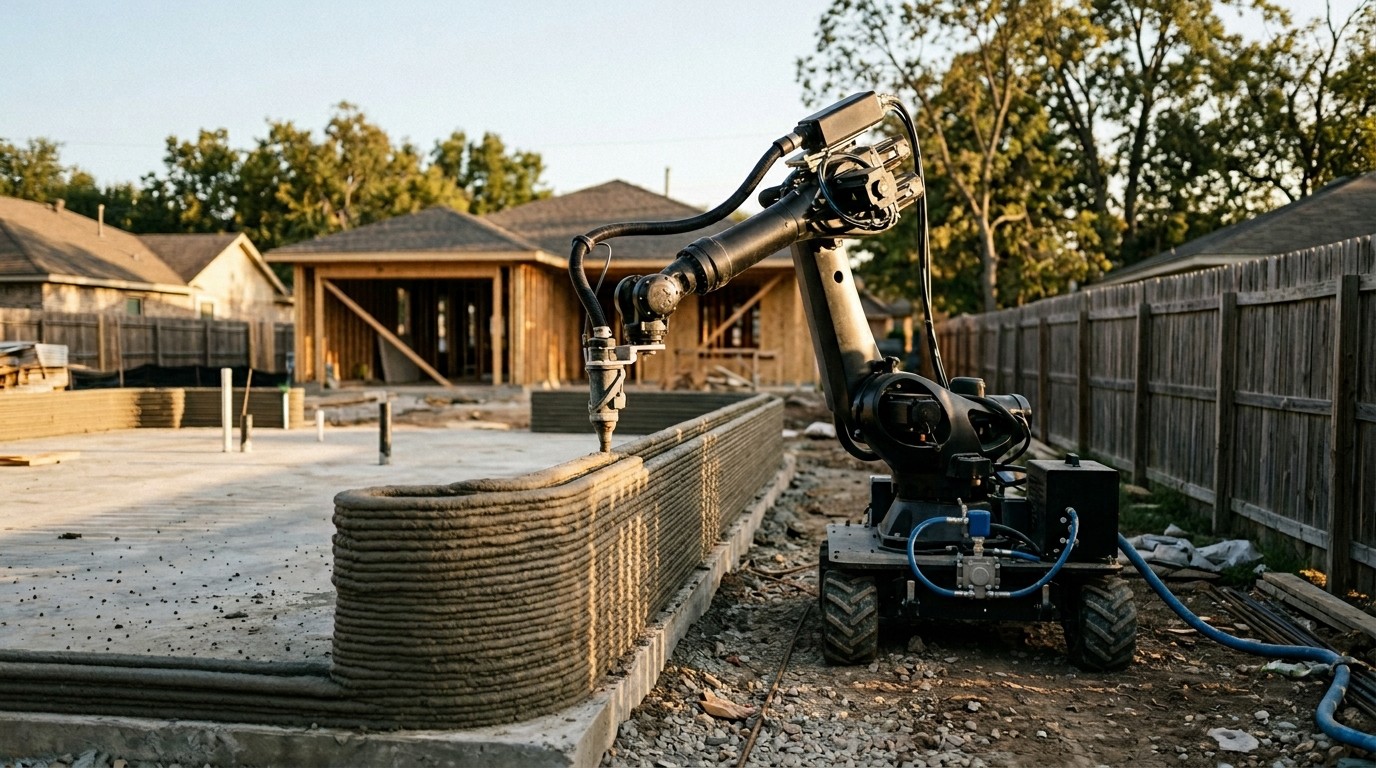
A compact modular robotic 3D printer ships in pieces, reassembles inside the build footprint, and prints from within the lot itself.
That is the form-factor breakthrough that makes onsite concrete ADUs viable for ordinary California backyards.
The first U.S. onsite-printed, fire-resistant concrete ADU — a Northern California build led by Builtech Construction Group with RIC Technology — is the working proof point.[1]
For contractors and homeowners, the practical takeaway is that 3D-printed ADUs are no longer a special-lot novelty.
The Lot-Size Bottleneck in 3D Concrete Printing
3D concrete printing has been hyped for almost a decade, but the actual built inventory in the United States is small. Most of the visible demos have been new subdivisions, planned communities, and open job sites where a contractor can stage a printer the size of a freight container. That is not where America's housing shortage lives.
The shortage lives on the existing single-family lot — a 5,000 to 8,000 square foot parcel with a house already on it, a driveway, a side yard, and a back fence. That is the lot where an accessory dwelling unit gets built, and that is the lot where every gantry-based 3D concrete printer hits the same wall. The machine is bigger than the available work area.
This is the bottleneck behind every '3D printing will solve the housing crisis' press release. The printer cannot reach the site, and even if it can, it cannot be installed within it. Until that geometric problem is solved, the technology is locked out of the part of the market that needs it most.
Why Gantry Printers Don't Fit a Residential Backyard
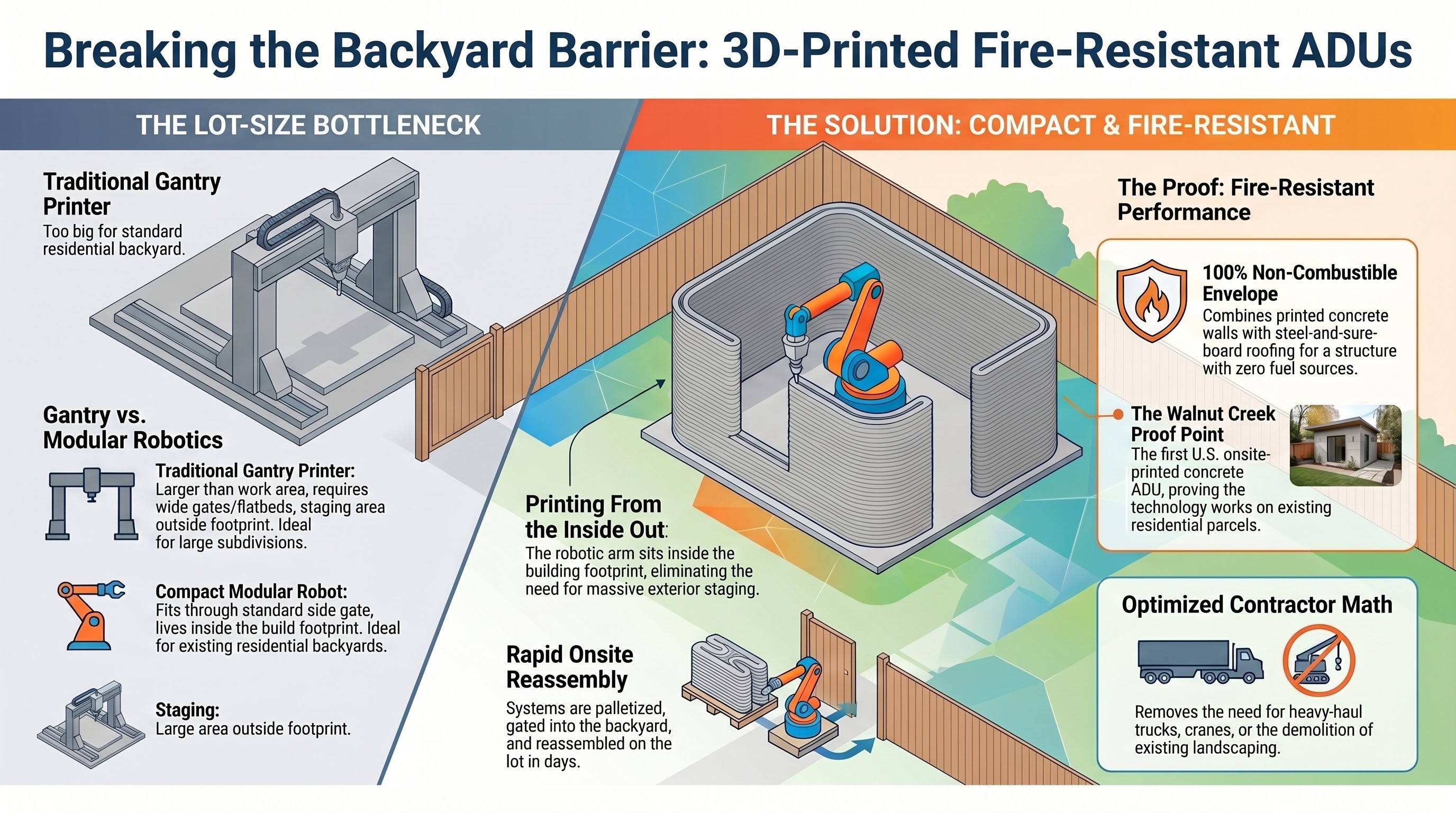
A traditional construction-scale 3D printer is a gantry: a rectangular steel frame, often with an overhead beam, that travels along fixed rails. The extruder hangs from the beam and prints concrete inside the rectangle the gantry defines. The printable area is always smaller than the gantry itself.
That works fine on a graded pad inside a large lot. It does not work in a backyard where the gantry would have to sit on top of an existing fence, a neighbor's property, or a mature tree. Even if the lot is generous, the gantry has to be trucked in on a flatbed, which requires gate width, overhead clearance, and turn radius that residential streets almost never offer.
There is also the question of staging. Gantry rigs need a flat staging area for the rails, a power source, concrete pumping, and operator clearance. Owners are usually not willing to demolish landscaping just to install a printer. The economics of an ADU collapse if the printer setup costs more than the value the printed walls deliver.
These constraints are not gossip. They are openly acknowledged by the manufacturers themselves. The Northern California ADU project lead, RIC Technology's CEO Ziyou Xu, stated plainly that traditional 3D printing methods 'have not been suitable' for ADU construction because they 'require large machines that cannot fit in small lots.'[1]
The Compact Modular Robotic Printer Advantage
The fix is structural, not incremental. Instead of scaling a gantry down, RIC built a fundamentally different system: a compact, modular robotic arm printer that ships disassembled and is rebuilt on site. Once on the lot, the arm is mounted on either a fixed rail or a small mobile platform that lives inside the build footprint rather than around it.
That distinction matters. A robotic arm prints in a roughly hemispherical work envelope around its base. As long as the base can be placed inside the building outline — or repositioned during the build — the printable area expands well beyond any gantry of comparable shipped volume. The arm can also tuck into corners, print under overhangs, and resume from a new anchor point without re-leveling a long rail.
Modularity is the second half of the unlock. The system arrives in components that fit through a standard side gate, gets reassembled in the back yard, and is taken apart and removed when the print is done. The printer's own footprint never has to compete with the house under construction for street access, fenced clearance, or staging area. In Xu's words, the compact modular robotic 3D printer 'overcomes these limitations, enabling 3D construction in people's backyards.'[1]
Walnut Creek: A Real-World Proof Point
The Northern California build is the first U.S. project to operationalize that form factor on a real residential lot. The structure is an onsite-printed concrete ADU, led by Builtech Construction Group with RIC Technology as the print-system provider. It is the first fire-resistant, onsite-built concrete ADU of its kind in the country.[1]
The build is not a one-day printing stunt. The exterior walls are printed in concrete on site, with the rest of the structure — foundation, plumbing, electrical, roof, finishes — handled by the general contractor under a normal residential schedule. That sequence matters. It means the printer is integrated into a standard ADU build, not staged as a standalone exhibition.
This is also why the choice of project matters. An ADU is the smallest envelope at which onsite robotic concrete printing has to prove itself economically. If the form factor and the print logistics work for a one- to two-bedroom backyard structure on an existing parcel, they will work almost anywhere ADUs are permitted. The Walnut Creek project is the bench test the rest of the market has been waiting for.
What This Means for California's ADU Pipeline
California's ADU market is the single most important demand signal for this technology. State and local policy reforms have pushed permitting volumes up sharply over the last decade, and the pipeline is now thick enough that any technology that can shave time, labor, or risk off an ADU build has a clear path to scale.
Compact robotic printing fits that pipeline more naturally than gantry-based systems do. A contractor running a portfolio of ADU projects across different neighborhoods cannot park a freight-sized rig at each one. A modular arm that can be palletized, gated in, set up over a weekend, and re-deployed at the next lot the following month is operationally compatible with how mid-market California general contractors actually run their schedules.
For homeowners, the practical effect is that '3D-printed ADU' stops being a special category and starts becoming a normal selection on a builder's spec sheet. The structural shell goes up faster. The wall material is concrete. The construction footprint is similar to a conventional build because the printer lives inside the work area rather than next to it.
The Hidden Benefit: Fire-Resistant by Design
Once concrete is the wall material, fire resistance comes along as a structural bonus rather than a paid upgrade. Concrete is non-combustible. It does not contribute fuel to a wildfire, it does not transmit flame across an assembly, and it does not need additional sheathing layers to meet ignition-resistant construction requirements.
That advantage is the explicit design driver for the Walnut Creek ADU. The project is engineered as a fire-hardened structure responding to California's wildfire crisis, with non-combustible exterior walls and a non-wood roof assembly. As Aaron Liu, CEO of Builtech Construction Group, put it: 'the ADU will be built without a single piece of wood or nail — no fuel on the main structure. So we significantly minimize the likelihood of fire entering the home, enhancing the safety of the structure.'[1]
The strategic point is that compact robotic printing puts this fire performance within reach of the typical California backyard. Owners no longer have to choose between an affordable ADU and a fire-resistant one. The same machine that solves the lot-size problem also delivers the wall assembly that addresses the wildfire problem.
Roof and Opening Detailing Still Matter
The printer is not the whole story. Concrete walls only buy a homeowner a survivable structure if the rest of the envelope is detailed to the same standard. Roofs, eaves, and openings are where most wildfire structure losses originate, and a printed concrete wall does nothing for those failure modes by itself.
The Walnut Creek build acknowledges this. The roof is constructed with light steel and sure-boards rather than the wood structural roof that most 3D-printed homes still use. This is one of the few projects that pairs a non-combustible wall with a non-combustible roof, which is what an envelope-level fire performance claim actually requires.[1]
Owners and contractors evaluating compact-robotic ADUs should look at roof systems, eave vents, window assemblies, and exterior penetrations with the same rigor they apply to the wall print. The whole assembly has to be non-combustible — or close to it — for the printed concrete to deliver the survivability it implies.
Cost, Schedule, and the Contractor Bid Math
For general contractors writing bids, the compact robotic printer changes the cost stack in three places. First, it removes the staging and access surcharge that a gantry job carries. There is no need to demolish landscaping, secure a heavy-haul route, or rent a long-reach crane to drop the rig. Second, it tightens the schedule on the wall-shell portion of the build, because the print proceeds continuously rather than as discrete framing days.
Third, it changes the labor mix. A printed wall does not need a framing crew, but it does need a print operator, a concrete mix manager, and finishing trades that can work over a non-conventional wall surface. Contractors who pre-train on that mix will run cleaner schedules than those who treat the printer as a black box and contract everything around it.
None of this means a 3D-printed ADU is automatically cheaper than a framed ADU today. It means the cost curve points in the right direction, and that the early movers who absorb the operating model will own the segment as it scales.
What a Compact-Printer-Ready Lot Looks Like
Not every backyard is print-ready. The lot needs a poured slab or footings cured to spec, side or rear access wide enough for palletized arm modules, a clear interior staging point for the printer base, and reliable single- or three-phase power depending on the system. It also needs neighbor management — printing days are noisy and pump trucks are large.
Permitting is a separate question. Most California jurisdictions are still building familiarity with non-combustible printed wall assemblies, so the most efficient ADU programs are the ones where the contractor pre-coordinates with the building department and local fire authority before pouring a foundation. The Walnut Creek build is one of the first to do this end-to-end on a residential lot, which is part of why it sets a useful template.
Owners who want to move on a compact-robotic ADU should treat the structural shell as the easy part. The harder work is sequencing the permit set, the fire-department review, and the finish trades around a wall system most local subs have not finished before.
Honest Limits and What's Still Unproven
Compact robotic printing fixes the lot-size problem. It does not yet fix every problem with 3D-printed homes. Wall print speed is favorable on simple geometries but slows on complex curves or heavily reinforced sections. Mechanical, electrical, and plumbing rough-ins still need chase planning that conventional framing crews handle by reflex.
Long-term performance data on onsite-printed concrete walls in California's seismic and freeze-thaw environments is still accumulating. Insurance carriers are still calibrating premiums for non-combustible printed envelopes. None of this is disqualifying — every new building system has gone through the same calibration period — but contractors should set client expectations realistically.
The technology is real, and the form-factor breakthrough is genuine. The market will catch up to the engineering on its own schedule, and the contractors and clients who move early on compact robotic ADUs will set the reference standard the rest of the industry follows.
FAQs
What is a compact modular robotic 3D printer for ADUs?
A compact modular robotic 3D printer is a small-footprint, articulated-arm concrete printer designed to ship in pieces and reassemble inside a residential lot. Unlike traditional gantry printers, the arm prints from within the building footprint rather than around it, which is what makes onsite ADU printing on ordinary backyards viable. RIC Technology's system, used on the Walnut Creek ADU, is the current reference build for this category.[1]
Why can't traditional gantry 3D printers build ADUs in residential backyards?
Gantry concrete printers are large rectangular steel frames that travel on fixed rails and print inside the rectangle they define. They need flatbed delivery, wide gate access, a flat staging area, and clearance for the rails themselves. A typical California backyard with an existing house, fence, and trees does not offer that geometry. Compact modular robotic systems are designed specifically to work where gantry rigs cannot fit.[1]
How does a compact modular robotic concrete printer get to the job site?
The printer is shipped disassembled, in components small enough to fit through a standard side gate. The robotic arm, mounting platform, control hardware, and concrete pump are reassembled on the lot. When the print is complete, the system is broken down and removed, so it never occupies space that the finished ADU will need. That logistics path is the operational unlock for residential lots.
Is a 3D printed concrete ADU more fire-resistant than wood framing?
Concrete walls are non-combustible, which means they do not contribute fuel to a wildfire. That gives a 3D-printed concrete ADU a real structural advantage over a wood-framed equivalent in wildfire-exposed areas — but only if the roof, eaves, and openings are also detailed to non-combustible standards. The Walnut Creek build pairs printed concrete walls with a steel-and-sure-board roof to deliver an envelope-level fire performance claim.[1]
How long does it take to 3D print the walls of a concrete ADU?
The wall-print phase is generally faster than equivalent framing or masonry, but the full build still includes foundation, MEP rough-in, roof, openings, and finishes on a conventional schedule. The print-speed advantage shows up in the shell phase, not the overall project length. Treat the printer as a wall-shell accelerator, not a full-build replacement.
Can a 3D printed ADU be permitted under California's residential code?
Yes — within the limits of the existing residential code and the authority having jurisdiction. The Walnut Creek build was advanced in coordination with the local building department and fire authority. Permitting still requires the contractor to document assemblies, coordinate with the fire department on hardening details, and pass the same inspections any ADU faces. The compact robotic system does not exempt a project from any of that.[1]
What roof system is used on a fire-resistant 3D printed ADU?
The Walnut Creek ADU uses a light-steel structural roof with sure-boards instead of the wood-framed structural roofs found on most 3D-printed homes. That combination keeps the roof non-combustible, which is necessary if the home is going to deliver real wildfire performance rather than a marketing version of fire resistance.[1]
Who is RIC Technology and what does their robotic printer do?
RIC Technology is the printer-system provider behind the Walnut Creek ADU. The company builds a compact modular robotic 3D printer designed for onsite concrete printing on residential lots. Founder and CEO Ziyou Xu describes the system as overcoming the lot-size limitations of conventional gantry printers and enabling 3D construction in people's backyards.[1]
Should homeowners in California wildfire zones consider a 3D printed concrete ADU?
For owners in wildfire-exposed areas, a non-combustible printed concrete ADU is worth evaluating alongside conventional fire-hardened framing options. The structural shell is intrinsically non-combustible, and a compact robotic printer makes the build feasible on lots that historically could not accommodate concrete 3D printing. The decision still comes down to lot suitability, permit complexity, and contractor experience.
When will compact robotic 3D printing reach mainstream contractor adoption?
Mainstream adoption depends on three things: more reference builds beyond Walnut Creek, calibrated permit playbooks in additional jurisdictions, and a generation of general contractors who have run print-plus-finish projects end to end. The form-factor problem is now solved. The remaining work is operational scaling, and that typically takes two to four building cycles before a new envelope system becomes a default option on a contractor's bid sheet.
Related resources
3D printed fire-resistant home being built in Los Angeles County (KTLA) — Local TV coverage of the project, including footage of the robotic arm in action.
RIC Technology Robotic 3D Printer — Manufacturer detail on the modular printer system used on the Walnut Creek ADU.
California's First Innovative Fire-Resistant 3D Printed ADU Unveiled in Walnut (3D Printing Industry) — Industry coverage of the unveiling and engineering rationale.