ICF Type I ADU: Building Wildfire Defense as a System
Builtech's Eagle Rock ADU is Los Angeles' first known ICF home built to Type I-level fire resistance. The real lesson isn't the wall — it's that wildfire survival in the WUI requires engineering the whole stack (structure, roof, windows, Zone Zero) as a single non-combustible system, with no weakest link.
Authors:


TLDR
Builtech's Eagle Rock project is Los Angeles' first known ICF (Insulated Concrete Form) home built to Type I-level fire resistance — a 1,150 sq ft ADU engineered to withstand up to 3 hours of direct fire exposure.[1]
The structural ICF wall is necessary but not sufficient. Wildfires win at the weakest link — usually a roof, a vent, or a window — not the wall.
The project's real innovation is integrating the wall with a non-combustible roof, fire-rated triple-glass windows, and a defensible-space landscape into a single engineered system.[1]
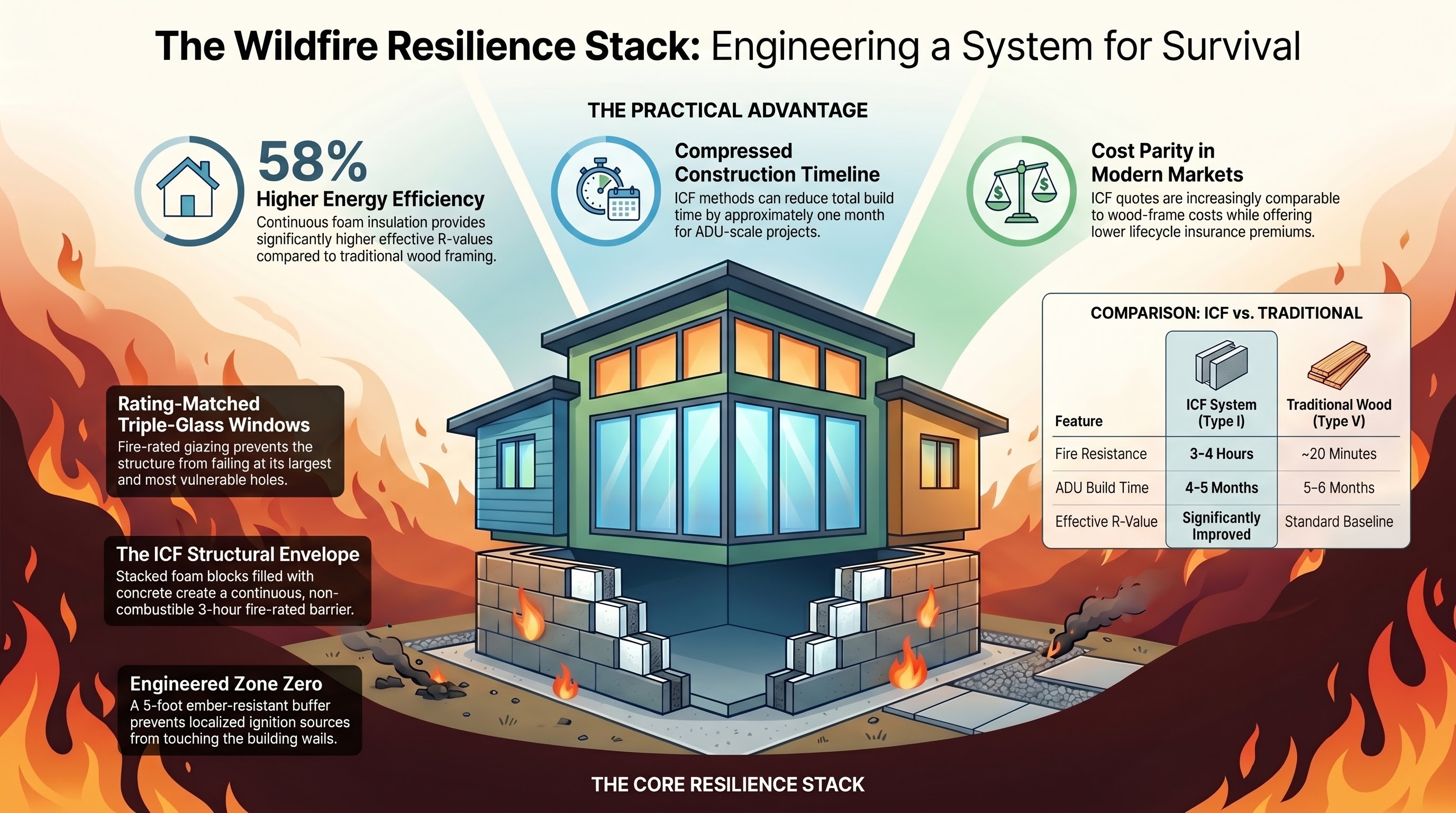
Cost is comparable to wood-frame quotes the homeowner received, and the build is tracking 4–5 months versus 5–6 months for traditional framing.[1]
For California homeowners in WUI zones, the takeaway is to specify the whole stack — not just upgrade the walls.
Why a Type I Sticker Is Not a Survival Plan
When press releases use the phrase "Type I," the implication is a binary: your house either is, or isn't.[1] The reality is messier. Type I, as defined under the International Building Code and the California Building Code, classifies the primary structural frame and bearing walls — not the roof covering, not the windows, not the vegetation in the front yard. A home with a Type I-level structural wall and a Class C asphalt-shingle roof is, in any practical wildfire sense, still a Class C roof problem.
This distinction matters because almost every published wildfire post-mortem — from CAL FIRE assessments to FEMA's P-737 Builder's Guide — keeps reaching the same conclusion: the structures that burn in the Wildland-Urban Interface mostly do not lose to a wall of flame.[5] They lose to embers landing on a vulnerable roof, blowing through an unrated vent, melting a window seal, or igniting a wood fence connected to the siding.
If you treat "Type I" as a single number that solves wildfire, you are buying a sticker. If you treat it as the structural floor of a coordinated system, you are buying resilience.
What Builtech Actually Built in Eagle Rock
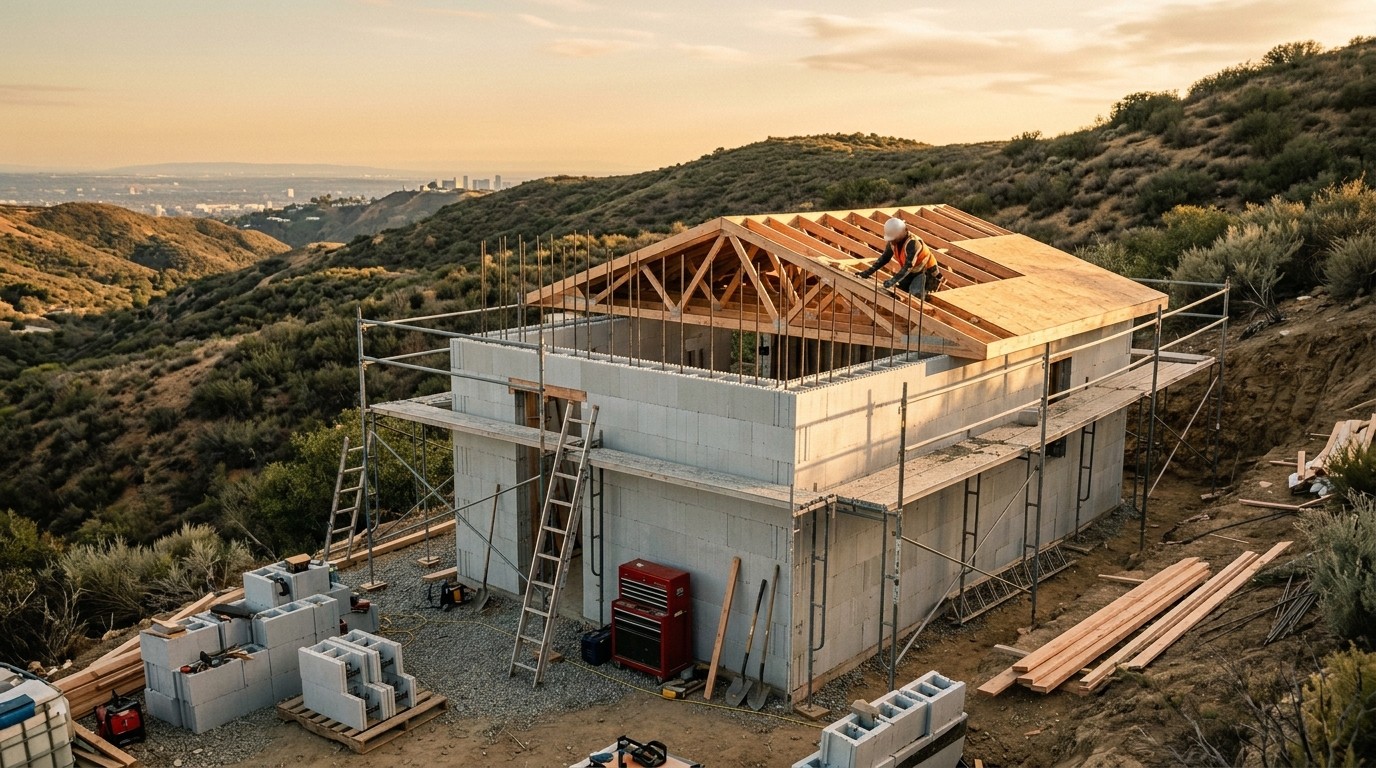
The project under construction in Eagle Rock is a 1,150 square foot ADU on a small, sloped lot inside a Wildland-Urban Interface zone.[1] The owners, Karl and his wife, watched the Eaton fire approach within two blocks of their primary residence earlier this year. Their home was spared. Their conviction was not.
The specification they ended up with reads less like a product brochure and more like an engineered stack:
ICF exterior walls — stacked foam blocks reinforced with rebar and filled with poured concrete, producing a continuous non-combustible structural envelope.[1]
A non-combustible roof assembly.[1]
Fire-rated windows with triple glass.[1]
A defensible-space landscape design coordinated with the structural envelope.[1]
A licensed contractor and Certified Wildfire Mitigation Specialist (CWMS) acting as the integrator across all four systems.[1]
That last line is the part that does not get printed on signage. The walls, the roof, the windows, and the landscape are not independent purchases. They are a system, and somebody has to be accountable for the seams between them. That is the role Aaron Liu, Builtech's founder and a CWMS, is playing on this project.[1]
The ICF Wall: Strong Floor, Wrong Ceiling
There is a reason ICF dominates the headlines. The wall assembly is genuinely impressive: a continuous concrete core sandwiched between two layers of fire-retardant foam, reinforced with steel, with no combustible studs or sheathing in the structural path.[8] Industry references commonly cite a 4-hour fire rating for typical ICF wall assemblies.[7] The Eagle Rock project's 3-hour direct-exposure target is a deliberately conservative spec that lines up with the most demanding cells of the IBC's structural fire-resistance tables.[1]
The wall also delivers benefits that have nothing to do with fire. ICF homes are pest-proof, soundproof, seismic-resistant, and notably energy-efficient — Builtech cites up to 58% higher effective R-values than traditional wood framing.[1] On a sloped, access-limited lot like the one in Eagle Rock, the lightweight, modular nature of ICF blocks is a genuine constructability advantage.[1]
None of that, on its own, prevents your house from burning down.
The wall sets the floor of fire performance. The roof, the openings, and the landscape set the ceiling. The Eagle Rock project is interesting because Builtech does not appear to be selling the floor as the ceiling.
Where Embers Actually Win the Fight
The failure modes that consume WUI homes are well-characterized. Embers — sometimes traveling more than a mile from the front — settle into receptive fuel near the structure or work their way into the building envelope through unprotected paths.[5] The Insurance Institute for Business and Home Safety's WUI codes supplement frames the same problem in three ignition mechanisms: ember exposure, radiant heat, and direct flame contact.[8]
For a residential structure, the realistic ranking of weak points looks roughly like this:
Roof covering and roof-to-wall junctions (ember accumulation in valleys and gutters, ignition of underlying combustibles)
Vents (embers entering the attic or crawlspace through unrated openings)
Windows and their seals (radiant heat fracturing glass, allowing flame entry)
Decks, fences, and exterior attachments (combustible elements wired directly into the wall plane)
Vegetation and mulch within Zone Zero (an ignition source touching the building)
Wall claddings and siding
The structural wall comes after most of these. A Type I structural wall behind a Class C roof and unrated vents is a Mercedes engine in a bicycle frame.
The Eagle Rock project, by spec, addresses items 1, 2, 3, and 5 explicitly through a non-combustible roof, the implied vent strategy that follows from a Type I roof assembly, fire-rated triple-glass windows, and a defensible-space landscape design.[1] Items 4 and 6 follow naturally from the ICF envelope.
Why Triple-Glass Fire-Rated Windows Are the Quiet Hero
Glass is the part of a wildfire-resilient envelope that homeowners most consistently underspecify. Single-pane glass routinely fractures from radiant heat alone. Standard dual-pane assemblies do better but still tend to fail at sustained high temperatures. Listed fire-rated windows — typically tempered, often triple-glass, and integrated with non-combustible frames and gaskets — extend the time-to-failure into the same band where the ICF wall is comfortable.[1]
Matching the window rating to the wall rating is the design move that prevents the structure from being undone by its largest holes. Specifying a 3-hour wall behind 20-minute windows produces a building that survives 20 minutes — not 3 hours.
The Eagle Rock spec gets this right. That is a more important detail than the wall material.
Defensible Space and Zone Zero Are Engineered Components
Zone Zero — the 0–5 ft ember-resistant buffer immediately surrounding the structure — is now a code-driven requirement on new builds in California's highest fire severity zones.[2] It is also routinely treated as landscaping rather than as a building system. That is a category error.
A noncombustible Zone Zero is not a planting decision. It is a continuation of the wall assembly into the air around it. Wood mulch, wood fences attached to the structure, planters, patio cushions, and any combustible item within five feet of the wall are functionally part of the wall's failure curve. If they ignite, the wall is fighting a fire that started inside its own protective bubble.
The Eagle Rock project treats the defensible-space landscape as a designed component, not as a separate trade.[1] That is the right level of intent, and it is the part that is hardest to retrofit later.
The Inspection Story Tells You Where the Market Is
During a recent routine inspection on the Eagle Rock site, three additional city personnel showed up alongside the assigned inspector — uninvited — to observe the ICF method first-hand.[1] That is a tell. Type I-level residential construction is not yet in the muscle memory of Los Angeles permitting and inspection. The default mental model is still wood-framed Type V-B with WUI Chapter 7A overlays for cladding and openings.[4]
This matters for two reasons. First, builders who want to deliver Type I-level residential are going to spend extra cycles educating reviewers and inspectors. Second, homeowners cannot assume the permit process will catch system-level mistakes — the inspectors are not yet pattern-matched on these assemblies. The integrator role is therefore not optional. Somebody on the project team has to own the seams between wall, roof, window, and landscape, because the regulatory environment is still calibrating.
The inspectors crashing the site is not a marketing anecdote. It is a market-readiness signal.
Cost and Schedule, Without the Hand-Waving
The most reliable objection to ICF is cost. Industry estimates typically put ICF at roughly 3–10% above stick-frame on a like-for-like basis.[6] For the Eagle Rock project, Karl reports that the ICF cost was "comparable, if not lower, than several wood-frame quotes" he received from other builders.[1] That is a single data point, on a small ADU, in a soft framing market. It is not a price for the entire category.
The schedule data is more interesting. The project tracked a 3-week foundation pour, then erected the first half of the ICF walls in 3 days, with a total expected build of 4–5 months versus 5–6 months for a comparable wood frame.[1] ADU-scale work tends to amplify schedule effects because foundation, wall, and roof phases each occupy a meaningful percentage of the timeline. ICF compresses the wall phase. That advantage degrades on larger custom homes but is real at this scale.
The operative cost question is not "ICF vs. wood" in isolation. It is the lifecycle cost of the system — including insurance, energy, durability, and the cost of a future fire. Insurance carriers are starting to recognize concrete envelopes with lower premiums, which closes part of the gap before lifecycle savings even show up.[6]
A Resilience Stack That Travels
The Eagle Rock ADU is one project. The argument it carries is portable.
For any homeowner, designer, or builder working in a California WUI zone — or in any high-severity fire context — the operative deliverable is not "upgrade the walls." It is a four-line specification:
Non-combustible structural envelope, rated for hours, not minutes.
Non-combustible roof assembly with ember-resistant vents.
Listed fire-rated windows with rating-matched openings.
Engineered Zone Zero and broader defensible-space landscape.
If any of those four lines is materially weaker than the others, the system performs at the weakest line. That is the part of the conversation the Eagle Rock project actually advances.
"This home shows a path for how Californians can build, and rebuild, safer and stronger homes," Aaron Liu of Builtech said.[1] The path he means is not a wall. It is a stack.
FAQs
What does Type I fire resistance actually mean for a residential ADU?
Type I is the IBC and CBC's highest fire-resistance classification, requiring the primary structural frame and bearing walls to be noncombustible and rated for several hours of fire exposure. Applied at residential ADU scale, it usually means a continuous non-combustible structural envelope — most commonly poured concrete, ICF, or hardened CMU — engineered to multi-hour fire ratings. It does not, by itself, regulate the roof covering, vents, windows, or landscape.
Is ICF construction more expensive than wood framing in California?
Industry data typically puts ICF at roughly 3–10% more than wood framing on a like-for-like basis, though the gap shrinks at ADU scale and in current California labor markets. Homeowners on specific projects, including the Eagle Rock ADU, have reported ICF quotes that are comparable to or lower than wood-frame quotes from other builders. Lifecycle cost — energy, insurance, durability — often closes or reverses the gap entirely.
How long does ICF take to build versus a traditional wood-framed home?
For an ADU-scale project, ICF can shorten the wall phase substantially because forms stack quickly and the concrete pour replaces extensive framing, sheathing, and weather-barrier work. Builtech's Eagle Rock project erected the first half of its ICF walls in 3 days and is tracking a 4–5 month total build versus 5–6 months for traditional framing. The advantage compresses on larger custom homes but is real at ADU scale.
Can ICF be used for ADUs and homes inside Los Angeles' Very High Fire Hazard Severity Zones?
Yes. Homeowners can use ICF for new single-family homes, ADUs, and remodels across Los Angeles, including in Very High Fire Hazard Severity Zones. The structural assembly typically meets and exceeds the noncombustible requirements in California Building Code Chapter 7A. Permitting still requires WUI-compliant cladding, openings, vents, and roofing — which is why ICF works best as part of a coordinated fire-resistant assembly rather than as a stand-alone wall upgrade.
Does an ICF wall make a home fireproof?
No. ICF walls are non-combustible and provide multi-hour fire ratings, but the home as a whole still loses to its weakest opening. Wildfire post-mortems consistently identify roofs, vents, and windows as the dominant ignition paths. An ICF wall raises the floor of fire performance dramatically, but pairing it with a Class A roof, fire-rated vents and windows, and a non-combustible Zone Zero is what turns the wall into actual whole-home wildfire resilience.
Why are LA inspectors unfamiliar with ICF construction?
The default residential building system in Los Angeles has been wood-framed Type V-B for decades. Inspectors are pattern-matched on framing, sheathing, and WUI cladding overlays — not on continuous concrete envelopes at residential scale. Type I-level residential is rare enough that even routine inspections on these projects, like the Eagle Rock ADU, draw additional inspectors who want to learn the method first-hand. Expect builder-led education to be part of the permitting process.
What is Zone Zero and is it required around new California homes?
Zone Zero is the 0–5 ft ember-resistant buffer immediately surrounding a structure, kept clear of wood mulch, wood fences attached to the building, planters, patio cushions, and other combustibles. In California's highest fire severity zones, a noncombustible Zone Zero is required on new builds. It exists because most home losses in WUI fires start with embers landing within a few feet of the wall, not from a wall of flame at the property line.
How do fire-rated triple-glass windows fit into a Type I residential design?
Fire-rated triple-glass windows are tested and listed to resist radiant heat, ember exposure, and direct flame for a defined duration. In a Type I-level residential design, the goal is to match the window rating to the wall rating so the building does not fail at its largest openings. A multi-hour ICF wall behind unrated windows will be undone by the windows; rating-matched glazing keeps the entire envelope on the same survival curve.
Is ICF construction also seismic-resistant and energy-efficient?
Yes. ICF walls combine reinforced concrete with continuous foam insulation, producing a structure that is naturally pest-proof, soundproof, seismic-resistant, and energy-efficient — Builtech cites up to 58% higher effective R-values than traditional wood framing. For California sites that face combined wildfire, seismic, and energy-cost exposures, that compounding of benefits is part of why ICF is gaining traction beyond the wildfire-rebuild conversation.
Should I retrofit an existing California home to Type I, or only specify it on new builds?
Full Type I retrofits on existing wood-framed homes are usually impractical because the structural frame is the part being replaced. A more realistic retrofit path focuses on the high-leverage components: a Class A roof, ember-resistant vents, fire-rated windows, non-combustible siding, and a true Zone Zero. New builds and major rebuilds are where the structural wall upgrade pencils out, and they are also where the entire system can be specified together rather than bolted on piecemeal.
Related resources
Builtech: California's First ICF Type I Home — A New Wildfire Standard — Builtech's own deep dive into the Type I wildfire standard at residential scale.
LAist: Why some homeowners rebuilding from the Palisades Fire are choosing concrete — Reporting on the post-Eaton/Palisades shift toward concrete homes, including insurance implications.
FEMA P-737: Builder's Guide to Construction in Wildfire Zones — Authoritative federal guide on wildfire-resistant construction practices in WUI zones.
References
AP News / EIN Presswire — Los Angeles' First Known ICF Home Built to Type I-Level Fire Resistance Rises in High-Risk Wildfire Zone: https://apnews.com/press-release/ein-presswire-newsmatics/los-angeles-first-known-icf-home-built-to-type-i-level-fire-resistance-rises-in-high-risk-wildfire-zone-796d6caa5c281e332f5a5a28f092a513
Builtech — California's First ICF Type I Home: A New Wildfire Standard: https://www.builtechcg.com/articles/california-s-first-icf-type-i-home-a-new-wildfire-standard
Builtech — ICF Construction in LA: Why Inspectors Crash Site Visits: https://www.builtechcg.com/articles/icf-construction-in-la-why-inspectors-crash-site-visits
California HCD — Wildland-Urban Interfaces: https://www.hcd.ca.gov/building-standards/mh/wildland-urban-interfaces
FEMA — P-737 Builder's Guide to Construction in Wildfire Zones: https://www.fema.gov/sites/default/files/documents/fema_building-science_builders-guide-construction-wildfire-zones_p-737.pdf
LAist — Why some homeowners rebuilding from the Palisades Fire are choosing concrete: https://laist.com/news/housing-homelessness/los-angeles-fire-palisades-eaton-rebuilding-concrete-homes-resistance-insurance
BuildBlock — One Year After the Fires: The State of Southern California: https://buildblock.com/one-year-after-the-fires-the-state-of-southern-california/
IBHS — Wildfire-Resistant Construction Codes Supplement: https://ibhs.org/wp-content/uploads/Wildfire_model_ordinances-in-WUI.pdf