The 20/100 Climate Damage Rule: A Builder's Playbook
Reframes Kenneth Smith's 20/100 climate damage cycle as a contractor pricing and detailing problem, not just a homeowner finance one. Positions Builtech as the GC voice on climate-resilient design adjacent to its Walnut fire-resistant ADU work, with a defensible 'Resilience Bid' structure for fire-, flood-, and wind-prone projects.
Authors:


TLDR
Climate damage no longer fits a 100-year storm frame. Plan as if every home will absorb up to 20% of its value in damage each year, plus a 75–100% loss event roughly once a decade.[1][2]
Architects sketch the form. The general contractor sets the actual standard of care: bid line items, assemblies, hardening details, and maintenance language decide whether the home survives.[5][9]
Future climate data — not historical weather files — should drive envelope, roof, opening, and site-water decisions on every project, even single-family.[3]
Insurance is now a third structural input. A 10-year-old roof, weak wind ratings, or unrated openings disqualify properties from standard programs and push deductibles to 2–10% of insurable value.[4]
A 20/100 Resilience Bid — a contract structure that prices hardening upfront and amortizes a once-a-decade repair across the same horizon — is a defensible GC offering anywhere fire, flood, or wind risk is real.
Climate Damage Now Follows a Predictable Cycle, Not a 100-Year Curve
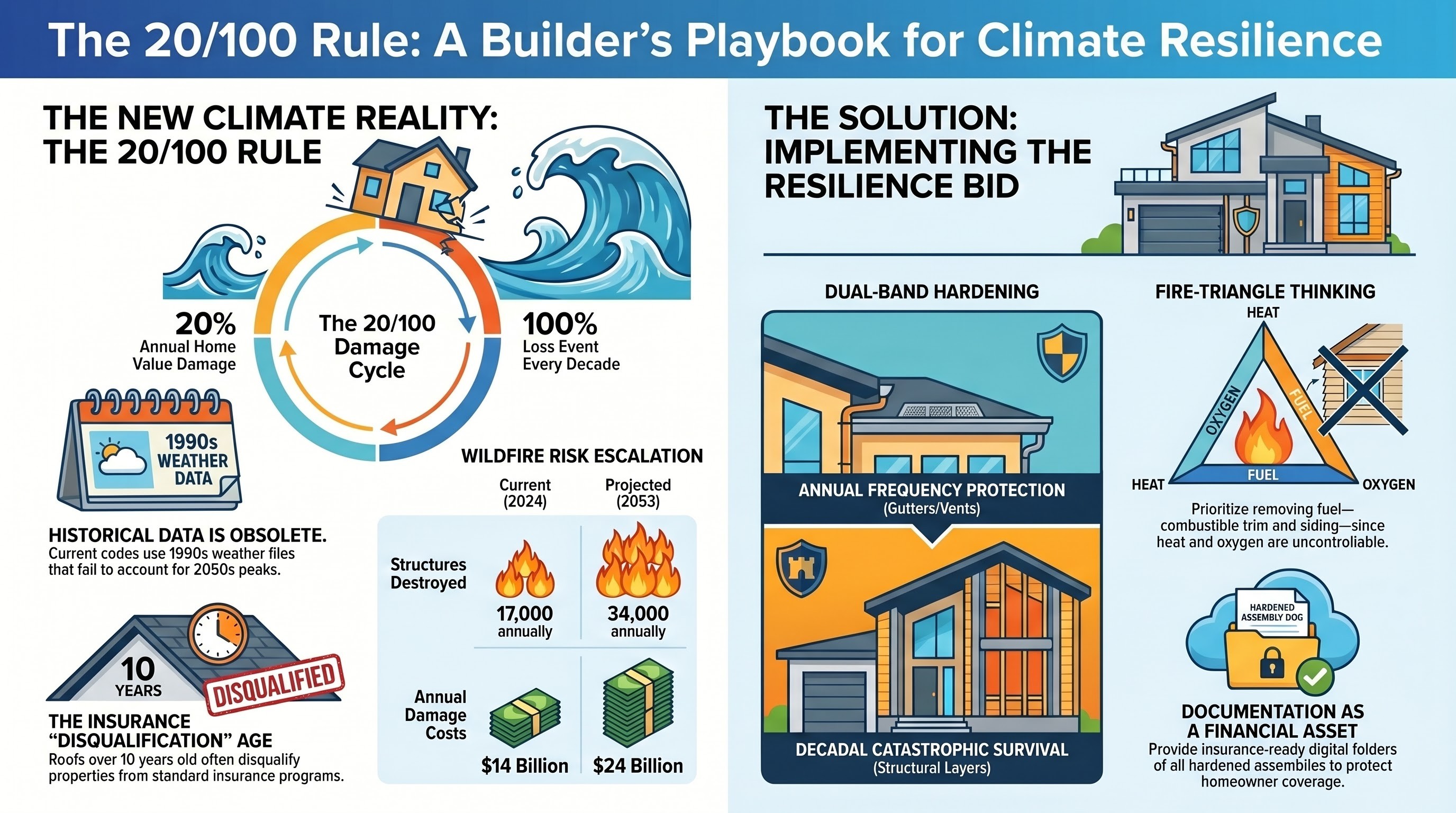
For a generation, residential builders priced risk as if extreme weather were rare and roughly unrelated year to year. That mental model is broken. In a 2024 Forbes feature, author Diamond-Michael Scott summarized Kenneth Smith's framing in Building Financial Resilience for an Uninsurable Future: homeowners should now assume at least one severe weather event per year that costs up to 20% of their home's value, plus at least one event every decade that costs 75–100% of the home's value.[1][2]
That is a brutal but honest cadence. We will call it the 20/100 rule. It forces a different question on every project: not whether a home is up to code, but whether it is engineered, contracted, and maintained to absorb a 20% hit and survive a 100% hit.
The numbers in the article support the urgency. First Street's modeling, cited in the same Forbes piece, places about 17,000 structures destroyed annually by wildfire today, scaling to nearly 34,000 in 30 years from climate alone, with $14 billion in current annual wildfire damages climbing to roughly $24 billion by 2053. Twelve million U.S. properties face flood risk without flood insurance.[1]
For a general contractor, this is not a homeowner finance problem. It is a construction problem with a financing tail. Every line item in the bid either reduces or amplifies the 20/100 cycle.
Why the 20/100 Rule Belongs on the GC's Bid Sheet
Candace Pearson, director of integration at BuildingGreen, told Forbes that the core single-family problem is that known risks rarely translate into design action: "They have tools, and they know that a house is in a wildfire zone, but they are not confident that they can go to the client and say we can increase resilience by doing X, Y, and Z."[1][7]
That hesitation usually breaks at the contractor's desk, not the architect's. Owners trust the builder's number. If hardening shows up only as a vague "upgrade," it gets cut. If it shows up as discrete line items keyed to specific hazards — ember-resistant vents, Class A roof assembly, hardened glazing, dry-floodproof seals, soffit screens — it gets discussed, defended, and built.
The 20/100 frame gives that conversation an anchor. Concretely:
Annual band (the 20%): durability of roof covering, fascia, gutters, exterior cladding, and openings under repeated wind, hail, and ember loads.
Decadal band (the 100%): structural envelope, roof structure, foundation, fire-triangle fuel exposure, and water entry pathways during the once-a-decade catastrophic event.
A strong bid lists hardening costs for each band, with the expected reduction in annual damage and the expected delta in catastrophic outcome (full loss vs. recoverable loss). It is the contracting equivalent of life-cycle cost analysis, and it is exactly the conversation insurers, lenders, and Fannie/Freddie underwriters are converging on.[4]
Building the Combustible-Free Envelope Without Losing the Project
The Forbes article highlighted Builtech Construction Group's collaboration with RIC Technology and the Los Angeles County Fire Department on California's first fire-resistant, concrete 3D-printed accessory dwelling unit in Walnut. The home eliminates combustible structural materials: 3D-printed concrete exterior walls, light-steel roof framing, hardened eave vents, and reinforced openings.[1][6]
The deeper lesson for builders is fire-triangle thinking: heat and oxygen are uncontrollable in a wildfire, so the only lever is fuel. Once fuel is the design variable, hardening becomes a sequence of subtractions — wood structure, wood sheathing, wood trim, exposed soffits, combustible cladding, vulnerable vents — each of which can be reasoned about independently.[6]
Three practical playbook items follow:
Lead with the smallest viable combustible-free assembly. A backyard ADU, garage, or guesthouse is the lowest-friction place to demonstrate a no-fuel envelope to a homeowner facing wildfire premiums.
Treat openings as the failure mode. Eave vents, gable vents, soffit returns, and window assemblies fail before walls do. Specify ember-rated vents and tested glazing; document them in the bid.
Don't overpromise on retrofits. A combustible-free retrofit of a stick-frame home is rarely possible end-to-end. Be explicit about which sub-assemblies (roof, eaves, cladding, deck) are being hardened and which remain legacy fuel.
Future Climate Data Is the New Reference Standard
HGA and the University of Minnesota Climate Adaptation Partnership found that early-stage decisions about massing, orientation, fenestration, and system selection are still being made almost exclusively from historical weather files.[3] That mismatch is no longer acceptable: "Design decisions are being made every day using only historical weather information, resulting in buildings that are designed to perform under past weather conditions, not the future climate," Pearson told Forbes.[1]
Future climate data — typical-year files projected to the 2050s and 2080s — should be referenced in three contractor-facing decisions:
Roof and envelope sizing. Wind uplift, snow load, and ember exposure should be scoped against projected, not historical, peaks.
HVAC and resilience capacity. Cooling loads sized to historic summer maxima will fail under heat domes; backup-power assumptions need to be re-examined against multi-day grid outages.
Site water management. Future precipitation intensity changes drainage, foundation waterproofing, and site grading specs more than nominal flood maps suggest.
The AIA Code of Ethics and Professional Conduct now states that architects should provide a built environment "resistant to climate change." A 2018 Conservation Law Foundation report goes further: "failure to act in the face of climate risk could result in legal liability."[1] That standard of care is migrating to engineering and construction. ACEC's 2025 commentary explicitly addresses an expanded standard of care for engineers facing extreme weather; Berkley Design Professional has documented how design strictly to published codes "may no longer meet this evolving standard."[5][9]
A general contractor that documents future-climate references in its scope of work shifts that legal and reputational risk into a defensible, auditable trail.
The Roof Line Is Now the Insurance Line
FS Insurance Brokers, quoted in the Forbes piece, identifies several factors driving today's coverage decisions: roof age, frame type, coastline proximity, wildfire score, windstorm and hail exposure, and prior claims. In Florida, a roof more than 10 to 15 years old can disqualify a home from standard programs entirely. Premiums in exposed markets are climbing as much as 500%, and named-storm deductibles now run 2–10% of total insurable value.[1][4]
For a GC, the roof has become an insurance instrument as much as a building component. Three implications:
Document the roof like a financial asset. Capture covering type, underlayment, fastener schedule, deck attachment, ridge venting, and install date in a transferable record. Owners will need it at every renewal.
Bid maintenance, not just installation. Reroof timing, periodic inspection, sealant refresh, and waterproofing are now coverage-protection costs. Include them in a 10-year service agreement.
Specify wind-rated and ember-rated assemblies up front. Class A roof coverings, ember-rated vents, and hardened soffits are usually cheaper at install than as forced replacements after non-renewal.
This is also where reroof-as-insurance work intersects the 20/100 cycle: a properly specified roof reduces both annual damage frequency and the chance that a once-a-decade event causes total loss.
Pricing the 20/100 Resilience Bid
The contracting structure that pulls all of this together is straightforward to describe and defensible to sell:
Base scope — code-minimum construction.
Annual-band hardening (the 20%) — itemized upgrades that reduce expected annual damage frequency: roof covering, gutters, openings, exterior cladding, and ember-rated venting.
Decadal-band hardening (the 100%) — itemized upgrades that change the catastrophic-event outcome: combustible-free envelope where feasible, hardened openings, dry-floodproof seals, foundation reinforcement, and structural redundancy at the roof line.
Maintenance covenant — a 10-year service agreement covering inspection, sealant refresh, vent cleaning, roof checks, and a documented coverage-protection trail.
Insurance-ready documentation package — a single binder or digital folder owners can hand to any underwriter or lender at renewal.
Nicole DeNamur, owner at Climate Aligned Law, told Forbes that "the insurance industry has a real opportunity to take a climate leadership role… by incentivizing projects that incorporate resilience strategies, and explor[ing] innovative ways to meaningfully value other risk reduction measures."[1] The contractor's role in that emerging market is to make the work legible to insurers — which is exactly what a 20/100 Resilience Bid does.
Coordinating With Municipalities, Insurers, and Digital Twins
Resilience isn't only a parcel-scale problem. EllisCities, profiled in the Forbes piece, builds AI-powered digital twins that connect parcel-level decisions to neighborhood and regional infrastructure: "flood proofing a home can save a family's future, while flood proofing a neighborhood street system can save hundreds of homes."[1][8]
A forward-leaning GC has three coordination plays here:
Anchor projects to municipal infrastructure plans. When a city has published resilience guidelines (e.g., Washington, DC's design tactics or NYC's design standards), reference them in the scope of work and in permit submittals to align with — and lean on — public guidance.
Use digital twins as a sales tool. When a regional twin exists, use it to visualize parcel-level interventions in their neighborhood context. It helps homeowners see why a hardened roof or floodproof entry matters for property value and community continuity.
Pursue mitigation incentives where available. Community-Based Catastrophe Insurance and other mitigation-aware programs are emerging; staying close to the local insurance commissioner's office is a meaningful business development channel.
The Contractor's Standard of Care Is Rising
The single most underappreciated line in the Forbes article is Pearson's: "It's changing the standard of care for how architects work."[1] The same shift is happening, more quietly, for builders. ACEC has formalized it for engineers; insurance carriers are formalizing it via underwriting; municipalities are formalizing it through zoning and permit reviews.[5][9]
The contractors who build for the 20/100 cycle — who bid to it, document to it, and maintain to it — will be the ones writing the next decade of the residential market. The contractors who don't will spend that decade explaining why a code-minimum home keeps absorbing a 20% hit every year.
FAQs
What is the 20/100 climate damage rule for homes?
The 20/100 rule is a planning heuristic drawn from Kenneth Smith's Building Financial Resilience for an Uninsurable Future, summarized in Forbes. It says homeowners should now assume at least one severe weather event per year causing damage up to 20% of the home's value, plus one event roughly every decade causing 75–100% damage. Builders can use this cadence to bid hardening upgrades against expected annual and catastrophic losses.[1]
How should a general contractor incorporate climate risk into a bid?
Split hardening into two bands: annual-band upgrades that reduce expected yearly damage (roof covering, openings, gutters, cladding, ember-rated vents) and decadal-band upgrades that change the once-a-decade outcome (combustible-free envelope, hardened openings, foundation reinforcement, dry-floodproof seals). Add a 10-year maintenance covenant and an insurance-ready documentation package. This 20/100 Resilience Bid makes hardening legible to owners, lenders, and underwriters.
Why are homes designed to historical weather data failing today?
Most residential design references typical-year weather files built from 1990s–2010s observations. Climate change is shifting wind, precipitation, ember, and heat-load distributions outside that envelope. HGA and the University of Minnesota Climate Adaptation Partnership found that historical files now produce undersized envelopes, undersized cooling, and underspecified water management — so homes that are technically code-compliant still fail under the cycle of events they actually face.[3]
What is fire-triangle design and why does it matter for builders?
Fire-triangle design treats heat, oxygen, and fuel as the three components of any wildfire and recognizes that only fuel is controllable at the structure scale. Builders apply this by removing combustible structural materials — wood framing, sheathing, trim, soffits — and hardening fuel-vulnerable openings like vents and windows. Builtech Construction Group's Walnut, California fire-resistant 3D-printed ADU is a working example of this principle taken to a code-compliant single home.[6]
How does roof age affect homeowners insurance in 2026?
In high-exposure markets like Florida, many carriers will not write or renew standard policies on roofs more than 10 to 15 years old, often defaulting older roofs to actual cash value (ACV) rather than replacement cost. Wind, hail, and named-storm deductibles can run from 2% up to 10% of total insurable value. Builders should document roof covering, fastener schedule, deck attachment, and install date so owners can defend their coverage at every renewal.[4]
When should a homeowner choose a fire-resistant ADU over a stick-frame addition?
A fire-resistant ADU is the strongest choice in any wildfire-zoned parcel, on any site where the main home cannot be retrofitted to a combustible-free envelope, and on any project where a homeowner is already facing carrier non-renewal or premium spikes tied to the wildfire score. The ADU becomes both a survival structure during evacuation events and a defensible-space anchor for future hardening of the primary residence.[6]
Is climate-resilient construction more expensive than code-minimum building?
Upfront, yes — typically 5–15% over code-minimum scope, depending on hazard exposure. But the cost difference shrinks quickly when measured against the 20/100 cycle: avoided annual repair, avoided premium increases, avoided non-renewal, and avoided catastrophic loss. The 20/100 Resilience Bid surfaces this comparison directly in the proposal so the owner can see the trade rather than guess at it.
Why should builders care about the architect's standard of care?
Because it migrates downstream. The AIA Code of Ethics, ACEC's 2025 commentary, and design-professional liability carriers like Berkley DP have all signaled that designing strictly to published codes may no longer meet a reasonable standard of care under climate risk. As insurers and courts adopt that view for architects and engineers, builders who continue to deliver code-minimum scope on hazardous sites take on the residual exposure.[5][9]
How can a contractor work with municipal climate guidelines and digital twins?
Reference any published municipal resilience guidelines (Washington, DC and New York City have leading examples) directly in scope of work and permit submittals. Where regional digital twins exist — EllisCities is profiled in the Forbes piece as one example — use them to visualize parcel-level interventions in their neighborhood and infrastructure context. This helps homeowners understand why hardening matters at the lot scale and makes the contractor's plan auditable against city-scale models.[1][8]
What credentials demonstrate a builder's expertise in climate-resilient construction?
The NFPA Certified Wildfire Mitigation Specialist (CWMS) is the most recognized credential for wildfire hazard mitigation in the United States. Builtech Construction Group's CEO, Aaron Liu, holds the CWMS certification, which is referenced in the parametric-architecture coverage of the Walnut ADU project. Builders should also document training in IBHS Wildfire Prepared Home or FORTIFIED Home standards, ASCE 24 flood-resistant design, and any state or county wildfire-mitigation specialist programs relevant to their service area.[10]
Related resources
Forbes — Climate Risk Is Real And Calculable, But Numbers Don't Protect Homes — The source feature this blog grounds itself in; useful primer for owners and underwriters.
HGA + University of Minnesota — Climate Forward report — Quantifies why historical weather files no longer support resilient envelope design.
Builtech Construction Group — Fire-Resistant 3D-Printed ADU: A Fire Triangle Blueprint — Builtech's own case study on the Walnut, California fire-resistant ADU and the fire-triangle design principle.
References
[1] Castenson, J. "Climate Risk Is Real And Calculable, But Numbers Don't Protect Homes." Forbes, Feb 16, 2024.
[2] Smith, K. Building Financial Resilience for an Uninsurable Future. Summarized in Forbes 2024.
[3] HGA + University of Minnesota Climate Adaptation Partnership. "Climate Forward."
[4] FS Insurance Brokers. Residential insurance overview.
[5] Berkley Design Professional. "Resilient Design in 2025: A Smarter Standard in a Changing Climate."
[6] Builtech Construction Group. "Fire-Resistant 3D-Printed ADU: A Fire Triangle Blueprint."
[7] BuildingGreen consulting.
[8] EllisCities digital-twin consultancy.
[9] American Council of Engineering Companies. "ACEC Commentary on Climate Change and the Engineer's Standard of Care." 2025.
[10] NFPA. "Certified Wildfire Mitigation Specialist (CWMS)."