Type 1A ADU: San Jose's 850-Sq-Ft Fire Safety Breakthrough
San Jose's first Type 1A ADU pushes the highest commercial fire-resistance classification onto an 850-square-foot backyard build for the first time, using insulated concrete form construction at conventional cost parity. The result is a repeatable, non-combustible model for densifying California neighborhoods where ember spread — not just WUI exposure — drives risk.
Authors:


TLDR
San Jose just broke ground on its first ADU built to Type 1A, the IBC's highest fire-resistance classification — a tier normally reserved for hospitals and high-rises.[1][2]
The 850-square-foot build uses insulated concrete form (ICF) walls and lands at roughly $350,000, on par with conventional construction in the area.[1]
Cost parity is the structural plot twist — Type 1A residential is no longer a luxury build, it is a repeatable spec for dense lots.
The real risk this addresses is structure-to-structure ember spread in non-WUI urban infill, not just classic wildland exposure.[9]
Builders, planners, and insurers should treat this 850-sq-ft prototype as a category, not a one-off.
What Type 1A Actually Means When You Apply It to a Backyard
Type 1A is not a marketing term. It is the apex tier of the five construction classifications defined by the International Building Code, adopted into the California Building Code with minimal deviation.[4] A Type 1A building must use noncombustible structural materials and carry the longest required fire-resistance ratings on its walls, floors, and structural frame. That is the language of hospitals, high-rises, and critical infrastructure — buildings where structural collapse during a fire is treated as unacceptable.[3]
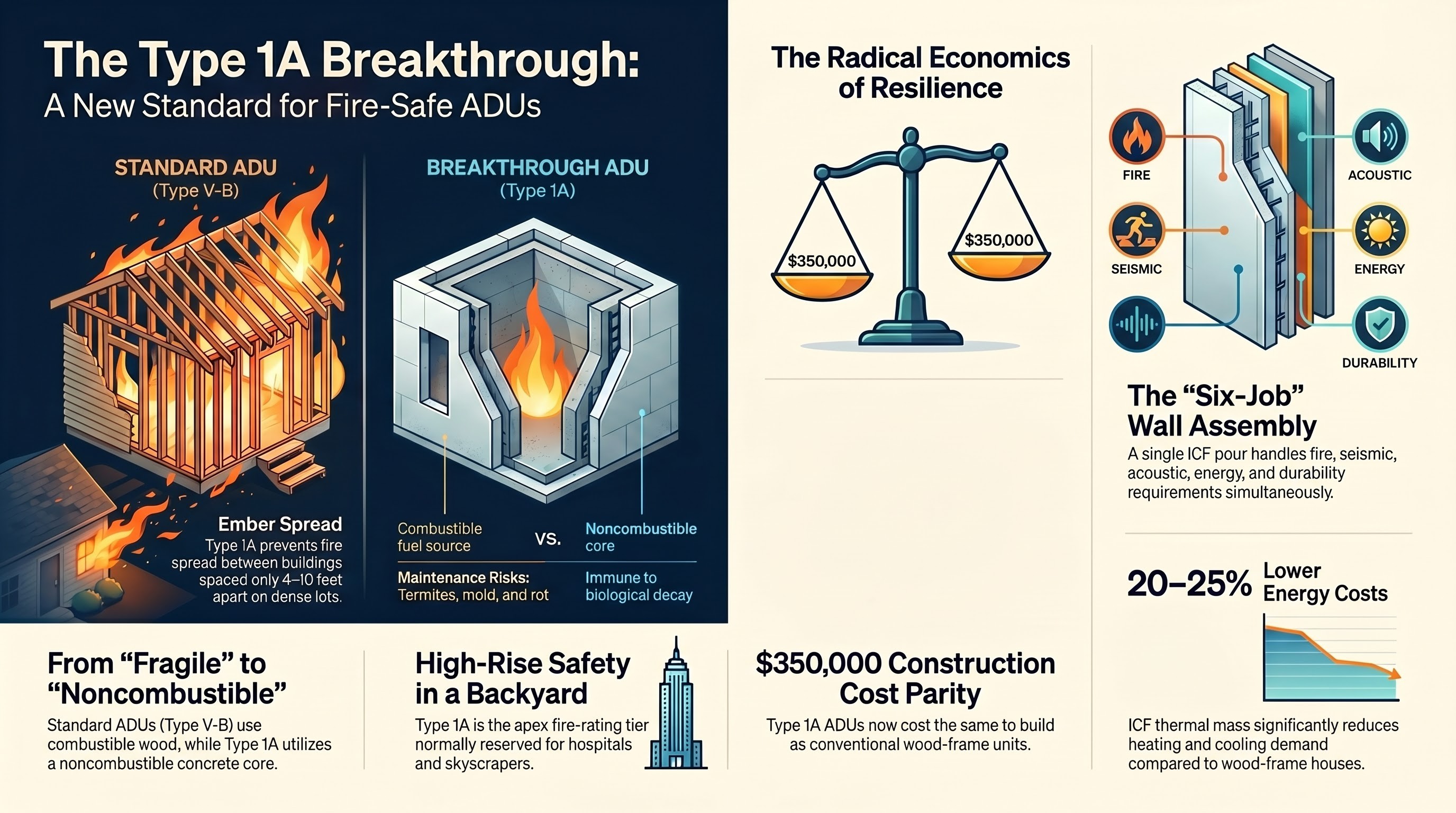
Applied to a single-family backyard ADU, Type 1A flips the historical default. The standard detached ADU in California is Type V-B: light wood-frame, gypsum-protected, with no structural fire-resistance rating required. Type V-B is what most code books assume when they talk about "residential." Pushing an 850-square-foot accessory dwelling all the way to 1A is a categorical jump, not an upgrade. It means there is no combustible structural fuel in the main assembly. Embers can land. Radiant heat can soak the wall. The structure does not feed the fire.
The project in San Jose is the first time a city in the Bay Area has permitted a residential ADU at this classification.[1][2] That is the headline. The deeper story is what the build implies for every other lot in California where an ADU is about to go up four to ten feet from a neighbor's window.
Why an 850-Square-Foot ADU Is the Right Place to Test This
Big fire-resistant custom homes have existed for years. So have isolated demonstration projects in heavily fire-prone canyons. What was missing was the small, urban, code-driven version. The San Jose ADU answers that gap.
At 850 square feet, the structure sits inside the most common detached ADU envelope in California. It is small enough that material premiums do not blow up the project budget, and big enough to support a full one-bedroom floor plan with a kitchen, bathroom, and living area. Most importantly, it is the size class regulators and homeowners are actually building, in volume, in the parts of California that are densifying fastest. If Type 1A works at 850 square feet, it works at the scale that moves the housing supply needle.[1]
That scale also matches the risk geography. ADUs are increasingly squeezed into infill lots where structure-to-structure spacing has shrunk to 4–10 feet.[9] At those distances, the deciding variable in a neighborhood fire is not vegetation. It is whether the next building is fuel.
Inside the ICF System Builtech Used
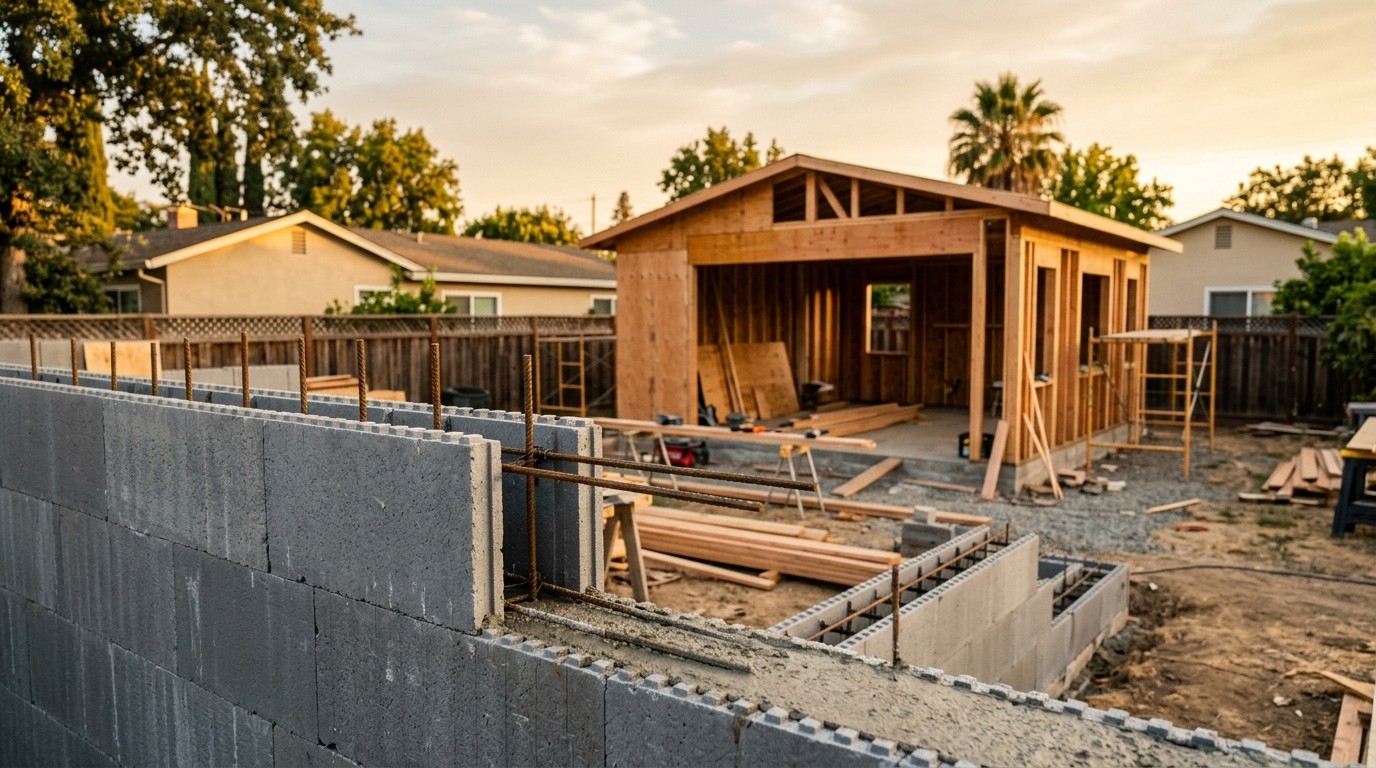
The physical mechanism is insulated concrete form construction. Crews stack lightweight expanded polystyrene blocks like oversized building blocks, thread rebar through the cavities, and pour reinforced concrete continuously into the column.[1] The foam stays in place after the pour, becoming permanent thermal insulation on both faces of the wall. The reinforced concrete core does the structural and fire work.
A few things about the assembly matter for the Type 1A read:
The structural core is monolithic and noncombustible, not assembled from wood studs and protective layers stacked to mimic noncombustibility.
The wall has continuous insulation, eliminating the thermal-bridging cold spots and air-gap leaks that wood-frame walls fight constantly.
Concrete delivers significant thermal mass, smoothing interior temperatures and reducing peak HVAC load.
The same wall picks up serious acoustic performance, with ICF assemblies routinely benchmarked around STC 54 — well past standard wood-frame partitions.[8][11]
Concrete walls are inhospitable to termites, mold, and rot, removing maintenance categories that wood-frame ADUs spend decades fighting.
This is the part most coverage of fire-resistant ADUs misses. ICF is not just a fire system. It is a single assembly that simultaneously addresses fire, seismic, acoustic, energy, and durability requirements. For an 850-square-foot ADU, you only have to design and pay for one wall — and that wall does six jobs.
Cost Parity Is the Quietly Radical Part
The most disruptive line in the original announcement is the price tag: roughly $350,000, matching conventional ADU costs in the same San Jose market.[1] That is the threshold that turns a demonstration project into a category.
For years, the public conversation around fire-resistant residential construction has treated noncombustible assemblies as an upgrade tax. The narrative was: you can build to a higher fire standard if you can afford it. With Type 1A landing at conventional ADU economics, the math inverts. The next homeowner choosing between a Type V-B wood-frame ADU and an ICF Type 1A ADU is not really choosing between cheap and expensive. They are choosing between fragile and resilient at the same price.
Long-run economics push the comparison further in ICF's favor:
ICF assemblies provide an estimated 20–25% energy savings versus comparable wood-frame construction, per HUD field comparisons.[6]
BuildBlock's reference modeling places ICF homes at roughly 44% less heating demand and 32% less cooling demand than equivalent frame houses.[7]
Insurance carriers are increasingly pricing wildfire risk into premiums, and noncombustible primary structures sit at the favorable end of that curve.
None of those tail benefits are the reason to choose Type 1A. Cost parity at construction is the reason. Everything else is compounding.
The Densification Fire Problem Type 1A Actually Solves
The usual framing for fire-resistant residential is wildland-urban interface: homes pressed against open vegetation in canyons, foothills, and forest edges. Chapter 7A and the WUI product list address that exposure.[10] But the San Jose project sits in a flatter, denser, more conventionally urban context, and it surfaces a different threat model.
Two California shifts converge on this build:
As of January 1, 2026, the WUI was redefined to coincide with the full extent of all Fire Hazard Severity Zone categories, expanding the geography of homes subject to ignition-resistant requirements.
The ADU boom has compressed structure-to-structure spacing across the state to roughly 4–10 feet on a typical infill lot.[9]
In that environment, the dominant fire-spread mechanism is no longer wildland fuel reaching the home. It is embers landing on a neighbor's combustible siding and igniting the wall closest to your bedroom. A Type 1A ADU is unusually well-suited to that scenario because it is, structurally, a building that cannot be set on fire by another building. Treat the 850-sq-ft ADU as a fire compartment in a densifying neighborhood, and the strategic fit becomes obvious.
Fire-Rated Windows, Vents, and Roof: Where Type 1A Lives or Dies
A noncombustible wall does not finish the job. Embers exploit attachments, openings, and edges first — they are gravity-fed into vents, they sneak under eaves, and they collect on roof valleys. The San Jose build pairs ICF walls with fire-rated windows, a metal roof structure, and fire-rated vents to close those flanks.[1]
A few alignment notes for builders specifying these components:
A Class A roof assembly — concrete, clay tile, metal, or qualifying asphalt — is the prerequisite for a Type 1A residential project, not an upgrade. The standard is referenced in California's higher-risk fire severity zones.[3]
Tempered, dual-pane glazing with metal-clad frames performs best under radiant heat exposure, per CAL FIRE home hardening guidance.[5]
Ember-resistant vents are required to maintain ventilation while excluding ignition vectors at the soffit, gable, and crawl space.
Detailing at penetrations and transitions — flashings, eaves, and gutters — is where most code-rated assemblies actually lose their rating in real-world conditions, so quality control on field installs determines whether the spec on paper survives audit.
The lesson is that Type 1A is not a single material decision. It is an envelope discipline.
Insurance, Permitting, and the Path to Repeatability
For Type 1A ADUs to scale beyond the San Jose prototype, three institutional conversations have to mature.
The first is insurance. Carriers in California's fire markets are recalibrating premiums and capacity weekly. Buildings that genuinely cannot ignite from ember exposure should be priced differently from light wood-frame stock, but actuarial models lag built-environment innovation. Builders pursuing Type 1A should document their assemblies in a format insurers can underwrite to — full material listings, fire-rated assembly numbers, and inspection records.
The second is permitting. The San Jose build pulled a residential permit at Type 1A through a process designed mostly around Type V-B. Plan reviewers, inspectors, and fire marshals have to develop reps with ICF detailing, fire-rated openings, and noncombustible roof transitions. Cities that publish pre-approved Type 1A ADU plans would compress permit timelines and unlock supply.
The third is financing. Construction lenders price risk based on what they have seen before. A few hundred completed Type 1A ADUs across the state, with documented appraisals and tracked insurance outcomes, would change loan-to-cost behavior. Each completed project is a data point against the next pro forma.
None of these levers is a code change. They are practice changes that follow demonstration projects.
What Owners Should Ask Their Builder About Type 1A ADUs
A homeowner evaluating a Type 1A ADU build is not buying a product line; they are buying an envelope discipline. The questions that surface a serious builder are concrete:
What construction type are you actually permitting this build under, and where is that documented in the plan set?
Which ICF system, block size, and concrete core thickness are you specifying?
What is the assembly fire-rating and the source listing for each wall, floor, and roof component?
What Class A roof system are you proposing, and how are the eaves, ridges, and penetrations detailed?
Which fire-rated window and door products are you using, and are they on California's WUI Building Materials Listing where required?[10]
What ember-resistant vent specs are you running, and how are they integrated with the soffit and crawl space details?
How are you planning to document the assembly for the homeowner's insurance carrier?
If the builder cannot answer these questions in writing, the ADU will not be a Type 1A ADU when it is finished. It will be a Type V-B ADU with a few upgrades.
The Strategic Read for California Builders
This San Jose ADU is most useful as a precedent. It tells builders three things:
Type 1A residential is now buildable at conventional ADU cost. That removes the strongest historical argument against specifying it.
The dominant residential fire risk is shifting from WUI to densification. Builders serving urban infill markets — San Jose, Oakland, the Inland Empire, San Diego — should be comfortable specifying noncombustible primary structures even when the lot is not in a high fire severity zone.
ICF is the most efficient single-assembly path to Type 1A at small scale. Other noncombustible systems exist; ICF is the one that combines fire, seismic, acoustic, energy, and durability work in one wall pour at residential scale.
The builders that win the next decade in California will be the ones who turn this 850-square-foot precedent into a productized line. The ones who treat it as a curiosity will find themselves quoting against it.
FAQs
What is a Type 1A ADU and how is it different from a regular ADU?
A Type 1A ADU is an accessory dwelling unit built to the IBC's highest fire-resistance construction class, typically using a noncombustible structural system like reinforced concrete. Most California ADUs are Type V-B — light wood-frame with no structural fire-resistance rating required. The Type 1A version has a structural core that cannot be ignited by direct flame, embers, or radiant heat, while a Type V-B ADU relies on protective layers over combustible framing.
Why is Type 1A important for California ADUs in 2026?
California's WUI now coincides with the full extent of all Fire Hazard Severity Zone categories, expanding the residential geography subject to ignition-resistant requirements. At the same time, ADU densification has cut typical structure-to-structure spacing to 4–10 feet. Type 1A is important because it eliminates the structural fuel from the residential assembly itself, which is the variable that matters most when fire spreads building-to-building rather than from wildland vegetation.
How much does a Type 1A ICF ADU cost compared to a conventional ADU?
The San Jose Type 1A ADU was built for roughly $350,000, on par with conventional ADU construction in the same market. Long-run operating costs typically fall further, with ICF homes showing about 20–25% energy savings versus wood-frame in HUD field studies. Cost parity at construction, plus lower energy and maintenance over time, is the central economic argument for Type 1A residential.
How is an ICF ADU built step by step?
Crews place footings and rebar, stack lightweight foam ICF blocks in continuous courses, thread vertical and horizontal rebar through the block cavities, and pour reinforced concrete continuously into the wall. The foam stays in place as permanent insulation, while the concrete core does the structural and fire-resistance work. Roof framing, fire-rated windows, ember-resistant vents, and finish systems are then attached to the cured concrete shell.
Does an ICF ADU qualify as Type 1A automatically?
No. An ICF wall system is one ingredient. Type 1A also requires a Class A roof assembly, fire-rated openings, ember-resistant vents, and detailed assemblies that hold their fire-resistance rating at penetrations and transitions. The construction type is set by the full envelope, not the wall material alone, so plan documents must call out Type 1A explicitly and assemblies must be verified during inspection.
What is the difference between Class A roofing and Type 1A construction?
Class A is a roof-covering rating under ASTM E108 / UL 790, focused on resistance to surface burning, flame spread, and ember exposure. Type 1A is the construction-type classification for the entire building, governing structural materials and fire-resistance ratings of walls, floors, and frame. A Type 1A residential build will use a Class A roof, but Class A roofing on a wood-frame house does not make that house Type 1A.
Can a Type 1A ADU lower my home insurance premium in California?
It can, especially in higher-risk fire severity zones, but the impact depends on the carrier, location, and how well the assembly is documented. Insurance underwriters are calibrating models to the new generation of noncombustible residential construction, so builders should provide assembly listings, inspection records, and product certifications to support a premium review. Coverage terms remain carrier-specific.
How does an ICF ADU perform in earthquakes?
Reinforced concrete, properly detailed and rebarred, performs strongly in seismic events when designed under California's structural code. ICF systems carry the same reinforced-concrete capacity in compression while adding continuous insulation. Seismic performance hinges on rebar layout, anchorage to footings, and connection details to roof and floor diaphragms, so engineering review is essential rather than optional for any Type 1A ADU.
Are Type 1A ADUs allowed in non-WUI San Jose neighborhoods?
Yes. Type 1A is a construction-type classification, not a zoning rule. Any San Jose ADU that meets local zoning and ADU ordinance requirements can be built to Type 1A regardless of WUI status. The strategic argument for non-WUI Type 1A ADUs is that infill densification has made structure-to-structure ember spread the dominant fire-spread mechanism on tight lots, which is exactly what a noncombustible primary structure addresses.
Should I build a Type 1A ADU even if I am not in a fire zone?
If cost parity holds in your market, the trade looks favorable. You get the same square footage at a comparable build price, with stronger fire, seismic, acoustic, and energy performance, plus reduced maintenance from termite, mold, and rot resistance. The decision still depends on lot constraints, builder availability, and local plan-review experience with ICF, so a feasibility check with a builder familiar with Type 1A residential is the right starting point.
Related resources
CAL FIRE — Home Hardening: California's official guidance on fire-resistant construction features and maintenance practices.
HUD User — Costs and Benefits of Insulating Concrete Forms: Federal field-comparison report quantifying ICF energy and durability outcomes versus wood-frame.
Builtech Construction Group — Structure-to-Structure Spacing: California's Fire Frontline: Companion analysis of how ADU densification reshapes the residential fire-spread model.
References
The San Jose Blog — San Jose Breaks Ground on First Type 1A Fire-Resistant ADU
Construction Owners — A New Precedent for Fire Safety in High-Density Housing Across California
Builtech Construction Group — California's First ICF Type I Home: A New Wildfire Standard
Builtech Construction Group — Structure-to-Structure Spacing: California's Fire Frontline