Why Narrow L.A. Backyards Are Redesigning 3D Printers
Most coverage of 3D-printed construction frames the race as cheapest, fastest, biggest. In Los Angeles, the binding constraint is geometry: the 8-foot side yard. This blog argues that the L.A. backyard is the real product spec for 3D concrete printers, and that general contractors who lock in tight-lot expertise now will own the detached-ADU segment as the technology scales.
Authors:


TLDR
L.A.'s most binding ADU constraint is no longer code or cost — it is the 8-foot side yard between the existing house and the property line.
Most commercial 3D concrete printers are sized for greenfield lots and physically cannot fit through a typical L.A. backyard.[1]
RIC Technology's smaller, modular gantry printer is one of the first machines explicitly designed around backyard logistics rather than maximum print volume.[2]
The strategic implication: the cheapest, fastest, most versatile race will not be won on speed — it will be won on footprint and field deployability.
General contractors who lock in tight-lot 3D-printed ADU expertise now will own the L.A. detached-ADU segment as the technology scales.
The L.A. Backyard Is the Hidden Spec Sheet
Most industry coverage of 3D-printed construction frames the same three-way race: cheapest machine, fastest print, tallest wall. ICON's new Titan, for example, is marketed on the promise of a 2,500 sq ft home in under seven days at $20 per square foot of wall.[6] Those numbers matter for greenfield subdivisions in Texas or Colorado. They matter much less in Los Angeles, where the binding constraint is not throughput but geometry.
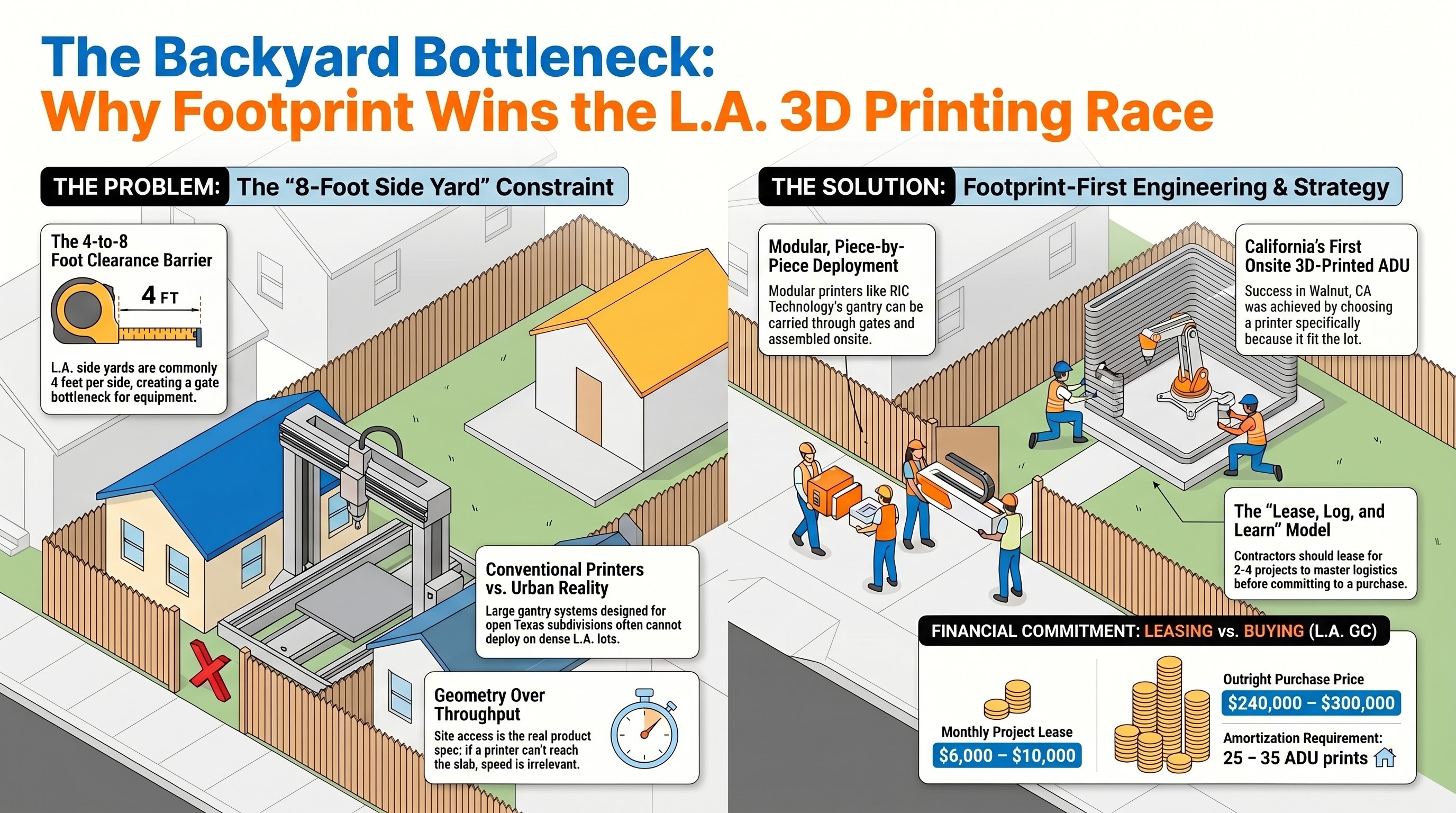
The L.A. detached ADU is almost always built on a lot that already has a primary residence, a detached garage, mature landscaping, and a single side gate. Side yards are commonly four feet per side. The buildable backyard footprint that remains is, in many cases, narrower than the gantry width of a conventional 3D concrete printer. Builders who optimize for print speed in this environment optimize for the wrong variable. The first question is whether the machine can physically reach the slab.
This is the silent product spec that has been writing itself in real time on Los Angeles job sites. RIC Technology's founder, Ziyou Xu, refers to it indirectly when he describes how the company narrowed its strategy in 2023.[1] Builtech Construction Group's CEO, Aaron Liu, names it directly: "Most L.A. backyards where you would build a detached ADU are very tight; they're very narrow. The conventional 3D printer is very large and heavy, so it's complicated to maneuver them in backyards. But RIC's smaller 3D printers overcome all those limitations."[1]
That quote, buried in a single paragraph of the Los Angeles Business Journal piece, is the entire blueprint for the next decade of 3D-printed residential construction in Southern California.
Why Conventional 3D Printers Stall at the Side Gate
Construction 3D printers come in two dominant form factors: the long-rail gantry and the multi-axis robotic arm. Both have a footprint problem in dense L.A. neighborhoods.
Gantry systems require a fixed track to be assembled around the entire build envelope. The track has to be longer than the building itself, the gantry has to be wider than the slab, and the whole assembly typically arrives on flatbed trucks. Once a gantry is on a backyard slab, repositioning it costs hours, not minutes. If the side yard cannot accommodate the disassembled rail segments through the gate, the project is dead before it starts.
Robotic arm printers are more agile in theory, but the heaviest commercial units used in production homebuilding still require concrete delivery infrastructure, ancillary equipment, and a clear staging zone. HUD's review of 3D-printed construction systems notes that polar-style printers can reach taller wall heights only at the cost of telescoping chassis that demand even more clearance.[7] None of those constraints are improved by going bigger.
The industry has been slow to admit that on a typical L.A. parcel, the side gate is the actual bottleneck. Wall height ceilings around 20 feet matter less than the question of whether the printer's largest single component can fit between the property line and the existing structure during install and breakdown.[1] Once a builder has lived through one job where the answer is no, the design priorities reorder permanently.
What Aaron Liu Saw That the Industry Missed
Builtech Construction Group's pilot with RIC Technology and the City of Walnut produced what is widely regarded as California's first onsite 3D-printed, fire-resistant accessory dwelling unit — a 1,200 sq ft, two-bed, 2.5-bath envelope with non-combustible walls.[8] Most of the press coverage focused on fire resistance, which is the consumer-facing benefit. The harder lesson sits one layer below the marketing.
Liu chose RIC because the printer fit. The Walnut lot, like much of L.A. County, was not built around 3D-printing logistics. It was built around a single-family home, a driveway, and a backyard that the homeowner had used for decades as actual yard. A printer that could not deploy in that footprint would have killed the project regardless of how compelling the fire-resistance story was.
The broader implication is that printer selection is now a constraint-driven decision dominated by site survey, not throughput specs. The first questions on a Los Angeles ADU 3D-print site walk are not "how many cubic yards per hour" or "what is the maximum continuous print height." They are "can the rail clear the trash chute," "where does the silo go," "can the pump line reach the back corner without a manifold," and "do we have to remove a section of fence and rebuild it." Vendors that answer those questions natively win. Vendors that hand the contractor a brochure full of throughput numbers lose.
The Footprint-First Engineering Tradeoffs
Designing a 3D concrete printer for tight L.A. backyards is not free. Each gain in maneuverability comes with a tradeoff that has to be engineered out elsewhere.
A smaller gantry has a smaller continuous print envelope, which forces the printer to reposition mid-build. Repositioning introduces seams that have to be designed not to coincide with structural load paths. A lighter machine puts less self-weight on the slab, which is good, but it also has less inertia to resist the reactive forces of pumping and extruding viscous concrete, which means the machine's anchoring system has to do more work.
A modular system that can be carried piece-by-piece through a side gate has more joints, more bolts, more fasteners, and therefore more places where calibration drift can creep in. RIC's design pitch is that the modular sourcing makes maintenance cheaper and the update cycle faster.[5] That is correct on the operations side, but it does mean that quality control has to migrate from the factory floor onto the job site, where conditions are noisier.
This is where Xu's onsite presence becomes the moat, not a quirk. "I work on the job site every single day. I monitor every single inch of concrete that comes out the nozzle and goes into the building."[1] That is not founder eccentricity. It is the only economically rational way to run a footprint-optimized printer in field conditions when the margins for calibration error are tighter than they are in a factory environment.
Field-Fed Iteration: Every Job Site Is a Product Update
The overlooked second-order effect of footprint-first design is that the product itself improves faster. Xu describes the feedback loop bluntly: "The more I see, the more I work, the more I talk to the client and to the workers on the job site — on all aspects of efficiency, safety — that's valuable information that I take back to my team and say, 'OK, we need to change our design to upgrade this.'"[1] That is a CAD-to-jobsite cycle measured in days, not quarters.
Larger competitors selling into utility-scale construction cannot realistically run that loop. ICON has signed multi-unit deals with the Department of Defense and is now reserving the Titan for 2027 deliveries.[6] When your roadmap is locked to defense and aerospace milestones, the constraints from a Walnut backyard never reach the engineering team. The L.A. detached-ADU market becomes invisible in the product plan.
This is precisely the asymmetry that lets a smaller, footprint-first competitor win in dense urban infill. The market is not too small to matter — over 25,000 ADU permits issue annually in California — it is too operationally specific for a generalist roadmap to address well. The contractor who partners early with a footprint-first vendor compounds learning every job. The contractor who waits for a brand-name vendor to ship a city-friendly product is giving up two to three years of operating reps.
Lease-First Economics for L.A. ADU Builders
For most L.A. general contractors, buying a 3D concrete printer for the first project is the wrong financial decision. RIC's printers retail at roughly $300,000.[1] The published RIC-1 starts at $240,000 outright or $9,600 per month, with monthly project leases more typically in the $6,000 to $10,000 range.[1][2]
A single ADU print is usually a four- to six-week job at the wall stage. At the high end of the lease range, that is about $15,000 to $20,000 of equipment cost spread across the print phase, plus operator and material. On a $250,000 to $400,000 ADU contract, that is recoverable inside the bid. Owning the same machine outright requires roughly 25 to 35 ADU prints to amortize cleanly, before maintenance — and the printer is depreciating against a fast-moving design baseline.
The right sequence for an L.A. GC is therefore lease, log, and learn. Lease for the first two to four projects. Log every operational data point: deployment time, print stoppages, repositioning cycles, mix performance in California ambient conditions, finishing crew throughput, inspection issues. Then evaluate purchase against a real utilization curve, not a vendor pitch. A printer that turns out to be wrong for narrow infill lots is not a sunk cost if it was leased. It is a $30,000 to $50,000 tuition bill, which is cheap relative to what the wrong fixed asset costs.
The corollary for vendors is that the lease is the actual sales channel. Contractors will adopt machines they can put on a job tomorrow without underwriting a quarter-million-dollar capital decision before they have proven a market.
Code, Permits, and the Real Bottleneck
California is one of the better-prepared jurisdictions for 3D-printed residential construction. The state has codified 3D-printed building construction inside the California Residential Code (Appendix AW), which gives permitting officials a shared reference for material specs, structural performance, and inspection protocols. The City of Walnut publishes ADU plan-review pathways and pre-approved plan options, both of which materially reduce the permitting timeline.[4][5]
The operational bottleneck has shifted away from "will the building department allow this" and toward "can the GC stage and run the print without disrupting the homeowner's daily life." That is a project management problem more than a regulatory one. It rewards the GC who can compress the rail-install, print, finish, and breakdown sequence so that the printer does not become a fixture in the homeowner's yard for two months.
The contractors who will win the L.A. detached-ADU segment over the next 24 months will not be the ones who memorize Appendix AW or chase the largest, fastest printer. They will be the ones who build a repeatable site playbook that works in eight-foot side yards: a defined gate footprint, a documented silo position, a tested pump-line geometry, a finishing crew sequence, and a homeowner communications kit. Footprint-first is a product spec for the printer. Sequence-first is the matching product spec for the contractor.
What the Next 24 Months Will Decide
Three things will get decided fast.
First, whether footprint-first becomes the explicit category in vendor marketing. Right now, machines are sold on speed and cost. The first vendor to publish a deployment-footprint dimension in feet alongside throughput in cubic yards per hour will reset the buyer's mental model. RIC is the closest to that today by virtue of customer pull, not marketing posture.
Second, whether L.A.-area GCs treat tight-lot 3D printing as a niche or as a core capability. The contractors who build the print-plus-finish split into their default ADU bid template will compound experience. The contractors who treat 3D as a one-off marketing experiment will lose to the firms that have already learned the sequencing.
Third, whether the homeowner experience becomes a product. Most current 3D-printed-ADU coverage is written for industry insiders. The homeowner buying a 3D-printed ADU in Encino does not care about extrusion rheology. They care about how long the gantry blocks the side gate, how loud the pump is, how soon the trash haul resumes, and whether the finished walls look like a home. The first GC that productizes that homeowner experience — fixed start date, fixed disruption window, fixed finish standard — will pull demand away from the rest of the market.
The Los Angeles Business Journal piece read at first as a profile of a struggling early-stage hardware company. Read more carefully, it is the early scouting report on the spec that will reshape the whole category: build the printer that fits the backyard, then let the homeowners come.[1]
FAQs
What size 3D concrete printer fits in a typical Los Angeles backyard?
There is no single size, but the practical ceiling is set by the side yard, the side gate, and the back-corner reach. RIC Technology's modular system targets this envelope explicitly, with components that can be carried through a standard residential side gate and assembled in place.[2] Larger gantry systems built for greenfield subdivisions or warehouse retrofits typically cannot deploy on a standard L.A. infill lot without removing fencing or staging from a neighboring parcel.
How does a narrow side yard limit ADU construction in L.A.?
The side yard sets the maximum width of any equipment, material, and personnel that can reach the rear buildable area. In Los Angeles, side yards of four feet per side are common, leaving an effective gate clearance under eight feet. That dictates not only printer dimensions but also concrete pump positioning, silo location, and crew movement. Many ADU projects fail at this stage of feasibility before printer selection ever begins.
Is a 3D-printed ADU cheaper than a stick-built ADU in L.A.?
Not necessarily, and the comparison depends on which scope you measure. Printing replaces wall framing, which is one of the cheaper steps in a conventional build. Foundation, roof, MEP, windows, doors, and finishes — roughly 80% of total build cost — remain conventional. The savings show up most clearly when fire-resistance, durability, and reduced maintenance are valued over decades, not when measured against the cheapest framing crew.
What is the maximum wall height for a 3D-printed ADU in California?
Current commercial 3D concrete printers in residential use generally cap out around 20 feet of wall height per print sequence.[1] Taller-rated machines exist, but for ADUs that envelope is rarely the binding constraint, since most California ADUs are limited to 16 feet of overall height by zoning. The practical ceiling for L.A. ADU printing is therefore set by zoning, not the machine.
Can you lease a 3D concrete printer for a single ADU project?
Yes. RIC Technology offers project-based leases that typically range from $6,000 to $10,000 per month, with the RIC-1 listed at $9,600 per month or $240,000 outright.[1][2] For a first-time L.A. ADU printer, leasing is almost always the right financial path, since it lets the contractor learn the operational pattern before committing capital to a depreciating, fast-iterating asset.
How long does it take to 3D-print the walls of an L.A. ADU?
The Walnut, CA fire-resistant ADU completed by Builtech Construction Group with RIC Technology had a wall-printing window of approximately 20 days for a 1,200 sq ft envelope.[8] That figure excludes foundation, plumbing rough-in, roof, finishes, and inspections. Total project duration from permit issuance to certificate of occupancy is typically four to seven months, comparable to or slightly faster than equivalent stick-built ADUs in the same jurisdiction.
Why did RIC Technology pivot away from doing everything in 3D printing?
Founder Ziyou Xu has said the original 2021 plan was to own the entire stack — design, equipment, materials, software, and onsite build.[1] After two years and millions of dollars, the company concluded that the construction industry cannot be revolutionized by a single startup and refocused on what it does best: equipment design, manufacturing, materials, and software service for builders who are already building. The narrower scope is what enabled the partner-driven L.A. strategy.
What permits are required to build a 3D-printed ADU in Los Angeles County?
A 3D-printed ADU in L.A. County requires the same building, zoning, mechanical, electrical, and plumbing permits as any other ADU, plus inspection alignment with California Residential Code Appendix AW for the printed elements. Cities like Walnut publish ADU handouts and pre-approved plan tracks that streamline review.[4] Statewide ADU rules are summarized by the California HCD.[5] Builders should align their inspection schedule to the print phase early.
Are 3D-printed ADUs in L.A. fire-resistant out of the box?
The printed concrete walls themselves are non-combustible, but the home is only as fire-resistant as its weakest assembly. The Walnut ADU achieved a fire-resistant envelope by pairing printed walls with a non-combustible roof and hardened openings.[8] A printed wall behind a wood-framed roof, open eave vents, or unrated windows is not a fire-resistant home. Specifying the full envelope, not just the walls, is what delivers the WUI-zone benefit.
Should L.A. general contractors buy or lease their first 3D concrete printer?
Lease. The right sequence for a first-time L.A. GC is to lease for two to four ADU projects, log operational data — deployment time, repositioning cycles, mix behavior, finishing throughput, inspection friction — and only then evaluate purchase against a real utilization curve. Buying a $240,000 to $300,000 machine before proving market demand and deployment fit on tight L.A. lots is the most common preventable mistake in the category.[1][2]
Related resources
The Robot Report — RIC Technology debuts a robotic 3D printer up to 3 stories high — Useful technical context on RIC's vertical reach claims and how those interact with site logistics.
Bluebeam BUILT — A robot that prints big-box stores in a week? Meet RIC-PRIMUS — Industry-press perspective on RIC's labor-shortage value proposition and where construction robotics is heading.
HUD User — 3D Concrete Printed Construction Systems, Part 2 — Federal review of 3D-printed construction systems with detail on print envelopes, wall heights, and quality-control considerations.
References
James Brock, "Firm Pushes 3D In Construction," Los Angeles Business Journal, Feb 5, 2024 — https://labusinessjournal.com/featured/firm-pushes-3d-in-construction
RIC Technology, Robotic 3D Printer product page — https://www.rictechnology.com/ric-0-robotic-printer
The Robot Report, "RIC Technology debuts robotic 3D printer that can print up to 3 stories high" — https://www.therobotreport.com/ric-technology-debuts-robotic-3d-printer-up-to-3-stories-high/
City of Walnut, California, Accessory Dwelling Unit Information — https://www.walnutca.gov/For-Residents/Departments/Community-Development/Planning-Zoning/Accessory-Dwelling-Unit-Information
California Department of Housing and Community Development, Accessory Dwelling Units — https://www.hcd.ca.gov/building-standards/adu
ICON, Titan 3D Construction Printer technology — https://www.iconbuild.com/technology
HUD User, 3D Concrete Printed Construction Systems, Part 2 — https://www.huduser.gov/portal/sites/default/files/pdf/3D-Concrete-Printed-Construction-Systems-Part-2.pdf
KTLA, "3D printed fire-resistant home being built in Los Angeles County" — https://ktla.com/news/california/wildfires/3d-printed-fire-resistant-adu-being-built-in-los-angeles-county/
Bluebeam BUILT, "A Robot That Prints Big-Box Stores in a Week? Meet RIC-PRIMUS" — https://blog.bluebeam.com/robots-printing-big-box-stores/